
Guide: How to Carry Your Car Seat and Stroller in Flight
This post contains affiliate links. As an Amazon Associate, we earn from qualifying purchases.
Bring a car seat and stroller on a plane by checking the car seat’s FAA label, measuring its width against the 16-inch coach seat, and gate-checking the stroller. The car seat flies free if your child has a ticket for the seat beside you; the stroller always flies free. Non-collapsible strollers check at the ticket counter, collapsible ones go plane-side.
The label matters because a flight attendant will ask to see it. No label, no boarding with the seat, they’ll gate-check it to the cargo hold. That red-lettered sticker is your boarding pass for the car seat itself.
What follows: the exact wording of the FAA label, the three devices airlines flat-out refuse, the coach seat width that decides if your seat fits, and the free-bag rule for international lap infants most parents miss.
Key Takeaways
- Your car seat must have a label with red lettering stating it’s certified for aircraft use. No label, no cabin.
- Coach seats are 16 inches wide. A car seat wider than that won’t install securely in the window seat.
- Booster seats, infant carriers (like BabyBjörn), and “belly belts” are not approved for use during taxi, takeoff, or landing.
- You can gate-check a collapsible stroller for free at the jet bridge. Non-collapsible strollers and stroller wagons must be checked at the ticket counter.
- On international flights, a lap infant gets one free checked bag under 25 lbs, a rule buried deep in most airline policies.
The FAA Label That Decides Everything
Look for a square, white-and-black sticker on the side or back of the car seat. The text will be in red. It must say, verbatim: “This restraint is certified for use in motor vehicles and aircraft.” That’s the FAA’s approval. A flight attendant will lean over, flip the seat, and scan for this sticker before they let you buckle it in.
No sticker means the seat wasn’t tested to the federal standard for aircraft seats and seatbelt geometry. They won’t risk it. The agent will take the seat at the gate and send it to the cargo hold. You’ll get it back at baggage claim, not at the jet bridge.
Common mistake: Assuming your car seat is approved because it’s sold in the U.S. Most are, but the label is the only proof. Infant seat bases are almost never approved for aircraft use, you bring the carrier portion only.
Convertible seats set up rear-facing can be a problem. The aircraft seat may force a more upright angle than the car seat’s manual allows. If your seat has an adjustable recline foot, extend it. If it doesn’t, and the angle is off by more than a few degrees, you might have to forward-face for the flight. Check your manual’s aircraft installation section; some explicitly permit a more upright position for planes.
What Not to Bring Onboard (And What Happens If You Try)
The list of banned devices is specific. Transport Canada publishes it, but U.S. Airlines follow the same prohibitions.
| Device | Why It’s Not Approved | What Airlines Will Do |
|---|---|---|
| Booster Seat | Designed for car lap-and-shoulder belts; aircraft lap belts alone can’t secure it. | Refuse boarding with it; require you to check it as luggage. |
| Infant Carrier / Sling | Not a restraint system; in turbulence, the child can be ejected. | Allow it as a carry-on item, but prohibit use during taxi, takeoff, landing. |
| “Belly” or “Loop” Belt | Attaches adult and infant with a single belt; in a crash, the adult’s weight crushes the infant. | Confiscate it; may provide a airline infant restraint belt (rare). |
| Child Vest / Harness | Requires a tether anchor, which aircraft seats do not have. | Treat as carry-on; not permitted as a restraint. |
Airlines draw a hard line on these because the physics of a 9G impact are different from a car crash. A booster seat needs that shoulder belt to keep the child from jackknifing forward. An infant carrier has no rigid shell. The “belly belt” is a known fracture risk. They aren’t being difficult; they’re following the engineering.
Gate-Check vs. Ticket Counter: The Size Cutoff
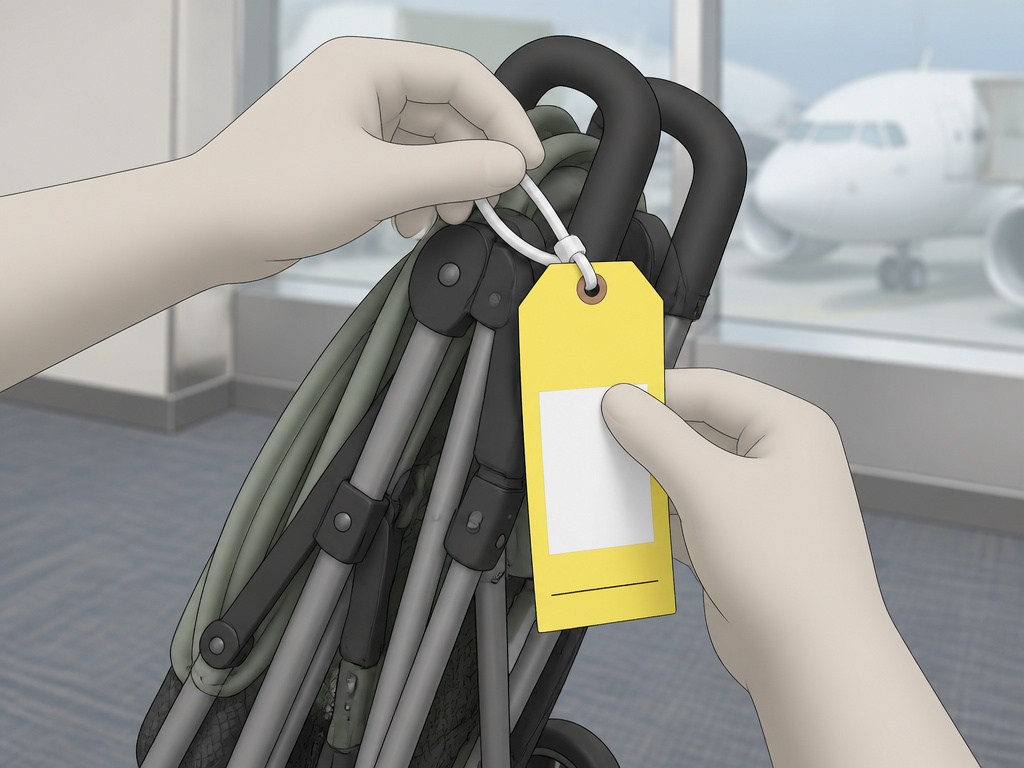
Your stroller’s fate depends on one thing: does it fold?
Collapsible strollers, the umbrella type, most travel systems, go plane-side. You use it all the way to the jet bridge, leave it with an agent there, and pick it up right outside the aircraft door at your destination. It flies free.
Non-collapsible strollers and stroller wagons must be checked at the ticket counter. That includes many jogging strollers and those giant travel-system frames. The same rule applies if the stroller weighs 20 pounds or more, ticket counter, not gate. The airline’s logic is cargo-bin space: a collapsed stroller fits in the onboard storage area; a rigid one does not.
Where this goes sideways: Assuming your “travel system” stroller is gate-check eligible. The chassis alone often doesn’t fold small enough. You’ll be re-packing your carry-ons at the counter while the line behind you grows.
Here’s the process, step by step: 1. Use your stroller through the airport. It counts as a mobility aid, not a bag. 2. At the gate, ask the agent for a gate-check tag. They’ll attach it to the stroller. 3. Leave the stroller at the end of the jet bridge just before you step onto the plane. Do not take it to your seat. 4. After landing, wait just outside the aircraft door. An agent will bring it up from the cargo hold.
Gate-checking is free for all strollers, collapsible or not. The ticket-counter check is also free. You never pay for a stroller.
The 16-Inch Coach Seat Squeeze
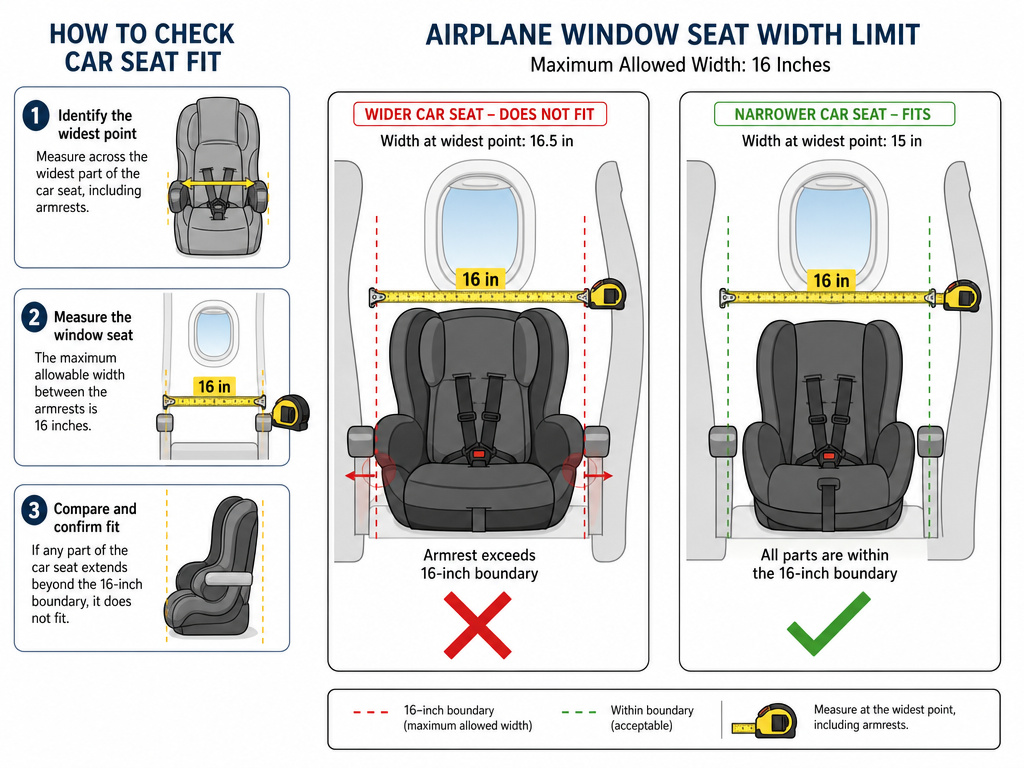
Coach seats are 16 inches wide, wall to wall. Your car seat must fit within that space, including its armrests and cupholders. The window seat is your only option, the aisle seat’s armrest is usually fixed and blocks a secure install.
Grab a tape measure. Measure your car seat at its widest point, armrests extended. If it reads 17 inches or more, you’re gambling. The seat might sit in the airplane chair, but it won’t be tight. In turbulence, a loose car seat can shift, compromising the harness.
Narrower seats like the Cosco Scenera Next (about 15.5 inches wide) or the WayB Pico travel car seat (15 inches) are built for this. Wider convertible seats, especially those designed for extended rear-facing, often fail the fit test.
If your seat is a tight fit, board early. Pre-boarding gives you time to wrestle it into place without a line of passengers waiting behind you. Use the aircraft seatbelt only through the path indicated on the car seat, usually a bright red guide. Do not use locking clips meant for cars; the aircraft buckle is already a locking latchplate.
How to Actually Carry It All Through the Airport
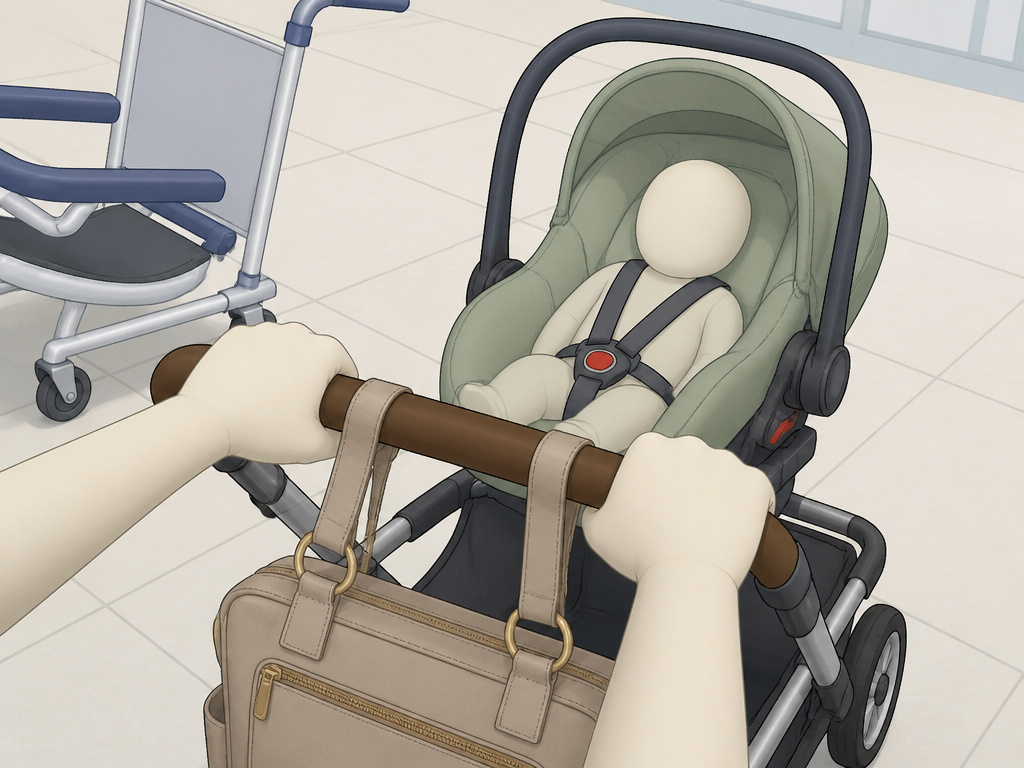
You have a child, a diaper bag, a car seat, and a stroller. The geometry is everything.
The best setup is a travel car seat that clips onto your stroller. Models like the Doona or the UPPAbaby Mesa with a compatible stroller frame let you click the seat directly in. You’re one unit rolling to the gate.
If you’re using a separate seat, a rolling car seat cart is the next best thing. The Britax Travel Cart or a generic J-LATCH compatible dolly lets you stack the seat and a bag, then push the whole pile. Don’t try to carry a 20-pound convertible seat through a terminal, your shoulder will give out at the TSA line.
The part nobody mentions: A car seat is a bulky item, not just heavy. It doesn’t fit down the aisle of the airport shuttle bus. You’ll be holding it in your lap. Plan for that.
At security, everything goes on the belt: the stroller (collapsed), the car seat, the diaper bag. The car seat may get swabbed for explosives residue. That’s normal. Have your child walk through, or if they’re an infant, carry them through the metal detector. The agent will hand-check the seat if it doesn’t fit through the X-ray.
The Free Bag for Your Lap Infant (Yes, Really)
If your child is under two and flying on your lap, they still get a checked bag on international itineraries. American Airlines spells it out: one bag, under 25 pounds (11 kg), and within 22 x 14 x 9 inches (56 x 36 x 23 cm). That’s the size of a standard carry-on, but it flies free in the hold.
Domestic flights within the U.S. Usually don’t grant this. The lap infant flies free, but their baggage doesn’t. International treaties change the math. Always quote the rule at check-in if the agent pushes back, it’s in their own policy manual.
Your stroller and car seat are separate from this allowance. They fly free regardless. The car seat only gets a free checked spot if you aren’t using it on board. If you buy a seat for your child and bring the car seat onboard, it’s not counted as baggage at all, it’s an approved child restraint system.
Your Legal Right to Stowage Space
Airlines must make room. Federal law, specifically 14 CFR § 382.123, says if you pre-board with a wheelchair or other assistive device, the crew must move their own luggage out of the priority stowage area to accommodate you. Your stroller counts as an assistive device for a small child.
This matters when overhead bins are full. If you pre-board and the bin over your seat is packed with crew bags, you can point to the regulation. They have to move them. This doesn’t mean you get the entire bin, but you get space for the stroller.
The same law covers damage. If the airline breaks your stroller or car seat in cargo, they are liable for the repair or replacement cost up to the original purchase price on domestic flights. On international flights, liability is lower and governed by treaty. Take pictures of your gear at check-in.
Documentation from the U.S. Department of Transportation is clear: assistive devices have priority over other items for stowage, and damage claims have a rebuttable presumption in your favor. The airline has to prove they didn’t cause it.
Frequently Asked Questions
Can I use my infant car seat carrier on the plane?
Yes, but only if it has the FAA approval label. Most infant seat carriers (the part the baby sits in) are certified. The base almost never is. Leave the base at home or pack it in checked luggage.
What if my car seat is too wide for the airplane seat?
If it’s more than 16 inches wide, you cannot safely install it in a coach window seat. Your options are to check it (free) and hold your child, upgrade to a first-class seat with more width, or hope for an empty row where you can use two seats. Gambling with a loose install isn’t one of them.
Do I have to buy a seat for my child to use a car seat?
Technically, no. You can bring the car seat onboard and hope for an empty seat next to you. If the flight is full, the gate agent will gate-check the car seat to the cargo hold. You cannot hold the car seat in your lap during the flight. Buying a seat guarantees you can use it.
Can I gate-check a car seat?
Absolutely. It’s free. Tell the gate agent you want to gate-check your car seat. They’ll tag it, and you’ll leave it at the jet bridge. You’ll pick it up plane-side at your destination, not at the main baggage carousel.
Are there any car seats that are not allowed at all?
Any car seat without the FAA approval label is not allowed for use in the cabin. It can still be checked as luggage. Booster seats, vests, harnesses, and “belly belts” are never allowed for use during taxi, takeoff, or landing, even if they have a label.
Before You Go
Check the label. Measure the seat. Know that booster seats and infant carriers stay on the ground. Gate-check the stroller, and use the lap infant’s free bag on international flights. The regulations are specific, but they’re on your side, your gear flies free, and you have the right to the space you need. Board early, be polite, and have the manual handy. The flight crew sees this every day; showing you know the rules gets you to your seat faster.
