
Guide to Knowing Precisely When to Replace Infant Car Seats
This post contains affiliate links. As an Amazon Associate, we earn from qualifying purchases.
Replace an infant car seat at its expiration date, after any moderate or severe crash, or if it shows damage, has missing parts, or has an unknown history. The expiration date, typically 6 to 10 years from manufacture, is stamped into the plastic. After a crash, follow the NHTSA’s five-point minor crash checklist; if any point fails, the seat is trash.
That date stamped into the plastic isn’t a suggestion. It’s a countdown based on material science, plastics degrade, harness webbing fatigues, and safety standards evolve. The seat in your garage from a friend, or the one you bought second-hand, carries risks you can’t see.
What follows: the exact expiration periods for major brands, the government’s crash-replacement checklist that most people misread, and the three physical signs that mean a seat is done before its date. By the end, you’ll be able to look at any infant seat and know whether it’s safe for one more ride or ready for the recycling bin.
Key Takeaways
- The expiration clock starts at manufacture, not purchase. A Graco SNUGRIDE SNUGLOCK 35 LX expires 7 years from its manufacture date; a Safety 1st seat expires at 8 years.
- After a crash, the seat is only reusable if it passes all five points of the NHTSA’s minor crash criteria. One “no” means replacement.
- Sun damage, food spills, and unknown history (like a used seat) can degrade materials silently, making a seat unsafe long before its printed date.
- Missing the expiration sticker doesn’t mean the seat is fine. Assume the worst, that all possible recalls apply, and replace it.
- Register your seat with the manufacturer. It’s the only way to get direct recall notices for defects that could warrant an early replacement.
The Expiration Clock Starts at Manufacture
Find the molded plastic on the back or bottom of the car seat shell. The expiration date or manufacture date is stamped or printed on a label there. This is your starting point.
All children’s car seats and booster seats sold in Canada have an expiry or useful life date on them… Manufacturers do this to inform current owners and prospective buyers of the potential risks of using car seats… That may be missing important parts, labels or instructions and/or may have an unknown history.
That “unknown history” clause is why the date exists. It’s a hard stop.
Graco is specific: the SNUGRIDE SNUGLOCK 35 LX infant seat “must be discarded 7 years after the date of manufacture.” Safety 1st (Dorel Juvenile Group) sets the limit at 8 years. Most brands fall in the 6-to-10-year window. The countdown starts the day the plastic is molded, not the day you buy it. A seat that sat on a store shelf for two years already lost two years of its life.
If the label is missing or unreadable, the rule is simple: assume the seat is expired and that every recall applies. You have no verifiable data. Without a date, you cannot check for recalls specific to its production batch. That uncertainty makes the seat a liability.
Why Plastic Has an Expiration Date
Car seat plastic is engineered for specific stress tolerances. Over 6–10 years, three things happen: 1. Polymer degradation. Heat cycles (summer car interiors, winter cold) and UV exposure make the plastic brittle. It may look fine but can fracture on impact instead of flexing. 2. Harness webbing fatigue. The constant tension and release from buckling and adjustments weaken the fibers. Spills of juice, milk, or cleaning agents can accelerate this decay. 3. Standard obsolescence. Safety standards and testing protocols improve. A seat made 10 years ago wasn’t tested against today’s side-impact or rollover simulations.
The date is the manufacturer’s guarantee that the seat will perform as tested. After that, they can’t guarantee it.
After a Crash: The Five-Point Checklist
A crash transfers immense force through the car’s frame into the car seat’s structure. That force can stress plastic, metal, and harness components in ways that are invisible. This is why manufacturer manuals and the NHTSA car seat safety guidelines are absolute: replace the seat after a moderate or severe crash.
The exception is a “minor crash.” But the definition is strict, and all five conditions must be met.
Common mistake: Assuming a fender-bender is “minor.” If the airbag deployed or any door was damaged, the crash is not minor. The seat must be replaced.
Here is the checklist, verbatim from NHTSA and manufacturer manuals like Nuna’s. If you answer NO to any of these, the seat is garbage.
| Condition | Pass (Seat MAY be OK) | Fail (Replace Seat Immediately) |
|---|---|---|
| 1. Vehicle Driveability | Vehicle could be driven from the crash site. | Vehicle was towed. |
| 2. Door Damage | The door nearest the car seat was undamaged. | That door was dented, jammed, or wouldn’t open. |
| 3. Passenger Injury | No occupants in the vehicle sustained any injury. | Any passenger reported soreness, cuts, or was checked by EMS. |
| 4. Airbag Deployment | No airbags (front, side, curtain) deployed. | Any airbag in the vehicle deployed. |
| 5. Visible Seat Damage | No visible cracks, tears, or deformities on the car seat. | Any crack in the shell, torn harness, or bent metal component. |
The airbag rule catches most people. Airbags deploy in crashes above a specific force threshold, if that force was enough to trigger them, it was enough to stress the car seat’s internal structure. There is no debate here.
What about the seat itself showing no damage? Irrelevant. The failure could be internal, like a fractured lock-off mechanism or a compromised energy-absorbing foam layer. You cannot inspect for that.
The Hidden Damage: When a Seat Ages Out Early
Expiration and crashes are clear lines. The murkier danger is cumulative damage from use and environment. This is why buying a used seat or accepting a hand-me-down is a massive gamble.
Sun and heat are the silent killers. A seat left in a sunny rear window day after day suffers UV degradation. The plastic shell fades and weakens. The harness straps lose tensile strength. You’ll see fading color long before you feel the brittleness.
Spills and cleaners matter. Sugar in milk or juice can mildew inside harness webbing, weakening the fibers. Harsh household cleaners can break down the plastics or the flame-retardant coatings. Always clean with mild soap and water only.
Missing parts is a direct failure. That lost infant head support or buckle tongue isn’t just an inconvenience. The seat was crash-tested with all parts installed. Using it without them changes how the child’s body is restrained in a collision.
Where this goes sideways: Using a seat with an unknown history. You don’t know if it was in a crash, stored in a damp basement, or cleaned with bleach. That uncertainty is itself a reason to replace it, as noted by Transport Canada.
This is also why you must register your seat. It’s the only way manufacturers can contact you directly for recalls. Need a replacement part? Companies like Nuna direct you to call 1-855-NUNA-USA. If you never registered, you might miss the notice that your seat’s buckle needs a free repair kit.
From Infant Seat to What’s Next
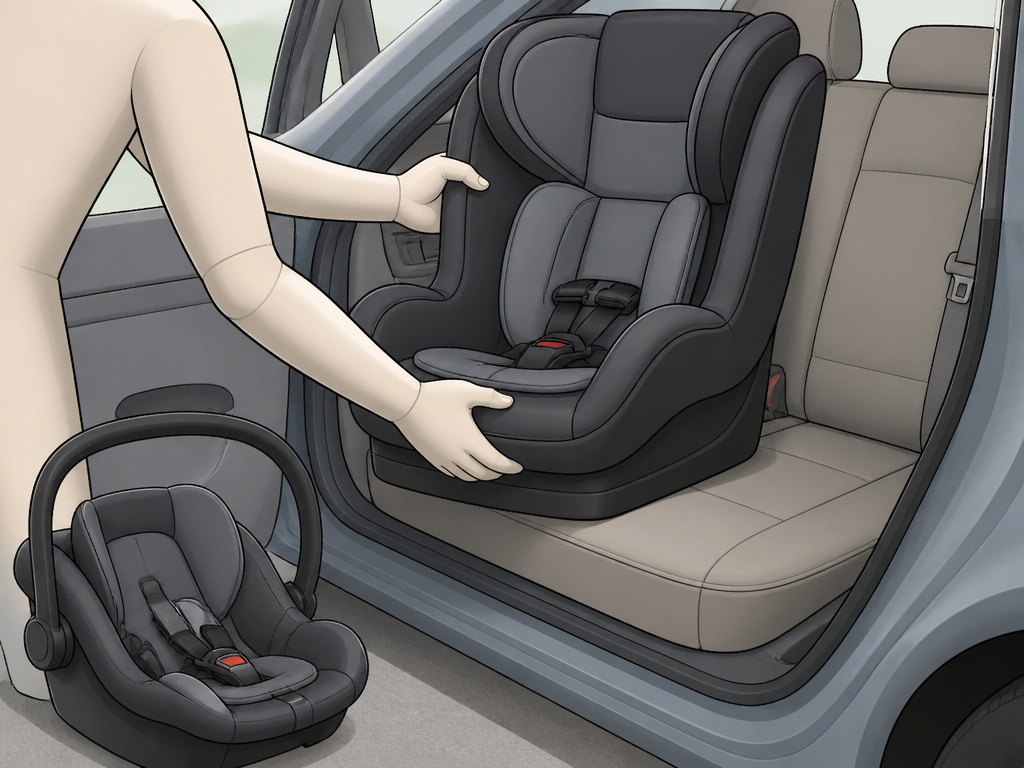
Knowing when to replace an infant seat naturally leads to the next question: what do you replace it with? The infant seat has hard limits, usually 30-35 pounds and 32-35 inches tall. Most babies outgrow an infant car seat in height before they hit the weight limit.
The universal next step is a rear-facing convertible car seat. It’s the workhorse of child passenger safety.
| Your Next Seat Type | Best For | Why It’s The Move |
|---|---|---|
| Convertible Car Seat | Babies outgrowing infant seat, up to toddlers ~40-50 lbs. | Serves rear-facing and forward-facing. Lasts 4+ years. |
| All-in-One Car Seat | Long-term value, minimal future purchases. | Converts from rear-facing to forward-facing to booster. |
| 3-in-1 Car Seat | Similar to all-in-one, but check booster weight limits. | Offers three stages, but the booster mode often fits poorly. |
The American Academy of Pediatrics recommends keeping children rear-facing until at least age 2, or until they hit the maximum height or weight limit of their convertible seat. This is non-negotiable for safety. A rear-facing seat cradles the head, neck, and spine, distributing crash forces across the whole shell.
When you switch to a convertible car seat, the installation changes. You’re no longer clicking a carrier into a base. You’re installing a monolithic seat using either the vehicle’s LATCH anchors or the seat belt. Get it inspected at a local car seat check event.
Step-by-Step: Inspecting Your Current Seat
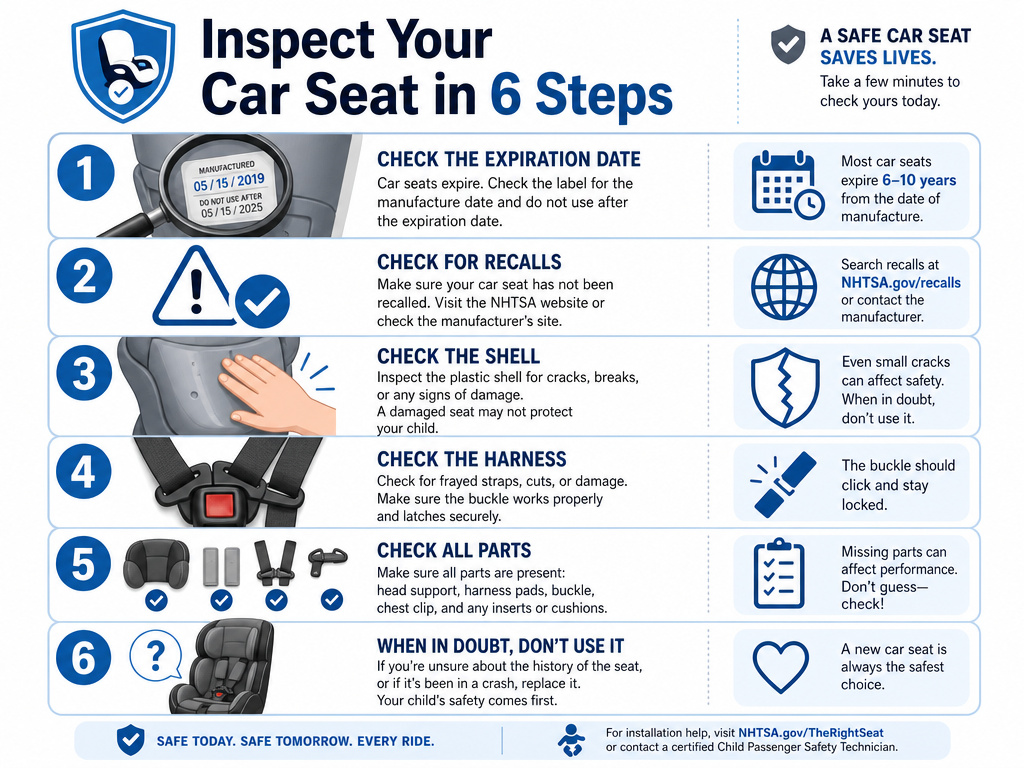
Before you decide to keep using a seat, run through this inspection. Do it in good light.
- Locate the date. Find the manufacture or expiration date sticker on the plastic shell. If it’s missing or illegible, stop. The seat is not verifiably safe.
- Check for recalls. Use the model number and manufacture date to search the child restraint recall list or the NHTSA website. This is critical for seats made between specific dates.
- Examine the shell. Run your fingers over the plastic, especially around the belt path and harness slots. Look for hairline cracks, fading, or unusual brittleness. Flex it slightly, it should not creak or feel like it might snap.
- Inspect the harness. Pull the harness straps all the way out. Check for fraying, cuts, or thinning. Smell them, a musty odor indicates mildew. Ensure the buckle clicks securely and the chest clip isn’t cracked.
- Verify all parts. Compare your seat to the manual’s parts diagram. Are all pieces present? This includes infant inserts, shoulder pads, and the buckle tongues.
- Assess the history. Be brutally honest. Do you know every trip this seat has taken? If the answer is no, the history is unknown. That’s a fail.
If you pass all six steps and the seat is within its expiration window, it’s likely safe for now. Schedule a reminder for one month before its expiry date to start shopping for its replacement.
Frequently Asked Questions
Can I use a car seat after a minor fender bender?
Only if it meets all five NHTSA minor crash criteria. The most common disqualifier is airbag deployment. If any airbag in the vehicle went off, the crash is not minor and the seat must be replaced.
What if I lost the manual for my car seat?
Download it. Go to the manufacturer’s website and search by your seat’s model number. The manual contains critical information on weight limits, installation, and parts. Using the seat without it means you might be using it wrong.
Is it illegal to use an expired car seat?
In Canada, using a seat past its expiry date may violate provincial highway safety acts. In the U.S., it’s not a federal traffic violation, but it violates the manufacturer’s instructions, which could affect insurance liability in a crash. More importantly, it’s dangerously unsafe.
How do I dispose of an old car seat?
To prevent someone else from using it, render it unusable. Cut the harness straps, remove the fabric cover, and write “EXPIRED” or “CRASHED” in permanent marker on the shell. Then, check if your local waste management recycles hard plastics. Some retailers offer trade-in events.
My baby hates the new convertible seat. What do I do?
This is common. The seat is unfamiliar and less cocoon-like. Do short practice sits in the house without driving. Hang toys from the handle (if allowed) or use a mirror they can see. Ensure the harness is snug but not pinching. The phase usually passes within a few weeks as they adjust.
Before You Go
Replace an infant car seat at its stamped expiration date, full stop. Replace it after any crash that doesn’t pass every point of the minor crash checklist. Replace it if any part is missing, damaged, or if you can’t account for its entire history.
The next seat is a rear-facing convertible. Install it tightly, register it for recalls, and keep your child rear-facing until they max out the seat’s limits. This isn’t about following rules. It’s about the one thing in your car that’s engineered to hold everything you love together when the world suddenly turns violent. Don’t gamble with its integrity.
