
Can I Travel with a Stroller and Car Seat on a Plane? Rules
This post contains affiliate links. As an Amazon Associate, we earn from qualifying purchases.
Yes, you can travel with a stroller and car seat on a plane, and airlines cannot charge you extra fees for either item. The U.S. Department of Transportation requires carriers to accept and stow these assistive devices at no cost, whether in the cabin or cargo hold, provided they meet specific safety certifications and size constraints. Your car seat must have a label stating it is “certified for use in motor vehicles and aircraft” to be used onboard.
That “certified for use” label is the single most important physical object in this entire process. It is not a suggestion. Federal motor vehicle safety standards (FMVSS No. 213) require that phrase, often in red letters, on any child restraint approved for aircraft. Without it, the flight attendant has a solid, regulation-backed reason to deny its use in your purchased seat, no matter how expensive the seat is.
What follows combines federal law, manufacturer specifications, and the gritty reality of baggage handling. You’ll get the exact wording from the DOT rules, the timeline for compensation if a wheelchair is delayed, and the one inspection step that matters after you gate-check a car seat.
Key Takeaways
- Airlines are federally required to accept strollers and car seats as assistive devices at no extra charge, but using a car seat in a purchased seat requires a specific “certified for aircraft use” label on the product.
- Gate-checking is standard, but a travel bag does not protect against structural damage from impacts; inspect the foam padding under the seat cover for cracks after any flight where the seat was checked.
- If a checked mobility device like a wheelchair is delayed, airlines must get it to you within 24 hours for domestic flights and 30 hours for international flights, per 14 CFR Part 382.
- Booster seats and child vests are not approved for aircraft use as child restraint systems by regulators like Transport Canada.
- Notify your airline at least 48 hours before travel if using a large, non-collapsible wheelchair or scooter; for a standard car seat used in-cabin, no advance notice is legally required.
The Core Rule: No Fees, Mandatory Stowage
The DOT assistive device stowage guide frames this in clear language. Strollers and car seats are classified as assistive devices for small children. This classification triggers specific legal protections that override standard baggage policies.
Common mistake: Assuming you need to pay a checked-bag fee for a stroller or car seat. The DOT rule states airlines must stow these items “at no extra cost,” and if they cannot go in the cabin, “you do not have to pay a checked-bag fee.”
The mandate is about access, not convenience. Airlines must accept the items and find a place for them. For compact, foldable strollers and car seats, that place is often the aircraft cabin—in an overhead bin, under the seat, or in a closet. For larger items, it’s the cargo hold. The choice between cabin and hold often comes down to the aircraft type and available space, which is why gate-checking became the default compromise.
The official FAA stowage rules in 14 CFR Part 382, Subpart I, add critical specifics. Assistive devices have priority stowage in the baggage compartment over regular luggage. If loading your stroller means another passenger’s suitcase gets bumped, the airline must make best efforts to get that suitcase on the next flight. Your child’s gear goes first.
| Item | Typical Stowage Location | Legal Protection | Key Constraint |
|---|---|---|---|
| Collapsible Umbrella Stroller | Overhead bin, aircraft closet | Must be accepted, no fee | Must fit within bin size limits |
| Full-Size Travel System | Baggage compartment (gate-check) | Must be accepted, no fee, priority load | Often too large for cabin storage |
| Car Seat (for use in cabin) | On purchased aircraft seat | Must be accepted if FAA-approved | Requires “certified for aircraft” label |
| Car Seat (checked) | Baggage compartment | Must be accepted, no fee | No guarantee against impact damage |
The 24/30-Hour Delay Rule. This is where the law gets specific with numbers. If the airline delays your checked wheelchair or scooter, they must transport it to your final destination within 24 hours for domestic and short international flights (12 hours or less). For long international flights, the deadline stretches to 30 hours. This rule is a concrete recourse that most general travel guides never mention.
The “Certified for Aircraft Use” Label: Your Boarding Pass
Forget manufacturer marketing. The only thing that matters for using a car seat on the plane is a physical label sewn into the fabric or molded into the plastic. Transport Canada and the European Union Aviation Safety Agency (EASA) are explicit: the seat must have a statement of compliance label showing it meets the design standard.
In the U.S., that standard is FMVSS No. 213. The label must state two things verbatim: “This child restraint system conforms to all applicable federal motor vehicle safety standards” and “This restraint is certified for use in motor vehicles and aircraft.” The second statement is often in red lettering. If that exact phrase is not on your seat, the item is unapproved for in-cabin use, irrespective of the box’s claims.
Pull your car seat out now. Look for the label, usually on the back or side near the harness path. The UPPAbaby MESA V2 manual states it clearly on page 49: “THIS CHILD SEAT IS CERTIFIED FOR AIRCRAFT USE.” That’s the model-specific confirmation you need.
Where this goes sideways: Bringing a booster seat or a child vest harness for the plane. Transport Canada’s guidance directly states booster seats are “not approved for use as child restraint systems on an aircraft.” They need a vehicle’s lap-and-shoulder belt system to function, which aircraft seats lack. The same goes for most child travel vests. If your child has outgrown a harnessed car seat, they use the aircraft seat belt alone.
Why the label trumps everything. A flight attendant’s primary mandate is compliance with federal regulations. Showing them that label ends the discussion. It transfers the liability and the approval to the certified product. Without it, you’re asking them to make an exception they are not authorized to grant.
Gate-Check vs. In-Cabin: The 3-Minute Decision
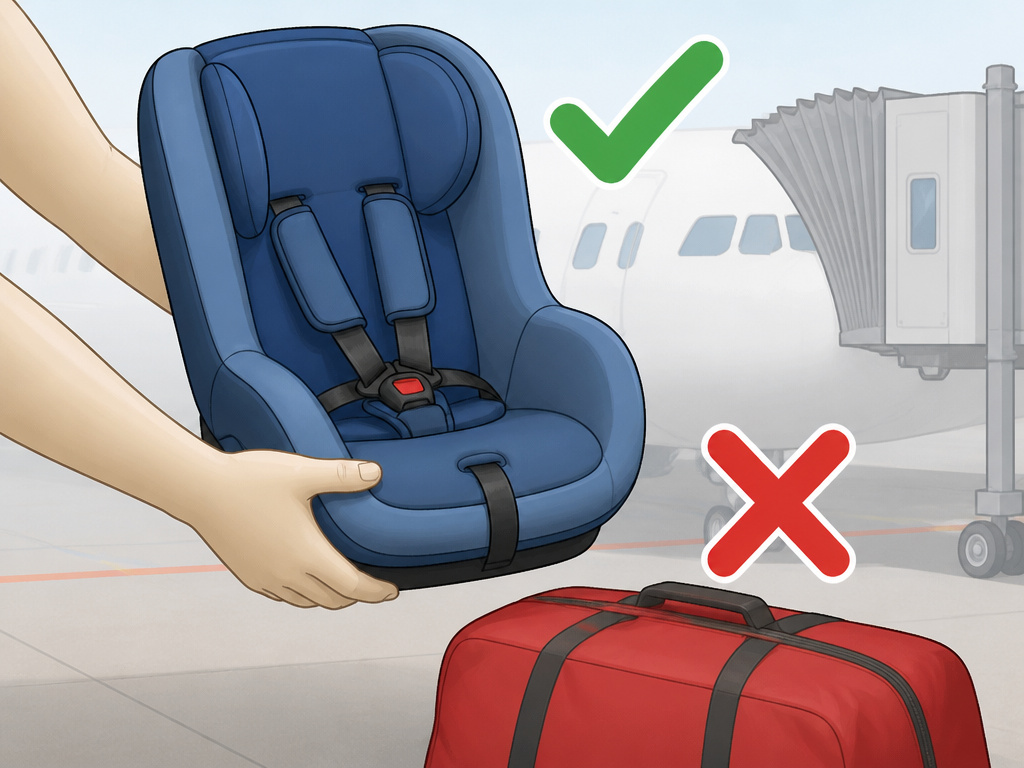
You have two fundamental paths: attempt to keep gear with you in the cabin, or surrender it at the gate to be stored below. The right choice isn’t about convenience—it’s about risk management.
Using a car seat in-cabin is the safest option, endorsed by the American Academy of Pediatrics for children under 40 pounds. It provides proper restraint during turbulence. To do this, you must purchase a seat for your child. The car seat must be installed in a window seat (never aisle or exit row) using the aircraft’s lap belt. Practice this installation at home. The belt threads through the same path you use in your car. If the aircraft belt is too short, ask a flight attendant for a seat belt extender immediately.
Gate-checking is the standard procedure for most full-size strollers and car seats you aren’t using onboard. You use the items through the airport, then leave them at the jet bridge to be loaded into the cargo hold. You pick them up at the jet bridge upon arrival or at baggage claim.
The part nobody mentions: A travel bag keeps things clean and dry, but it is not a crash-rated box. The IATA mobility aid guidance PDF discusses proper tie-down points for wheelchairs, but car seats are treated as baggage. They are tossed, stacked, and can experience impacts far beyond what a car crash would deliver. The bag protects the fabric, not the structure.
This is why many frequent flying families buy a dedicated, less-expensive travel car seat. They accept that checking a seat risks damage, so they don’t risk their primary $300+ model. The Cosco Scenera Next is a common choice for this—it’s lightweight, FAA-approved, and cheap enough to replace.
The Post-Flight Inspection You Cannot Skip
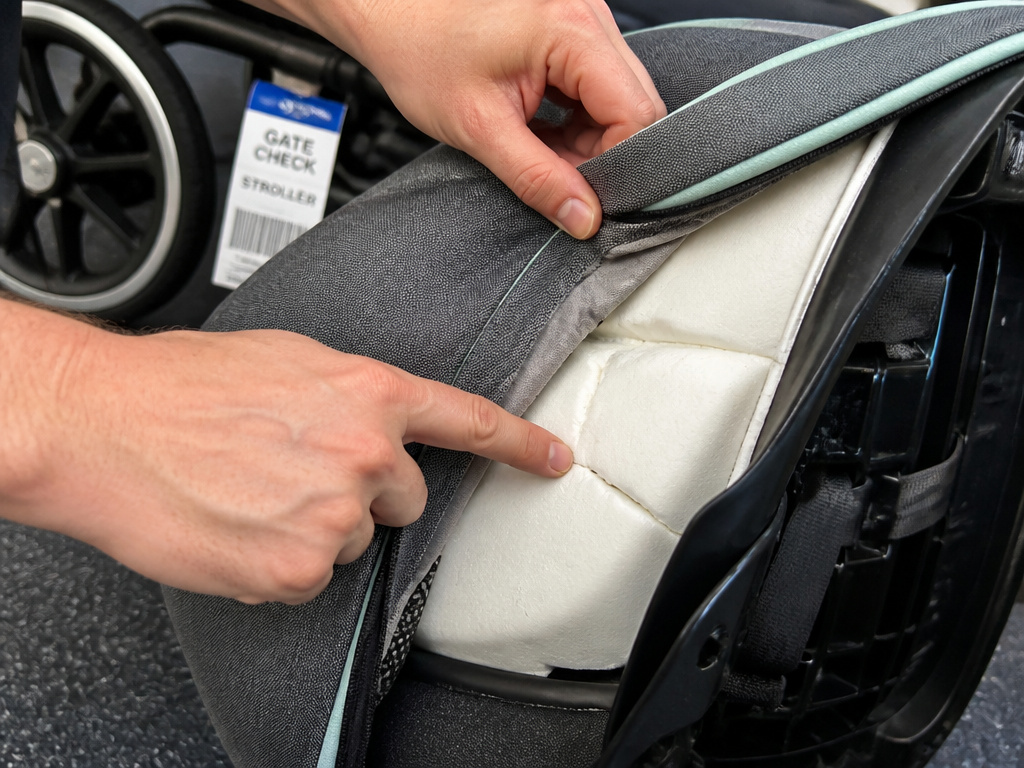
Retrieving your gear is not the last step. The first step is a damage inspection. This is non-negotiable.
Do not just look for scrapes on the plastic. You must check the energy-absorbing foam. This foam is usually hidden beneath the fabric seat cover. After any checked journey, remove the cover and inspect the foam pads for cracks, compression, or crumbling. The foam is what manages crash forces; cracked foam means the seat is compromised.
Consumer Reports cites safety technicians who emphasize this exact check. If you find damage, or if any part (the harness adjuster, buckle, or recline mechanism) does not work smoothly, the seat is not safe. Contact the airline to file a damage claim immediately. Under the DOT’s December 2024 rule, there is a rebuttable presumption that the airline is liable for damage to assistive devices in their care.
Your 5-Point Gate-Check Survival List:
- Tag it yourself. Use a bright, durable luggage tag with your name and flight info on the stroller frame and car seat handle.
- Remove and carry on all accessories. Detach the cup holder, travel tray, and stroller basket. These will snap off and get lost.
- Fold and lock the stroller. Present it to the agent in its fully folded, locked position. If it’s a travel system, remove the car seat first.
- Get a gate-check tag for every item. One tag for the stroller, one for the car seat. Do not let them bundle them together.
- Take a photo. A quick picture of your gear at the jet bridge proves its pre-flight condition.
This process turns a chaotic moment into a repeatable routine. The gate-checking procedures are worth rehearsing.
Navigating Airline Policies and Practical Reality
Federal law sets the floor. Each airline builds its own house on top of it. Your job is to know where the floor is so you can spot when an airline agent mistakenly cites a more restrictive internal policy as law.
For example, the law says airlines may not require advance notice for a passenger traveling with a manual wheelchair. This extends to a standard car seat. You do not need to call ahead to say you’re bringing a Graco Extend2Fit. However, if you are traveling with a large, battery-powered wheelchair or scooter, airlines can require 48 hours advance notice, especially for small aircraft with fewer than 60 seats.
Always check your airline’s website for their “special items” or “traveling with children” section. Look for specifics on stroller weight/size limits for in-cabin stowage. Delta might allow a folded stroller up to a certain size in the overhead bin, while a regional jet operated by American Eagle may not.
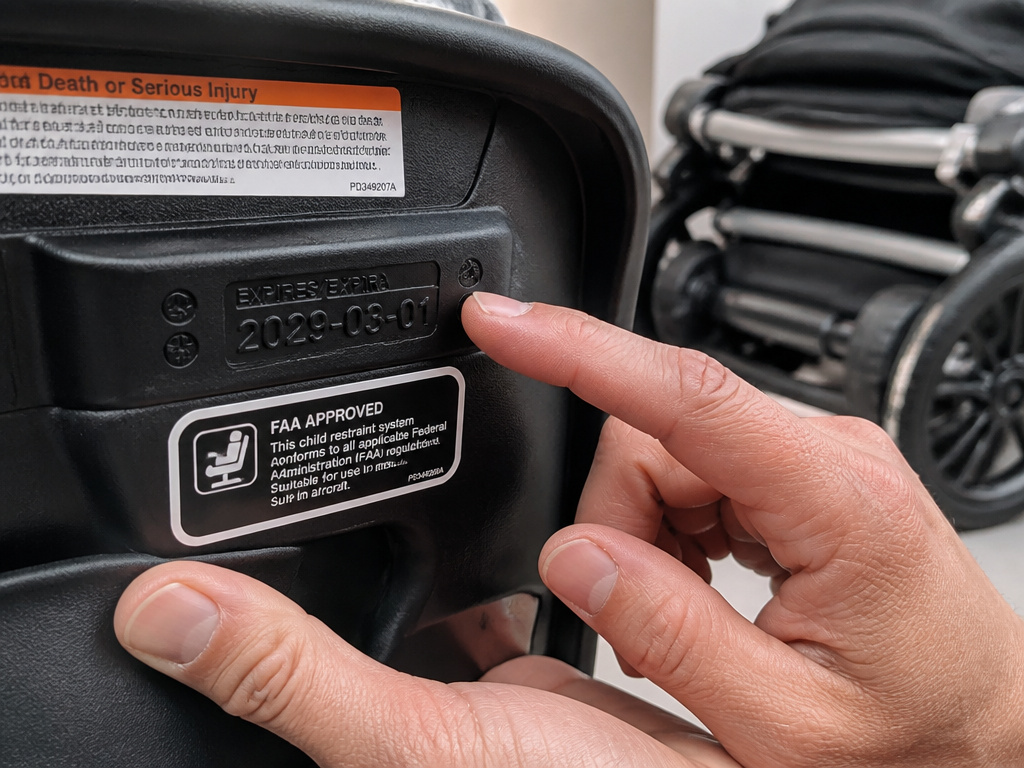
Easy to miss: Your car seat’s expiration date. Most seats expire 7 to 10 years after manufacture. The date is molded into the plastic shell. An expired seat is not airworthy, even with the FAA label. The UPPAbaby MESA V2 has a 7-year lifespan. An agent can deny an expired seat.
The airline policies are your pre-flight homework. The federal rules are your in-the-moment backup. The difference matters when you’re tired, your child is crying, and an agent is telling you something that doesn’t sound right.
Frequently Asked Questions
Does a stroller and car seat count as a checked bag?
No. Under U.S. DOT regulations, strollers and car seats are considered assistive devices for young children. Airlines must accept them for transport at no extra charge, whether they are checked at the ticket counter, the gate, or brought into the cabin. They do not count toward your personal baggage allowance.
What is the best stroller and car seat for plane travel?
The “best” is a system that balances airline compliance with your needs. For maximum simplicity, a lightweight, FAA-approved car seat like the Cosco Scenera Next paired with a compact, umbrella-style stroller that fits in the overhead bin is the most reliable combo. For infants, the Doona car seat/stroller is popular but controversial—some airlines balk at its installation method. Always verify your specific model with your airline.
Can you use any car seat on a plane?
No. Only car seats bearing a label that states “This restraint is certified for use in motor vehicles and aircraft” are approved for in-cabin use. This label is required by FMVSS No. 213. Booster seats, which lack a internal harness, are not approved for aircraft use as child restraints.
Is it safer to check a car seat or use it on the plane?
It is significantly safer to use an FAA-approved car seat on the plane in a purchased seat. It provides proper restraint during turbulence, which is the most common in-flight hazard. Checking a car seat exposes it to unpredictable baggage-handling forces that can cause hidden structural damage, compromising its safety in a vehicle crash.
What if the airline loses or damages my stroller or car seat?
First, file a report with the airline before leaving the airport. For damage, take clear photos. For a lost wheelchair or mobility aid, airlines have 24 hours (domestic) or 30 hours (long international) to deliver it to you. Under DOT rules, airlines are responsible for repairing or replacing damaged assistive devices up to the original purchase price. Keep all receipts.
Before You Go
You can travel with a stroller and car seat on a plane. The law is on your side. The process hinges on three tangible things: the “certified for aircraft” label on your car seat, the airline’s specific stowage size limits, and your own post-flight inspection.
Gate-check with a plan, not with hope. Use a bag for weather protection, but inspect the foam for cracks as soon as you land. If you choose to buy a seat and use your car seat onboard, practice the lap-belt installation until it’s muscle memory. That label is your authority. The rest is logistics.
The goal is to ensure your gear arrives safely and remains fully functional.
