
Are Car Seat Protectors Safe? The Official Safety Guidance
This post contains affiliate links. As an Amazon Associate, we earn from qualifying purchases.
Car seat protectors are not federally regulated for safety, and their use introduces risk by potentially interfering with a secure installation. The National Highway Traffic Safety Administration (NHTSA) states no FMVSS directly applies to aftermarket covers, but manufacturers remain liable for safety-related defects, and commercial installers face a $1000 penalty per violation for installing covers that degrade flammability resistance. Safety depends entirely on the protector not compromising the car seat’s fit or function.
That gap between “no standard” and “defect liability” is where the whole debate lives. The government isn’t certifying these mats as safe, but it will hold a company accountable if one catches fire in a crash where a compliant material would not. The real danger isn’t a regulatory gap, it’s physical interference.
What follows: the NHTSA’s exact legal interpretations, the two specific failure modes that matter in a collision, and a field test you can run in your driveway in five minutes to know if your mat is safe.
Key Takeaways
- The NHTSA has no Federal Motor Vehicle Safety Standard (FMVSS) for car seat protectors, but covers are considered motor vehicle equipment subject to defect recalls.
- A business (manufacturer, dealer, repair shop) that installs a cover degrading a seat’s flammability resistance violates federal law and can be fined $1,000 per violation.
- The primary mechanical risk is a protector introducing compressible space or interfering with belt paths, which can mimic a loose installation during a crash.
- You can test any protector by installing your seat over it, checking for ≤1 inch of movement at the belt path, removing the mat without loosening straps, and re-checking. If tightness changes, the protector fails.
- The only universally safe options are those explicitly approved by your specific car seat manufacturer in the manual, often limited to a single, thin layer like a towel.
What Does the NHTSA Actually Say?
The National Highway Traffic Safety Administration is the definitive source, not parenting blogs. Their official interpretation letters, written in response to manufacturer inquiries, draw the legal boundaries.
FMVSS No. 213 applies to child restraint systems prior to their first purchase, and not to aftermarket accessories. Generally those aftermarket accessories may be added… Even if the addition causes the child restraint to no longer comply with Standard No. 213, without violating the requirements of the standard.
This is the core of the NHTSA interpretation on seat covers. In plain English: the government tests and certifies the car seat itself. Anything you add later, like a protector, exists in a regulatory gray zone. The agency acknowledges you can add something that makes the seat non-compliant, and you aren’t breaking federal law by doing so.
But that gray zone has bright red edges. The same letter clarifies two massive caveats that reshape the entire conversation.
The $1,000 Violation for Businesses
While you can modify your own seat, a commercial entity cannot “knowingly render inoperative” any safety feature. FMVSS No. 213 requires seat materials to meet FMVSS No. 302 for flammability resistance.
If a store, dealership, or repair shop installs a seat cover that does not meet this flammability standard, they violate federal law. The penalty is a civil fine of $1,000 for each violation. This isn’t theoretical. The NHTSA slip-on seat cover interpretation applies the same “make inoperative” prohibition to vehicle seat covers, establishing a consistent enforcement principle.
Why does this matter to you? It proves the risk is real. If flammability is serious enough to warrant a four-figure fine for a business, it’s a genuine hazard in your car.
The Manufacturer’s Recall Liability
Even if you install the cover yourself, the company that made it isn’t off the hook. The NHTSA states that car seat protectors are “motor vehicle equipment.” This makes their manufacturer subject to recall and remedy requirements if a safety-related defect is found.
The agency explicitly warns that if a cover catches fire in a situation where an FMVSS No. 302-compliant cover would not, it “might well be found to contain a safety-related defect.” The manufacturer would be forced to notify all purchasers and fix the problem for free. This liability threat is why some companies voluntarily comply with standards even when they don’t have to.
| Entity | Legal Responsibility | Key Consequence |
|---|---|---|
| Vehicle Owner (You) | Can install aftermarket covers on own equipment. No federal violation for making seat non-compliant. | Assumes all risk of improper installation and potential defect liability. |
| Commercial Business (Dealer, Shop) | Cannot install covers that degrade flammability resistance (FMVSS No. 302). | $1,000 civil penalty per violation for rendering a safety feature inoperative. |
| Protector Manufacturer | Must produce equipment free of safety-related defects. Subject to recall authority. | Mandatory recall and free remedy if product is defectively flammable or causes installation failure. |
How Protectors Fail in a Crash
Regulations matter, but physics decides the outcome. A protector doesn’t need to be defective to be dangerous. It just needs to change one of three things about the seat’s installation.
Compression is the silent killer. A crash applies immense force. A thick, padded mat or a folded towel compresses under that load. This compression creates sudden slack in the LATCH strap or vehicle seat belt. That slack allows the car seat to jerk forward several extra inches. In a frontal collision, that extra travel can be the difference between the child’s head staying within the protective shell and impacting the vehicle seat in front of them.
Interference blocks a secure fit. Many protectors are designed with “grippy” rubber pads or raised edges to prevent sliding. This texture can make a seat feel rock-solid during a hand-check. The grip masks movement that should be taken up by the belt. In a crash, that grip can fail instantly, allowing the seat to lurch. Other protectors physically block access to lower anchor points or create a rounded surface that prevents the car seat base from sitting flush against the vehicle seatback.
Material alters the system. This is the flammability issue. The car seat’s original fabric is tested to resist ignition and slow flame spread. An aftermarket cover made of non-compliant material could ignite more easily or burn faster, turning a survivable incident into a tragedy.
Where this goes sideways: Using a folded towel or a mat with memory foam. It feels firm during installation, but under crash forces it compresses like a spring. That compression introduces 2-3 inches of slack in milliseconds, and the seat’s performance is compromised before the harness even begins to manage the child’s movement.
The 1-Inch Movement Test
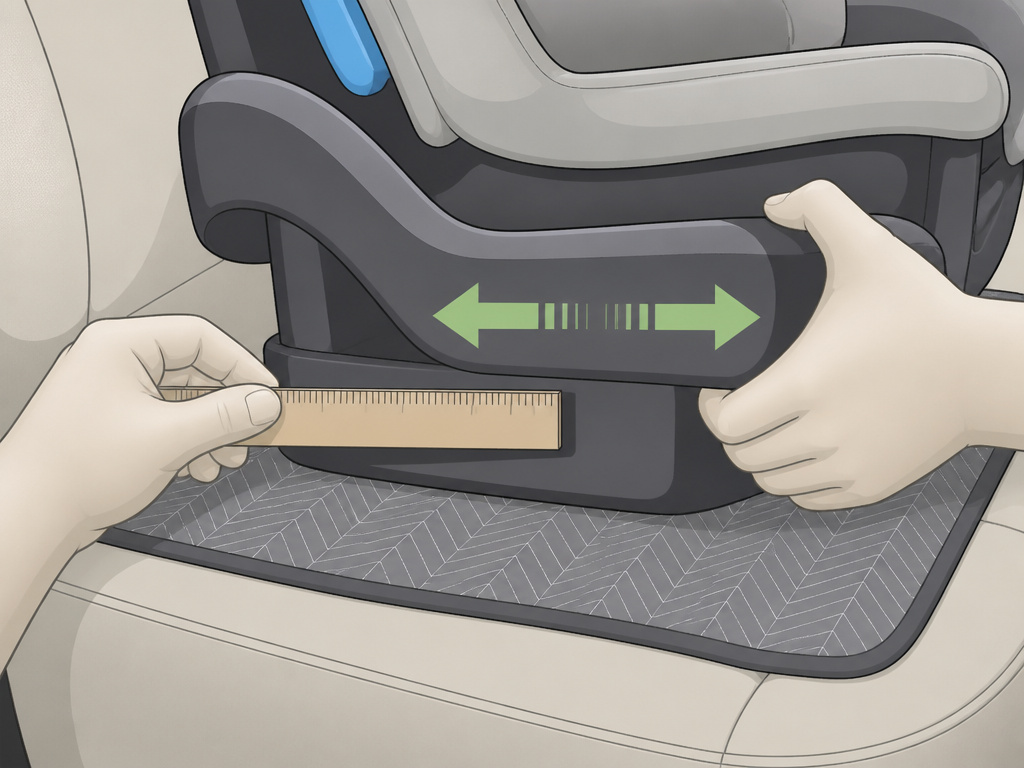
Forget the marketing claims about “crash-tested” protectors. There is no federal standard for that testing, so the term is meaningless. Your car seat manual has the final authority. If it doesn’t explicitly permit a protector, the answer is no.
If your manual does allow one, or permits a thin towel or blanket, you must verify it doesn’t interfere. Certified Child Passenger Safety Technicians (CPSTs) use this field test. You need five minutes and no tools.
- Install Over the Protector. Place your protector (or thin towel) on the vehicle seat. Install the car seat or base on top of it exactly as your manual instructs, using LATCH or seat belt. Tighten until you have no more than 1 inch of movement side-to-side or front-to-back at the belt path.
- Remove the Protector Without Loosening. This is the critical step. Do NOT unbuckle or loosen the installation. If using LATCH, carefully unclip only one side of the lower anchor connectors. If using a seat belt, press the buckle release but hold the belt tight so it doesn’t retract. Slide the protector out from under the installed seat.
- Re-secure and Re-check. Re-attach the loose LATCH connector or re-buckle the seat belt. Do not tighten further yet. Now, check for movement at the belt path again.
- Interpret the Result. If the seat now moves more than 1 inch, the protector was providing false tightness. It is too thick or compressible and is unsafe. If movement is still 1 inch or less, the protector passes.
This test isolates the protector’s effect. A passing result means the mat isn’t contributing to the install. A failure means it’s part of the structure, and a dangerous, unreliable part at that.
Safer Alternatives (and What to Skip)
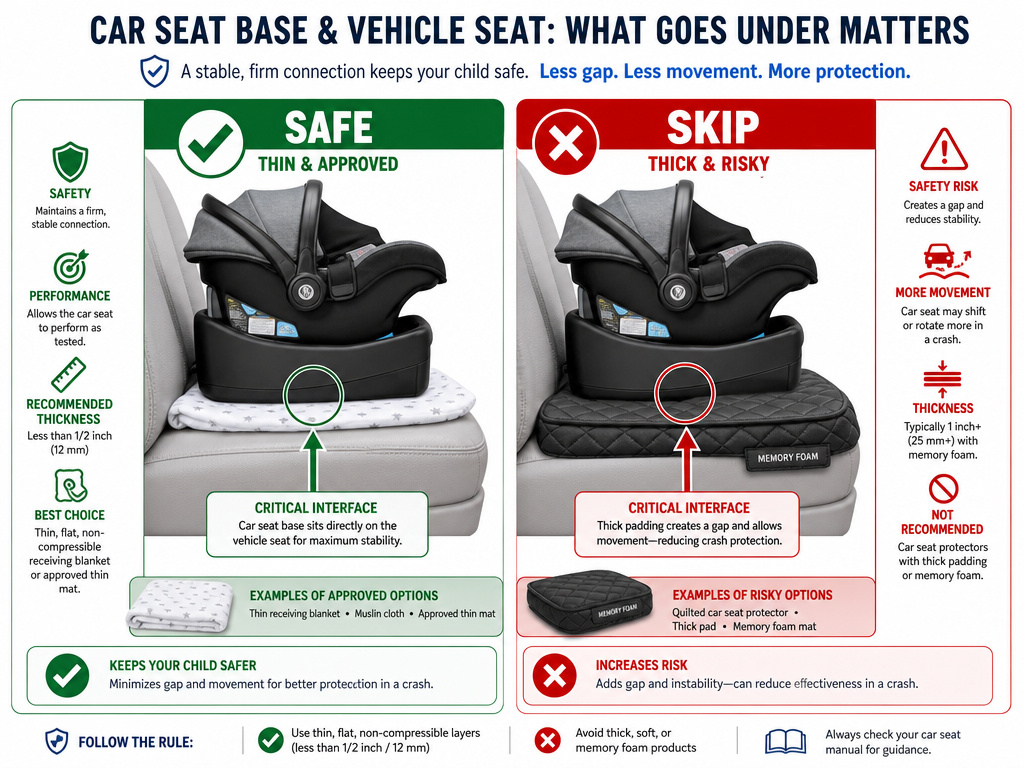
Your goal is to protect the vehicle seat without adding a variable to the safety equation. The hierarchy is straightforward.
Approved & Thin is Best. Some car seat manufacturers, like Graco, explicitly permit a single, thin layer like a towel or blanket under their seats. This is your safest bet if you must use something. A thin receiving blanket or a flat, unfolded towel often passes the 1-inch test because it adds negligible bulk. It protects against superficial scratches and crumbs without becoming a structural component.
Manufacturer-Specific Protectors. Brands like Britax and Diono sometimes sell their own branded protectors designed for specific models. These are the only aftermarket mats with any claim to being vetted. If your manual names a specific product, that product is your sole option. Using a different brand voids your warranty and assumes unknown risk.
Common mistake: Choosing a protector based on vehicle seat material. A “hard shell” mat for leather or a “grippy” mat for cloth seats focuses on the wrong problem. The interface that matters is between the protector and the car seat’s base, not the protector and your upholstery.
| Option | Mechanism | Risk If Used Improperly |
|---|---|---|
| Thin Receiving Blanket | Adds minimal, non-compressible layer. Slides out easily for testing. | Almost none, if it passes the 1-inch test. Becomes risky if folded. |
| Manufacturer’s Branded Mat | Designed for specific seat geometry and installation method. | High, if used with a different brand seat. May interfere with belt path or recline angles. |
| Thick “Premium” Mat with Padding | Uses memory foam or quilted padding for comfort and grip. | High compression risk. Masks loose installs, fails catastrophically in crash. |
| Hard Plastic Shell Mat | Aims to prevent leather indentation with a rigid plate. | High interference risk. Prevents seat base from contouring to vehicle seat, creating pivot points and slack. |
| Folded Towel or Blanket | Creates a soft, unstable platform that seems firm. | Very high compression risk. The multiple layers act like a spring, guaranteed to compress. |
Skip anything that looks plush, has a raised lip, or feels like a mattress topper. Skip the hard plastic trays. Their design goals, preventing dents, adding comfort, are fundamentally at odds with the car seat’s need for direct, stable, uncompressed contact.
Warranty and Insurance Implications
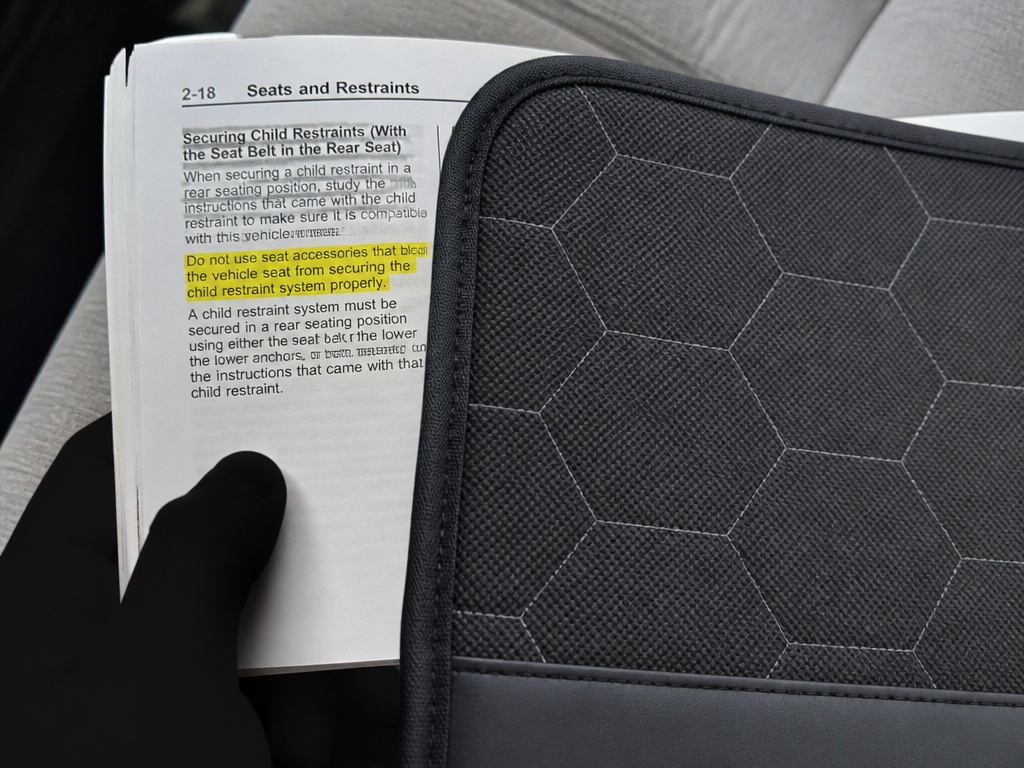
This is the practical headache most parents don’t see coming. Your car seat’s warranty is a contract. Adding an unapproved accessory is a common warranty-voiding act.
The language is usually broad: “Use of non-approved accessories that alter the fit or performance may void this warranty.” If you have a crash and the insurance adjuster or manufacturer’s investigator finds an unapproved mat under the seat, they can deny a warranty replacement. They will argue the accessory altered the installation dynamics, making the seat’s performance in the crash unpredictable.
Your auto insurance could raise similar questions about liability. While less common, if an improper installation contributed to injury, an insurer might scrutinize whether an aftermarket accessory played a role.
The safe path is documentation. If your manual allows a protector, keep a screenshot of that page. If you buy a manufacturer-branded mat, keep the receipt. For homemade solutions like a towel, note the manual’s allowance. This isn’t paranoia, it’s ensuring the safety net you paid for remains intact.
Frequently Asked Questions
Do car seat protectors void warranties?
Many do. Most car seat manufacturers state that using accessories not approved by them can void the warranty. Always check your specific seat’s manual before placing anything underneath it. An unapproved mat found after a crash is grounds for a warranty claim denial.
What is the safest car seat protector?
The safest option is the one explicitly named in your car seat’s owner’s manual. For many seats, that’s no protector at all. For others, it may be a specific brand’s mat or a single, thin, unfolded towel. No generic aftermarket protector is universally “safest.”
Are there any federally approved car seat protectors?
No. The NHTSA does not approve or certify any car seat protectors. There is no FMVSS that applies directly to these products. Manufacturers self-certify other items, but for protectors, there is no federal safety standard to certify against. Claims of “meets FMVSS” are misleading at best.
Can I use a towel under my car seat?
Maybe. Several major car seat brands, including Graco, permit a thin towel or blanket. The key words are thin and single layer. A folded towel is never safe. You must perform the 1-inch movement test to confirm the towel does not affect the installation’s tightness.
How do I protect my leather seats from car seat dents?
Temporary indentations are a cosmetic issue, not a safety one. They almost always dissipate within hours or days after removing the seat. Using a hard protector to prevent dents is riskier than the dent itself, as it can compromise installation. The safest method is to accept the temporary indentation as a trade-off for a proper, direct installation.
Before You Go
Car seat protector safety isn’t about finding a magical product that passes a government test. That test doesn’t exist. It’s about rigorously eliminating anything that adds variables, compressible padding, gripping textures, rigid plates, between your child’s restraint and the vehicle seat.
The NHTSA’s position is clear: the onus is on you and the accessory maker, not a federal checklist. Your manual is the first authority. The 1-inch test is your final verification. Choose the option that leaves the least room for physics to disagree with your assumptions. Often, that’s nothing at all.
