
When Is It Safe To Turn An Infant Car Seat Around? Guide
This post contains affiliate links. As an Amazon Associate, we earn from qualifying purchases.
You can turn an infant car seat around when your child exceeds the rear-facing height OR weight limit printed in your specific seat’s manual. For most infant-only “bucket” seats, that limit is 30-35 lbs or when the top of the head is within 1 inch of the seat shell. Convertible seats have higher rear-facing limits, often 40-50 lbs. Legally and safely, the minimum is 22 lbs and 2 years old, but those are floors, the goal is to max out the rear-facing limits your seat allows.
That answer is the rulebook. What it doesn’t tell you is how a seat’s own manual can force a specific, earlier switch, or why turning a 22-pound, 18-month-old is a different kind of risk than turning a 35-pound 3-year-old. The difference is the gap between a legal minimum and a physiological reality.
What follows: the exact cutoffs for popular models, the biomechanics that make rear-facing non-negotiable, and the three signs that trump the calendar. By the end, you’ll read a car seat manual like a technician, not a parent guessing at dates.
Key Takeaways
- Your seat’s manual overrides every guideline. The Evenflo Sonus 65, for example, mandates discontinuing use if a child under 2 outgrows its rear-facing limits, you don’t turn it forward.
- 22 lbs and 2 years old is the absolute legal/safety floor. The American Academy of Pediatrics (AAP) and NHTSA say “as long as possible” up to the seat’s limits; turning at the minimum forfeits proven protection.
- Harness strap position changes when you turn. For rear-facing, straps must be at or just below the shoulders. For forward-facing, they must be at or just above, a detail missed in over 70% of installations.
- Pre-term or low-birth-weight infants need a 90–120 minute hospital observation before their first car trip, per AAP guidelines adopted by Cybex and Evenflo.
- Convertible seats are the bridge. When your infant outgrows the bucket seat, a rear-facing convertible seat like the Graco Extend2Fit or Chicco NextFit Max allows you to continue rear-facing for years longer.
The Hard Limits: Your Seat’s Manual is Law
General advice is a suggestion. The manual for your specific model is a contract. It contains the only numbers that matter for your child in that seat. Ignoring them voids the seat’s safety certification.
Common mistake: Assuming all infant seats have the same limits. The Cybex CLOUD T tops out at 30 lbs rear-facing. The CLOUD G Pro goes to 35 lbs. The Graco SnugRide SnugFit 35 ELR? That’s in the name, 35 lbs. You must know your model’s exact designation.
The most critical fine print lives in the “Child Requirements” or “Use” section. Here’s where you find clauses that change the entire plan.
The Evenflo Sonus 65™ Rule (A Non-Negotiable Example)
This convertible seat’s manual states two things many parents miss. First: “NEVER turn a child restraint forward-facing with a child who weighs less than 10 kg (22 lbs).” Second, and more stark: “Once a child exceeds any of the size requirements for rear-facing use, they MUST use the restraint in the forward-facing orientation, if possible. However, if the child exceeds rear-facing limits and is less than 2 years old, use of that specific child restraint MUST be discontinued.”
Let’s translate. If your 18-month-old hits the seat’s rear-facing height limit, you cannot use the Sonus 65 anymore, period. You don’t get to turn it forward. You must buy a new seat with higher rear-facing limits. This is the manufacturer’s certification boundary.
| Car Seat Model | Type | Rear-Facing Weight Limit | Critical Fine Print |
|---|---|---|---|
| Cybex CLOUD T | Infant Carrier | 30 lbs (13.6 kg) | Harness straps MUST be at or just below shoulders. |
| Evenflo Sonus 65 | Convertible | Up to seat’s limits | Discontinue use if child outgrows RF limits before age 2. |
| Graco SnugRide SnugFit 35 | Infant Carrier | 35 lbs | Limit is for the carrier; base may have lower anchor weight limits. |
| Chicco KeyFit 35 | Infant Carrier | 35 lbs | Often outgrown by height before weight. |
Where This Goes Sideways: The lower anchor weight limit. Your car’s LATCH system has a maximum weight, usually 65 lbs total. That’s the child’s weight plus the seat’s weight. For a 30 lb child in a 20 lb seat, you’ve hit 50 lbs. You have 15 lbs of LATCH capacity left. Many parents blow past this limit because they only watch the child’s weight. Once you exceed it, you must switch to installing the seat with the vehicle’s seat belt. The manual shows the math.
The takeaway? Before you even think about turning a seat around, you must know two numbers: your child’s height/weight and your seat’s certified limits. Guessing here is how you fail the official child passenger safety guide before you even start.
The Physical Why: Crash Forces & Immature Spines
Rear-facing is a fundamental re-engineering of crash physics for a child’s body. An adult spine is a column of interlocked bones.A toddler’s spine is still a chain of separate, softer vertebrae connected by stretchy ligaments.
In a forward-facing crash, the body is hurled forward and stopped by the harness. The head, which is proportionally huge and heavy, keeps going. This puts immense tensile (pulling) force on the neck and spine. In a rear-facing crash, the child’s entire back, the strongest part of the body, cradles into the seat shell, and the force is spread evenly across the head, neck, and back. The head is contained.
A properly installed child restraint reduces the risk of death by over 70% for infants involved in crashes. That statistic, cited by NHTSA and in every major seat manual, is for a correctly used seat. The benefit plummets with misuse.
The “as long as possible” mantra exists because a 2-year-old’s spine is still ossifying. A 3-year-old’s is stronger. A 4-year-old’s stronger still. Every month you gain in a rear-facing convertible seat is more development time for the vertebrae to fuse and the ligaments to tighten. Turning at the legal minimum of 2 and 22 lbs is choosing the least-safe point within the safe zone.
This is why the move from an infant carrier to a rear-facing convertible seat is a strategic upgrade, not just a size up from infant seat. The convertible seat is designed for the long rear-facing haul.
Signs Your Child is Ready to Turn Forward-Facing
The limits are black and white. But within those bounds, you watch for physical signs. All three must be true before you switch.
- They exceed the rear-facing height limit. This is the most common outgrowing factor. The rule: the top of the child’s head must be more than 1 inch below the top of the seat’s shell. Not the headrest, the hard plastic shell. An inch matters. Less than that, and in a crash the head can whip over the top, with nothing to stop it.
- They exceed the rear-facing weight limit. Straight from the label on your seat. Use a reliable scale. Don’t estimate in winter clothes.
- They are at least 2 years old. This is the non-negotiable minimum from the AAP and NHTSA. Even if they hit the weight/height limit at 23 months, you need a new seat with higher limits to continue rear-facing. This is the scenario the Evenflo Sonus 65 rule addresses.
Worth knowing before you start: “Comfort” is not a sign. Legs bending or touching the vehicle seat is not a safety issue. Children sit cross-legged or prop their feet up. Broken legs heal; spinal cord injuries often do not.
What about the switch from infant seat to a convertible car seat transition? That happens when signs 1 or 2 are met, regardless of age. You move to the next stage car seat to continue rear-facing. Turning forward is a separate, later decision.
The Special Case: Preterm & Low-Birth-Weight Infants
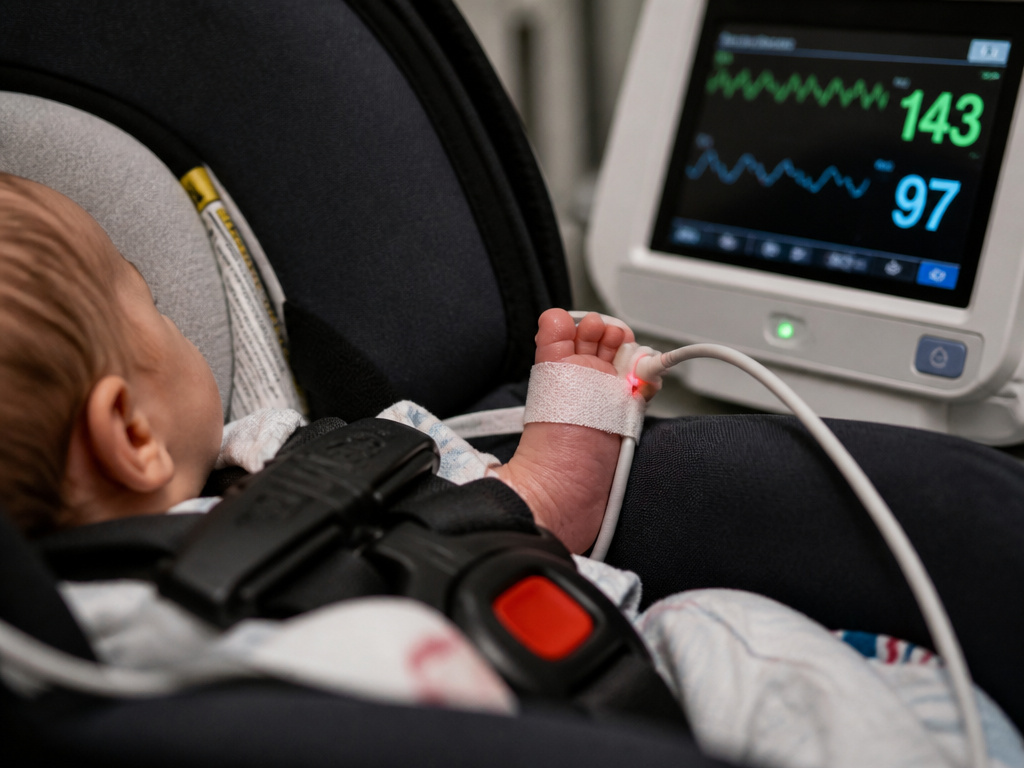
For infants born earlier than 37 weeks or weighing less than 5 lbs at birth, the manual has an extra chapter. Both Cybex and Evenflo (and the AAP) mandate a specific protocol before the first car trip.
The semi-upright angle of a car seat can cause oxygen desaturation or apnea in these vulnerable infants. The rule is a requirement printed in the manual: the infant must undergo a “car seat challenge” or “car seat tolerance test” before discharge.
The AAP recommends that appropriate hospital staff observe your infant in the child restraint for a period of 90 to 120 minutes or the duration of travel, whichever is longer.
This observation checks for breathing difficulties or heart rate problems. If your infant is in this category, the hospital staff will guide you. This is a clear example of how the book answer, “use from 4 lbs”, meets a much more complex medical reality. The car seat challenges scientific review notes this is an area requiring more research, but the current clinical standard is clear.
How to Correctly Install a Forward-Facing Seat
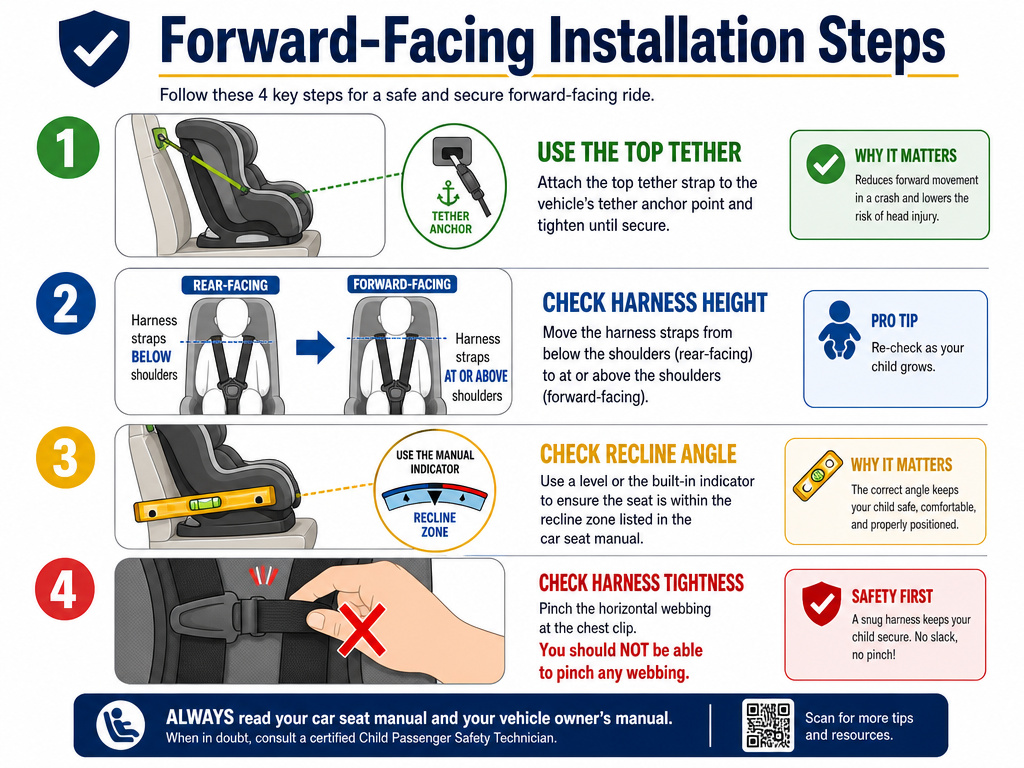
When the day comes that all conditions are met, the installation changes. Getting it wrong negates the safety you just preserved by waiting.
1. Use the Tether. Always.
This is the single most important step. The tether strap anchors to a dedicated point in your vehicle (check your car’s manual). It limits forward head movement in a crash by several inches, dramatically reducing the risk of head injury. NHTSA states to always use a tether with a forward-facing seat installed with either the seat belt OR lower anchors.
2. Harness Strap Position Flips.
For rear-facing: straps at or just below the shoulders. For forward-facing: straps at or just above the shoulders. This ensures the harness catches the body at the strongest point. Incorrect positioning is a major component of the 70%+ misuse rate.
3. Recheck the Recline Angle.
Most convertible seats have an upright setting for forward-facing mode. Set it according to the manual’s indicator. The seat should not wobble at the belt path.
4. Pinch Test the Harness.
Tighten the harness so you cannot pinch any horizontal webbing at the child’s shoulder. If you can pinch a fold, it’s too loose.
This is where choosing the right best car seat after infant matters. A seat like the Britax Boulevard ClickTight or the Graco TriRide makes a proper, tight installation almost foolproof with clear indicators and simple mechanisms.
Frequently Asked Questions
Can I turn my infant seat around at 1 year old?
No. The absolute minimum is 2 years old, and only if your child also exceeds the seat’s rear-facing weight or height limit. Turning at 1 year is illegal in many states and violates every safety guideline. If your child has outgrown the infant seat by 1, you need a convertible seat to continue rear-facing.
My child’s legs are bent in the rear-facing seat. Is that safe?
Yes. It is completely safe. Children are flexible and will sit cross-legged or prop their feet on the seat back. There are no documented cases of broken legs from rear-facing in a crash. The risk of spinal injury from forward-facing is far greater.
What is the next car seat after an infant seat?
The next stage is a convertible car seat. It installs rear-facing for infants and toddlers, then converts to forward-facing later. Popular models include the Graco Extend2Fit, Chicco NextFit Max, and Britax One4Life. This is your post-infant car seat solution.
Do I have to stop using the base when I turn the seat?
Infant carrier seats are rear-facing only. You cannot turn them forward. When your child outgrows it, you retire the entire infant seat system (carrier and base) and move to a convertible car seat.
Why do some manuals say to discontinue use if a child under 2 outgrows it?
That seat, like the Evenflo Sonus 65 cited earlier, is a liability and safety boundary, as it is not certified by the manufacturer to be used forward-facing by a child under 2. You must select a different seat that is certified for heavier/older children in a rear-facing position.
Before You Go
The date on the calendar is the least important factor. The numbers in the manual are everything. Maximize the rear-facing limits of every seat you own, that’s the core of child passenger safety.
The switch is a buffer to use up. When you finally move to that forward-facing convertible seat, you’ll do it knowing you didn’t trade a single day of proven protection for convenience.You followed the data, not the crowd.
And you’ll have the tight tether strap to prove it.
