
Can You Gate Check a Car Seat and Stroller? The Definitive Guide
This post contains affiliate links. As an Amazon Associate, we earn from qualifying purchases.
Yes, you can gate check both a car seat and a stroller. The standard airline policy allows one of each per child to be checked for free, either at the ticket counter or at the gate. The catch is a weight limit, strollers over 20 pounds must be checked at the ticket counter on some airlines like American, and the car seat must be FAA-approved if you plan to use it onboard.
That weight limit is the first thing that trips people up. A Bob jogging stroller weighs 28 pounds. A Chicco Keyfit caddy weighs 11. The difference decides whether you haul your child through the terminal or check the stroller before security and carry the child.
This guide walks through the three specs that matter: the 20-pound rule, the FAA approval label, and the ASTM F833-13 standard that defines what “stroller” even means to an airline. It also covers what to do when things go wrong, because if a gate agent denies your stroller, you need to know the next step before your flight boards.
Key Takeaways
- Most airlines let you gate check one stroller and one car seat per child for free, but strollers over 20 lbs must be checked at the ticket counter on carriers like American Airlines.
- A car seat is only eligible for in-cabin use if it has an FAA approval label; without that label, it must be checked.
- The ASTM F833-13 safety standard requires a stroller to support a static load of 100 lb per seat, a number that explains why flimsy umbrella strollers get damaged in cargo.
- Always report any damage at the airline’s service desk before leaving the terminal; waiting even an hour can void your claim.
- A travel system, where the car seat clicks directly into the stroller frame, is the single easiest path through security, but only if the total weight stays under that 20-pound gate-check threshold.
The 20-Pound Weight Limit That Changes Everything
The rule seems simple: one stroller, one car seat, free gate check. Then you get to the airport with your 28-pound Bob jogging stroller and the agent points to the ticket counter. American Airlines enforces a hard 20-pound limit for gate-checked strollers. Delta and others are more lenient, but their ground crews still have discretion.
Common mistake: Assuming all strollers are gate-check eligible. The 20-pound limit on American is printed policy, not a suggestion. A Bob Revolution SE single stroller weighs 28 pounds. A UPPAbaby Cruz V2 weighs 26 pounds. Both fail the gate-check test on American before you even add a cup holder.
Why the limit? It’s about baggage handler safety and equipment constraints. The cargo-loading conveyors and bins on most regional jets are rated for standard checked bags, not for bulky, irregularly shaped items over a certain weight. A heavy stroller tossed from a height can jam a conveyor or injure a worker. The airline’s liability calculation changes at 20 pounds, so the policy draws a bright line.
Your first move before any trip is to find your stroller’s actual weight, not the manufacturer’s “shipping weight.” Use a bathroom scale: weigh yourself, then weigh yourself holding the folded stroller. The difference is your real number. If it’s 22 pounds, you’re checking it at the counter on American. That changes your entire airport strategy, you’ll be carrying your child from the curb to the gate.
What “FAA-Approved” Actually Means for Your Car Seat
If you want to use your car seat on the plane, it must have a label that reads “This restraint is certified for use in motor vehicles and aircraft” or “FAA approved in accordance with 14 CFR Part 21.” No label, no onboard use. Gate-checking it is your only option.
The UPPAbaby MESA V2 child restraint manual states it is “certified for aircraft use” right on the cover. The Joie i-Snug 2 manual notes it complies with UN Regulation No. 129 for enhanced child restraint systems, but that’s a European vehicle standard, not an FAA approval. You need the FAA label.
Where this goes sideways: Bringing a European i-Size seat without an FAA label and expecting to use it onboard. The flight attendant will ask for the label. If you don’t have it, the seat goes to cargo. Know your label before you board.
Even with the label, your child must have their own ticketed seat to use the car seat onboard. Lap infants do not get an extra seat, so their car seat must be gate-checked. If you purchased a seat for your child, the car seat must be installed in a window seat, never in an aisle or emergency exit row, and the child must remain buckled during taxi, takeoff, landing, and turbulence.
The One Step Nobody Skips (And Why You Shouldn’t Either)
Collapse the stroller and secure the car seat before you reach the jet bridge. This sounds obvious, but in the rush of boarding, parents forget. A gate agent will not fold your stroller for you. They will not secure the loose parts of your car seat. They will tag it as-is and send it down the conveyor.
Easy to miss: The telescoping handle on most travel strollers. If you don’t push it all the way down and lock it, it can snap in transit. Same with the sun canopy on a car seat, if it’s not Velcroed or snapped down, it’s a sail waiting to catch a baggage cart.
Take sixty seconds at the gate. Fold the stroller, double-check that all latches are engaged, and use a strap or bungee to keep it folded. For the car seat, tuck the harness straps inside, buckle the chest clip, and if you have a travel bag, use it. A $30 bag is cheaper than a $300 replacement seat.
What Happens When You Gate Check?
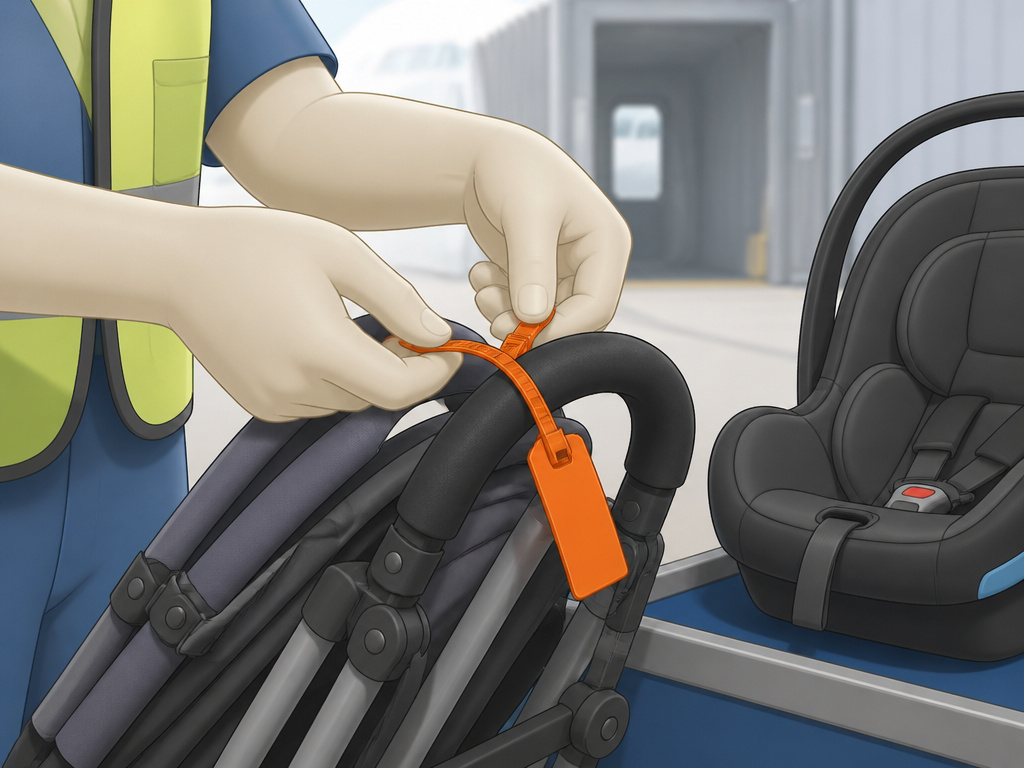
You hand the items to a gate agent just before you step onto the jet bridge. They attach a bright tag, usually a plastic zip-tie with a barcode, and place them on a cart. That cart goes down to the tarmac, where baggage handlers load it into the aircraft’s cargo hold. You do not get a claim check. You pick up the items in the same jet bridge after landing, not at baggage claim.
The system works well for lightweight, compact items. It fails for heavy or complex items because the handlers are on a clock. They are not gentle. The ASTM F833 stroller safety standard requires a stroller to support a static load of 100 pounds (or 2.5 times the manufacturer’s rated weight) per seating area. That’s the engineering margin for a single bag dropped on it. It is not a guarantee against a 50-pound suitcase thrown from a height.
Damage is rare, but when it happens, you must report it immediately. Airlines require you to file a report at their service desk before you leave the terminal. If you discover a broken wheel at baggage claim, walk back to the gate. If you find a cracked frame at home the next day, the airline will deny the claim. The timeline is not flexible.
Gate Check vs. Counter Check: The Real Difference
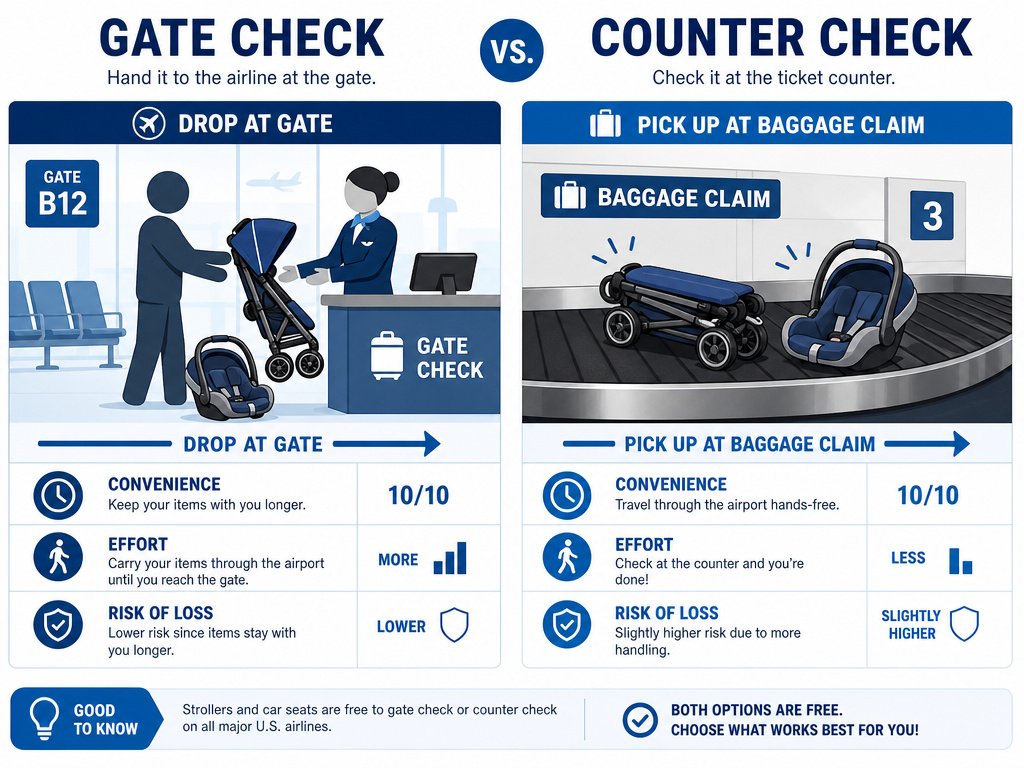
| Checkpoint | Gate Check | Counter Check |
|---|---|---|
| Where you drop it | At the boarding gate, just before walking onto the plane. | At the airline ticket counter during check-in. |
| Where you get it back | In the jet bridge immediately after deplaning. | At your destination’s baggage claim carousel. |
| Weight limit | Often 20 lbs (American Airlines) or at agent’s discretion. | No specific weight limit; standard checked baggage rules apply. |
| Best for | Lightweight umbrella strollers, travel systems under 20 lbs, car seats in bags. | Heavy jogging strollers, double strollers, any item over the airline’s gate-check weight limit. |
| Risk of loss/damage | Lower (fewer handling touchpoints). | Higher (goes through the main baggage system). |
Counter-checking at the ticket counter means your stroller and car seat travel with the rest of the checked luggage. They appear on the carousel at your destination. The advantage is you don’t have to navigate the airport with them. The disadvantage is increased risk of loss or damage, and you’re without them if your flight is delayed or you have a long layover.
If you must counter-check, use a hard-sided travel case for the car seat. For the stroller, a padded bag is the minimum. Neither is foolproof, but they reduce the chance of a torn canopy or a snapped plastic clip.
How to Actually Do It: A Step-by-Step Walkthrough
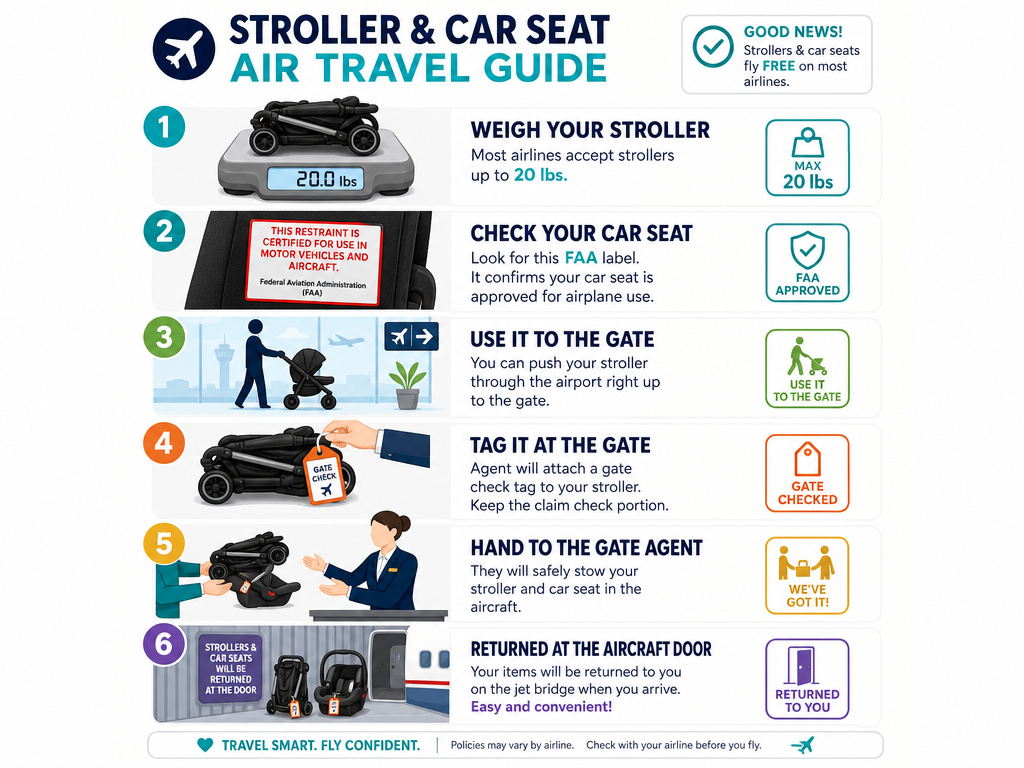
- Weigh your stroller at home. Use a bathroom scale. If it’s over 20 pounds and you’re flying American, plan to check it at the ticket counter.
- Find the FAA label on your car seat. Look on the side or back for the red and white sticker. No label means it cannot be used onboard, even if you bought a seat.
- At the airport, use the stroller all the way to the gate. Even if you’re counter-checking it, push it to the ticket counter. Don’t carry a child and a diaper bag a mile.
- If counter-checking, get a luggage tag for each item. The agent will attach tags and send them down the belt. Get a claim check.
- If gate-checking, wait until final boarding call. Fold the stroller, secure the car seat, and hand both to the gate agent. Watch them tag it.
- Pick up at the jet bridge. After landing, wait just outside the aircraft door. Your items will be brought up from the hold.
The part nobody mentions: On smaller regional jets, gate-checked items are sometimes brought up to the jet bridge by hand, not by cart. If yours isn’t there immediately, wait. Don’t head to baggage claim, it’s not there.
The Travel System Shortcut (And Its Limitation)
A travel system, where the infant car seat clicks directly into the stroller frame, is the most efficient setup for airport travel. You snap the seat into the stroller, wheel everything to the gate, then at the last moment you separate them. The car seat goes into its travel bag, the stroller gets folded, and both get tagged.
The limitation is weight. A UPPAbaby Vista V2 stroller frame weighs about 17 pounds. Add a MESA V2 car seat at 9.5 pounds, and you’re at 26.5 pounds, over American’s 20-pound gate-check limit. You’d have to counter-check the frame. The Chicco Keyfit 30 car seat with a Caddy stroller frame stays under 15 pounds total, so it sails through.
| Travel System | Stroller Frame Weight | Car Seat Weight | Total Weight | Gate-Check Eligible on American? |
|---|---|---|---|---|
| UPPAbaby Vista V2 + MESA V2 | ~17 lbs | ~9.5 lbs | ~26.5 lbs | No |
| Chicco Keyfit 30 + Caddy | ~11 lbs | ~9.5 lbs | ~20.5 lbs | No (by half a pound) |
| Baby Jogger City Tour 2 | ~14 lbs | N/A (stroller only) | ~14 lbs | Yes |
If you’re set on a travel system and fly American often, your only real choice is an ultra-lightweight frame like the Baby Jogger City Tour 2. Everything else fails the weigh-in.
Frequently Asked Questions
Can you gate check a car seat without a base?
Yes. The base is not required for gate-checking. You can check the base separately at the ticket counter or carry it on. Most parents gate-check the seat and carry the base in a backpack to use at their destination.
What if my stroller is over the weight limit?
You must check it at the ticket counter. There is no appeal. The 20-pound rule on American Airlines is a hard limit for baggage handler safety. Weigh your stroller at home to avoid the surprise at the gate.
Do airlines provide bags for gate-checked items?
Some do, but you cannot rely on it. Delta and Southwest sometimes have clear plastic bags at the gate. Most do not. Bring your own car seat travel bag and a bungee cord for the stroller.
Can I use my car seat on the plane if my child is a lap infant?
No. FAA rules require a child to be in a ticketed seat to use an approved car seat onboard. A lap infant’s car seat must be gate-checked.
What happens if the airline damages my gate-checked stroller?
Report it immediately at the airline’s service desk before you leave the terminal. Take photos. You have zero leverage if you leave the airport. Airlines have a specific window, often just hours, to file a damage claim.
Before You Go
Gate-checking both a car seat and a stroller is standard, but the details decide your day. Weigh your stroller first. Find the FAA label on your car seat. If the numbers go against you, check the heavy item at the ticket counter and use a lightweight carrier through the airport. The difference between a smooth walk to the gate and a frantic carry is half a minute on a bathroom scale.
