
Learn How to Get Your Baby to Sleep in a Car Seat Safely
This post contains affiliate links. As an Amazon Associate, we earn from qualifying purchases.
Getting a baby to sleep in a car seat is safe only when you follow two rules: keep the seat at the correct recline angle so their airway stays open, and never let them sleep in it for more than 90 minutes once you’ve stopped driving. The seat is for transport, not a crib.
That recline angle is the whole game. Too upright, and their heavy head can slump forward, chin-to-chest, and restrict breathing. Too reclined, and they risk ejection in a crash. The Graco SnugRide SnugLock 35 LX manual states a rear-facing seat must be “properly leveled” for exactly this reason. The 90-minute limit comes from a 2017 University of Bristol study linking upright sleep positions in young infants to breathing difficulties. Past that mark, the risk curve steepens.
What follows is not a list of lullabies. It’s a mechanical breakdown of the seven physical adjustments that keep a sleeping baby safe, the single biggest mistake parents make in cold weather, and the documented cases where the system failed.
Key Takeaways
- The car seat’s recline angle is the primary safety factor for sleep; use the built-in level indicator or a rolled towel under the foot to achieve it.
- Never let a sleeping baby remain in a car seat for more than 90 minutes after the vehicle stops moving.
- Remove all bulky winter coats and snowsuits before buckling; harnesses must be tight against the body, not the padding.
- The chest clip must be at armpit level, and harness straps should be at or just below the shoulders for a rear-facing seat.
- Use only manufacturer-provided inserts for head support; aftermarket pillows or positioners are not crash-tested and can become projectiles.
The 7-Step Setup That Actually Works
This isn’t about comfort. It’s about geometry and physics. A sleeping infant’s airway is a straight pipe from nose to lungs. If that pipe kinks, oxygen drops. The goal is to position the seat and the child so that pipe stays open regardless of head movement.
Start with the seat itself. Every modern infant seat has a built-in angle indicator or level line. That little bubble or line isn’t a suggestion. It’s the result of crash testing with a dummy in that exact position. An angle that’s off by even a few degrees changes how the harness holds the body and how the head is supported.
The Graco SnugRide SnugLock 35 LX manual warns: “Rear-facing car seat must be properly leveled: Too reclined can result in injury or ejection. Too upright can result in breathing difficulties.”
If your vehicle seat is too sloped, the fix is in the car seat base or a tightly rolled towel placed under the foot of the seat, never under the child. Once the angle is set, you move to the child.
- Strip down the outer layers. Before you even lift your baby into the seat, take off the puffy coat, the snowsuit, the thick fleece bunting. You’ll buckle the harness over lighter clothing, then place the coat or a blanket over the secured child. Why? A 2012 case report in Pediatrics & Child Health documented an infant burn from a hot car seat, but the principle is the same: anything between the harness and the body compresses in a crash, creating dangerous slack.
- Position the harness straps. For a rear-facing seat, the shoulder straps must be at or just below the baby’s shoulders. This pulls the child down and back into the seat shell during impact, cradling the spine. Straps above the shoulders pull the child upward, increasing neck strain.
- Buckle and tighten. Pull the harness tight until you cannot pinch any webbing at the child’s shoulder. The “pinch test” is non-negotiable. If you can gather a fold of the strap between your fingers, it’s too loose.
- Set the chest clip. This piece is often called the “chest” clip, but its real job is to keep the shoulder straps properly positioned. Place it at armpit level. Any higher risks neck injury; any lower allows the straps to slide off the shoulders.
- Check for head support. An infant’s head is about 25% of their body weight. In sleep, it will loll to the side. If the car seat’s built-in headrest doesn’t prevent lateral slump, use only the infant insert that came with the seat. Aftermarket head support pillows that wrap around the neck or go behind the head are not crash-tested with your specific seat model.
- Secure all extras. Tuck any blanket around, not under, the harness. Ensure no loose fabric, toys, or pacifier clips are near the face.
- Verify the install. With the child secured, grab the car seat at the belt path and try to move it side-to-side and front-to-back. It should not shift more than one inch in any direction.
Do these steps in this order every time. Skipping the pinch test is how you end up with a child who can wiggle an arm out by the third red light.
| Step | Critical Check | What Happens If You Skip It |
|---|---|---|
| Remove bulky layers | Harness is on clothing, not coat | In a crash, the coat compresses and the child can be ejected |
| Set harness height | Straps at/below shoulders for rear-facing | Straps pull child up, not back, increasing neck injury risk |
| Perform pinch test | No fold of webbing at the shoulder | Child slips down or out of harness during sudden stop |
| Position chest clip | Clip at armpit level | Straps slip off shoulders, harness becomes ineffective |
| Check head support | Head doesn’t slump chin-to-chest | Airway can become obstructed during sleep |
| Verify seat install | Movement ≤ 1 inch at belt path | Seat becomes a projectile in a crash |
Why Does My Baby Fight the Car Seat?
They’re not being difficult. They’re responding to a physical environment that, from their perspective, is all wrong. The most common culprit is the harness buckle digging into their back or thighs. That hard plastic piece lives underneath them, and on a long ride, it presses.
The fix is to check under the child before you buckle. Some seats have a padded buckle cover; if yours doesn’t, a thin, flat muslin cloth folded and placed between the buckle and the baby’s clothes can remove the pressure point without affecting harness safety. Never use a thick pad or aftermarket cushion.
Temperature is the second battle. Car seats are mostly plastic, which holds heat and cold. A cold seat against their back feels shocking. A hot seat in summer sun can cause a burn, as documented in the 2012 case report. Preheat or cool the car cabin for five minutes before putting them in.
Where this goes sideways: Assuming the crying is behavioral. It’s usually a physical discomfort, a pressure point, a draft, a strap twisted and digging, or a sunbeam hitting their face through the window.
The third reason is positional. An infant who hasn’t developed head control is fighting against gravity. Their head feels unsupported, which is stressful. This is where a proper, manufacturer-supplied infant head support insert is essential, not for comfort, but for stability. A head that feels secure is a head that can relax.
The 90-Minute Rule and Why It’s Non-Negotiable
 The car seat is a travel safety device, not a sleep space. This distinction is the core of the safe sleep guidelines from groups like the Lullaby Trust. Their stance is blunt: take the baby out as soon as you reach your destination.
The 90-minute clock starts when the car stops moving. The vibration and motion of a moving vehicle can help maintain breathing rhythm. When that motion stops, the risk of positional asphyxia, where the baby’s position restricts their airway, increases. A 2012 study in Pediatrics & Child Health detailed two childhood deaths after children were left to sleep in car seats. The timeline from the end of travel to the onset of breathing trouble is not infinite.
If your baby changes their position and slumps forward, stop straight away. Then take them out of the car seat and sit them upright before continuing on your journey.
That’s from the Lullaby Trust’s travel advice. It’s a specific, actionable instruction because the slump is the visible red flag. You cannot see the oxygen saturation dropping. By the time a baby’s skin color changes, they are in severe distress.
Plan long trips around this limit. If the drive is over 90 minutes, plan a stop where you can take the baby out, hold them upright, and let them move. This isn’t just about diaper changes or feeding. It’s about resetting their position and breathing mechanics.
What Most People Get Wrong About Winter Coats
You see the photo: a baby bundled in a thick snowsuit, snug in their car seat. It looks safe. It is not. That image violates the fundamental physics of a 5-point harness.
The harness must be tight against the child’s body. A puffy coat compresses in a crash. Engineers at the Children’s Hospital of Philadelphia demonstrate this with a simple test: put the coat on your child, buckle them in tightly, then without loosening the straps, take the coat off. You will be able to fit your entire hand between the child and the harness. In a crash, that space is where the child moves before the straps catch them, multiplying the forces on their body.
The correct method is the backwards coat technique. Buckle the child in over their thin indoor layers. Then, place their winter coat on backwards, over the secured harness. Or, use a blanket. The warmth is on the outside, where it can’t compromise the system.
This isn’t a minor tip. It’s the difference between a harness that holds and one that merely appears to hold. The American Academy of Pediatrics recommendations are clear on this point, and it’s one of the most common errors certified car seat technicians see.
Products That Help vs. Products That Hurt
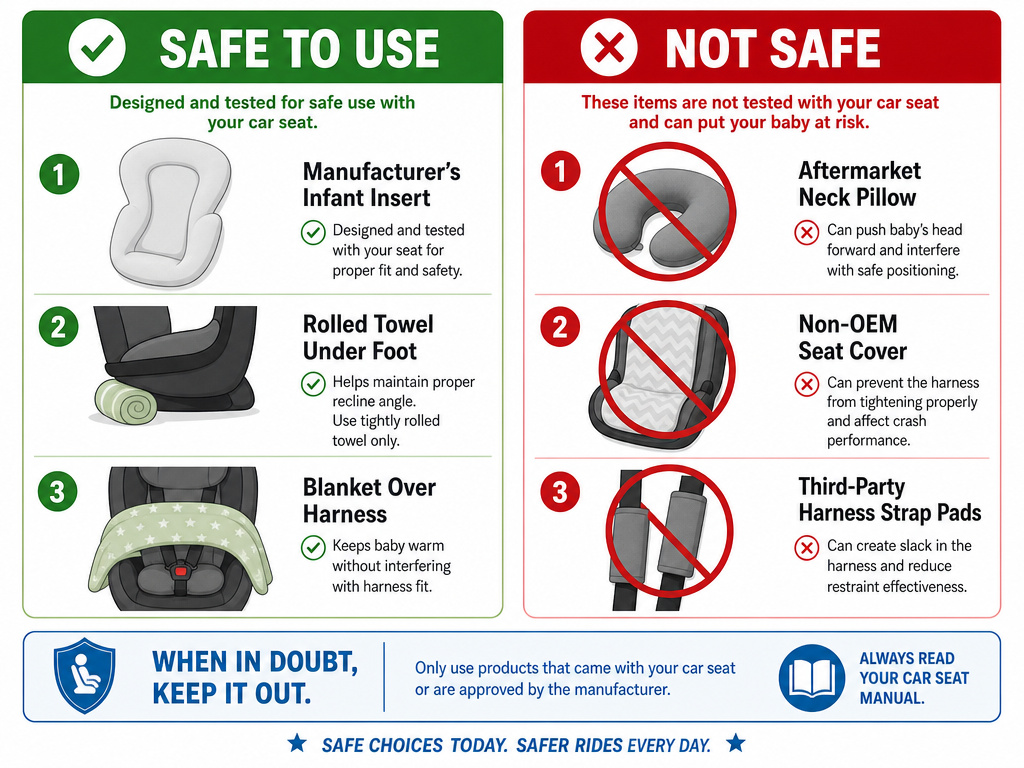 The market is full of gadgets promising better sleep. Almost all of them are dangerous. The rule from every car seat manual, including the Graco guide, is explicit: use only accessories provided by the manufacturer.
Safe to use:
- The infant insert that came in the box with your seat.
- A thin, rolled towel placed under the car seat’s foot to adjust angle (never under the child).
- A blanket placed over the child after they are buckled.
- Sun shades that suction-cup to the window glass, away from the child.
Not safe and not tested:
- Aftermarket head and neck support pillows that wrap around the neck or go behind the head. These can interfere with harness routing and are not evaluated in your seat’s crash tests.
- Seat covers that go between the child and the seat fabric, unless sold by your seat’s brand for your exact model.
- Harness covers, strap pads, or buckle positioners not made by the manufacturer. They can change how the harness performs in a crash.
- Any product that says it “positions” or “aligns” the baby’s body. Your car seat is already designed to do that.
The urge to add comfort is natural. Resist it. The car seat’s safety system is a carefully engineered unit. Adding an untested component turns it into an unknown.
How to Handle Crying Without Compromising Safety
 The sound of a crying baby in the backseat tests every nerve. The instinct is to reach back, adjust, soothe, or, worst case, unbuckle them “just for a minute.” Don’t. Pull over.
If the crying starts and doesn’t stop, your first move is to find a safe place to park. Then you can address the real cause, which is usually one of three things:
- Discomfort: Check for a twisted harness strap, a too-tight crotch buckle, a hot neck, or a sunbeam in their eyes.
- Overstimulation: The world is rushing by. Try a pacifier (if they use one), white noise from a portable machine, or simply pulling a light muslin blanket over the carrier to dim the view.
- Need for a Reset: They might just need out. Unbuckle, hold them upright, walk around for five minutes. This breaks the cycle and resets their posture.
Common mistake: Unbuckling a crying baby while the car is still moving, even at a slow roll. A sudden stop turns a 15-pound baby into a 150-pound projectile. It happens faster than you can brace.
Sometimes, the crying is a phase they need to pass through to get used to the car seat. Short, positive trips with no destination, just a drive around the block with a favorite song, can build tolerance. The goal isn’t to stop all crying instantly. It’s to ensure the crying doesn’t lead to an unsafe decision.
Frequently Asked Questions
Can I let my baby sleep in the car seat at home?
No. The car seat is not a substitute for a crib, bassinet, or play yard. The seated sleep position is not considered safe for unsupervised sleep. The risks of letting a newborn sleep in a car seat outside the vehicle are well-documented and include positional asphyxia. Once you’re home, move them to a firm, flat sleep surface.
How can I prevent my baby’s head from slumping forward?
Use the infant insert that came with your seat to provide lateral support. For older infants who have outgrown the insert but still lack head control, a rolled muslin cloth placed on either side of the head (outside the harness straps) can offer gentle support. Never place anything behind the head or neck that could push the head forward. For a dedicated solution, look into products to support a sleeping baby’s head that are approved by your car seat manufacturer.
Is it okay to use a car seat neck pillow?
Only if it is the specific neck pillow or head support sold by your car seat’s manufacturer for your exact model. General “travel pillows” or aftermarket supports that wrap around the neck are a strangulation hazard and can interfere with the harness system. They are not crash-tested with the seat.
Why does my baby wake up as soon as the car stops?
This is common and relates to the change in motion and vibration. The steady movement of the car is soothing and can help regulate breathing. When it stops, that sensory input vanishes, startling them awake. It doesn’t mean the sleep was unsafe; it means the condition for sleep has changed.
Can I recline the car seat more to help them sleep better?
You can only recline to the angle indicated by the seat’s level line or bubble. Going beyond that “too reclined” mark increases the risk of injury or ejection in a crash, as warned in the manual. The angle is set by crash physics, not sleep quality.
What if my baby only sleeps in the car seat?
This is a habit to gently break. Start by ensuring all naps at home happen in a proper crib or bassinet. Use white noise and blackout curtains to mimic the car’s environment. For travel, accept that car sleep is supplemental and governed by the 90-minute rule. Don’t transfer a sleeping baby from the car seat to the crib; the motion usually wakes them anyway. Wake them gently, then put them down in their safe sleep space.
The Bottom Line
A sleeping baby in a car seat is safe only under two conditions: the seat is installed at the correct angle with a tight harness, and the sleep session ends within 90 minutes of the car stopping. Every other tip, white noise, sun shades, pacifiers, is secondary to those mechanics. The real work happens before you back out of the driveway: stripping off the puffy coat, checking the level, and performing the pinch test. Get those right, and the sleep will follow. Get them wrong, and no amount of rocking the car will matter. Your job isn’t to make them sleep. It’s to make the seat safe for when they do.
