
The Essential Guide to Head Supports for Infant Car Seats
This post contains affiliate links. As an Amazon Associate, we earn from qualifying purchases.
You need a head support for your infant car seat if your specific model’s instruction manual requires it. For some seats, like the Doona, the head support is mandatory and must never be removed. For others, like the Graco SnugRide 30, it’s an optional accessory with strict rules about which harness slots you can use it with. The only correct answer is inside your seat’s manual, using or removing a head support against the manufacturer’s instructions creates a safety gap.
That manual-first rule isn’t bureaucratic. It’s a physical constraint. A car seat is a rigid shell engineered to manage crash forces in a specific way. Anything you add or remove, a head support, a body pillow, a rolled towel, changes how those forces travel to your child’s neck and spine. The manual tells you what the engineers tested and certified.
What follows is a breakdown of how different brands handle head support, the mechanics of why the rules exist, and the specific scenarios where you must take extra steps. By the end, you’ll know how to find your answer and why that answer is the only one that matters.
Key Takeaways
- Your car seat’s instruction manual is the final authority. Never use an aftermarket head support unless the manual explicitly permits it.
- For preterm or low-birth-weight infants (under 5 lbs or born before 37 weeks), the American Academy of Pediatrics mandates a hospital observation period before the first car trip, regardless of head support use.
- A head support’s primary job is to position the harness straps at or just below the shoulders and to keep the airway open, it is not a pillow for comfort.
- If your seat didn’t come with a head support, you can often use tightly rolled receiving blankets placed along the child’s sides for support, as shown in many manuals.
- The top of your child’s head must be at least 1 inch (2.5 cm) below the top of the car seat shell in a rear-facing seat. A too-high head support can violate this rule.
The Answer Is in Your Manual (It’s Not a Yes or No)
Open the booklet that came in the box. Search for “head support,” “body support,” or “infant insert.” The language is not a suggestion.
Manufacturers certify each seat model to Federal Motor Vehicle Safety Standard (FMVSS) 213 with the exact accessories they include and test. A Graco SnugRide 30 certified with its specific head support is a different tested system than a SnugRide 30 without it. Using a non-approved accessory voids that certification. It’s not a paperwork issue, it’s an un-tested physical system.
The part nobody mentions: Aftermarket head supports that strap around the shell or harness can compress in a crash, allowing dangerous head excursion. They can also interfere with the harness lying flat on the shoulders, concentrating crash forces on a smaller area.
Here’s how major brands specify head support use, drawn directly from their official manuals:
| Car Seat Model | Head Support Rule | Critical Restriction |
|---|---|---|
| Doona Car Seat | Must never be removed. The head support is required as long as the child uses the seat. | Shoulder straps must be through slots at/below shoulders. Head support straps wrap around harness straps. |
| Joie Sprint | Must be installed at all times while using the infant carrier. | Shoulder harness straps must be nearest to child’s shoulders to prevent ejection. |
| Graco SnugRide 30 | Optional. Some infants may need extra support. | Only use with the bottom two sets of harness slots. Harness must remain flat on shoulders. |
| Evenflo Triumph | Infant Head Support D is an optional accessory. | For rear-facing use only (5-40 lbs). Top of child’s head must be at least 1 inch below seat back top. |
| Joie Mint Latch | Can be used for a snug fit for small babies, removed when outgrown. | Head support straps cannot go through the same slots as harness straps. Only use in top two harness slot positions. |
The variation is the point. There is no universal “yes.” Your seat has its own rule.
The Physical Mechanics of a Safe Head Position
A head support isn’t a pillow. Its engineering purpose is to fill the space between the child’s head and the hard shell to prevent lateral head slump, which can compromise the airway. More critically, it positions the child so the harness straps enter the seat shell at the correct height: at or just below the shoulders for rear-facing seats.
If the straps are too high, they can ride up onto the neck. Too low, and they allow excessive forward movement in a crash. A proper head support cradles the head to keep it centered and the spine aligned, so crash forces are distributed across the back and shoulders, not focused on the neck.
The 1-inch rule is non-negotiable. You must have at least one inch of hard shell above the top of your child’s head. This ensures that in a violent frontal crash, the most common and severe type, the child’s head cannot strike the vehicle seat in front of them. A bulky, aftermarket head support can lift the child up, effectively reducing that clearance.
Where this goes sideways: Adding a fluffy head hugger for comfort. It can push the child’s chin to the chest (positional asphyxiation risk) and insulate the child from the seat’s side-impact protection, which is designed to compress in a controlled way.
When a Head Support Isn’t Enough: The Preterm & Low-Birth-Weight Protocol
For infants under 5.5 pounds, the question shifts from “which head support?” to “is a car seat safe right now?” The AAP guideline referenced in the Evenflo, Graco, and Joie manuals is specific: infants born before 37 weeks or weighing less than 5 pounds at birth need a hospital observation before their first trip.
This isn’t about head control. It’s about cardiopulmonary stability. The semi-reclined position of a car seat can cause a preterm infant’s oxygen saturation to drop and heart rate to slow, a condition called positional apnea. The AAP recommends a 90- to 120-minute observation in the actual car seat, monitored by hospital staff, before discharge.
If your child falls into this category, their first car seat is a medical decision. Your pediatrician may recommend a car bed for early trips. The head support safety conversation comes later, after they’ve passed the observation and are growing.
How to Install and Adjust Your Seat’s Head Support Correctly
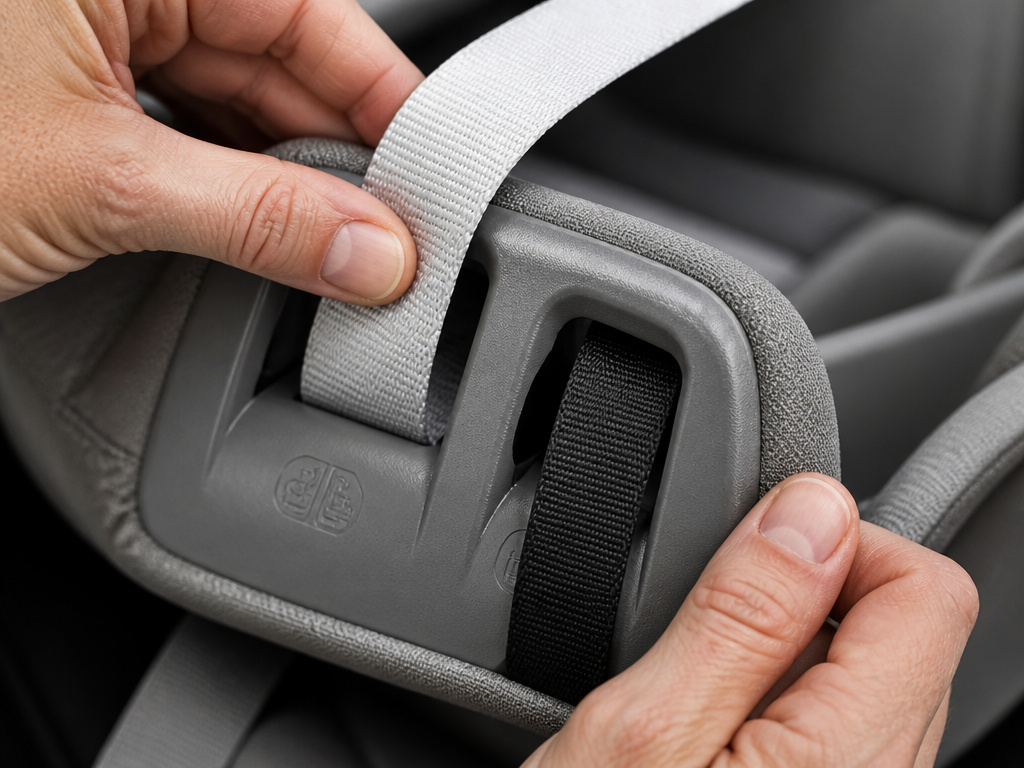
If your manual calls for a head support, installing it wrong defeats its purpose. The most common error is misrouting the harness.
For seats like the Joie Mint Latch, the head support has its own straps that thread through a harness slot at the same level, then attach with hook-and-loop fasteners behind the seat back. The harness straps then go through their own slots. They must never share a slot.
For the Doona, the head support straps wrap around the shoulder harness straps before snapping to the back of the head support. This ensures the head support moves with the child, not independently.
Step-by-Step Check After Installation:
- Harness Check: Pinch the harness strap at the child’s collarbone. You should not be able to pinch any excess webbing.
- Straightness Check: The harness straps must be straight from the shell to the shoulder. No twisting.
- Position Check: The chest clip is at armpit level. The head support is not pushing the chin down.
- Clearance Check: The top of the head is at least one inch below the shell. Measure it.
Skipping the pinch test is the most common mistake. A loose harness lets the child move too far forward in a crash, risking head injury against the interior of the vehicle. The head support can hide that looseness.
The Forbidden Zone: Aftermarket and Non-Approved Inserts
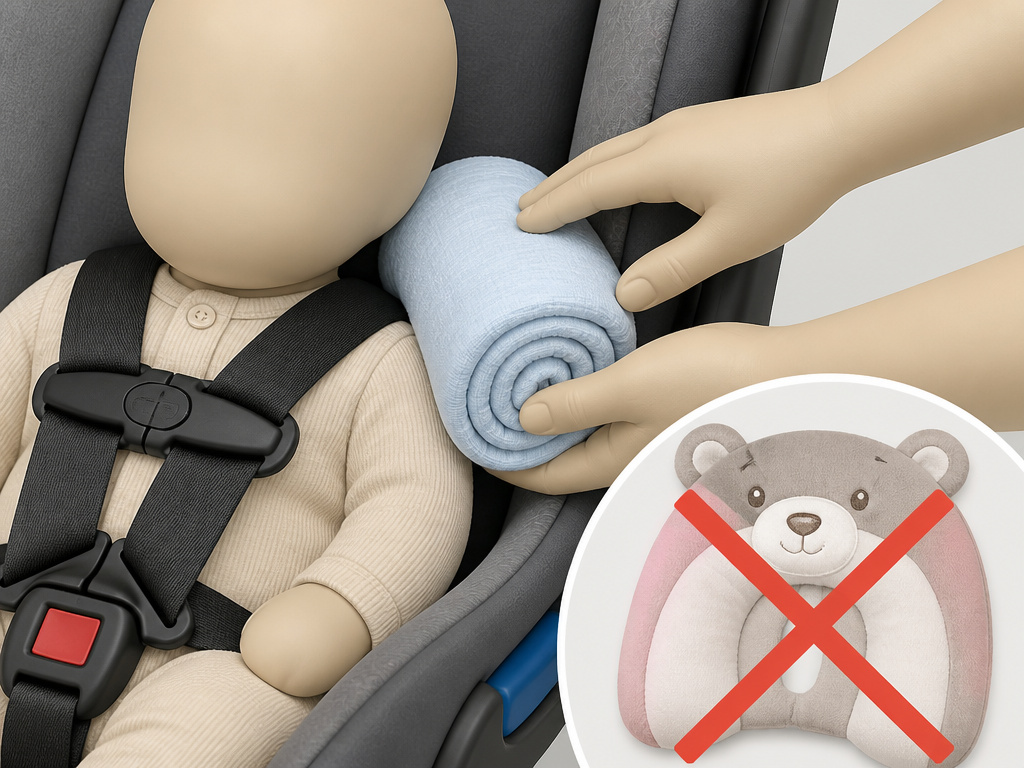
The market is full of cute, plushy head supports and body pillows. They are not certified child restraint components. Using one is like swapping your car’s airbag for a decorative pillow.
Common mistake: Using a memory foam or padded insert for a “more comfortable ride.” These materials compress unpredictably in a crash, creating space for the child to submarine (slide under) the harness or for the head to whip forward farther than the seat was designed to allow.
The Graco SnugRide 30 manual is explicit: if your model didn’t come with a body support, you may use tightly rolled receiving blankets placed along the child’s sides, between the child and the seat shell. This is the only manufacturer-approved alternative. It provides lateral support without adding dangerous, compressible material behind the back or head.
The risk of an infant insert that wasn’t crash-tested with your seat is real and documented. It can alter the harness geometry and the seat’s performance in a side-impact collision. For a vetted option, see our list of recommended infant car seat inserts.
Head Support vs. Infant Insert: Know the Difference
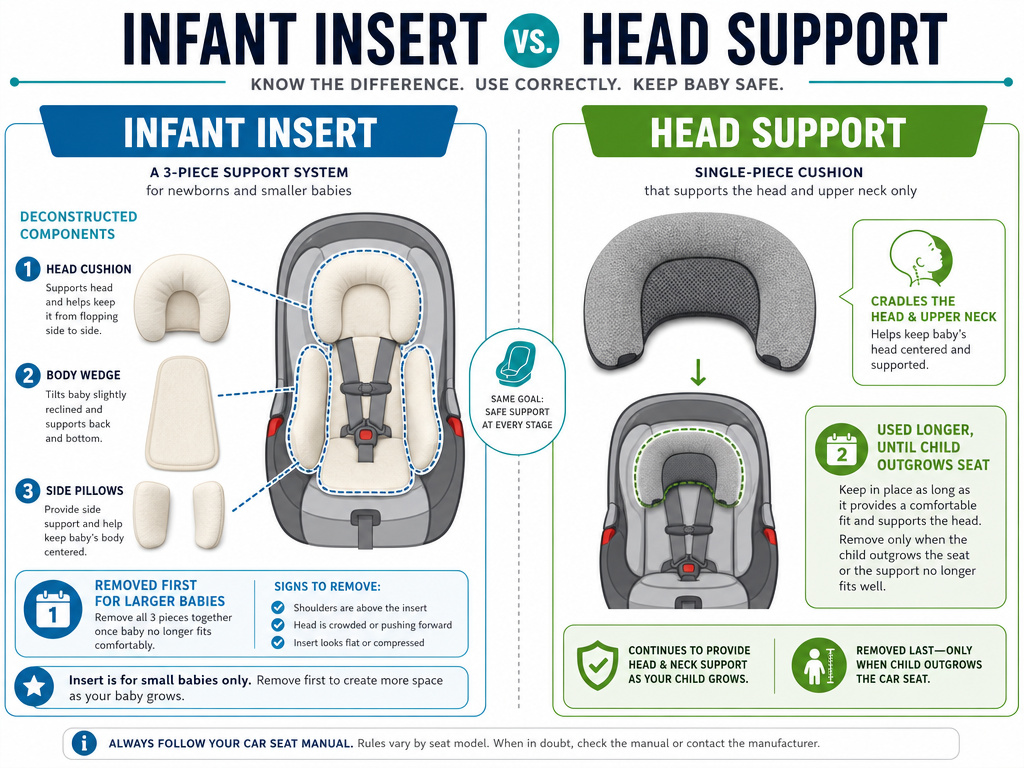
This confusion causes errors. They are different parts with different rules.
- Infant Insert: A thicker, often multi-piece pad set that provides overall body containment for very small newborns. It usually includes a head portion, a body wedge, and sometimes side pillows. Its job is to make the large seat cavity fit a tiny body so the harness can be properly tightened. Examples include the Doona Infant Insert and the Joie Mint Latch Low Birth Weight Pillow.
- Head Support: A single piece that cradles only the head and sometimes the upper back. It is used for a longer period, often until the child outgrows the seat. Examples are the Doona Head Support or the removable head pad on a Graco SnugRide.
The rule is typically: Remove the infant insert first, keep using the head support. The Doona manual states to keep using the Head Support even after removing the Infant Insert. You remove the infant insert when the child’s shoulders are above the lowest harness slots without it. The head support stays.
Knowing when to remove the head insert is a separate milestone, usually tied to height and shoulder position, not weight alone.
The Bottom Line
Stop looking for a general rule. Your answer is on page 25 of your Graco manual, or in section 8.2 of your Doona guide. Find it. Follow it.
If your seat requires a head support, use only the one that came with it and install it exactly as shown. If your seat offers it as an optional accessory, use it only with the specified harness slots and ensure the harness remains snug. If your seat didn’t come with one, use rolled blankets for side support, nothing more.
For the smallest infants, consult your pediatrician and follow the AAP’s observation guideline before worrying about head support. Safety starts with physiology, then mechanics. When in doubt, a certified Child Passenger Safety Technician can help you interpret your manual and check your installation. You can find one through the NHTSA child passenger safety recommendations website.
Frequently Asked Questions
My baby’s head flops to the side in the seat. Do I need a head support?
First, check if your seat’s manual includes a head support and if you’re using it. If you are and the flop persists, the issue might be harness tightness or the child’s size. For a very small newborn, you may need the full infant insert, not just the head piece. Never use an aftermarket product to solve this. Lateral head slump can be a sign your child is not yet ready for extended time in the seat.
Are head support pillows safe for newborns?
Aftermarket head support pillows that you purchase separately are not safe unless your specific car seat manufacturer explicitly approves that specific product. They are not crash-tested with your seat and can interfere with the harness system. The only safe supports are those that came with your seat or the rolled blanket technique described in your manual.
How do I know when to remove the head support?
Consult your manual. For some seats, like the Doona, you never remove it. For others, you remove it when the child outgrows the need for it, often when their head is well-supported by the seat’s own structure or when the harness slots need to be moved above the head support’s allowable position. A common cue is when the child’s ears reach the top of the head support.
Can I use a head hugger with my car seat?
Head hugger” is typically an aftermarket accessory. Using it without manufacturer approval is not safe. If your seat lacks sufficient head containment, look for a newborn head hugger that is specifically recommended by your seat’s brand or a certified technician. The safest path is to use the components designed for your model.
Where can I get my car seat checked for proper head support use?
You can find a free car seat inspection station near you via the NHTSA website. Certified technicians will check your installation, harness fit, and accessory use against your manual. They can show you the correct way to achieve a safe, snug fit that prevents head slumping forward.
