
Is Using a Head Support in Your Car Seat Actually Safe?
This post contains affiliate links. As an Amazon Associate, we earn from qualifying purchases.
Yes, using a head support in a car seat is safe, but only under one non-negotiable condition: it must be the specific head support or insert that came with your seat, used exactly as the manufacturer’s manual instructs. Adding any aftermarket head pillow, neck support, or insert voids the seat’s safety certification and can cause the harness to fit incorrectly, which risks ejection in a crash.
That single rule from the manual is the whole game. Every major car seat maker. Graco, Nuna, Doona, Joie, states it explicitly. They don’t hedge. They say “always use” their included head support and “never use” anything else. This isn’t about comfort; it’s about keeping the harness straps at the right height on your child’s shoulders, which is the primary mechanism that prevents spinal and head injury during a collision.
What follows is the breakdown of why that rule exists, how to follow it for your specific seat, and the exact consequences of getting it wrong.
Key Takeaways
- The head support that comes with your car seat is a safety component, not just padding. Using it correctly is as important as buckling the harness.
- Never add any aftermarket head or body insert, not a rolled towel, not a neck pillow, not a “universal” head hugger. These alter the harness geometry and void the seat’s safety certification.
- Harness height is everything. For rear-facing seats, the straps must be at or just below the child’s shoulders. For forward-facing, at or just above. An incorrect head support pushes the straps out of this zone.
- Read your specific manual. Terms like “head support,” “infant insert,” and “head hugger” mean different things across brands. The Doona’s head support is mandatory; the Graco Nautilus 65‘s head support clicks into the seat back.
- Remove the infant-specific body insert when your baby outgrows it, but often keep using the head support. The Doona manual explicitly says to keep the head support even after removing the infant insert.
The OEM Mandate: Why Aftermarket Inserts Are a Hard No
Car seats are certified as a complete system. Every piece of foam, fabric, and plastic you see is part of a crash-tested unit. When you buy a Graco Nautilus 65, the certification covers the seat shell, the harness, and the specific head support that clicks into the back. Swapping that out for a plush, aftermarket neck pillow changes how the child’s body interacts with the harness during a 30-millisecond crash pulse.
The Nuna REVV manual puts it in blunt, all-caps language that leaves no room for interpretation: “DO NOT modify your child restraint or use any accessories or parts supplied by other manufacturers unless they are approved by Nuna for use with this child restraint. Doing so may be unsafe and may void the warranty.”
Common mistake: Adding a cute aftermarket head hugger. The extra bulk behind the child’s head pushes the shoulder straps forward, creating slack. In a crash, that slack lets the child’s torso travel farther before the harness catches, increasing the risk of injury.
Why is this so absolute? The foam density, thickness, and contour of the OEM head support are engineered to work with the seat’s specific recline angle and harness routing points. An aftermarket pillow is just padding. It doesn’t account for where the harness straps thread through the seat shell, which is the variable that decides safe versus dangerous.
| Component | OEM (Original Equipment) | Aftermarket Add-On |
|---|---|---|
| Safety Certification | Part of the FMVSS 213 or UN R129 tested system | Not tested with your specific seat; voids certification |
| Harness Fit | Designed to position straps at correct shoulder height | Can push straps up or down, creating dangerous slack |
| Warranty | Maintains full manufacturer warranty | Explicitly voids warranty (per Nuna, Graco, etc.) |
| Crash Performance | Engineered foam compresses predictably | Unknown density may bottom out or rebound unpredictably |
How to Use a Factory Head Support Correctly
If the head support came in the box with your seat, you must use it. The trick is using it right. The term “head support” is a catch-all; manuals use it to describe different parts.
For infant carriers like the Doona Car Seat, the head support is a removable padded unit with its own straps. The manual is emphatic: “NEVER remove the Head Support as long as you carry your child in the Doona Car Seat.” and “NEVER place your child in the Doona Car Seat without the Head Support.” It even specifies to “Keep using the Head Support in the Doona Car Seat even after removing the Infant Insert.” For the Doona, the head support’s job is to fill the space behind a newborn’s head and neck, ensuring the harness slots align at or just below the shoulders.
For convertible and all-in-one seats like the Graco Nautilus 65, the head support is often a padded piece that attaches to the seat back. The manual states: “Always use child restraint with head support installed and properly adjusted.” You typically squeeze a button on the sides and push it into slots on the seat back until it clicks. The adjustment is key, it must be moved up as your child grows to keep the harness slots in the correct position relative to their shoulders.
The Joie Sprint manual refers to its “head support” in the context of the infant carrier, noting it “must be installed at all time while using the infant carrier.” For i-Size installations under UN Regulation No. 129, the child must be between 40cm and 75cm tall.
Harness Slot Alignment: The Make-or-Break Detail
This is the single most important check you will do every time you adjust the head support. The harness straps must pass through the seat shell’s slots at the correct height relative to your child’s shoulders.
- Rear-facing: The straps should be at or just below the child’s shoulders.
- Forward-facing: The straps should be at or just above the child’s shoulders.
An incorrectly positioned head support lifts the child too high or sinks them too low, moving the harness slots out of this safe zone. If the slots are too high when rear-facing, the child can submarine downward in a crash. If they’re too low when forward-facing, the harness won’t properly restrain the torso, allowing excessive forward head movement.
Where this goes sideways: Threading the harness straps over the top of the head support instead of through the designated slots in the seat shell. This creates a false, higher harness point that feels tight but offers zero structural integrity in a collision.
When Is a Head Support Actually an Infant Insert?
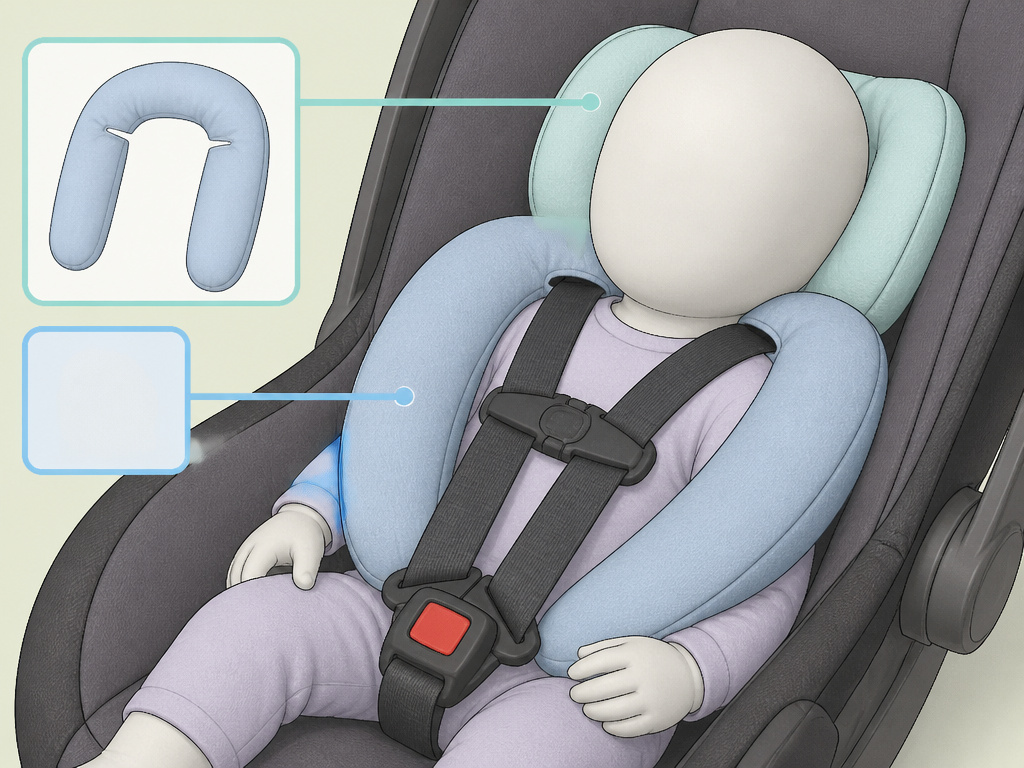
Manufacturers use these terms interchangeably, but there’s a functional difference parents need to spot. An infant insert typically refers to a larger, U-shaped body insert that provides side and lower-back support for very small babies. A head support or head hugger is usually a smaller, more localized piece for neck and head positioning.
The rule is simple: use what the manual says, and remove it when the manual says to. The Doona guide says to remove the infant insert “when your child’s shoulders no longer fit comfortably.” The Joie Sprint recommends its infant insert for babies under 60cm. These inserts are for fit, not just comfort. Once your child’s body fills the seat shell without it, the insert becomes a compression hazard.
The best car seat sleep support for babies is the one designed for your seat, because it maintains that critical harness geometry. Aftermarket sleep positioners are a known suffocation risk and should never be used in a car seat.
The 3-Step Check for Safe Head Support Use
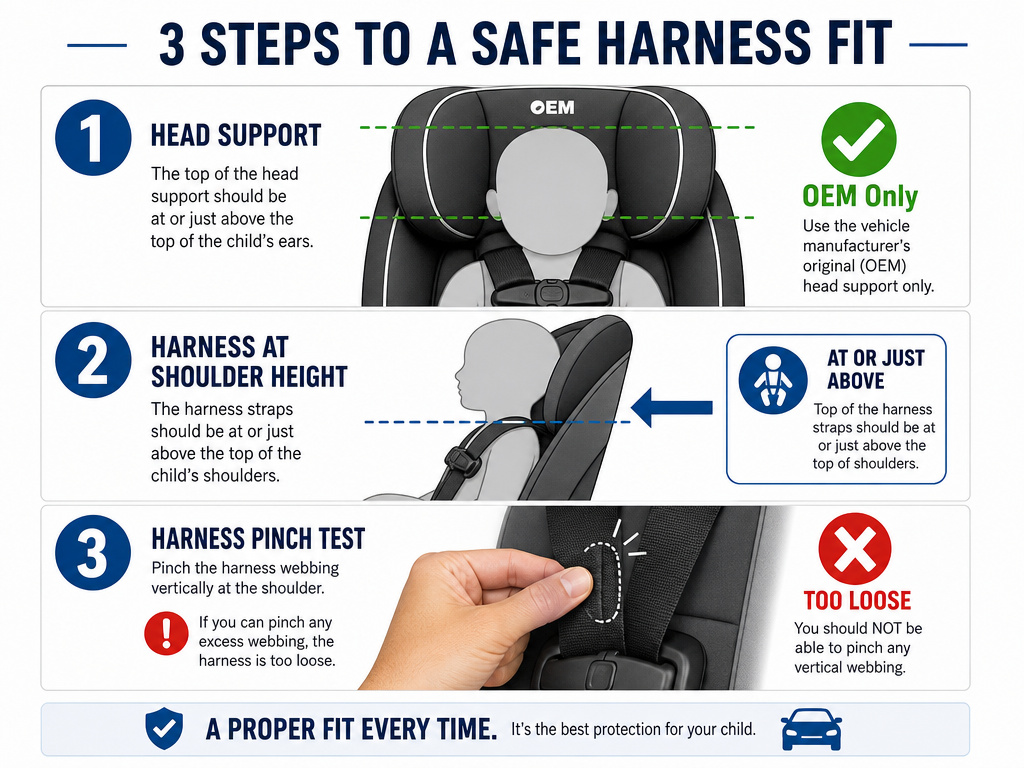
Follow this sequence every time you place your child in the seat, especially after adjusting the head support height.
- Confirm OEM-Only. Verify the head support or insert is the one that came in the original box. If you bought the seat second-hand and it’s missing, contact the manufacturer to purchase a replacement specific to your model. Do not improvise.
- Check Harness Slot Height. With your child sitting in the seat, press down on their shoulders to simulate a snug harness. The harness straps should exit the seat shell at or within one finger’s width of their shoulders (below for rear-facing, above for forward-facing).
- Perform the Pinch Test. After buckling and tightening the harness, try to pinch the strap vertically at the child’s collarbone. If you can pinch a fold of webbing, it’s too loose. A proper head insert removal happens when the child outgrows the insert, not before, and never compromises this test.
Skipping the pinch test is how a seemingly snug harness hides dangerous slack. That slack is where injury happens.
Which Car Seats Require Their Head Support?

Most do. It’s safer to assume yours does unless the manual explicitly says it’s optional. Here’s how major brands phrase it:
- Graco (Nautilus 65): “Always use child restraint with head support installed and properly adjusted.”
- Doona: “NEVER remove the Head Support as long as you carry your child in the Doona Car Seat.”
- Joie (Sprint): “Head support must be installed at all time while using the infant carrier.”
- Nuna (REVV): While not mandating a specific head support, its manual warns against any non-approved modifications, which includes adding unsupported head pillows.
The federal NHTSA car seat safety guidelines don’t legislate head supports, but they emphasize following the manufacturer’s instructions to the letter for proper installation. Using an unapproved accessory violates that core principle.
What About “Head Huggers” and Neck Pillows Sold Online?
They are unsafe and untested with your seat. They void your warranty and the seat’s certification.A car seat neck pillow sold separately might seem like a solution for a sleeping baby’s head slump, but it introduces the exact harness interference problem the manuals warn against.
If your child’s head is falling forward, the issue is the seat’s recline angle. For rear-facing seats, you must follow the manual’s instructions to achieve the correct recline, often using a built-in level indicator or a pool noodle/towel under the seat base (if the manual permits).Addressing the angle is the safe fix; adding a pillow is a dangerous workaround.
For a deep dive on solving the slump safely, our guide on how to prevent a baby’s head from falling in a car seat walks through recline adjustments and position checks.
Frequently Asked Questions
Can I use a rolled-up towel for head support?
No. Never place any padding behind or around your child that did not come with the seat. A towel can compress unpredictably in a crash, creating slack in the harness system. It also poses a suffocation risk for infants. The only safe way to keep a newborn’s head up is by ensuring the seat is reclined to the manufacturer’s specified angle.
My car seat didn’t come with a head support. Should I buy one?
Only if it’s sold by the manufacturer of your specific car seat model as an official accessory. Check their website or call customer service. Do not buy a “universal” head support. If the manufacturer doesn’t offer one, your seat was designed to be used without it.
When should I remove the infant insert?
Follow your manual. Generally, remove the full-body infant insert when your baby’s shoulders no longer fit comfortably within it or they reach the maximum height/weight limit stated for the insert. Often, the head support remains in use longer. The Doona manual is clear: keep using the head support even after removing the infant insert.
Are head supports safe for preemies?
For premature infants, medical guidance supersedes the car seat manual. Hospitals often use approved, medically indicated positioning devices. Always follow the discharge instructions from the NICU or your pediatrician, and have your car seat installation checked by a Child Passenger Safety Technician (CPST) before the first ride home.
Do booster seats need head supports?
High-back boosters have built-in head rests. Backless boosters do not. Never add any aftermarket support to a booster seat, as it can alter the seat belt’s path across the child’s body. The belt should lie flat across the shoulder and chest, not be pushed forward by a pillow.
The Bottom Line
Safety isn’t about adding more stuff to the seat; it’s about using exactly what the engineers tested. That head support in your box is a required part of the crash-tested system. Adding anything else, a head hugger, a neck pillow, a rolled blanket, introduces a variable the safety certification doesn’t cover.
Your manual has the answer. It always does. The Mayo Clinic car seat safety guide lists using unapproved accessories as a common mistake because it seems harmless. It’s not. Install the support that came with your seat, adjust it to keep the harness slots level with your child’s shoulders, and leave everything else in the store.
