
Baby Crying in Car Seat: When It’s Okay and When to Stop
This post contains affiliate links. As an Amazon Associate, we earn from qualifying purchases.
Yes, it is okay to let your baby cry in a car seat for short periods while you are driving, but you must stop and address their needs if they are in distress or if the trip exceeds two hours. The real question is not about the crying itself, but about the specific, physical risk of positional asphyxia. Infant healthcare professionals and safety experts recommend babies not be in a car seat for longer than two hours at a time without a break, regardless of whether they are crying or sleeping.
That two-hour limit is not a parenting guideline. It’s a physical safety threshold. A 2016 University of Bristol study found pre-term and young babies may be at risk of breathing difficulties if travelling upright in car seats for extended periods. Their neck muscles are not yet strong enough to keep their airway open if their head slumps forward. A crying baby is telling you something is wrong, but a silent, sleeping baby in the same slumped position is actually in more danger. You cannot see breathing.
What follows: the difference between protest crying and distress, the exact signs that mean you must pull over, how to check five fit-and-comfort factors most parents miss, and the one car seat adjustment that stops crying for good in older infants.
Key Takeaways
- Letting a baby cry briefly in a car seat is safe if you are driving and cannot safely stop, but prolonged crying often points to a fixable problem with the seat’s fit or the child’s comfort.
- Never leave a baby in a car seat for longer than two hours without taking them out. This is a hard safety limit due to the risk of positional asphyxia, not just a comfort suggestion.
- The most common fix for car seat crying is moving the harness straps up. For rear-facing seats, straps must be at or below the shoulders; an inch too high can make a toddler fight the restraint.
- Overheating is a silent trigger. Feel the back of the neck, not hands or feet. If skin is clammy, remove a layer before you try anything else.
- Some babies genuinely hate the car. If all physical checks pass, your job shifts to distraction and co-regulation until they outgrow the phase, which most do by 6-7 months.
The 2-Hour Limit & Positional Asphyxia Risk
The car seat is for transport, not sleep. While it’s fine for your baby to doze off during a drive, the official advice from infant health professionals is clear: babies should not be in a car seat for longer than 2 hours at a time. You must take them out frequently.
This concerns oxygen, not spoiled routines or bad habits. A young baby’s head is heavy, and their neck muscles are weak.In a semi-reclined car seat, it’s possible for the head to tip forward, chin-to-chest. This position can kink the trachea and restrict airflow, a condition called positional asphyxia. The baby may not cry or struggle; they may just quietly stop breathing.
The University of Bristol 2016 study on infant car seat travel concluded that pre-term and young babies may be at risk of breathing difficulties if travelling in an upright position in car seats for a long period of time.
The two-hour rule is your guardrail. On any trip longer than that, plan to stop. Get the baby out, let them stretch on a flat surface, reposition them, and check for the head-slip. If your baby slumps forward at any point, you stop immediately. No debate.
This is also why a car seat should never be used as a primary sleep space at home. The firm, flat surface of a crib or bassinet is designed to keep the airway open. A car seat is not.
Is Crying in the Car the Same as “Cry It Out”?
No. Crying in the car is not sleep training. “Cry it out” (CIO) is a deliberate sleep-training method where a child is left alone to self-soothe. In the car, you are present. You are responding. You are just limited in how you can respond while operating a vehicle.
Your baby’s cry is communication. They are saying, “I don’t like this, help me.” Your nervous system is wired to react, that stress you feel is biological. The key difference is that in the car, you provide coregulation. Your voice, your smell, your familiar music are all forms of connection. You are not abandoning them; you are containing the experience until you can physically intervene.
Where this goes sideways: Assuming all crying is equal. Protest crying (“I’m bored”) is very different from distress crying (“I can’t breathe”). One you can manage with your voice; the other demands you pull over at the next safe spot.
The goal is to ensure a baby’s safety and offer comfort within the constraints of the drive, not to eliminate all tears. If you’ve checked the major physical causes and the crying continues, you are not failing.You are enduring a phase that most children outgrow between 6 and 7 months as their communication skills develop.
Check The Harness First
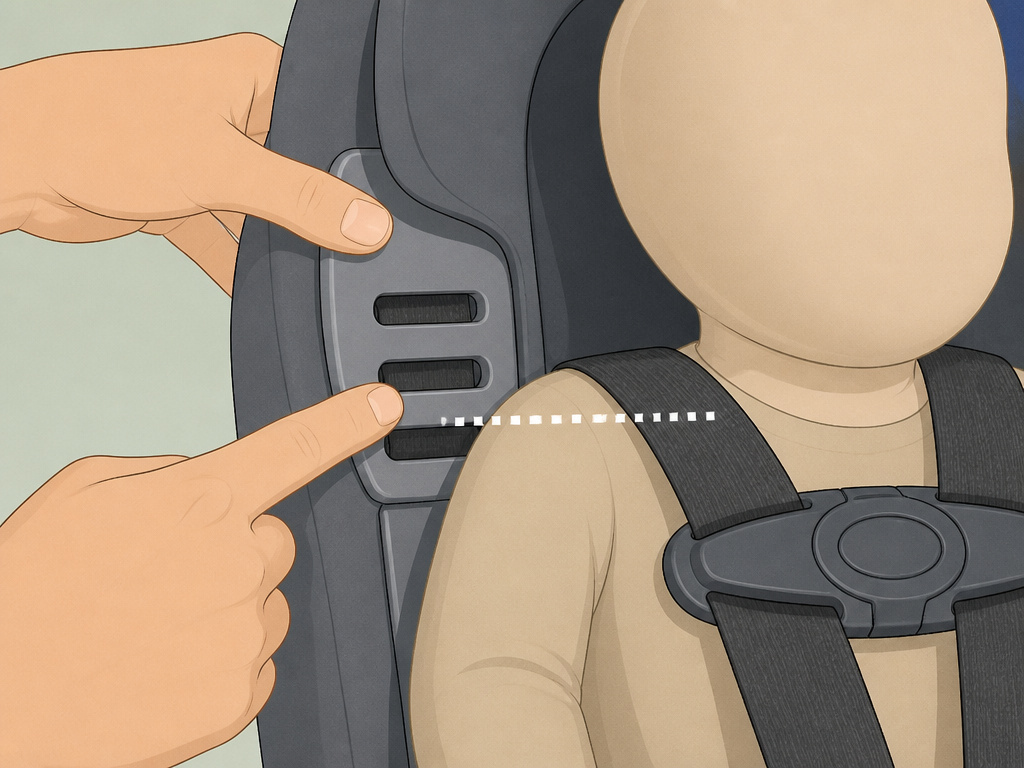
Nine times out of ten, a baby who suddenly starts fighting the car seat has outgrown the harness height. It’s the first thing you should verify.
For a rear-facing seat, the harness straps must be at or below the child’s shoulders. For forward-facing, they must be at or above. This demonstrates the NHTSA car seat safety guidelines in action, rather than being a comfort tip.The harness is designed to hold the child’s body back against the seat shell in a crash. If the straps are above the shoulders when rear-facing, the child can be thrown upward and forward, increasing the risk of spinal injury.
| Harness Position | Rear-Facing Rule | Forward-Facing Rule | Consequence If Wrong |
|---|---|---|---|
| Shoulder Height | At or below shoulders | At or above shoulders | In a crash, improper placement can cause excessive body movement, leading to injury. |
| Tightness | Snug enough that you cannot pinch a horizontal fold in the strap at the collarbone. | Same as rear-facing. | Loose straps offer no crash protection; overly tight straps are uncomfortable and restrict breathing. |
| Chest Clip | Level with the armpits. | Level with the armpits. | Too low fails to position the straps correctly; too high poses a neck injury risk. |
The fix is simple but often overlooked: move the headrest up or re-thread the straps through the next higher slot. On a seat like the Graco SlimFit3 LX, you press a button on the back of the headrest to adjust it without rethreading. An older baby who feels constrained will arch their back and cry. Move the straps up one notch, and the crying often stops on the next trip.
The 5-Point Comfort & Safety Scan
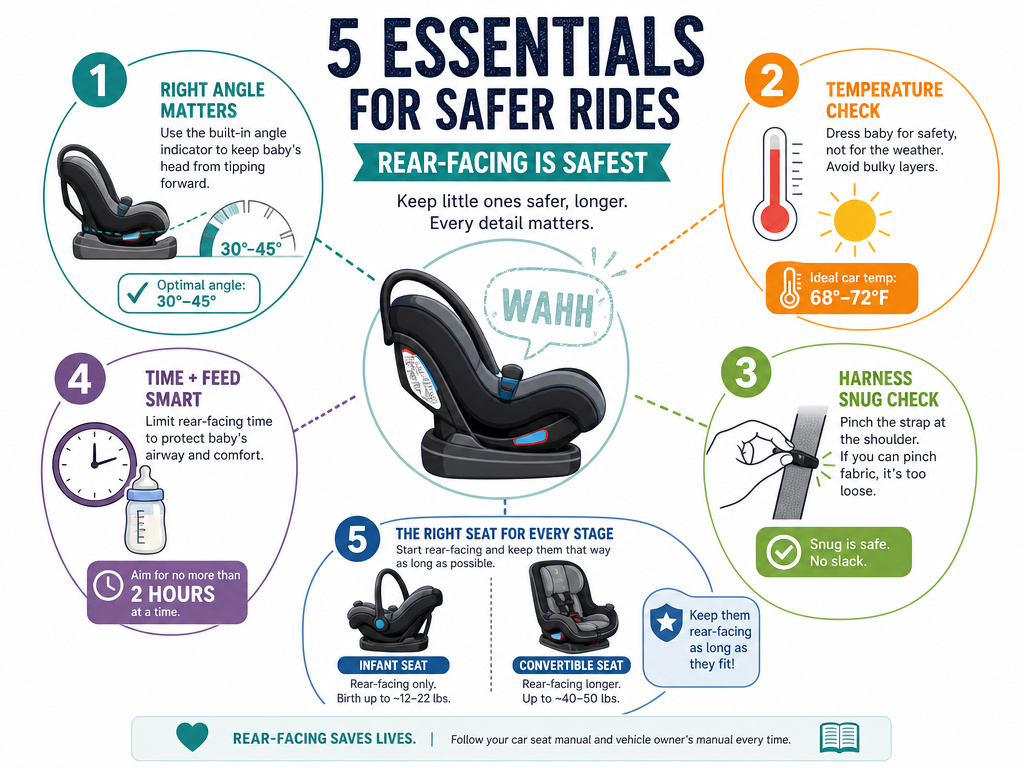
Before you decide the crying is just an unavoidable phase, run through this checklist. Each item addresses a common, fixable trigger.
- Recline Angle. A newborn needs a deep recline to keep their airway open. An older baby or toddler with good head control might find that same angle uncomfortable. If your child is fighting the seat, check if your model allows a more upright installation when rear-facing. The Graco Turn2Me, for example, has an indicator that shows the acceptable range. A more upright position can be the difference between a content baby and a screaming one.
- Temperature. Feel the back of their neck or their chest. Hands and feet are poor indicators. If their skin is clammy or sweaty, they are too hot. Overheating is a direct SIDS risk factor and a major cause of agitation. Remove a hat or a snowsuit layer before you buckle them in. For summer, a car seat fan or a breathable liner can make a drastic difference.
- Harness Tightness. Use the pinch test. Try to pinch the harness strap horizontally at the child’s collarbone. If you can get a fold of webbing between your fingers, it’s too loose. A loose harness is unsafe and allows the child to slump into an awkward position, which can cause discomfort and crying.
- Timing. Just like adults, a car ride right after a big feed can lead to discomfort and indigestion. If your child is prone to spitting up or seems gassy after car trips, try leaving a 20-30 minute buffer between feeding and driving.
- Transition Readiness. Is your infant still in a rear-facing-only bucket seat? Some older babies simply hate the deep, capsule-like recline. Transitioning to a convertible car seat can help. Convertible seats often install more upright for older babies, giving them a better view and a less confined feeling. The crying might be their way of saying they’re ready for the next stage.
When Crying Signals “Pull Over Now”
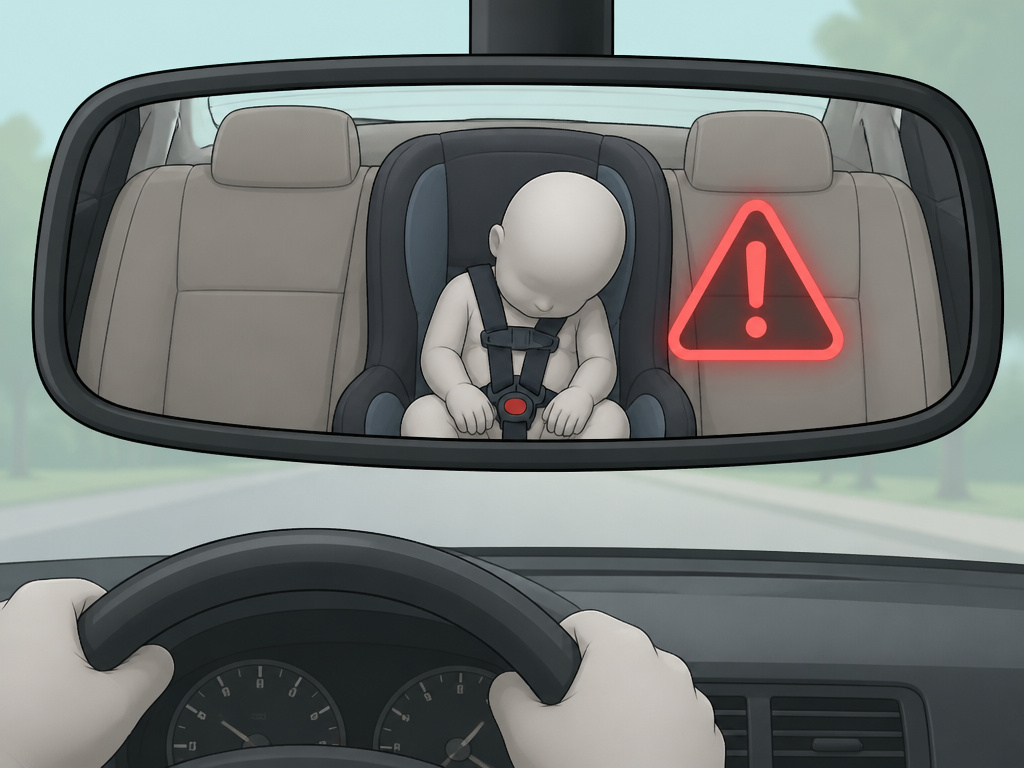
Not all crying is created equal. You need to know the difference between protest crying and distress crying. Your ears are your best tool.
- Distress Cries are sharp, panicked, and escalating. They often sound painful or desperate. The baby may be gasping or coughing.
- Physical Signs of Distress: Look in the mirror. Is their face turning a dusky red or pale? Are they arching their back severely? Are they vomiting?
- The Slump: This is the silent emergency. If you glance back and see your baby’s head has fallen forward with their chin on their chest, you stop at the next safe opportunity and reposition them.
Your primary duty is to drive safely. If you cannot safely pull over immediately for a distress cry, speak to your baby in a calm, reassuring voice until you can. But for a suspected slump or a cry that signals genuine physical distress, finding a safe spot to stop is non-negotiable.
Common mistake: Dismissing intense, new crying as “just a phase” without a physical check. A cry that is different in tone or intensity is your child’s only way to signal that something is physically wrong.
Soothing Strategies That Actually Work While Driving
When the physical checks are clear and the crying is protest, your job is management. You can’t hold them, but you can connect.
- Your Voice is Your First Tool. Talk to them. Sing a familiar song. Narrate what you see. The sound of your voice is a powerful regulator.
- White Noise or Calm Music. Skip the upbeat kids’ music. A white noise app or a playlist of low, rhythmic music (like classical or ambient) can be surprisingly effective. It masks the jarring sounds of the road.
- A Designated Car Toy. Keep a special, soft toy or “lovie” that only comes out in the car. The novelty can be a distraction.
- A Co-Pilot. If possible, have another adult ride in the back next to the baby. A hand on the chest, a pacifier offered, a gentle shush, this physical presence is the most effective soothing technique for many infants.
- Timing with Sleep. If you can, plan drives around nap times. A sleeping baby is a quiet baby. The motion of the car often lulls them to sleep.
Remember, the goal is to calm your baby enough for the journey to continue safely, not to achieve perfect silence. Some rides will just be loud, and that’s okay.
What If Nothing Works?
You’ve checked the harness. You’ve adjusted the recline. You’ve ruled out temperature. You’ve tried music, toys, and your most soothing voice. The crying continues. Now what?
First, you accept that some babies are car-haters. It’s a real temperament trait. The confinement, the vibration, the lack of control, it overwhelms their sensory system. This doesn’t mean you’ve failed or that the seat is wrong. It means you’re in a hard season.
Second, you trust that this phase is almost always temporary. As the NIH parenting the crying infant study notes, crying is a developmental phase that peaks and resolves. For car-specific crying, many parents report a significant shift around 6-7 months, when babies become more interactive and visually engaged with the world outside the window.
Until then, your toolkit is patience and preparation. Keep drives as short as absolutely necessary. When a long trip is unavoidable, plan for extra stops. Have a plan to keep baby cool or warm to eliminate one major variable. And sometimes, the only way out is through. You take a deep breath, you speak calmly, and you drive on, knowing you are keeping them safe even when they are furious about it.
Frequently Asked Questions
How long is it safe to let a baby cry in a car seat?
The safety limit is not about the crying, but about the total time in the seat. Do not leave a baby in a car seat for longer than two hours without a break, whether they are crying or sleeping. For a crying baby, if you cannot soothe them while driving and the crying is intense, you should pull over at the next safe opportunity to check on them.
Can crying in a car seat cause harm?
The act of crying itself is not harmful. The risk comes from the physical environment of the car seat if the baby is in it for too long or if they slump into a chin-to-chest position. Always ensure the harness is correctly positioned and tight, and adhere to the two-hour maximum travel time.
What’s the difference between a cry of protest and a cry of distress?
Protest cry is often rhythmic, lower-pitched, and may come and go. A distress cry is sharp, high-pitched, panicked, and escalating. It may sound pained or be accompanied by gasping, coughing, or dramatic color changes in the face. A distress cry warrants pulling over as soon as it is safe to do so.
My baby only cries when the car is moving. Why?
This is often related to vestibular input, the sensation of motion, or an inability to see a familiar face. Some babies find the movement unsettling, while others get frustrated because they can’t see you. A mirror that lets them see your reflection, or having a passenger in the back, can sometimes help.
Will getting a new car seat stop the crying?
Maybe, but not always. If your infant has outgrown the recline angle of a rear-facing-only seat, moving to a convertible seat installed more upright can help. If the issue is temperature, a seat with better breathability or added accessories might help. However, if the crying is temperamental, a new seat likely won’t solve it. Always rule out fit and comfort issues first.
Before You Go
Letting your baby cry briefly in a car seat is a reality of parenting, but it’s not a free pass to ignore their needs. Your two non-negotiable rules are the two-hour travel limit and the immediate correction of any chin-to-chest slump. Everything else, the harness height, the temperature, the recline angle, is a solvable problem. Check those first. When all else fails, your calm presence is the safety net. This phase will pass. In the meantime, drive safe, pull over when you need to, and know that a crying baby in a correctly used car seat is still a safe baby.
