
Can I Bring a Car Seat on a Plane? Identifying FAA Labels
This post contains affiliate links. As an Amazon Associate, we earn from qualifying purchases.
You can carry a car seat on a plane if it has a label stating “THIS RESTRAINT IS CERTIFIED FOR USE IN MOTOR VEHICLES AND AIRCRAFT.” That label, required by the Federal Aviation Administration (FAA), is the single most important piece of documentation you need. Without it, the airline can deny boarding for the seat. The second label, “This child restraint system conforms to all applicable Federal motor vehicle safety standards,” is not enough by itself.
The FAA passenger seat rule is explicit: every passenger over age two must have an approved seat and safety belt during takeoff, landing, and taxi. For a child, that approved seat can be a car seat, but only if it bears the right certification. The red-letter aircraft certification is non-negotiable. A seat that only meets Federal Motor Vehicle Safety Standard (FMVSS) 213 is not automatically cleared for flight.
What follows: the two specific labels you must find, the one type of seat that is never allowed, and the installation trick that stops a car seat from sliding forward on an aircraft seat.
Key Takeaways
- Look for the red-letter label that says “THIS RESTRAINT IS CERTIFIED FOR USE IN MOTOR VEHICLES AND AIRCRAFT.” A label that only says “FMVSS 213” or “conforms to all applicable Federal motor vehicle safety standards” is not sufficient.
- Booster seats, even combination seats used in booster mode, are prohibited on aircraft. They require a lap-and-shoulder belt, and airplane seats only have lap belts.
- Always install a car seat in a window seat. Aisle seats block evacuation routes, and flight attendants will ask you to move.
- You cannot use a car seat’s lower anchor connectors (LATCH) or tether straps on a plane. The installation must be done solely with the aircraft lap belt threaded through the seat’s belt path.
- If you buy a ticket for your child, the airline must accommodate your FAA-approved car seat. If it doesn’t fit in your assigned seat, they are obligated to find you another seat in the same class of service.
The Two Labels That Matter Most (FAA vs. FMVSS 213)
Not all car seat labels are created equal. The difference isn’t academic; it’s the line between walking onto the plane and gate-checking your seat.
Common mistake: Assuming any car seat sold in the US is automatically approved for airplanes. The FMVSS 213 certification is for crash testing in cars, not for aircraft seat geometry or turbulence loads.
The FAA’s regulation, 14 CFR § 121.311, spells out exactly what labels a child restraint system must bear to be used on an aircraft. Seats manufactured to U.S. Standards on or after February 26, 1985, must have two labels. One states the seat conforms to all applicable Federal motor vehicle safety standards. The other, in red lettering, must read “THIS RESTRAINT IS CERTIFIED FOR USE IN MOTOR VEHICLES AND AIRCRAFT.”
That red label is your boarding pass for the car seat. If it’s missing, faded, or torn off, you need the car seat’s manual or a letter from the manufacturer confirming the seat’s approval for aircraft use. Keep a digital copy of the manual on your phone.
| Label Text | Approved for Aircraft? | Why It Matters |
|---|---|---|
| “THIS RESTRAINT IS CERTIFIED FOR USE IN MOTOR VEHICLES AND AIRCRAFT” (in red) | Yes | This is the FAA’s explicit approval for use during all phases of flight. |
| “This child restraint system conforms to all applicable Federal motor vehicle safety standards” (FMVSS 213) | No | This only certifies the seat for use in motor vehicles. It is not sufficient for airline use. |
| Foreign government approval label (e.g., ECE R44-04) | Maybe | Accepted on US carriers for international flights, but not all foreign airlines. Always check with the specific carrier. |
| No visible label, manual missing | No | The airline has no proof of certification and will almost certainly deny its use on board. |
Foreign-made seats add another layer. For flights on US carriers, a seat bearing a foreign government’s approval for use in aircraft is acceptable. However, foreign airlines set their own rules. Some ban car seats outright, some only allow forward-facing seats for toddlers, and others follow the FAA standard. The burden is on you to check your carrier’s policy before you fly.
Which Car Seats Are Allowed (and Which Are Absolutely Not)
The type of seat matters as much as the label. Aircraft seats have fixed, forward-facing backs and only lap belts. That geometry and restraint system disqualifies certain car seat configurations immediately.
Infant car seats (like the Cybex CLOUD T) and convertible car seats (like the Nuna EXEC or Evenflo Litemax NXT Sensory Soothe) are allowed, but only when used with their internal five-point harness. They must be installed either rear-facing or forward-facing, following the seat’s own height and weight limits.
Where this goes sideways: Using a car seat base on a plane. The Cybex CLOUD T manual explicitly states, “When used in aircraft, DO NOT use the Convenience Base when installing this Child Restraint.” The base is designed for a vehicle’s LATCH anchors, which planes don’t have. Installing the seat directly onto the aircraft seat with the lap belt is the only approved method.
Booster seats are prohibited. This includes high-back boosters, backless boosters, and combination seats when used in booster mode. Transport Canada’s guidance is blunt: “Booster seats… are not approved for use as child restraint systems on an aircraft, as they are designed to be used with a car lap and shoulder belt.” The FAA regulation also explicitly prohibits “booster-type child restraint system” during takeoff, landing, and surface movement. A booster relies on the vehicle’s shoulder belt to position the lap belt correctly; without it, the lap belt can ride up into the child’s abdomen, causing serious internal injury in a crash or severe turbulence.
Travel harnesses and vests (like the CARES harness) are a special category. They are FAA-approved devices specifically designed for aircraft use and attach directly to the aircraft lap belt and the seatback. They are not car seats, but they are a legitimate, space-saving alternative for toddlers.
The 4-Step Gate-Check Test
Before you even get to the gate, run this check. Failing any step means you’ll be checking the seat.
- Find the red FAA label. Check the side or back of the car seat shell. If it’s not there, pull out the manual. No label and no manual equals no fly.
- Verify the seat’s mode. Is it a booster? If yes, check it. Is it a convertible seat being used as a booster? Switch it back to five-point harness mode for the flight.
- Check for damage. Look for cracks in the plastic shell, frayed harness straps, or a missing buckle. Airlines can refuse a damaged seat, and for good reason.
- Confirm it’s not expired. Find the manufacture date on the seat. Most seats expire 6-10 years after that date. An expired seat is not airworthy.
If you pass all four, you’re cleared to bring the seat to your gate agent. They will visually confirm the FAA label. This is also the moment to ask if the flight is full, if it’s not, you might get an empty seat next to you for the car seat at no extra cost.
How to Install a Car Seat on a Plane

The process is different from a car. You have no lower anchors, no tether points, and a seatback that doesn’t recline. The Evenflo Litemax NXT manual is direct: “lower anchor and tether straps cannot be used on board the aircraft.”
Step 1: Secure the window seat. This is not a suggestion. The FAA’s advisory circular strongly prefers window seats because a car seat in the aisle blocks emergency egress. If you’re assigned an aisle, ask the gate agent to switch you. Middle seats are almost impossible due to narrow armrests.
Step 2: Thread the aircraft lap belt. Place the car seat firmly against the back of the airplane seat. Find the correct belt path for your seat’s installation direction (rear-facing path is usually marked in blue, forward-facing in red). Thread the lap belt through this path and buckle it. Pull the belt tight.
Step 3: Apply your weight and cinch. Put a knee in the seat and pull the lap belt strap as tight as you can. The seat should not move more than one inch side-to-side or front-to-back at the belt path. The Nuna EXEC manual specifies installing the aircraft belt “on top of closed True Tension™ door, under seat cover” for their model, follow your seat’s specific instructions.
Step 4: Secure your child. Buckle your child into the car seat’s five-point harness. The harness should be snug, you should not be able to pinch any slack at the shoulder. For rear-facing infant seats like the Cybex CLOUD T, ensure the foot end is firmly against the back of the aircraft seat.
Easy to miss: The angle of the airplane seat. Most aircraft seats are slightly reclined. For a rear-facing infant seat, this can cause it to be too upright. You cannot use towel rolls or aftermarket products to adjust the angle on a plane. If the seat’s level indicator shows it’s outside the safe range, you may need to hold your infant instead.
What If My Car Seat Doesn’t Fit?
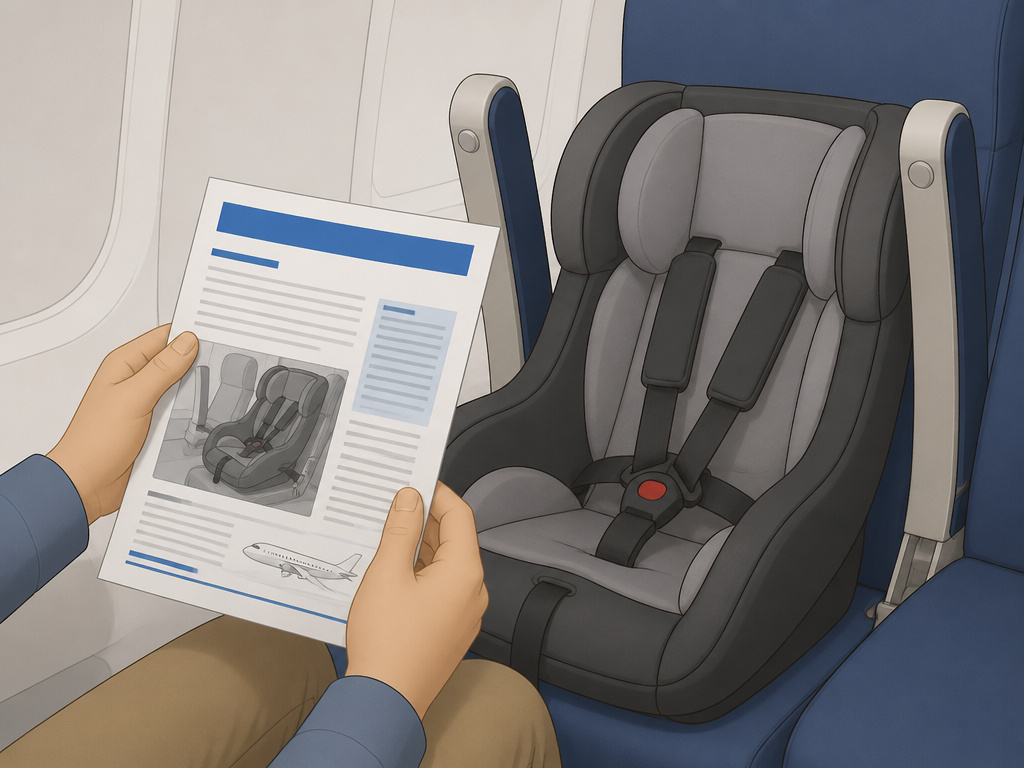
You bought a ticket for your child. The FAA says if your approved car seat doesn’t fit in your assigned seat, the airline must try to find another seat in the same class of service where it will fit. This is your right.
Common fit issues are width (the seat is too wide for the rigid airline armrests) and pitch (the distance between rows is too short for a rear-facing seat to be installed properly). The airline’s solution is usually to move you to a seat with moveable armrests or to a bulkhead row with more legroom. They cannot simply tell you to gate-check it and charge you for the now-empty seat. Be polite but firm, and have a printed copy of the FAA Advisory Circular handy.
Checking a Car Seat: A Last Resort
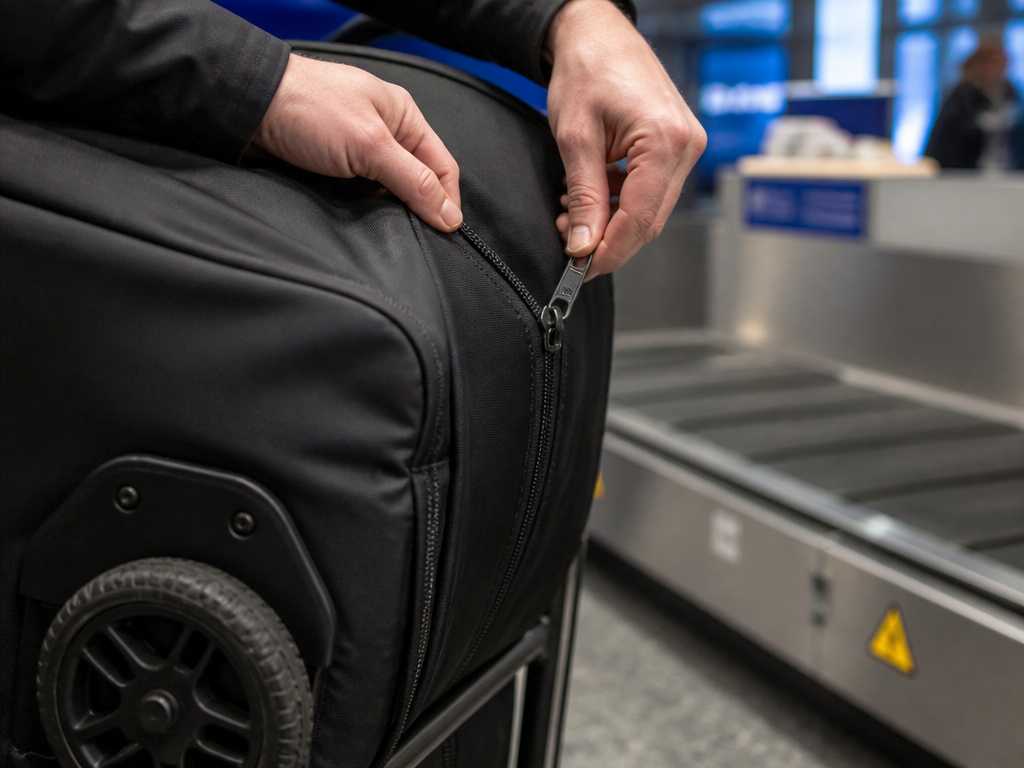
Gate-checking a car seat is always a gamble with baggage handling. If you must check it, do not use a thin nylon bag. Invest in a padded, wheeled car seat travel bag. It won’t guarantee safety, but it will protect against scrapes, rain, and dirt.
Worth knowing before you start: Airlines do not assume liability for damage to checked car seats in the same way they do for luggage. While a new DOT rule establishes a rebuttable presumption of airline liability for damage to assistive devices like wheelchairs, car seats are often classified as standard baggage. The repair or replacement cost falls on you.
The bottom line: Carry it on if you can. Check it only if the seat fails the label test, is a booster, or you’re flying on a foreign airline that prohibits them.
Frequently Asked Questions
Can I use a car seat in first or business class?
Maybe, but it’s risky. Many premium cabins have seats that angle toward the aisle (oblique seating) or that are pod-style. The FAA prohibits car seat use on seats angled more than 18 degrees from the aircraft centerline. If you can’t get a straight answer from the airline about the seat geometry, book economy.
Does a car seat count as my carry-on bag?
No. According to the carry-on baggage federal code (14 CFR § 121.589), airlines cannot count an FAA-approved child restraint system against your carry-on allowance. You are also allowed a diaper bag. The car seat and stroller are considered assistive devices, not luggage.
Can I hold my child under 2 instead of using a car seat?
Yes, but Transport Canada “highly recommends” against it. A child under two may travel on your lap. In turbulence or an emergency, your arms cannot restrain them. The force of a sudden stop can turn a 20-pound infant into a 200-pound projectile. If you can afford the ticket, the car seat is the safer choice.
What about “Child Safety Devices” like the CARES harness?
The CARES harness (Aviation Child Safety Device) is the only FAA-approved alternative to a car seat for children between 22 and 44 pounds. It uses the aircraft lap belt and a top tether that loops over the seatback. It’s lightweight and packs small, but it’s only for toddlers who can sit upright unassisted.
Do flight attendants help install the car seat?
No. You are responsible for knowing how to install your own seat correctly and quickly. Flight attendants are not trained on every car seat model and cannot assist due to liability. Practice at home using a dining chair before your trip.
Before You Go
Carrying a car seat on a plane comes down to three things: the right label, the right seat type, and a window spot. Find the red “CERTIFIED FOR USE IN MOTOR VEHICLES AND AIRCRAFT” label on your seat today. If it’s not there, dig out the manual. If the manual is gone, contact the manufacturer for a confirmation letter.
Book a window seat when you buy your tickets. Practice threading a lap belt through your seat’s belt path until you can do it blindfolded. And if the gate agent pushes back, know your rights, you bought the ticket, they have to find a spot for that seat. The alternative is checking it, and that’s a roll of the dice with your child’s safety.
