
FAA Decides: Is a Car Seat Considered Your Carry-On Item?
This post contains affiliate links. As an Amazon Associate, we earn from qualifying purchases.
Yes, a car seat is considered a carry-on item by the Federal Aviation Administration (FAA). It can be brought onboard and used in a forward-facing aircraft seat in place of your standard carry-on bag or personal item. However, individual airline policies dictate whether it counts against your carry-on allowance or is considered a free extra item, so you must check your specific carrier’s rules.
That FAA rule is the baseline, but it’s not the whole story. The gap between federal regulation and airline-specific policy is where travelers get tripped up. One airline might wave it through as a free child safety item; another might count it against your one-bag limit if you’re not careful.
What follows: the exact FAA regulation, a breakdown of how major carriers interpret it, the critical difference between using the seat onboard versus gate-checking it, and the model-specific details, like handle positions, that manuals insist on for safe carrying. By the end, you’ll know exactly how to present your seat at the gate to avoid fees and ensure it’s ready to protect your child, whether it’s buckled in beside you or traveling in the hold.
Key Takeaways
- The FAA permits car seats as carry-ons for use onboard, but each airline sets its own policy on fees and baggage allowances.
- For a seat to be used in the cabin, it must be FAA-approved for aircraft use, look for a sticker on the seat certifying it meets Federal Motor Vehicle Safety Standard (FMVSS) 213.
- Never check a car seat at the ticket counter without a protective bag. The baggage system is not gentle, and a damaged seat must be replaced.
- Manufacturer manuals specify exact handle positions for carrying (e.g., Evenflo SafeMax Position 1); using the wrong position can compromise the seat’s structure.
- Always call your airline 48 hours before your flight to confirm their current car seat policy and any documentation they might require.
The FAA’s Official Stance on Car Seats
The Federal Aviation Administration (FAA) is clear: a child restraint system (CRS) that is approved for use in motor vehicles is also approved for use in aircraft. This isn’t a courtesy; it’s a regulation designed for child safety. The seat must have a label stating it conforms to Federal Motor Vehicle Safety Standard (FMVSS) 213. You’ll find this label, often with the words “This child restraint is certified for use in aircraft,” on the side or back of the seat.
A child restraint system manufactured to U.S. Standards on or after February 26, 1985, must bear the label: “This child restraint is certified for use in motor vehicles and aircraft.” The restraint must be installed in a forward-facing aircraft seat, using the aircraft seat belt.
This technical snippet is what you cite if a gate agent questions you. The FAA’s position is that a properly used car seat is the safest way for a child under 40 pounds to fly. It’s not considered special oversized luggage in this context, it’s a safety device. However, the FAA delegates the “how” of implementation to the airlines. This is where the uniform federal rule splinters into a dozen different airline-specific policies.
How Airlines Interpret the Rule (And Where They Differ)
While the FAA gives the green light, your airline writes the fine print. Most U.S. Carriers follow a similar pattern: if you are traveling with a child who has a seat, you can bring an FAA-approved car seat for them to use in that seat, and it does not count as your carry-on or personal item. It’s an extra, free item for the safety of a ticketed child.
The catch comes when your child is flying as a lap infant. Some airlines, like Delta and American, will still allow you to bring the car seat onboard to use in an empty seat if one is available, but they may then count it as your one carry-on bag. Others might only permit you to gate-check it for free. This is not a minor detail, it’s the difference between walking onto the plane with your seat or handing it over at the jet bridge.
Common mistake: Assuming “FAA-approved” means “airline-mandated.” The airline decides if it’s free, if it replaces a bag, or if you need to buy a seat for it. Not checking this 48 hours before your flight is how you get stuck paying a $75 oversize baggage fee at the gate.
You must verify directly. A policy listed online can be overridden by a gate agent’s discretion on a busy travel day. Your best defense is a printed copy of the airline’s specific policy and the FAA regulation. For a comprehensive look at how these policies break down, our guide on airline carry-on for car seats compares the major carriers line by line.
Car Seat as Carry-On vs. Checked Baggage
This is the core decision. Bringing the seat into the cabin is the safest option, as it remains under your control and can be used for its intended purpose. Checking it, either at the ticket counter or at the gate, introduces risk. The baggage handling system is designed for durability, not delicacy. Car seats can be crushed, thrown, or have their internal components compromised in ways that aren’t visible.
| Method | Best For | Risk If Skipped |
|---|---|---|
| Cabin (Carry-On) | Any child with their own seat; maximizing safety. | None, if FAA-approved and airline policy is met. |
| Gate-Check | Lap infants; avoiding ticket counter fees. | Seat is tossed with strollers; may sustain hidden damage. |
| Checked at Ticket Counter | Long trips with multiple seats; necessity. | High. Must use a padded bag, or the seat is likely to be destroyed. |
If you must check the seat, you are entering a mitigation game. A thin nylon bag is not enough. You need a dedicated, padded car seat travel bag. Even then, you should inspect the seat thoroughly upon arrival. Look for new cracks in the plastic shell, a harness adjuster that sticks, or a buckle that doesn’t click cleanly. Any of these mean the seat is compromised and should not be used. The NHTSA car seat safety guidelines are unequivocal: a seat involved in a moderate or severe crash, or one with visible damage, must be replaced.
Gate-Checking vs. Cabin Use
Gate-checking is the middle ground. You use the seat through the airport, then hand it over at the door of the aircraft just before you board. It’s stored in the cargo hold but avoids the rougher main baggage system. It’s usually free.
The trade-off is that you cannot use it during the flight. For a lap infant, this is often the only practical choice. The process for managing this, along with a stroller, has its own logistics. For a step-by-step on that maneuver, see our article on how to carry car seat and stroller in flight.
What Makes a Car Seat “Portable” for Travel?
Portability isn’t just about weight. It’s about design features that make the schlep through a terminal manageable. True travel-friendly seats often have integrated carry handles, a compact footprint, and straightforward installation without a base.
Integrated carry handles are the key feature. But here’s the detail most reviews miss: not all handle positions are for carrying. Your manual is law. The Century Carry On 35 Lightweight Infant Car Seat manual states the handle “must be in position A (upright) when carrying.” The Evenflo SafeMax Infant Car Seat is more explicit: Position 1 is for “Carry and Travel,” and it warns “NEVER use this position when traveling in a vehicle.” Using the wrong position doesn’t just strain your arm, it can stress the handle’s locking mechanism over time.
Where this goes sideways: Using the car seat’s “convenience” handle position for carrying. On models like the Evenflo Nurture, Position 3 is labeled “Convenience” and the manual shouts: “NEVER use this position to carry your child in the carrier.” The plastic isn’t reinforced for the leverage of a full carry, and a fatigue crack can form after a few airport hauls.
A lightweight frame matters, but so does the shape. A seat that is narrow at the base will fit more easily down airplane aisles and into tighter vehicle seats at your destination. Some parents opt for a dedicated travel car seat like the Cosco Scenera Next for these reasons, it’s a known quantity for airport navigation. For more tips on the physical act of moving a seat, our guide on how to carry a car seat covers grips and techniques.
Packing a Car Seat for Checked Luggage
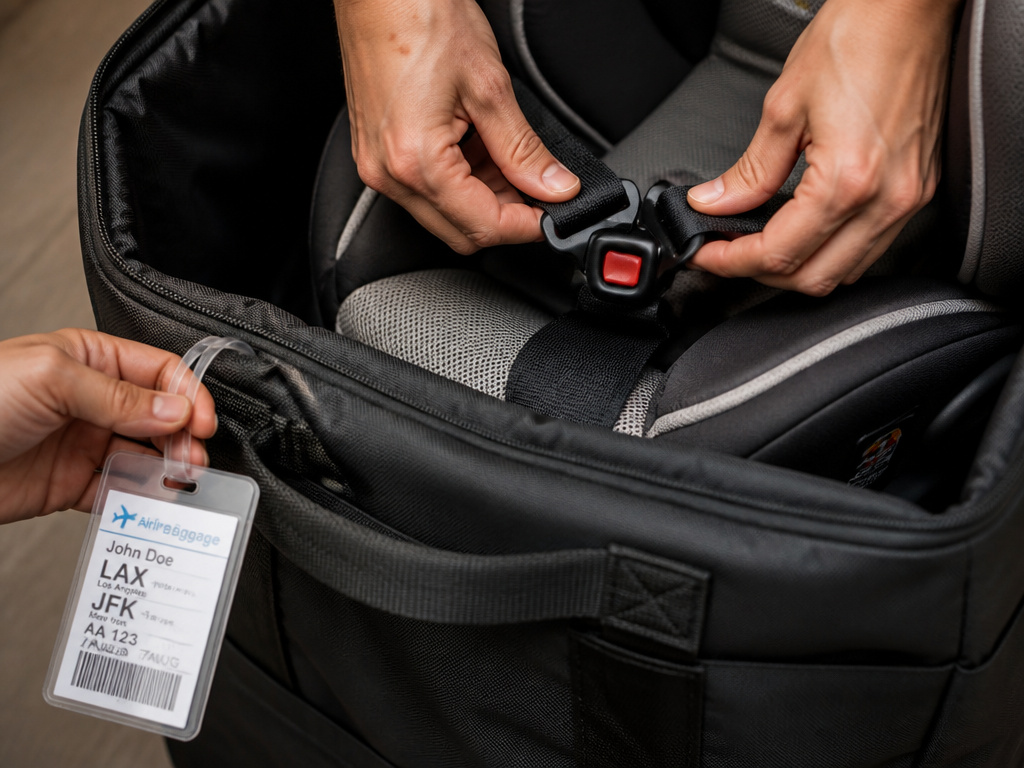 If checking the seat is unavoidable, packing it correctly is a non-negotiable safety step. This isn’t about keeping it clean; it’s about preserving its structural integrity.
- Clean it first. Crumbs and spills attract pests and can corrode metal parts over time in a cargo hold.
- Tighten all straps. Pull the harness straps tight and buckle the chest clip and crotch buckle. This prevents the straps from flapping and getting caught in conveyor machinery.
- Use a rigid, padded travel bag. The bag should have thick walls and a hard bottom. Label it clearly with your name, address, and flight information.
- Pack accessories separately. Never leave toys, mirrors, or aftermarket head supports attached. They will snap off. Place them inside the seat or in your main luggage.
- Consider disassembly. If your seat has a removable base, take it off and pack it separately within the bag, using clothing as padding.
Skipping step 3 is the most common and costly error. A seat tossed onto the tarmac in just its original box or a flimsy sack is a gamble. The $30 investment in a proper bag is cheaper than a $300 replacement seat. For a visual guide on this process, check out our tutorial on how to pack infant car seat for air travel.
The Car Seat Travel Bag Checklist
Before you zip it up, run through this list: – [ ] Harness straps are pulled tight and buckled. – [ ] Chest clip is fastened. – [ ] All aftermarket accessories are removed. – [ ] Seat is placed in padded bag. – [ ] Base (if separate) is packed inside, padded with soft items. – [ ] Luggage tag is secured to the bag’s handle.
Navigating Airport Security with a Car Seat
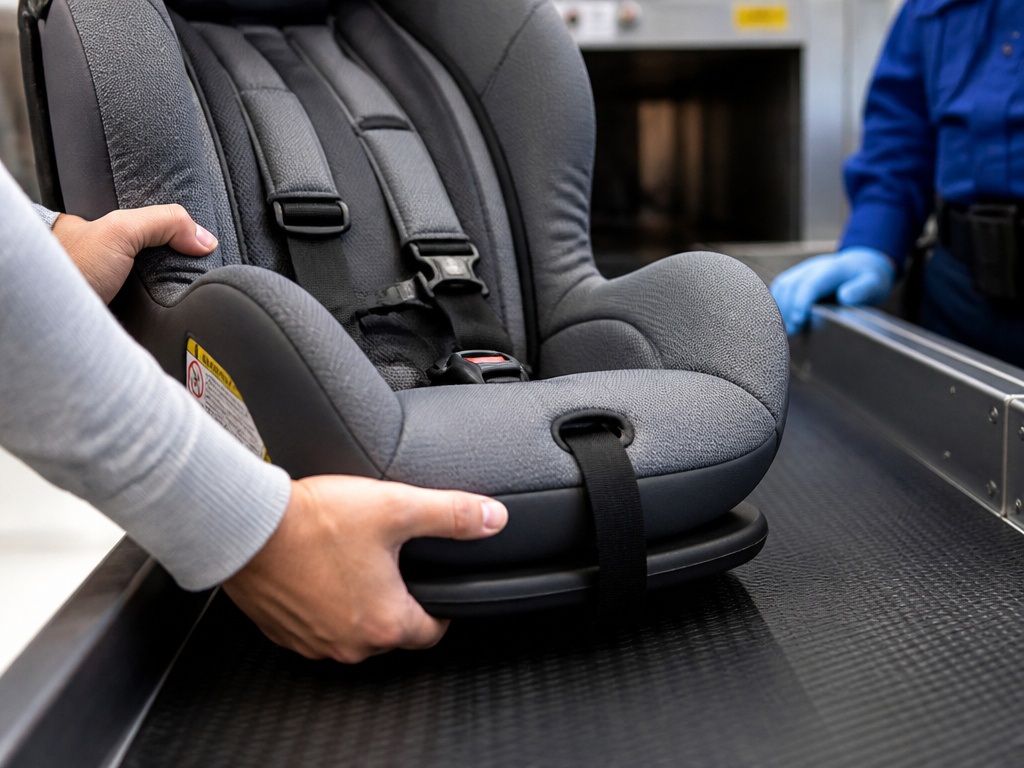 The Transportation Security Administration (TSA) sees car seats every day. The process is standardized, but knowing what to expect saves time and stress at the checkpoint.
The seat will need to go through the X-ray machine. You have two choices: send it through on the belt as-is, or request a visual inspection. If it fits on the belt, sending it through is faster. For very large convertible seats, a visual inspection is the only option. A TSA officer will swab the seat for explosive residue, this is normal.
Unfasten any chest clips before screening. This is a specific FAA rule for aircraft seats containing SensorSafe or similar technology. The Evenflo Gold SecureMax manual explicitly states: “the SensorSafe Chest Clip MUST be unfastened before take-off.” Doing it at security gets it out of the way.
I prefer sending the seat through the X-ray. The one time I opted for a visual inspection during a peak morning rush, it took 20 minutes for an available officer. The belt takes 90 seconds.
Have your child out of the seat before you reach the front of the line. You’ll need to collapse your stroller, too. It’s a juggling act best performed with a plan. For a full walkthrough of terminal logistics, from curbside to gate, see our article on how to carry car seat through airport.
Using Your Car Seat Onboard the Aircraft
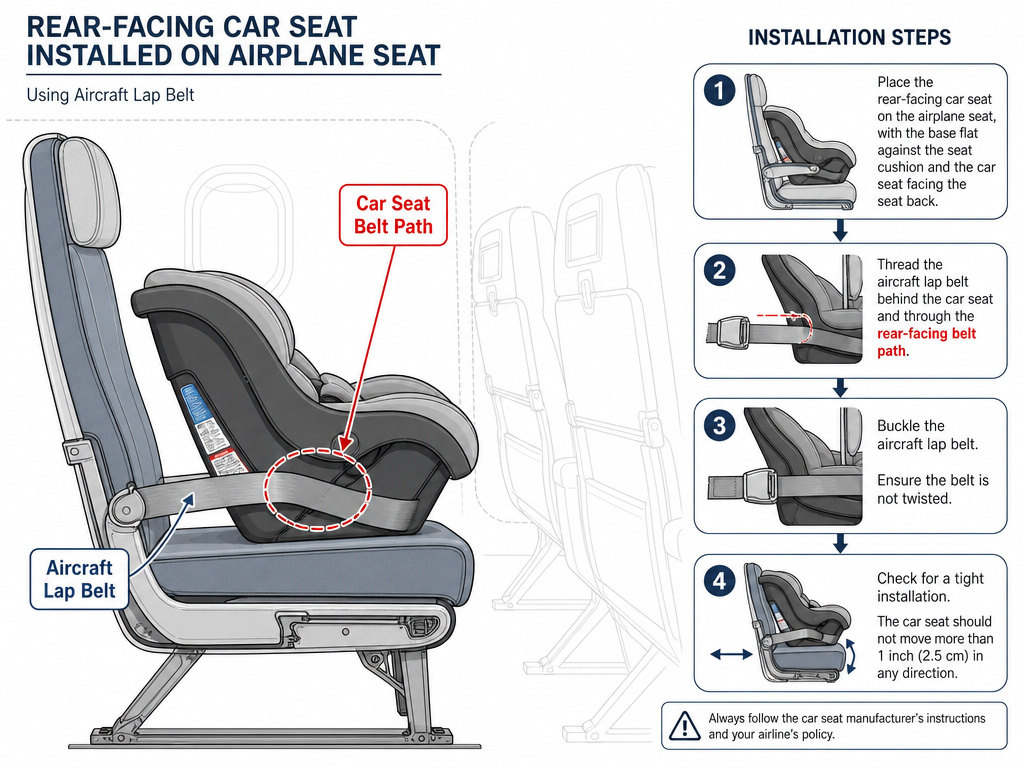 You’ve gotten it through security and onto the plane. Now comes installation. The aircraft seat belt is a simple lap belt. You’ll thread it through the car seat’s rear-facing belt path (for infants) or forward-facing path (for larger convertibles), just as you would in a car without the LATCH system.
Tighten it until the seat does not move more than an inch side-to-side or forward at the belt path. This is the same standard as a vehicle installation. Use your body weight to lean into the seat while you pull the belt tail tight. Many parents don’t pull hard enough, resulting in a loose seat that’s ineffective in turbulence or a rough landing.
| Car Seat Type | Aircraft Installation Method | Key Check |
|---|---|---|
| Infant Carrier (with base) | Install carrier directly with lap belt. Base must be checked. | Belt path is often under a canopy flap; find it before boarding. |
| Convertible Seat | Rear-facing or forward-facing with lap belt only. | Ensure seat is in correct recline mode for child’s age/weight. |
| Booster Seat | Not permitted for use onboard. Must be checked. | Use only if child meets vehicle seat belt fit test without it. |
Remember, the Graco SlimFit 3-in-1 Car Seat manual (and most others) specifies that the LATCH system is not used on aircraft. You use the seat belt alone. Once installed, your child is secured in the car seat’s harness, which should be snug, you should not be able to pinch a horizontal fold in the harness strap at the child’s shoulder.
This onboard use is why understanding your car seat carry-on policy is so critical. If the airline counts it as your one bag, you’re sacrificing your diaper bag or laptop. Knowing your rights lets you plan your other luggage.
Frequently Asked Questions
Does a car seat count as a carry-on for every airline?
No. While the FAA allows it, each airline sets its own policy. Most major U.S. Carriers do not count it as a carry-on if you are using it for a ticketed child in their own seat. If your child is a lap infant, policies vary: some may allow it as a free gate-check, others may count it as your carry-on bag if you bring it onboard. Always verify with your specific airline before your travel date.
How do I prove my car seat is FAA-approved?
Look for a label on the seat itself. It will state, “This child restraint is certified for use in motor vehicles and aircraft” and reference compliance with Federal Motor Vehicle Safety Standard (FMVSS) 213. This label is often sewn onto the fabric near the child’s legs or printed on a sticker on the plastic shell. Have this visible or know where it is in case a gate agent asks.
Can I use my car seat’s base on the plane?
No. Aircraft seats are not designed to accommodate car seat bases. You must install the infant carrier directly onto the aircraft seat using the lap belt, threading it through the seat’s belt path as described in your manual. The base must be checked as luggage. Make sure to pack it securely in a padded bag.
What is the best type of car seat for air travel?
Lightweight infant seats with integrated carry handles, like the Century Carry On or the Chicco KeyFit, are easiest for travel. For older children, a compact, lightweight convertible seat like the Cosco Scenera Next is a popular choice because it’s designed for easy installation without a base and has a narrow footprint. The “best” seat is one you can carry, install correctly, and that fits your child’s height and weight.
What happens if I gate-check my car seat?
You will use the seat to transport your child through the airport. At the entrance to the aircraft (the jet bridge), you will hand the seat to a baggage handler. They will tag it and place it in the cargo hold. It will be returned to you at the aircraft door upon arrival at your destination, or sometimes on the baggage claim carousel. There is always a risk of damage, so a protective bag is recommended even for gate-checking.
Can I bring a car seat and a stroller?
Yes, and both are typically gate-checked for free. This is standard airline policy for families traveling with young children. The stroller can be used right up to the aircraft door, and the car seat can be secured on the stroller or carried separately. Managing both requires a bit of coordination. For a detailed plan, read our guide on car seat and stroller policies.
Before You Go
A car seat is more than luggage; it’s a piece of safety equipment. The FAA recognizes this by allowing it as a carry-on, but your journey from curb to cabin depends on your airline’s specific rules. The winning move is a three-part check: confirm your airline’s policy, verify your seat’s FAA label, and pack with the assumption that checked baggage is handled roughly. Bring the seat onboard if you’ve bought a seat for your child, it’s the safest place for it. If you must check it, armor it in a padded bag. That label on the side isn’t just a certification. It’s your ticket to bringing a critical piece of your child’s safety along for the ride.
