
Do All Car Seat Bases Fit All Car Seats? Compatibility Guide
This post contains affiliate links. As an Amazon Associate, we earn from qualifying purchases.
No, car seat bases are not universal. Each base is designed to fit only a specific list of car seats from the same brand, and often only within a particular model line. Mixing a seat with a base it wasn’t crash-tested with voids the safety certification and can lead to an improper, dangerous fit.
That gap between “should fit” and “does fit” is where the risk lives. The locking pins on the seat must align perfectly with the receivers on the base, and the seat’s weight and geometry must match the base’s support leg and anti-rebound systems. A mismatch of even a few millimeters can leave the seat unsecured.
What follows: a breakdown of why this proprietary lock exists, how to decode your seat’s manual for the exact base it needs, and what to do if you already own a mismatched set.
Key Takeaways
- Bases are brand-specific and often model-specific. A Nuna PIPA RELX base only fits Nuna PIPA series seats, not a Graco or Britax seat.
- The word “universal” on a seat label refers to its compatibility with vehicles, not with other brands’ bases.
- Using an unapproved seat-base combination is illegal in many places and voids all warranties and insurance.
- Every base manual lists the exact seat models it is compatible with. Never guess based on looks.
- If your seat doesn’t fit your base, you can always install the seat directly into the car using the vehicle’s seat belt.
Why Car Seat Bases Aren’t Universal
Think of a car seat base as half of a single, certified safety unit. Brands crash-test the seat and base together as a locked pair. The base’s support leg, anti-rebound bar, and the specific angle of the seat are all engineered in tandem.
Your car seat is only compatible with the Base Z2, if you can see one of the following Type Approval labels on your car seat. Cybex Base Z2 User Manual
That sticker is the certification. If you snap a different seat onto that base, you are using an unapproved restraint system. The locking pins might engage, but the seat’s center of gravity could be off. The support leg might not bear the load correctly. In a crash, that seat could rotate, tip, or detach.
The support leg is the silent partner. It’s calibrated for the exact weight and bottom contour of its matched seat. A Rehanorm ISO-Base manual warns against use with seats less than 40 cm deep because the leg needs that contact patch. A mismatched seat might perch on it wrong, turning a safety feature into a pivot point.
How to Find a Compatible Base
You have two documents: the car seat manual and the base manual. The answer is in both.
First, check the car seat’s manual. It will list compatible bases by model name. For example, the Nuna PIPA RELX manual states its base is “compatible with all USA PIPA™ series infant car seats.” That’s a closed list—it doesn’t include the Nuna PIPA urbn.
Second, check the base’s manual. It lists the exact seat models it accepts. The Graco GoMax base manual is blunt: “This base is compatible ONLY with the Graco® GoMax TM car seat.” The BeSafe Beyond Base manual lists three specific BeSafe seats it works with.
Skip the visual check. Two bases can look nearly identical, but the spacing between the ISOFIX connectors or the shape of the locking mechanism can differ by a few critical millimeters. The green “locked” indicator on the base might light up even if the seat isn’t fully secured. That’s a false positive you can’t afford.
| Brand | Base Model | Compatible Seats | Critical Note |
|---|---|---|---|
| Nuna | PIPA Series Base | All USA PIPA series infant seats except PIPA urbn | Must follow all warnings from the original seat manual. |
| Graco | GoMax Base | Graco GoMax car seat only | No other Graco infant seats are listed as compatible. |
| BeSafe | Beyond Base | BeSafe Go Beyond (40-87 cm), BeSafe Beyond (61-125 cm), Beyond B (40-125 cm) | Requires ISOFIX anchorage points approved to UN/ECE Regulation No.14. |
| Cybex | Base Z2 | Only seats with specific Cybex approval stickers (Cloud Z2 i-Size, Sirona Z2 i-Size modules) | Check for the R129-030079 type approval label on the seat itself. |
Common mistake: Assuming a base fits because the brand name matches. A Britax One4Life seat won’t fit a Britax B-Safe base. Model lines change every few years, and a 2018 base likely won’t fit a 2024 seat, even from the same brand.
The i-Size and ISOFIX Confusion

This is where most people get tripped up. ISOFIX (also called LATCH in the US) is a vehicle standard. It’s the pair of metal anchors built into your car’s seat bight. I-Size (UN Regulation No. R129) is a newer seat and vehicle standard focused on side-impact protection and height-based classification.
A base labeled “i-Size compatible” means it’s designed to fit into any i-Size approved seating position in a car. It does not mean any i-Size seat will fit on any i-Size base. The connection between the seat and the base remains proprietary.
Think of it like USB-C. The port on your laptop (the car’s ISOFIX anchors) is standard. The cable (the base) must have a standard plug on one end (the ISOFIX connectors) but can have a proprietary connector on the other end (the seat attachment). Your phone (the car seat) only works with its specific cable.
What Happens If You Use the Wrong Base?
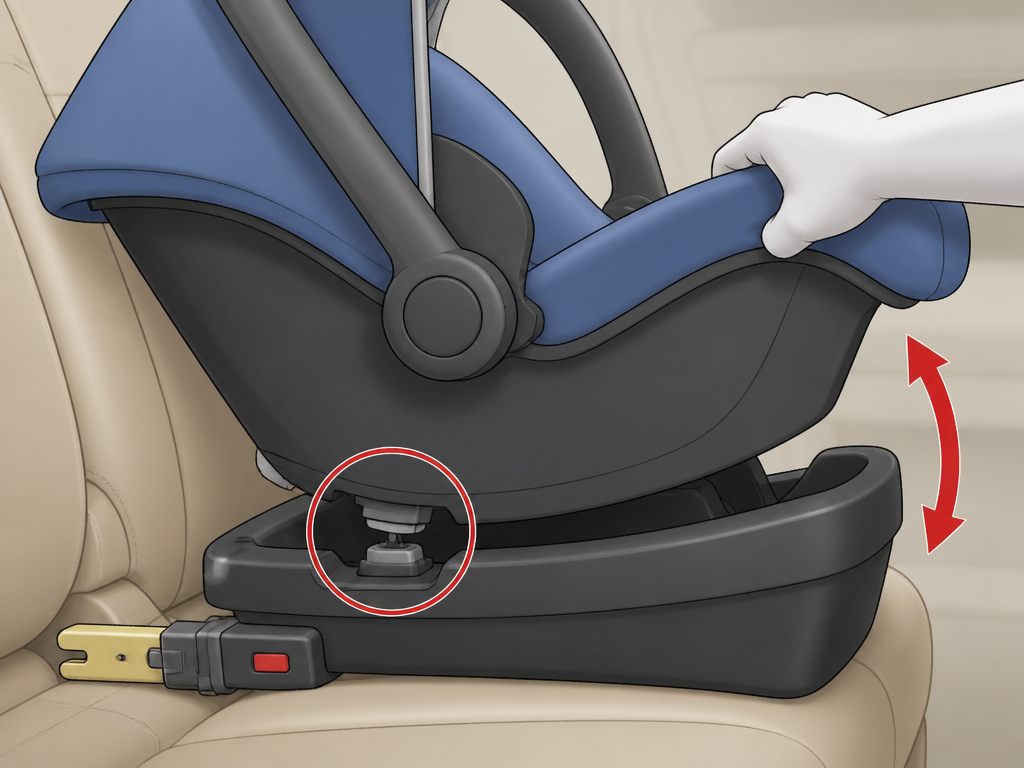
The consequences are layered, from immediate physical failure to long-term liability.
- Improper Fit: The seat might seem secure but have slight play. At 30 mph, that play becomes violent movement. The seat can twist, putting immense strain on one ISOFIX connector or causing the support leg to buckle.
- Voided Certification: You are using the seat outside its tested and certified configuration. This is often explicitly stated in the manual. The Nuna PIPA series base manual warns, “Never attempt to use another manufacturer’s seat on this base.”
- Legal and Financial Risk: If you are in an accident, using an unapproved combination could void your car insurance and any product liability from the manufacturer. In many jurisdictions, it’s illegal to use a child restraint not as specified by its certification.
- Warranty Voidance: All manufacturer warranties are nullified. If the base fails, you have no recourse.
Your safe alternative is always the vehicle seat belt. Every modern infant carrier has belt guides (usually marked in blue) for a secure, belt-only installation. It’s just as safe when done correctly—pull the belt tight until there’s less than an inch of movement at the seat’s belt path.
How to Check Your Base and Seat Combo

Don’t guess. Follow this sequence.
- Locate both manuals. Find the car seat’s manual (often tucked in a pocket on the side) and the base’s manual.
- Find the compatibility list. In the seat manual, look for “Compatible Bases” or “Required Base.” In the base manual, look for “Compatible Car Seats.”
- Match model names exactly. “PIPA” is not “PIPA urbn.” “GoMax” is not “SnugRide.”
- Check for a physical label. Like the Cybex example, some bases require a specific approval sticker on the seat itself.
- Perform the “inch test.” Even with a confirmed match, install the seat on the base as directed. Grab the seat at the belt path and try to move it side-to-side and front-to-back. There should be less than one inch of movement in any direction.
If you no longer have the manuals, go to the manufacturer’s website. Most have a support section where you can download the PDF by entering the model number, usually found on a label on the side or bottom of the seat and base.
Frequently Asked Questions
Can you use a Graco seat on a Britax base?
No. Graco and Britax use completely different locking mechanisms. Their bases and seats are not cross-compatible. You must use a Graco seat with a Graco base listed as compatible in the seat’s manual, and the same rule applies to Britax.
Do all Nuna car seats use the same base?
No. While the Nuna PIPA RELX base fits all USA PIPA series infant seats (except the PIPA urbn), Nuna’s convertible seats, like the RAVA or REVV, do not use a base at all. They install directly into the vehicle using the seat belt or LATCH.
What does “universal” mean on a car seat?
When you see “Universal” on a seat label, it refers to vehicle compatibility. It means the seat or base is designed to fit in almost any car with standard ISOFIX/LATCH anchors. It says nothing about compatibility with other brands’ seats. A “Semi-Universal” label means it may need a support leg or top tether, requiring you to check your vehicle’s manual.
Is it safe to buy a used car seat base?
Manufacturers like BeSafe advise against buying child seats second-hand because you cannot know their full history. A base that has been in a crash—even a minor one not visible to you—may have compromised integrity. Furthermore, used bases often lack the crucial instruction manual, making proper compatibility checks impossible.
What if my car doesn’t have ISOFIX anchors?
If your car lacks ISOFIX (LATCH) anchors, you cannot use a base that requires them, like the BeSafe Beyond Base. Your option is to install the car seat directly into the vehicle using the seat belt. All infant seats and convertible seats have belt-path guides for this purpose. Ensure you switch your vehicle belt to locking mode per your car’s manual.
The Bottom Line
Car seat bases are not interchangeable Lego bricks. They are precision-tested components of a single safety system. The rule is simple: use only the base listed in your car seat’s manual, and only the seat listed in your base’s manual.
When in doubt, the seat belt is your safe, always-available option. It takes a minute longer to install, but it bypasses the entire compatibility question. For your primary vehicle, invest in the correct base for ease. For grandparent’s cars, taxis, or rentals, master the seat belt install. That skill is truly universal.
