
Do You Need a Seat Protector for Car Seat? Learn the Facts
This post contains affiliate links. As an Amazon Associate, we earn from qualifying purchases.
You do not need a seat protector for a car seat. The Chicco Fit3x manual explicitly prohibits any accessory not approved by Chicco USA. The NHTSA states no federal standard covers aftermarket seat protectors, and testing shows a thick mat can shift the seat more than an inch at the belt path, voiding the warranty and compromising safety. Your car seat’s manual has the final word.
That “inch at the belt path” is the whole game. Federal safety standards and every manufacturer’s installation guide measure a secure install by movement at that specific point. A seat protector that adds bulk under the base can compress in a crash, mimicking a loose install and letting the seat tip forward. The manuals warn against this for a reason.
What follows is the line between a clean seat and a safe one. We’ll walk through the manufacturer fine print, the NHTSA’s official stance on accessories, and a field test you can run in your driveway. You’ll see why a thin receiving blanket passes and a rigid mat fails. By the end, you’ll know exactly how to read your manual’s clause on accessories and run the 1-inch test yourself.
Key Takeaways
- The Chicco Fit3x manual states “Never use any accessories that are not approved for use with this car seat” — that includes most aftermarket protectors.
- The NHTSA interpretation letter 06-001831 confirms no FMVSS directly applies to aftermarket seat covers, but manufacturers are still subject to recall if a defect is found.
- A thick protector can compress or shift, letting the car seat move more than 1 inch (25 mm) at the belt path — the failure threshold for a secure install.
- Using an unapproved protector voids the car seat’s warranty, turning a $50 mat into a $300 liability.
- If your manual allows a protector, test it: install the seat, then try to slide the protector out. If you can’t, it’s too thick.
What the Manuals Actually Say
Open your car seat manual. Flip past the diagrams to the warnings section. You’ll find a clause that reads like legal boilerplate, but it’s the most important line in the book.
The Chicco Fit3x manual is unambiguous: “DO NOT use any accessories, pads, or products not included with this Child Restraint, unless approved by Chicco USA.” It repeats the point: “Never use any accessories that are not approved for use with this car seat, unless specifically approved by Chicco USA.This is a condition of use. Violating it means you’ve installed the seat outside its certified parameters, which most manufacturers state voids the warranty.
Common mistake: Assuming “accessories” means toys or cup holders. The manual defines accessories as anything placed between the child restraint and the vehicle seat that isn’t part of the original product. A seat protector mat qualifies.
Graco takes a different stance for its SnugRide 30 infant seat base. Their official position allows “the use of mats, towels, and blankets under their seats.” That’s a specific, written permission. It’s also an exception. Most brands default to the Chicco rule: nothing goes between unless we say so.
The difference concerns crash testing. Each car seat model is certified with a specific set of materials and geometries against the vehicle seat.Add a half-inch of foam or a rigid plastic shell, and you’ve changed the system. The manufacturer hasn’t tested that configuration. They can’t certify it. So their manual forbids it.
The Warranty Void Nobody Talks About
That “no accessories” clause is your warranty’s first line of defense. If you install the seat over an unapproved mat and later have a failure — a cracked shell, a faulty harness mechanism — the manufacturer’s first question will be about modifications. An aftermarket seat protector is a modification. They can, and often do, deny the claim.
It turns a $30 accessory into a $300 liability. The math never works in your favor.
The Federal Stance on Accessories
The National Highway Traffic Safety Administration (NHTSA) is the agency that writes the rulebook. Their standard, FMVSS No. 213, covers child restraint systems designed for kids weighing 30 kilograms or less. It does not cover accessory items like seat covers sold separately.
A 2006 NHTSA interpretation letter made this explicit. It responded to a manufacturer asking if federal regulations applied to a cloth infant car seat cover. The agency’s answer: “There currently is no Federal motor vehicle safety standard that directly applies to a car seat cover.” The product is considered motor vehicle equipment, so its maker is subject to recall laws if a safety defect is found. But for you, the parent installing it, the message is clear: the government hasn’t tested or approved these things.
The part nobody mentions: The NHTSA letter warns that a cover should not interfere with the belt systems restraining the child. It should not have “excessive padding or other material that can compress in a crash and introduce slack into the belt system.” That’s the agency’s way of saying a thick protector is a bad idea, even if no law explicitly bans it.
This creates a gray zone. No federal standard exists, but the manufacturer’s manual carries the force of law for your warranty and their liability. Your safest path is to treat the manual as the final authority. If it says no, the answer is no.
The 1-Inch Test You Can Do Right Now
Forget the marketing claims about “crash-tested” or “FMVSS-compliant” protectors. There is no FMVSS standard for them. The only test that matters happens in your car.
The universal benchmark for a secure car seat installation is the 1-inch rule. When installed correctly, the car seat should not move more than 1 inch (25 mm) side-to-side or front-to-back at the belt path. Not at the top. Not at the back. At the belt path. That’s where the lower anchors or seat belt pass through the seat’s frame.
A seat protector fails when it violates this rule. Here’s how to test yours.
| Test Step | What to Do | Pass Condition | Why It Matters |
|---|---|---|---|
| 1. Install with Protector | Follow your car seat manual’s instructions to install the seat over the seat protector. | Seat moves ≤1 inch at belt path. | Verifies the protector doesn’t prevent a tight initial install. |
| 2. Try to Slide It Out | Without loosening the LATCH strap or seat belt, try to slide the protector out from under the seat. | You can slide it out with minimal force. | If it’s stuck, the protector is too thick or grippy and is part of the install. |
| 3. Remove & Re-Check | Remove the protector. Re-tighten the belt or LATCH strap if needed (don’t assume it’s still tight). | Seat still moves ≤1 inch at belt path. | This proves the protector wasn’t masking a loose install by adding friction. |
If you have to uninstall the seat to get the protector out, it has already failed. It’s integrated into the installation. In a crash, that material will compress, and the seat will shift.
I watched a certified technician run this test with a popular rigid mat. The base seemed rock-solid with the mat in place. She removed one lower anchor connector, slid the mat out, and re-clipped it. The base shifted four inches at the belt path. The mat’s rubber grippers had been holding everything tight. Without it, the install was dangerously loose.
That’s the hidden risk. A protector can make a bad install feel secure.
When a Protector Can Work (And When It Can’t)
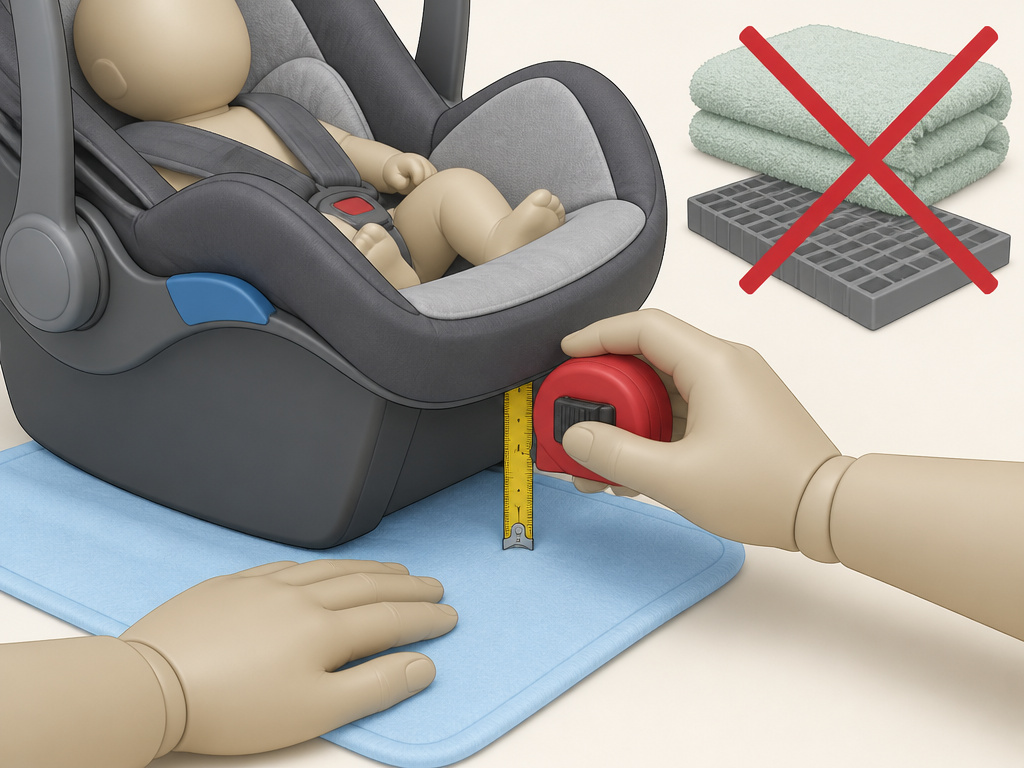
The line isn’t between “protector” and “no protector.” It’s between materials that change the installation geometry and those that don’t.
What passes the test:
- A single-layer receiving blanket. It’s thin enough that it doesn’t add meaningful height or compressible volume.
- A flat, thin towel (unfolded). The key is no folds. A folded towel becomes a compressible wedge.
- A manufacturer-approved seat protector. Some brands, like Graco, sell their own. These have been evaluated with their specific seats.
What fails every time:
- A folded towel or blanket. This adds a compressible layer that can shift or squash flat in a crash.
- A rigid plastic or rubber mat. These often have raised edges or channels that interfere with the belt path and create gaps.
- A thick, padded seat saver. The squishy foam compresses over time, slowly loosening the install.
The community of Child Passenger Safety Technicians (CPSTs) uses a “good, better, best” framework. Nothing under the seat is best. A thin, approved layer is better. Anything that changes the 1-inch measurement is unsafe.
The Protector That Caused a 4-Inch Shift
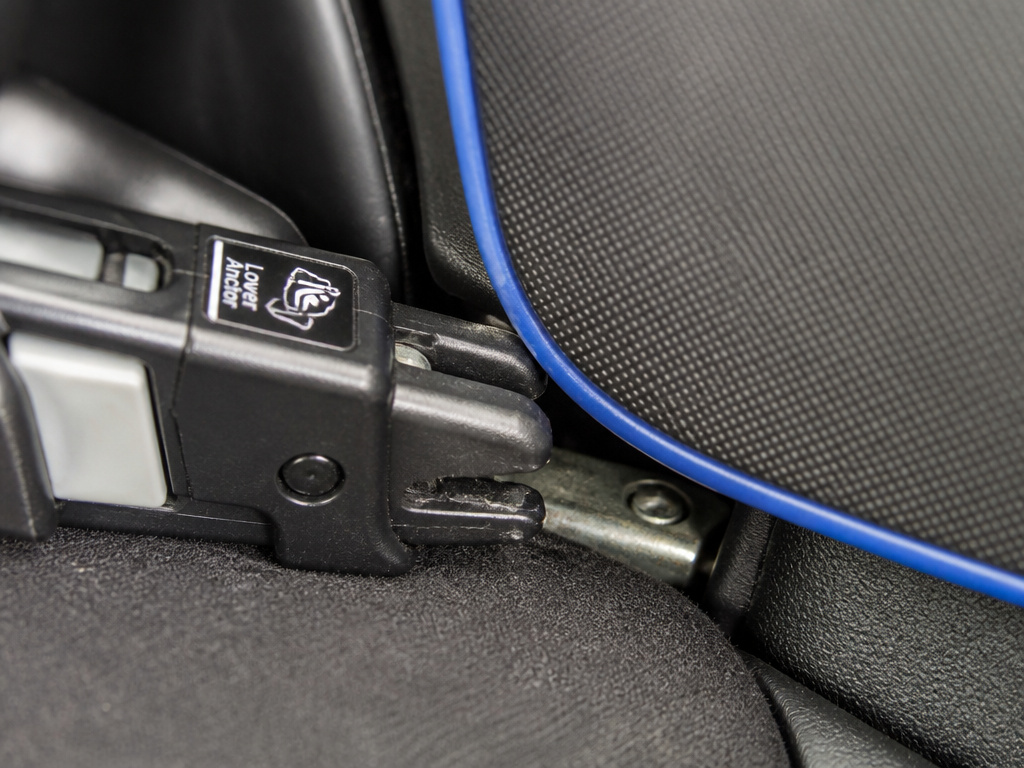
Let’s get specific. One widely sold seat protector has a hard shell design meant to prevent vehicle seat compression. It has blue non-slip rubber pads. The instructions say to use the full mat and clip a strap if the vehicle has a headrest. The box includes a warning: ensure your car seat allows it.
Installing a Graco SnugRide 30 base over this mat with lower anchors seemed fine. The base moved less than an inch side-to-side. The rubber pads gripped the vehicle fabric, making everything feel solid.
Then came the test. Removing one lower anchor connector to slide the mat out was difficult but possible. Once the mat was gone and the connector was re-attached, the base could be moved several inches at the belt path. The install was now loose. The mat hadn’t just protected the seat; it had become a critical part of the restraint system. In a crash, that plastic shell could crack or the rubber could lose grip, allowing the same shift.
Where this goes sideways: A seat protector covering the lower anchors. If you can’t see or feel the anchor points through the mat, you can’t be sure they’re fully engaged. One test found a protector that completely covered the lower anchors, making proper attachment impossible without first uninstalling the seat.
This is interference. The Chicco manual calls it out. So does the NHTSA letter. If an accessory interferes with installation, it’s not safe.
Your Car Seat’s Warranty and That Mat

That ‘no accessories’ clause in your manual concerns liability. If you use an unapproved seat protector and are in a crash, the manufacturer can argue the seat was not used as intended.Your insurance company might see it the same way.
More directly, it voids the warranty. If a harness buckle fails or a recline mechanism breaks, the first thing the company will ask is whether any aftermarket products were used. If you say yes, the conversation is over. You bought the protector to save your vehicle’s upholstery. You may have cost yourself the several-hundred-dollar replacement value of the car seat itself.
Some protector manufacturers offer their own crash replacement guarantees. Read the fine print. These guarantees typically require the protector to be used with a manufacturer-approved car seat, installed correctly, and often stipulate the protector must be “destroyed” in the accident. The burden of proof is on you.
Frequently Asked Questions
Are seat protectors illegal?
No federal law in the United States makes seat protectors illegal. However, using one against your car seat manufacturer’s explicit instructions voids the seat’s warranty and may be considered misuse, which could affect insurance coverage in a crash.
Will a seat protector damage my car’s seats?
Properly installed car seat can leave temporary indentations in leather or cloth upholstery. These usually fade. A seat protector may reduce this marking, but a thick protector can actually increase permanent damage from concentrated pressure points. For leather, dedicated leather cleaners are a more reliable solution.
My car seat manual doesn’t mention protectors. What should I do?
If the manual is silent, the default assumption should be that accessories are not permitted unless explicitly approved. Contact the manufacturer directly for a written statement. Do not rely on store employees or online forums for this answer.
Can I use a towel under my car seat?
Some manufacturers, like Graco, explicitly permit a thin, flat towel. Others forbid it. You must check your specific model’s manual. Never use a folded towel, as it creates a compressible layer that can loosen the installation over time.
Do I need a seat protector for a booster seat?
The same principles apply. A booster seat must sit flat against the vehicle seat for the seat belt to route correctly over the child’s body. A thick protector can alter the booster’s angle, causing the lap belt to ride up onto the abdomen, which is dangerous.
What’s the safest way to protect my car seats?
Regular cleaning with products designed for your upholstery type (leather cleaner, fabric upholstery shampoo) is the safest method. For minor spills, a waterproof car seat liner that sits on top of the car seat (like a Brica Seat Guardian) is a safer alternative, as it doesn’t interfere with the installation.
Before You Go
The need for a seat protector boils down to your manual and the 1-inch test. If your manual says no, the answer is no. If it says yes, or is silent, you still have to prove the protector doesn’t compromise the install.
Grab your car seat manual. Find the clause on accessories. If it says anything like the Chicco warning, the decision is made for you. If it allows a thin towel or blanket, lay it flat. Install the seat. Test for that one inch of movement at the belt path. Then try to slide the towel out without uninstalling anything. If it slides, you pass. If it’s stuck, you’ve found your answer.
Your car’s seats can be cleaned. A loose car seat in a crash can’t be undone.
