
Are All Car Seat Bases the Same? The Official NHTSA Answer
This post contains affiliate links. As an Amazon Associate, we earn from qualifying purchases.
Car seat bases are not universal or interchangeable. A base is a legally defined component of a specific child restraint system, crash-tested only with its matching seat. The National Highway Traffic Safety Administration (NHTSA) explicitly states that a convertible car seat shell that depends on a detachable base for installation fails federal safety standards because it cannot be installed “solely” by a seat belt or LATCH anchors. Compatibility is locked within brand families and specific model lines.
That legal definition is the spine of the issue. It turns a question of convenience into one of compliance. A base isn’t just a piece of plastic; it’s a certified part of a safety system.
What follows is the breakdown of that ruling, the two layers of compatibility that trap parents, and the one documented recall that shows why mixing parts is a regulatory and physical impossibility. By the end, you’ll read a base’s manual not as suggestions, but as the conditions of its legal certification.
Key Takeaways
- The NHTSA’s FMVSS No. 213 standard requires a child restraint to be installable by a seat belt or LATCH anchors without a separate base. A convertible seat that needs a base to attach to the car fails this test.
- Vehicle anchors (LATCH/ISOFIX) are standardized; the plastic base that clicks into them is not. The locking mechanism between the base and the infant carrier is a proprietary, brand-specific design.
- A 2008 recall of 18,000 Chicco KeyFit bases showed a defect where the LATCH webbing could slip. The remedy required cutting the connectors from the old base, proving bases are serialized safety components, not generic accessories.
- “Universal” travel system stroller adapters create dangerous confusion. They allow seat-stroller mixing, which has no relation to the crash forces a base must handle. Never assume stroller compatibility implies base compatibility.
- Your only safe path is to verify exact model compatibility in the manufacturer’s manual or online guide. Guessing based on look or brand family alone voids the seat’s certification and any insurance coverage in a crash.
The Two Layers of “Compatibility” Parents Confuse
Parents hear “ISOFIX” or “LATCH” and think universal. That’s the first and most dangerous mix-up. You’re dealing with two separate connections, and only one is standard.
The metal anchor bars in your car’s seat bite are universal. They’re built to a precise spacing and strength standard (FMVSS 225 in the US, UN Regulation No. 14 for ISOFIX). Any LATCH or ISOFIX connector on any base is designed to hook onto these.
The connection between the plastic base and the infant carrier is a closed, proprietary system. The plastic hooks, release levers, and alignment guides on the bottom of a Graco SnugRide seat are shaped to fit only into a Graco Click Connect base. A Nuna PIPA seat has a different pattern that aligns only with a Nuna PIPA series base. They are different languages.
The part nobody mentions: This proprietary lock is why a seat will often physically refuse to click into a mismatched base. It’s not being finicky; it’s a mechanical block preventing an unapproved, untested combination. If you force it, you break the lock or the shell.
Using a mismatched seat and base creates an untested restraint system. The center of gravity shifts. The anti-rebound bar or support leg, calibrated for a specific seat’s weight, may not engage correctly. In a crash, that seat can rotate, pivot, or detach in ways the engineers never modeled.
What Does the Law Actually Say About Detachable Bases?
The legal framework comes from the NHTSA detachable base interpretation. This document analyzes a hypothetical “Z Project” car seat system with a detachable base.
The agency’s conclusion is blunt. Under FMVSS No. 213 S5.3.2, a child restraint system must meet all safety requirements when installed “solely” by a vehicle seat belt or “solely” by the LATCH anchors. If a convertible car seat shell has no built-in belt path or LATCH connectors, if it depends on a detachable base to attach to the car, it fails the standard. It is not a legal child restraint system by itself.
A convertible child restraint that cannot be installed solely by a belt and by a child restraint anchorage system will not meet S5.3.2. The shell depends on the base for vehicle attachment, but the base is wholly separate.
This is why you’ll never find a convertible seat sold without a way to install it directly. Infant carriers get a pass because they’re considered “rear-facing only” systems often used with a base, but even they must have a belt path for base-less installation. The law draws a bright line: a seat you can’t strap directly into the car isn’t a seat.
The Recall That Proves Bases Are Serialized Parts
If you need a real-world example of why bases are specific, dated components, look at NHTSA Recall 08C-007. In 2008, Chicco recalled approximately 18,000 KeyFit and KeyFit 30 bases manufactured over a three-week period.
The defect was in the LATCH adjustment mechanism. On affected bases, the webbing could slip through the lock, preventing a tight installation. The recall notice is a masterclass in treating the base as a tracked safety part.
| Recall Step | Action Required | Why It Matters |
|---|---|---|
| Identification | Check manufacture date: Feb 26 – Mar 17, 2008. | Bases are tracked by a specific 21-day production window, not just model. |
| Interim Use | Continue using old base WITH VEHICLE SEAT BELT only. | Acknowledges the LATCH system on that specific base is faulty, but the belt path is still valid. |
| Permanent Fix | Cut the lower LATCH connectors from the defective base and mail them in. | The base is deliberately disabled. You don’t return the whole unit; you destroy the faulty subsystem. |
| Replacement | Chicco sends a new, certified base. | The replacement is a new, serialized part that restores the full, tested system. |
The remedy wasn’t a repair kit. It was a replacement of the entire base unit. This NHTSA child restraint investigation report shows regulators and manufacturers treat bases as indivisible safety components with a defined lifespan and a chain of custody. You can’t swap in a “similar” base any more than you could swap in a “similar” airbag module.
How to Verify Your Base and Seat Are Actually Compatible
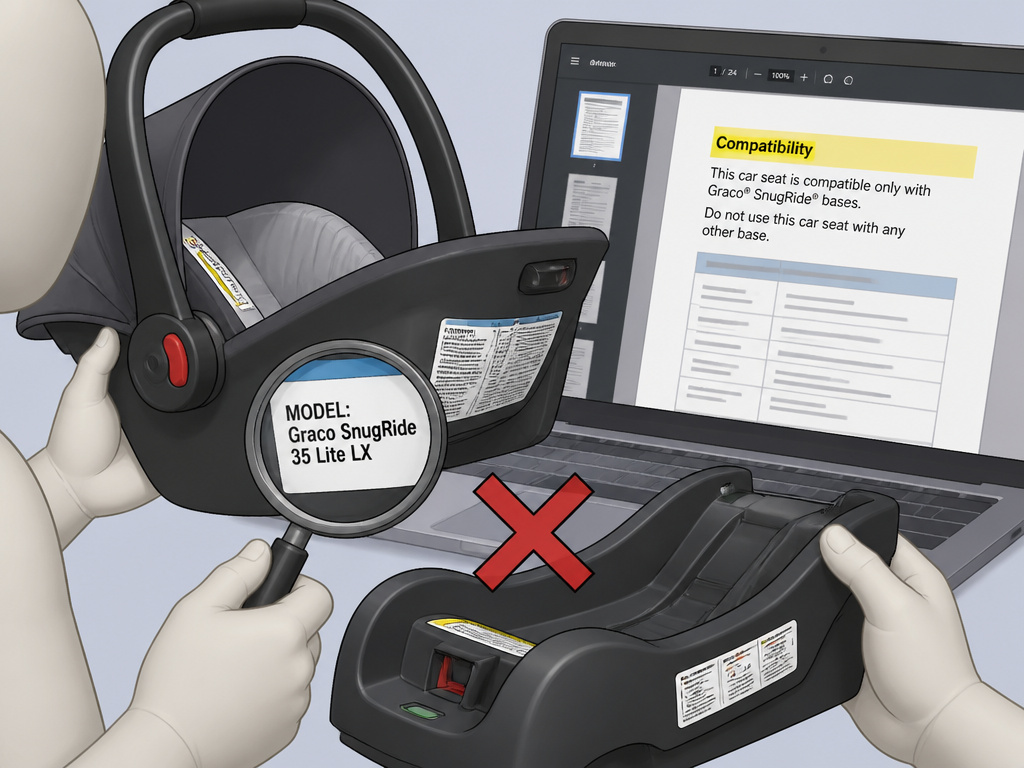
Throw out the idea of guessing. Compatibility is a documented fact, not an opinion. Here is the only sequence that works.
- Find the exact model name and number. This is on a label on the side of the car seat shell and on the bottom of the base. “Graco SnugRide 35 Lite LX” is different from “Graco SnugRide SnugLock 35.” Write them down.
- Pull the official manual. Go to the manufacturer’s website, navigate to the product support page, and download the PDF manual for your specific model. Do not rely on memory or a quick-start guide.
- Search the “Compatibility” section. It’s always there. The Nuna PIPA Series Base manual states: “This base is compatible with all USA PIPA series infant car seats except the PIPA urbn.” The BeSafe Beyond Base manual lists three exact seat models it works with. This list is the final word.
- Use the brand’s online fit finder. Most major brands (Britax, Chicco, Graco) have a tool on their site where you input your car seat model and it outputs a list of compatible bases. This is especially crucial if you’re buying an extra car seat base for a second vehicle.
If you’re considering a best infant base, you must start with the seat you own or intend to buy. The base choice flows from the seat, never the other way around.
Common mistake: Assuming a base fits because the seat “clicks” onto a stroller via an adapter. Stroller adapters are for convenience, bearing only the child’s weight. Car seat bases are for survival, managing crash forces exceeding 30 G’s. The two systems are unrelated.
When You Have No Choice: Installing Without the Base
What if you’re in a taxi, a rental car, or using grandma’s car without a base? This is the scenario the NHTSA’s “solely by a seat belt” rule exists for. Every infant carrier has built-in belt paths for this reason.
Installing an infant seat with a seat belt:
- Route the vehicle’s lap and shoulder belt through the designated belt path on the car seat shell (usually marked with blue or red guides).
- Buckle it. Press down firmly into the vehicle seat and pull the shoulder belt tight to remove all slack.
- The seat should not move more than an inch side-to-side or front-to-back at the belt path. This install base without LATCH method is federally approved and just as safe as a base when done correctly.
Knowing this drill is essential. It turns a base from a necessity into a convenience, a very helpful one, but not the only legal way to secure your child.
The Lifespan and Legacy of a Base
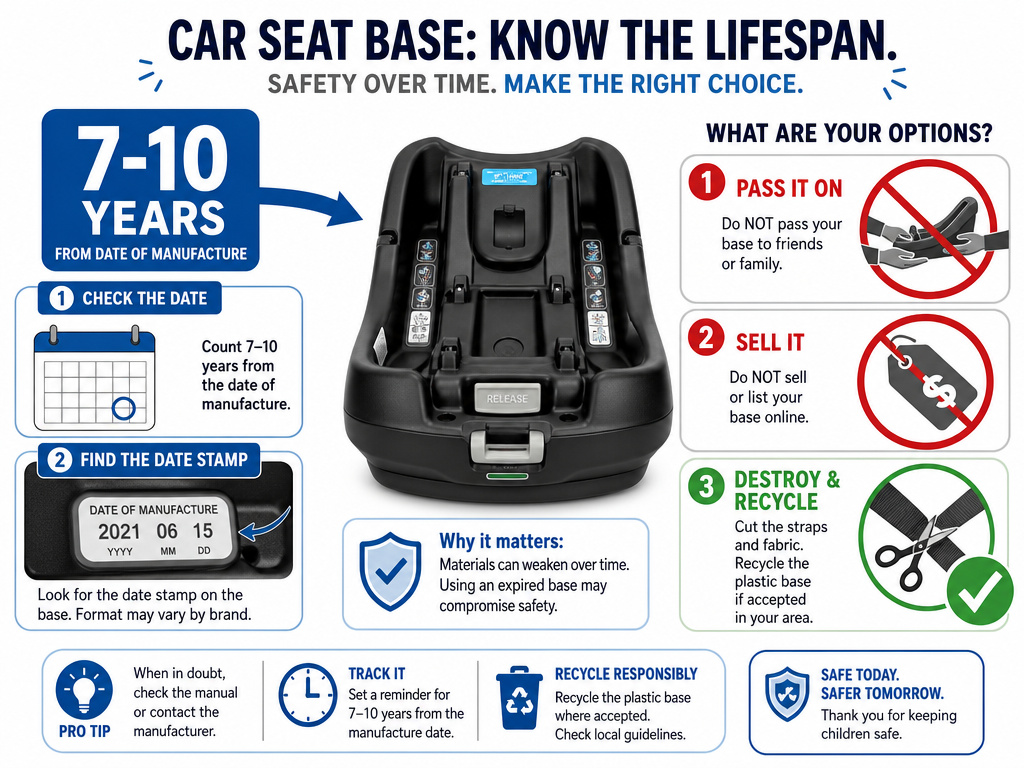
A base isn’t a one-time purchase. It’s a component with an expiration date and an end-of-life plan.
Most bases have a useful life of 7 to 10 years from the date of manufacture. Plastic degrades, and safety standards evolve. The car seat base expiration date is stamped on the unit. Respect it.
What about old car seat bases? You have three options, and only one is good. * Pass it on? No. You cannot verify its crash history or if all parts are present. Most manuals advise against second-hand use. * Sell it? Never. You transfer liability for a safety-critical component with an unknown history. * Destroy and recycle. Disable it by cutting the LATCH straps and harnesses, then check with your local waste management for recycling programs. Some retailers offer trade-in events.
This lifecycle, from dated manufacture to mandated destruction, further underscores that a base is a specific part of a certified system. It is not a generic accessory.
Frequently Asked Questions
Can I use a Graco seat on a Chicco base?
No. The locking mechanisms are completely different. A Graco seat will not physically engage with a Chicco base’s lock. Even if you managed to wedge it in, the combination has never been crash-tested and provides zero guaranteed protection.
Are European ISOFIX bases universal?
No. The ISOFIX anchor points in the car are standard, but the base itself is brand-specific. A Cybex base is only for Cybex seats, a BeSafe iZi Modular base only for BeSafe iZi seats. The term “ISOFIX” refers only to the vehicle connection.
My friend has the same brand seat. Can I borrow their base?
Only if it is the exact same model line and within its expiration date. A Nuna PIPA base is not compatible with a Nuna PIPA urbn seat, as the manual explicitly states. Always check the specific model compatibility list first.
Why does my travel system let me mix brands then?
Travel system strollers use adapters that simply cradle the infant carrier. They handle static weight, not dynamic crash forces. Car seat bases have rigid, positive locks designed to withstand thousands of pounds of force. The two functions are unrelated, and the adapter’s flexibility creates a dangerous false analogy.
How do I find a compatible base for an older seat?
Start with the seat’s model number and manual. Contact the manufacturer’s customer service directly with that number. They can tell you if replacement bases are still available for that specific, discontinued model. Do not guess.
The Bottom Line
Car seat bases are not the same. They are legally defined components of a crash-tested system, married to specific seat models by proprietary locks and federal regulation. The NHTSA’s interpretation makes clear that a seat must work without its base, and the 2008 Chicco recall shows bases are treated as serialized, replaceable safety parts.
Your rule is simple: compatibility is a documented fact, not a visual guess. The manual for your seat holds the only list that matters. Choose a base from that list, install it tightly, whether by LATCH installation or seat belt, and replace it when it expires. That path doesn’t just follow best practices; it follows the law.
