
Do Car Seat Bases Expire | The 7 vs 8 Year Split by Brand
This post contains affiliate links. As an Amazon Associate, we earn from qualifying purchases.
Car seat bases expire, and the timeline is printed in the manual and on a label on the base itself. Most major brands, like Maxi-Cosi, Safety 1st, and Cosco, set the limit at 8 years from the date of manufacture. Others, including Baby Jogger and UPPAbaby, enforce a 7-year lifespan. The countdown starts the day the plastic is molded, not the day you buy it.
That seven or eight year clock is non-negotiable. It’s a material science limit, not a marketing suggestion. The plastics, foams, and webbing degrade from heat, cold, and UV exposure, losing their ability to absorb crash forces predictably. An expired base is a compromised safety device.
What follows is a breakdown of where to find your base’s birthday, why the expiration exists, and what happens if you ignore it. We’ll also cover the critical difference between a base that’s merely old and one that’s been in a crash, because a crash demands immediate replacement, regardless of the calendar.
Key Takeaways
- Brands dictate the timeline: Most Dorel Juvenile brands (Maxi-Cosi, Safety 1st, Cosco) expire in 8 years; Baby Jogger and UPPAbaby expire in 7.
- The clock starts at manufacture: The expiration is calculated from the date molded into the plastic, not your purchase date.
- A crash trumps the calendar: Any moderate or severe crash necessitates immediate replacement, even if the base is brand new.
- Second-hand is high-risk: Without a verifiable history free of crashes and within the expiration window, a used base is a gamble.
- Disposal is a responsibility: Cut the straps and write “EXPIRED” or “CRASHED” on the shell before recycling or trashing to prevent reuse.
Why Do Car Seat Bases Have an Expiration Date?
Plastic gets brittle. It’s that simple. The high-impact polymers and energy-absorbing foams in a car seat base are engineered to perform within a specific tolerance for a finite period. The expiration date is the manufacturer’s guarantee that the materials will behave as tested up to that point.
The polymers in car seat components are subject to plasticizer loss, UV degradation, and thermal cycling. Over 6–8 years, these processes can reduce the material’s ductility and impact resistance by a measurable percentage, moving it outside the certified performance envelope defined during FMVSS 213 testing.
Think about the environment a base lives in. A car’s interior can swing from below freezing to over 140°F. Summer sun beats on the plastic for hours. This thermal cycling stresses the material, slowly breaking down the polymer chains. The harness webbing and LATCH straps are also textile products; they can weaken from friction, moisture, and repeated tension.
The 7 or 8 year mark isn’t arbitrary. It’s the result of accelerated aging tests that simulate years of real-world conditions. Brands like Baby Jogger and UPPAbaby have settled on 7 years for their specific material blends, while Maxi-Cosi and Safety 1st certify theirs for 8. Going past that date means you’re relying on materials that have exceeded their tested service life.
How to Find Your Car Seat Base’s Expiration Date
You need two pieces of information: the manufacturer’s stated useful life and the base’s date of manufacture. The first is in the manual. The second is on a label stuck to the base itself.
Step 1: Consult the manual. Dig out the paper booklet that came with the base. Look for a section titled “Expiration,” “Replacement and Expiration,” or “Safety Information.” The language is direct. For example, the Maxi-Cosi manual states, “Do not use this base more than 8 years after the date of manufacture.” The Baby Jogger manual says, “DISCONTINUE USE of this child restraint base after 7 years from the manufacture date.”
Step 2: Locate the manufacturer’s label. This is usually a white sticker affixed to the underside or top-side of the base shell. It lists the model number, serial number, and, critically, the date of manufacture. The date is often in a YY-MM-DD or MM-YY format.
Step 3: Do the math. If the label says “DOM: 03-22-2023” and your manual says “8 years,” then the base expires on March 22, 2031. Write this date with a permanent marker directly on the base. Future-you will thank present-you.
| Brand | Standard Expiration | Where to Find DOM | Manual Reference |
|---|---|---|---|
| Maxi-Cosi, Safety 1st, Cosco | 8 years | Label on top of base | “Do not use… More than 8 years after date of manufacture.” |
| Baby Jogger, UPPAbaby | 7 years | Label on bottom/top of base | “Discontinue use after 7 years from date of manufacture.” |
| Nuna PIPA Series | Check label | Label on underside of base | “Check the label… For expiration date information.” |
| Orbit Baby G5 | Check label | Product information label | “DO NOT use… After the expiration date.” |
Common mistake: Assuming the “DOM” is the purchase date. The plastic was molded months, sometimes a year, before you bought it. The countdown started then.
If you’ve lost the manual, download a fresh PDF from the manufacturer’s website. Searching “[Brand Name] [Model] manual” almost always works. This is also the only way to get definitive car seat base expiration guidelines for your specific model.
The 7-Year vs 8-Year Split: Which Brands Use Which Timeline?
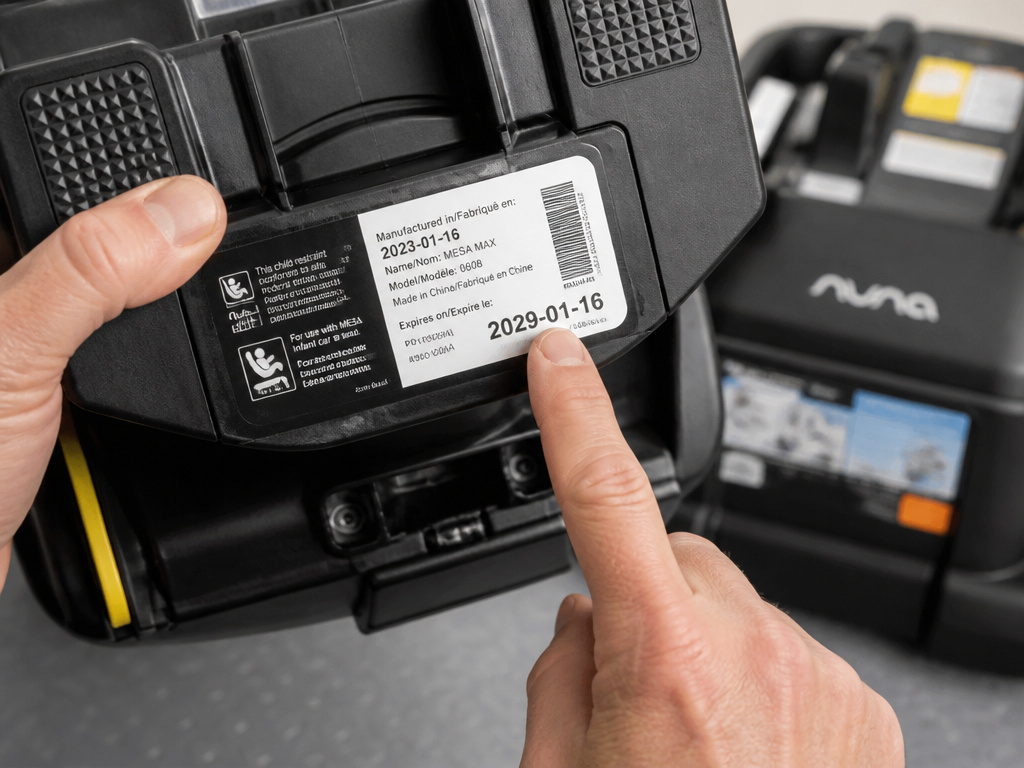
Not all bases share the same lifespan. The split largely falls along corporate brand lines.
The 8-Year Club: This group is predominantly under the Dorel Juvenile umbrella. If you have a Maxi-Cosi, Safety 1st, or Cosco base, the manual almost certainly states an 8-year useful life from the manufacture date. Their testing and material specifications support this longer window.
The 7-Year Standard: Baby Jogger and UPPAbaby (for models like the Mesa Max) explicitly call for discontinuation after 7 years. Their engineering and safety certifications are built around this shorter timeline. It’s not that their plastics are inferior, it’s a more conservative certification based on their specific designs and material choices.
The “Check the Label” Group: Some brands, like Nuna, don’t print a universal number in the manual. Instead, they stamp an explicit expiration date on the label of each individual base. You must find that sticker. Similarly, Graco uses a tiered system: up to 10 years for steel-reinforced seats, but often 7 years for infant seats with plastic belt paths. Always verify.
This is why asking “do car seat bases expire?” gets a yes, but the follow-up is always “which one do you have?” Your base’s lifespan is a fact printed on it, not a general rule.
Expiration vs. Crash Replacement: A Critical Distinction
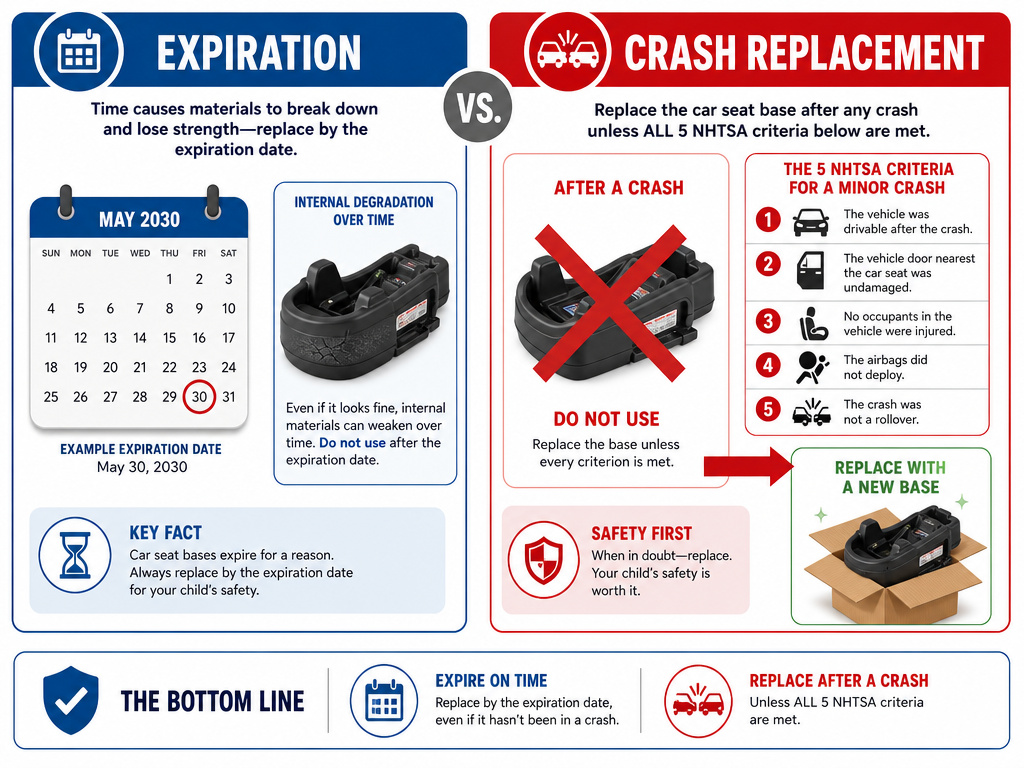
Expiration is a slow, predictable end of life. Crash replacement is an immediate, event-driven mandate. Confusing the two is dangerous.
After any moderate or severe crash, the base is done. Full stop. The NHTSA states that a car seat is designed to protect a child in a single crash. The energy absorption is a one-time event; the plastics and foams compress and deform in ways you cannot see. Continuing to use it is like reusing a bicycle helmet after an impact, the protection is gone.
The NHTSA’s criteria for a minor crash are strict. All of the following must be true: * The vehicle was drivable away from the crash site. * The door nearest the car seat was undamaged. * No passengers were injured. * No airbags deployed. * There is no visible damage to the car seat or base.
If any one of those points fails, or if you’re unsure, you must replace the base. This is why buying a second-hand car seat or base is so risky. You are trusting a stranger’s word about a potentially life-threatening event.
Where this goes sideways: Using an expired but undamaged base because “it looks fine.” The internal degradation isn’t visible. In a crash, brittle plastic can shatter instead of flexing, and weakened straps can snap.
Expiration is the maximum service life. A crash can end that service life in an instant. Treat them as separate, non-negotiable rules.
The Physical Signs of an Aging Car Seat Base
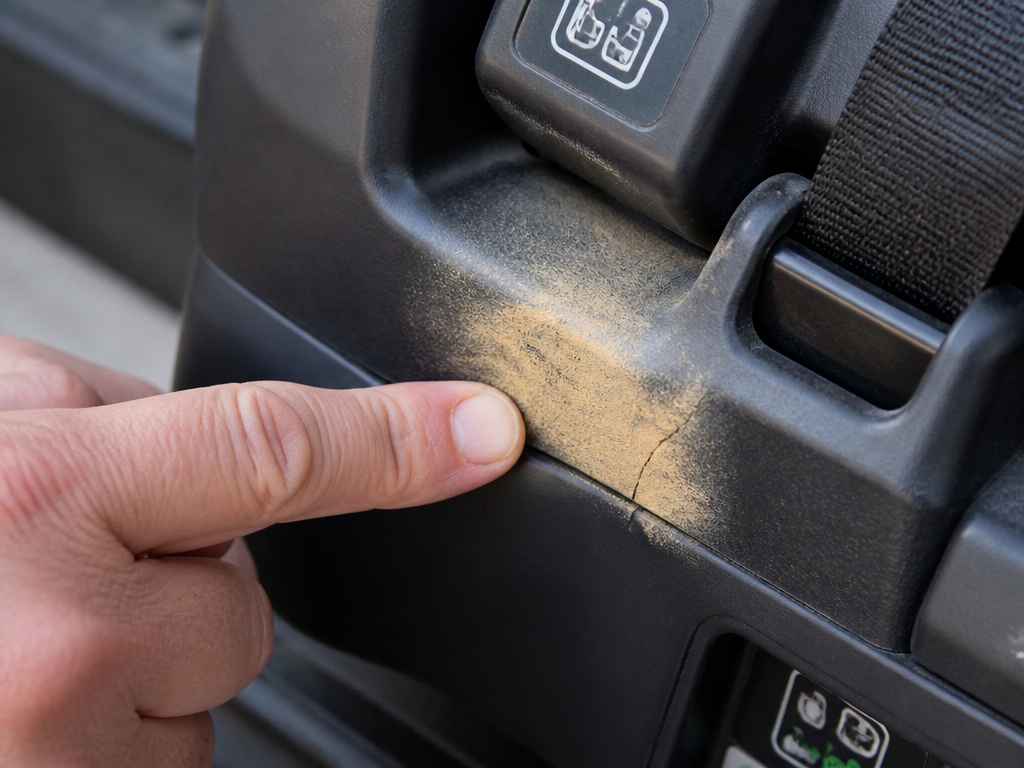
While you should never wait for visual cues to retire a base, knowing the signs of degradation helps explain why the rule exists.
- Discolored or Chalky Plastic: Sun exposure breaks down UV stabilizers, leaving plastic faded, often grayish or yellowish. This is a sign of surface degradation.
- A Sticky or Gummy Texture: This is plasticizer leaching out of the polymer. The surface feels tacky and attracts dirt. The material’s integrity is compromised.
- Visible Cracks or Stress Whiteners: Look around high-stress points: where the LATCH straps route through the shell, near the belt path, or where the carrier clicks in. Small cracks or white stress marks mean the plastic is fatigued.
- Stiff, Frayed, or Faded Straps: The LATCH webbing and vehicle belt should be flexible and strong. If they’re stiff, frayed, or the color has bleached from the sun, they are weaker.
- Difficulty with Mechanisms: The release button for the carrier gets harder to press. The recline adjuster sticks. This is often worn plastic on plastic, a sign of aging and wear.
If you see any of these, the base is telling you it’s done. Even if the calendar hasn’t hit the official expiration date, significant wear is a valid reason to replace. Safety isn’t just about the number; it’s about the condition.
What to Do With an Expired or Crashed Car Seat Base
You must prevent its reuse. An old car seat base in a thrift store or online marketplace is a hazard waiting for an uninformed parent.
- Disable It: Using a permanent marker or paint, write “EXPIRED” or “CRASHED” in large letters on multiple sides of the shell. Cut the LATCH straps and vehicle belt webbing with heavy-duty scissors.
- Check Local Recycling: Some municipal recycling programs accept hard plastics like car seat shells. Check your city’s guidelines. Do not just put it in the regular recycling bin unless instructed.
- Retailer Trade-In Events: Stores like Target host annual car seat trade-in events, offering a coupon in exchange for your old seat. They ensure the seats are properly recycled and kept out of the second-hand market.
- Landfill as Last Resort: If recycling isn’t an option, place the disabled base in your regular trash. Taking up landfill space is better than it ending up in another car.
The goal is to break the cycle. Responsible disposing of a base ensures it can’t be found and used by someone who doesn’t know its history.
Frequently Asked Questions
Can I use a car seat base past its expiration date if it looks fine?
No. The degradation that weakens the plastic and webbing is often internal and microscopic. “Looking fine” is not a safety test. The expiration date is the result of standardized material aging tests; exceeding it means using the product outside its certified performance parameters.
Do I need to replace the base after a minor fender bender?
Follow the NHTSA’s five-point checklist. If your crash meets all criteria, drivable, no door damage, no injuries, no airbags, no visible seat damage, replacement may not be legally required. However, most manufacturers, like Dorel Juvenile, strongly recommend replacement after any crash. When in doubt, replace.
My car seat and base were bought together. Do they expire on the same date?
Not necessarily. The carrier and base are manufactured separately and can have different dates of manufacture stamped on their labels. Always check each label individually and calculate expiration separately. An infant car seat expiration date is independent of the base’s date.
Is it illegal to use an expired car seat base?
There is no federal law prohibiting the use of an expired car seat. However, using one violates the manufacturer’s instructions, which is a primary tenet of proper child restraint use. In the event of a crash, using an expired seat could be used as evidence of negligence in a liability case.
How can I check if my car seat base has been recalled?
Visit the National Highway Traffic Safety Administration (NHTSA) website and enter your base’s brand, model, and model number. You can also check the manufacturer’s website. For example, a notable past issue was the 2008 NHTSA child seat recall notice for certain Chicco KeyFit bases due to a LATCH webbing defect.
Before You Go
Car seat bases expire. The timeline is specific, printed, and non-negotiable. For most parents, the rule is simple: find the manufacture date on the label, add the years stated in your manual (7 for Baby Jogger/UPPAbaby, 8 for Maxi-Cosi/Safety 1st/Cosco), and mark that date on your calendar.
But the real takeaway is broader. A base’s life is defined by two hard stops: the expiration date and any crash event. Both demand immediate retirement. This makes second-hand bases a minefield and diligent ownership a requirement. When the time comes, destroy the old base to prevent its reuse. The right choice is usually the one that seems overly cautious, because with child safety, cautious is correct.
