
Why Is a Rear Facing Car Seat Safer? The Definitive Data
This post contains affiliate links. As an Amazon Associate, we earn from qualifying purchases.
A rear facing car seat is safer because it cradles a child’s head, neck, and spine, distributing crash forces across the entire back. In a frontal collision, the most common and severe type, a forward-facing child’s body is held by the harness, but their head whips forward, putting immense strain on the undeveloped cervical spine. A rear-facing seat allows the child’s back to absorb the deceleration, reducing the odds of injury by 9% compared to forward-facing.
That 9% figure comes from a real-world crash analysis. It’s not a theoretical best-case scenario. It’s the measured outcome when comparing thousands of actual collisions.
The rest of this guide walks through the physics that make this happen, the government testing that proves it, and the specific misconceptions that lead parents to switch too early. By the end, you’ll know exactly what the seat is doing in a crash and why the height and weight limits on the label are the only numbers that matter.
Key Takeaways
- A 2022 study of real crashes found children aged 0-4 were 9% less likely to be injured when rear-facing versus forward-facing.
- In a frontal crash, a rear-facing seat allows the child’s back to absorb force; a forward-facing seat leaves the neck to bear the load of the head’s whiplash motion.
- Minimum weight limits on forward-facing labels are legal minimums, not safety recommendations. The safe guideline is to use the seat’s maximum rear-facing limit.
- Swedish research estimates nearly half of fatally injured children under four could have survived if using a rear-facing seat.
- Concerns about cramped legs or boredom are not safety issues. A child’s leg position does not increase injury risk in a crash.
The Physics of a Crash: Why Direction Matters
Forget the marketing. The safety difference is a simple engineering problem. In a violent frontal collision, everything not secured keeps moving forward at the vehicle’s original speed until it’s stopped by something.
An adult’s three-point seat belt allows controlled upper-body movement to manage that energy. A forward-facing child in a five-point harness is held tightly at the shoulders, hips, and pelvis. Their head, which is proportionally larger and heavier than an adult’s, is completely unrestrained.
During testing of rear-facing child restraint systems, all portions of the test dummy’s torso must be retained within the system, and specific target points on the dummy’s head must not pass through defined planes. This is the federal performance standard (49 CFR § 571.213b) that every seat must pass.
The result is dramatic differential movement. The body stops with the car seat. The head keeps going. The immature vertebrae and ligaments in a young child’s neck are not designed to handle that sudden loading. The risk is a catastrophic spinal cord injury, not merely a neck sprain.
A rear-facing seat redefines the problem. The child’s entire back, from the base of the skull to the tailbone, is in continuous contact with the seat shell. During a frontal crash, the child is pushed deeper into the supportive shell. The crash forces are spread across a large area of the body’s strongest bones. The head moves in unison with the torso, eliminating the whiplash effect.
The seat itself is designed to rotate or “cocoon” upward toward the vehicle seatback in a severe crash, further managing the deceleration. Transport Canada’s high-speed testing documented this rotation and confirmed it’s part of the design, not a failure.
The short version: Forward-facing focuses crash energy on the neck. Rear-facing spreads it across the back. One is a single point of failure. The other is a distributed load.
The Data That Convinced Regulators
The physics are clear in slow motion. Real-world epidemiology confirms they matter on the road. Two studies, one from the U.S. And one from Sweden, provide the hard numbers that shifted official guidelines.
A peer-reviewed child restraint research study analyzed over a decade of Kansas crash data. It compared injury outcomes for children aged 0-4 in rear-facing versus forward-facing seats. The unadjusted data showed a 14% reduction in injury odds for rear-facing. After controlling for factors like crash severity and seating position, the benefit remained a significant 9% reduction.
| Study Focus | Key Finding | Why It Matters |
|---|---|---|
| U.S. Observational (Kansas Data) | 9% lower odds of any injury for rear-facing vs. Forward-facing. | Proof from thousands of real crashes, not just lab tests. |
| Swedish Fatal Crash Analysis | Up to 48% of fatally injured children 0-3 could have survived rear-facing. | Quantifies the life-or-death stakes of the decision. |
| Transport Canada Crash Testing | Seats provided excellent protection in tests up to 56 km/h; rotation is by design. | Validates the crash dynamics observed in the real world. |
The Swedish research is even more stark. Analysts reviewed decades of fatal crashes. They estimated that 48% of children aged 0-3 who were killed could likely have survived if they had been in a rear-facing restraint. For children aged 4-6, an additional 27% had survival potential. Sweden’s national recommendation to stay rear-facing until at least age four is a policy built on decades of casualty data, not a cultural preference.
These numbers are why the NHTSA car seat safety guidelines dropped age-based advice. The current directive is a single line: “Keep your child rear-facing as long as possible, until he or she reaches the top height or weight limit allowed by your car seat’s manufacturer.”
Navigating Car Seat Labels and Limits
This is where parents get tripped up. Every convertible seat has two sets of limits printed on the label: one for rear-facing, one for forward-facing. The forward-facing limit always has a minimum weight (like 22 lbs). The rear-facing limit is a maximum (like 40 or 50 lbs).
Common mistake: Switching to forward-facing once the child hits the minimum weight. That minimum is the legal threshold at which the seat has been tested and approved for forward-facing use. It is not the safe or recommended time to switch.
The safe choice is to ignore the forward-facing minimum. Your only guide is the rear-facing maximum. Use the seat in the rear-facing mode until your child exceeds either the height or weight limit printed for that mode. A child who is 30 lbs but has a 40 lb rear-facing limit should stay rear-facing. A child who is 38 lbs but whose head is within an inch of the top of the seat shell is still within the limit.
This is the core of extended rear-facing. It means using a convertible seat’s higher rear-facing capacity instead of moving to an “all-in-one” seat’s forward-facing mode prematurely. Seats like the Graco Extend2Fit or the Chicco NextFit Max are designed specifically for this, with high weight limits and adjustable leg rooms.
The rule is absolute. The limits are based on the seat’s structural integrity and harness geometry in crash testing. Going past them means the seat’s performance is no longer certified.
Addressing Parent Hesitations (And One Real Danger)
The data is compelling, but daily realities make parents question it. Let’s separate legitimate concerns from myths.
“Their legs are bent/cramped/touching the seatback.”
This is the most common worry. It feels uncomfortable to an adult. The biomechanics say otherwise. Children are flexible and will sit cross-legged, froggy-legged, or draped over the sides. In a crash, legs are far less likely to be injured than the head or spine. There is no documented case of a child suffering leg injuries due to rear-facing. The risk of a spinal injury from forward-facing is well-documented. It’s not a comparable trade-off.
“They get bored or carsick.”
A child who can see you might be happier, but not safer. Try using a mirror that straps to the headrest. For carsickness, the direction of travel is rarely the primary cause; it’s more about inner-ear sensitivity and focusing on near objects. Forward-facing doesn’t guarantee relief.
“They’ve outgrown their infant seat.”
This is the correct time to move, not to forward-facing, but to a rear-facing convertible car seat. These seats are the workhorses of child passenger safety, designed to handle toddlers and preschoolers in the rear-facing position.
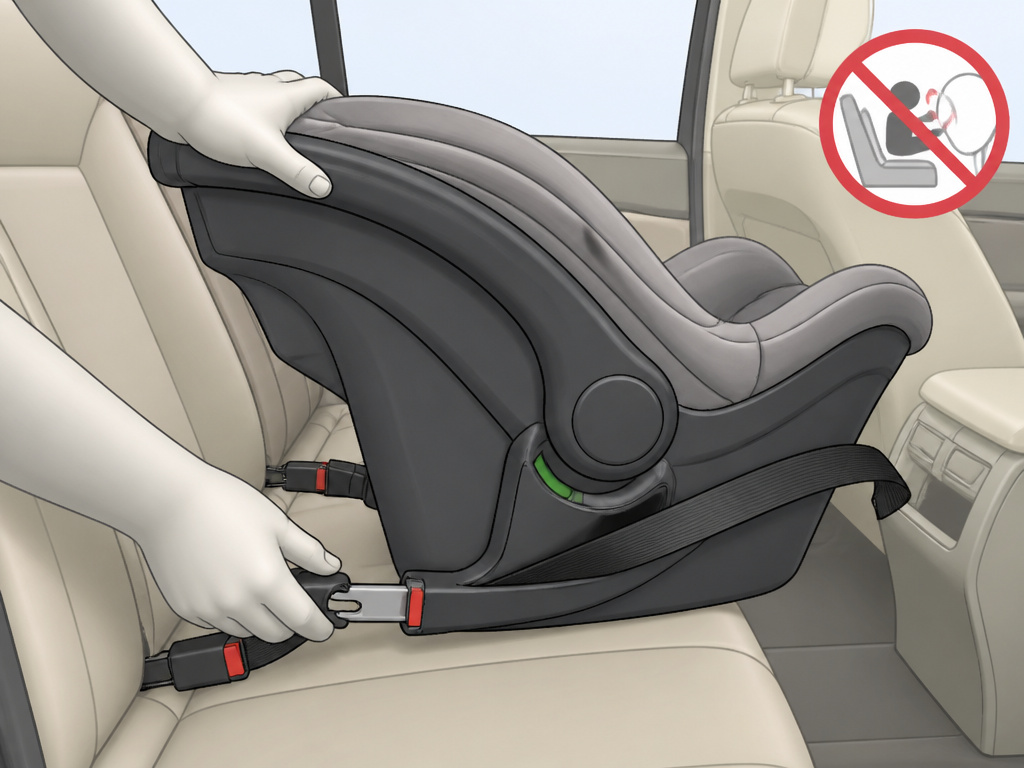
The one real danger: Using a rear-facing seat in the front passenger seat of a vehicle with an active airbag. The CDC MMWR air bag warning is explicit: a deploying airbag can strike the back of a rear-facing seat with tremendous force, potentially causing serious injury. Always install rear-facing seats in the back seat. If you must use the front seat (e.g., in a two-seater truck), the passenger airbag must be professionally disabled.
When you’re ready to make the switch, a proper rear-facing installation is non-negotiable. Whether you use the LATCH system or the vehicle seat belt, the goal is a tight, secure fit with less than one inch of movement at the belt path.
Frequently Asked Questions
Why do convertible seats have a forward-facing minimum weight if it’s less safe?
The minimum weight (e.g., 22 lbs) is a regulatory compliance threshold. It means the seat passed all required safety tests with a dummy of that weight in the forward-facing mode. Regulations set a floor, not a ceiling. Best practices, driven by the injury data, use the seat’s maximum rear-facing capacity as the true safety benchmark.
How long should a child really stay rear-facing?
Follow the seat’s limits. For most modern convertible seats, that means a weight limit of 40 or 50 pounds and a height limit where the child’s head is more than one inch below the top of the seat shell. Many children can ride rear-facing until age 3 or 4. The American Academy of Pediatrics and NHTSA both advise this is the safest practice.
Is a rear-facing seat safe in a rear-end collision?
Yes. While frontal and front-angle crashes are more common and severe, rear-facing seats are also effective in rear-end crashes. In such a crash, the child is pushed back into the seat shell, similar to how an adult is pushed into their seatback. The seat’s structure and the vehicle’s seat absorb the energy.
What about side-impact crashes?
Rear-facing provides significant side-impact protection. The deep, contained shell surrounds the child’s head and torso, creating a protective cocoon. Many seats also have additional side-impact technology, like reinforced wings or energy-absorbing foam, which work in both directions.
My child screams when rear-facing. What do I do?
Comfort and routine are key. Ensure the harness is snug but not pinching, the child isn’t too hot or cold, and they have safe, soft toys. A mirror can help them see you. Consistency is vital, turning them forward to stop the crying teaches them that screaming works and removes their safety advantage.
The Bottom Line
The question concerns physics and verified outcomes rather than parent judgment. A rear-facing car seat is a necessity based on physics.It’s a proven intervention that changes injury odds by a measurable percentage.
The move to a forward-facing seat is a step down in protection. It should be delayed until the seat itself forces your hand by way of a hard, printed limit. Until that day comes, a child’s crossed legs or occasional protest is a minor trade for the documented security of a spine cradled by its strongest bones.
Choose a seat with high rear-facing limits, install it tightly in the back seat, and let the harness hold them close. That’s the configuration the data supports. Everything else is noise.
