
Are Car Seat Inserts Safe? Get the Definitive Facts Here
This post contains affiliate links. As an Amazon Associate, we earn from qualifying purchases.
Car seat inserts are safe only when they are the specific model made and approved by your car seat’s manufacturer. Using any other insert, whether sold separately as a “universal” fit or handmade, introduces unverified padding that can compress in a crash, creating dangerous slack in the harness. The Axkid ONE 3 insert, for example, is mandatory for infants under 11 lbs but must be removed once the child weighs over 20 lbs or sits on the buckle.
That approval clause is the whole game. An insert isn’t just a piece of foam; it’s a crash-tested component of the restraint system. Its thickness, density, and placement are engineered to work with the seat’s shell and harness at specific force levels.
What follows: the exact federal rules that create a dangerous loophole for aftermarket products, the two physical failure modes that happen when you add unapproved padding, and the simple checklist to know if your insert is doing its job or putting your child at risk.
Key Takeaways
- The only safe insert is the one that came with your seat or is sold as a direct replacement by the manufacturer.
- Federal regulations allow aftermarket accessories to be sold even if they make a car seat non-compliant with safety standards, a loophole that shifts all risk to you.
- Added padding creates harness slack by compressing during a crash; a half-inch of slack can double the force on a child’s body.
- You must remove the infant insert when your child exceeds the manufacturer’s weight or height limit, or if the child is sitting on top of the harness buckle.
- Never use inserts, head supports, or blankets that go between the child and the seat or harness.
The Only Safe Car Seat Inserts
Forget the cute patterns and the soft, plush aftermarket pillows. The safety of a car seat insert isn’t about comfort, it’s about certification. The only inserts that are safe are those that have been dynamically crash-tested as part of the specific car seat model they are designed for.
The Axkid ONE 3 infant insert manual states it is “ONLY for use with the AXKID ONE 3 car seat” and warns that “use of accessories not approved by Axkid could alter the performance and injure the child.”
This isn’t corporate liability talk. It’s physics. During a crash, every material in the seat compresses. The factory insert is engineered to compress in a predictable, minimal way. Its foam density and placement are calculated so that when the harness is tightened to the proper snugness, it stays snug through the crash pulse. An aftermarket insert is an unknown variable. It might be twice as thick and compress by 80%, turning a tight harness into a lethal amount of slack.
Where this goes sideways: Buying a second-hand seat without its original insert. You see a “similar” one online or figure a rolled-up blanket will do. That blanket compresses to nothing on impact. The child’s body now moves several inches forward before the harness engages, multiplying the crash forces on their neck and spine.
How to Verify Your Insert is Approved
You need the manual. If you lost it, download it from the manufacturer’s website using your seat’s model number and manufacture date. The manual will list all approved accessories by name and part number.
For a newborn, the insert is often mandatory. The Axkid ONE 3 insert is required for infants weighing 2.3–5 kg (5–11 lbs). For babies between 5–9 kg (11–20 lbs), it becomes optional, use it only if it improves the fit. The rule is concrete: discontinue use when the child’s weight exceeds 9 kg (20 lbs), height exceeds 61 cm (24 in), or if the child is sitting on top of the harness buckle. Other brands, like Baby Trend, have similar strict weight limits, often capping mandatory insert use at 8 lbs.
If your manual doesn’t mention an insert, your seat wasn’t designed for one. Adding one now voids its certification.
The Aftermarket Insert Loophole
Here’s the confusing part that traps parents. A car seat manufacturer like Graco or Britax will tell you never to use an unapproved accessory. Yet, you can easily buy non-approved inserts, head supports, and strap covers online. Why? Because of a regulatory gap.
The NHTSA interpretation on seat covers clarifies that Federal Motor Vehicle Safety Standard (FMVSS) No. 213 applies to the child restraint system itself, not to aftermarket accessory items sold separately to consumers. Another ruling, NHTSA regulatory letter 06-001831, goes further: “aftermarket accessories may be added to the child restraint system, even if the addition of those accessories causes the child restraint to no longer comply with Standard No. 213, without violating the requirements of the standard.”
| Entity | Stance on Aftermarket Inserts | Consequence for Parents |
|---|---|---|
| Car Seat Manufacturer (e.g., Axkid) | “DO NOT use accessories… Other than those provided by Axkid.” | Using one voids the seat’s warranty and safety certification. |
| NHTSA / Federal Regulation | Aftermarket accessories are allowed, even if they make the seat non-compliant. | The accessory seller isn’t violating FMVSS 213, but your modified seat may fail in a crash. |
| American Academy of Pediatrics | “Car safety seat inserts should only be used if they came with the seat.” | Using non-approved inserts is not recommended by pediatric safety experts. |
The takeaway is jarring. The law protects the aftermarket seller, not your child. The responsibility for ensuring a modified seat still works falls entirely on you, the parent, with no way to test it.
Why Unapproved Padding Fails (The Physics)
An aftermarket insert can cause injury in two specific, physical ways. It’s not a vague “might be unsafe.” It’s a predictable mechanical failure.
First, harness slack. You tighten the straps until you can’t pinch any webbing at the shoulder. You add a plush, one-inch thick insert behind the baby’s back. In a 30-mph crash, that plush foam compresses to a quarter-inch. That three-quarters of an inch of compression is now slack in the harness system. The child’s body moves forward that extra distance before the harness catches them, increasing the forces on their body exponentially.
Second, flammability and fit. FMVSS 213 requires materials in the child restraint to meet specific flammability resistance standards (FMVSS No. 302). An aftermarket insert has no such requirement unless it’s installed by a dealer or repair shop. Furthermore, a bulky insert can alter the harness routing, pulling it away from the child’s body or creating pressure points.
Common mistake: Using a “head support” pillow that straps around the car seat shell. These often push the child’s head forward into an unnatural, chin-to-chest position that can restrict airflow. This is a suffocation risk for infants who lack head control.
The AAP car seat information for families is blunt: additional products are not covered by any federal safety standards, and they do not recommend their use. The data backs this up. A peer-reviewed car seat challenges analysis notes that improper use of car seats is common and dangerous, and that manufacturers have a responsibility consumers often don’t fully understand.
Manufacturer-Approved Inserts vs. Everything Else
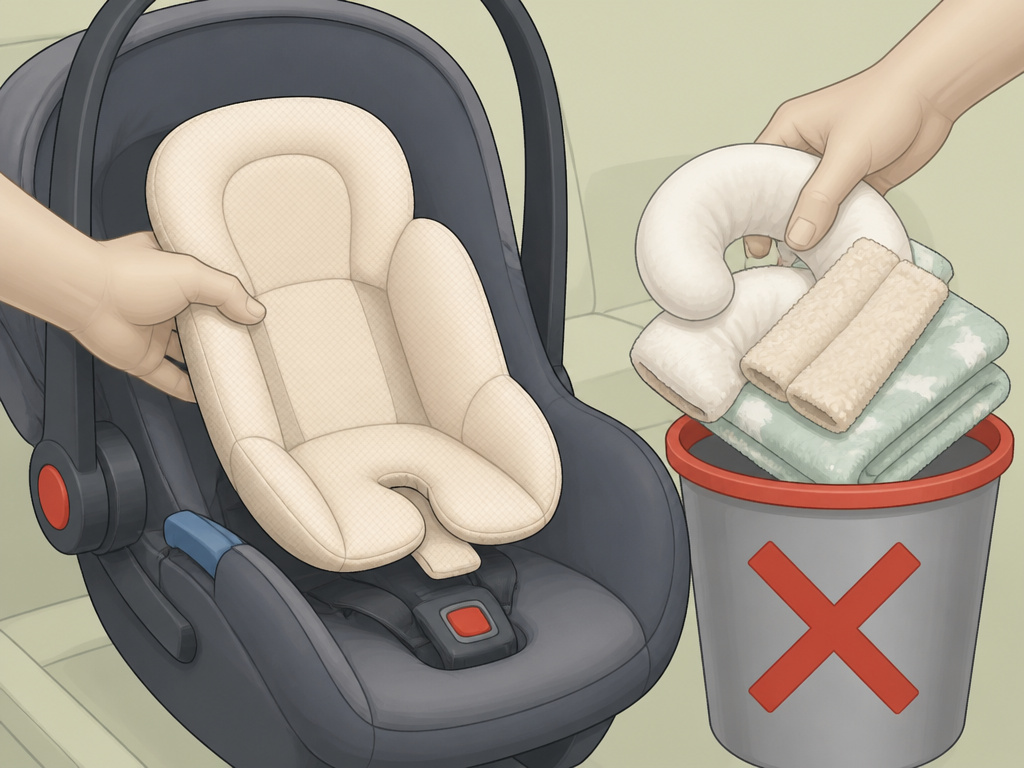 Let’s be specific. What you can use is narrow. What you can’t use is everything else.
Approved (Safe):
- The infant insert that shipped in the box with your new convertible or infant-only seat.
- The toddler insert or “body pillow” that comes with some convertible seats for older babies.
- A replacement insert purchased directly from the car seat manufacturer’s website or parts department, using your exact model number.
Not Approved (Unsafe):
- “Universal” newborn inserts sold on Amazon or at baby stores.
- Strap covers that didn’t come with your seat.
- Head support pillows that wrap around the seat or harness straps.
- Hand-knit or sewn inserts placed behind the child’s back or under their bottom.
- Any additional padding, including folded blankets, between the child and the seat harness.
The line is absolute. If it didn’t come from the car seat maker for your specific model, it’s a hazard. This includes seemingly harmless car seat blankets that tuck around the child after harnessing and aftermarket car seat covers that go under the child.
When to Remove the Insert
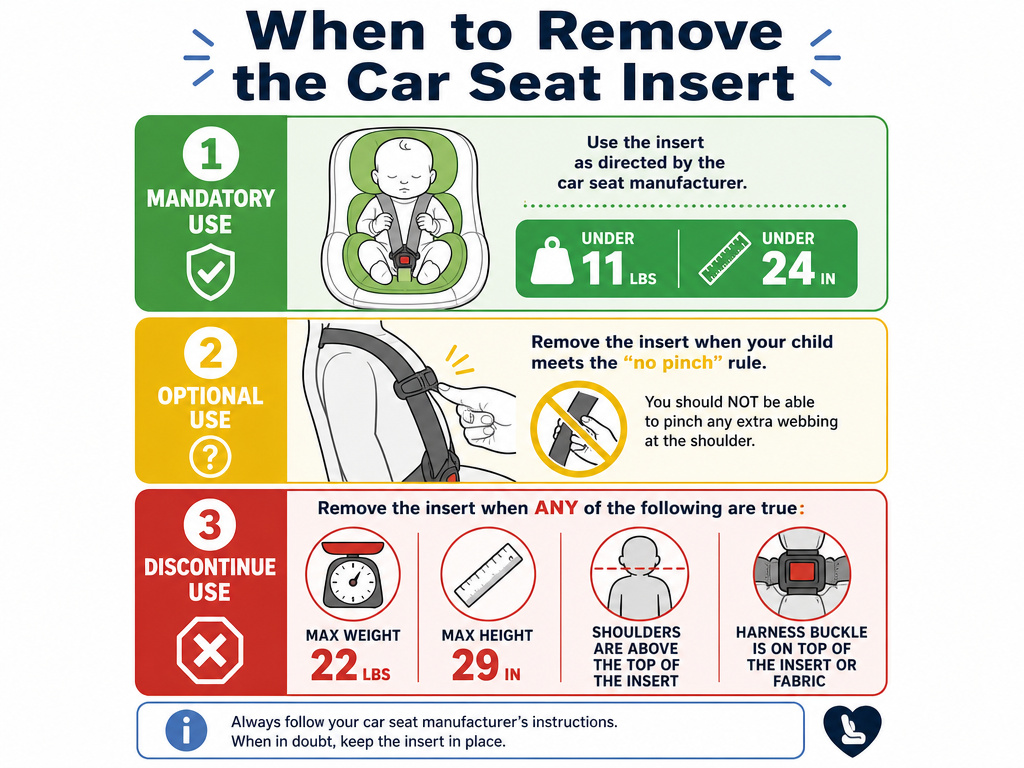 The insert has a job, and that job ends. Using it too long is as risky as not using it when needed. The decision is driven by weight, height, and fit, not age.
Follow your manual. Generally, you’ll move through three phases:
- Mandatory Use: For the smallest newborns. (e.g., Axkid: under 11 lbs, under 24 inches).
- Optional Use: For babies who still fit better with it. The harness should be at or below the shoulders, and you should not be able to pinch the strap.
- Discontinue Use: When any of these happen:
- Child’s weight exceeds the maximum (often 18-20 lbs).
- Child’s height exceeds the maximum.
- The child’s shoulders are above the lowest harness slots.
- The child is sitting on top of the harness buckle crotch strap.
If you have to force the buckle between the insert and the child, or if the buckle sits on top of the insert material, the insert is too small. Take it out. This is a common point of confusion, which is why we have a dedicated guide on when to remove the newborn insert.
The Safe Alternatives to Aftermarket Inserts
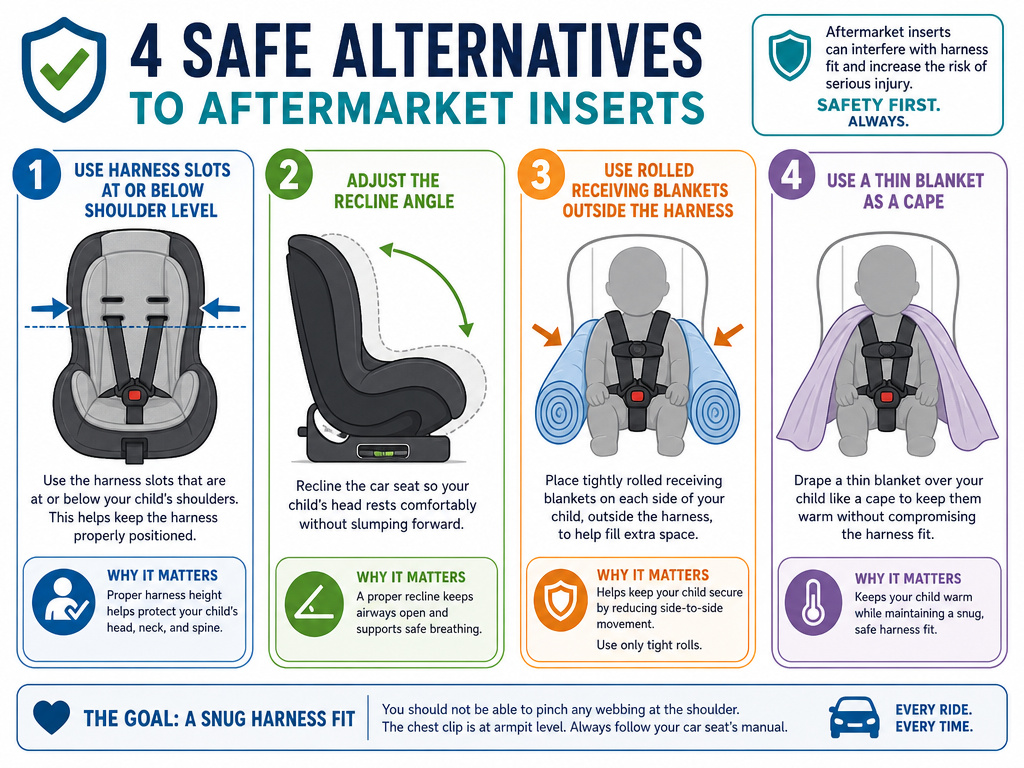 Your baby is swimming in their seat. The harness seems too high. You need a solution that doesn’t involve unapproved infant inserts. Here’s what to do, in order.
- Check the harness height. For rear-facing, the harness straps must be at or below the child’s shoulders. Lower them to the nearest slot.
- Use the built-in recline. Many seats have an adjustable recline foot or position. A more reclined angle can better cradle a newborn.
- Roll small receiving blankets. Place tightly rolled blankets on either side of the baby’s torso and hips, outside the harness. Never put anything under or behind the baby that wasn’t tested with the seat.
- Use a blanket over the top. Once the harness is snugly secured, tuck a thin blanket over the child like a cape. This provides warmth without interfering with the restraint system.
If these steps don’t create a secure fit, your child may simply be too small for that particular convertible seat. An infant-only car seat (a “bucket” seat) is often a better fit for premature or very small newborns and is designed with integrated infant padding.
Frequently Asked Questions
Can I buy a replacement insert from the manufacturer?
Yes, and this is the only safe way to replace a lost or damaged insert. Contact the car seat manufacturer directly with your model number and manufacture date. They can sell you the correct, crash-tested part. Do not buy generic “replacement inserts” from third-party sellers.
Are head support pillows safe for car seats?
No. Aftermarket head supports that attach to the harness or seat are not approved by car seat manufacturers. They can alter harness routing and push an infant’s head forward, compromising their airway. The only safe head support is the one integrated into the seat’s design.
What about car seat protectors under the seat?
Use extreme caution. Aftermarket car seat protectors can prevent the seat from installing tightly or interfere with the lower anchor connectors. Only use a protector that is explicitly approved by both your car seat manufacturer and your vehicle manufacturer, and ensure it is thin and non-compressible.
My baby slouches to the side without an insert. What do I do?
This is common. The correct fix is to use tightly rolled receiving blankets or small, firm burp cloths placed alongside the baby’s hips and torso, outside the harness straps. This provides lateral support without adding dangerous padding between the child’s back and the seat shell.
How can I be sure my whole setup is safe?
Beyond inserts, complete car seat safety requires a proper installation (less than 1 inch of movement at the belt path), correct harness tightness (no pinched strap), and keeping your child rear-facing as long as the seat allows. The NHTSA car seat safety guidelines are the definitive resource.
The Bottom Line
Car seat safety is a system of engineered parts working together. An insert is one of those parts, not an optional comfort item. The safe path is unambiguous: use only the insert that was made for your exact car seat model, and remove it the moment your child outgrows the specified limits.
The market is flooded with soft, appealing products that promise better sleep or comfort. They are selling you a risk wrapped in fleece. Your child’s crash protection is certified as a complete unit, seat, harness, and approved padding. Adding anything else changes the math in a way you cannot see until it is too late. Stick with what was tested. When in doubt, take it out.
