
Car Seat Safety: Is LATCH or Seatbelt Safer? Data Revealed
This post contains affiliate links. As an Amazon Associate, we earn from qualifying purchases.
A 2015 peer-reviewed crash study found LATCH does not offer equal protection to lap/shoulder belts from head injuries in rear impacts for infant seats. In those tests, LATCH installations produced head injury criterion (HIC15) values up to six times higher than seatbelt installations. The safer choice depends on your child’s weight, your vehicle’s LATCH rating, and the specific crash dynamics most likely for your driving.
That finding flips the common assumption that LATCH is inherently safer because it’s newer and “made for car seats.” The data is specific and mechanical. For a rear-facing infant seat in a rear-end collision, the rigid lower anchors can act as a fulcrum, rotating the seat and child into the vehicle seatback. The seatbelt, with its give and different attachment geometry, often prevents that rotation.
The rest walks through the numbers from that study, the real-world limits every LATCH system has, and the seatbelt defects that have triggered major recalls. You’ll see where the consensus advice falls short and where the actual evidence points. By the end, you’ll know which system to use for your child’s current seat, and the one switch you must make on their fifth birthday.
Key Takeaways
- A 2015 sled test study showed LATCH-installed infant seats had significantly higher head injury risks in rear impacts compared to seatbelt installations.
- Never use LATCH and a seatbelt together—this can overstress the car seat shell and is not approved by any manufacturer.
- You must switch from LATCH to seatbelt once the combined weight of your child and car seat exceeds the lower anchor limit, typically 65 lbs.
- Certain vehicle seatbelts have been recalled for faulty Automatic Locking Retractors (ALR) that can deactivate early, failing to secure a car seat.
- For three-across installations or in vehicles with poor LATCH hardware ratings, the seatbelt is almost always the better, more flexible choice.
The 2015 Crash Test Data That Changed the Conversation
Most safety discussions treat LATCH and seatbelt as equally safe when installed correctly. The 2015 study, cited in the PubMed study on LATCH vs seatbelt installation, introduces a crucial caveat. Researchers conducted 48 km/h (30 mph) rear-impact sled tests using a 6-month-old crash test dummy in three infant seats.
The key metric was HIC15, a measure of head injury risk. Lower numbers are better.
The data showed a clear split. For the Graco SnugRide, LATCH installation produced a HIC15 of 394. The same seat installed with a seatbelt scored 218. For the Britax Chaperone, LATCH scored 133 versus a seatbelt score of 65. The third seat, a convertible, showed no significant difference.
The mechanism explains the gap. In a rear-end crash, the vehicle seat moves forward. With LATCH, the rigid anchors can act as a pivot point. The car seat and child rotate rearward, often striking the vehicle’s seatback. A seatbelt, which attaches higher on the car seat shell and has some webbing stretch, often prevents this rotation.
This doesn’t mean LATCH is “unsafe.” It passed the federal standard (FMVSS 213) it was tested under. It does mean “equal protection” isn’t a guarantee. The risk is specific to rear-facing infant seats in rear-end collisions—a common crash type.
Where this goes sideways: Assuming LATCH is universally superior. For parents who do mostly city driving with frequent stop-and-go traffic, the rear-impact scenario is a real, daily risk. The study gives a concrete reason to choose a seatbelt installation if your driving pattern makes rear-enders more likely than frontal crashes.
LATCH Weight Limits: The Non-Negotiable Switch
LATCH has a hard ceiling. The system’s lower anchors are tested and certified to handle a maximum weight. Exceed it, and you’re outside the bounds of proven safety.
The NHTSA car seat safety guidelines state the rule clearly: you must stop using the lower anchors once your child outgrows the manufacturer’s limits. Most often, that limit is a combined 65 pounds for the child plus the weight of the car seat itself.
| Component | Typical Limit | What Happens If You Ignore It |
|---|---|---|
| Vehicle Lower Anchors | 65 lbs total (child + seat) | Anchors and attachments are overstressed; in a crash, they could deform or detach, allowing excessive seat movement. |
| Car Seat LATCH Straps | Varies by model (e.g., 40 lb child weight) | The car seat’s own LATCH connectors are not rated for higher loads; the webbing or plastic could fail. |
| Tether Anchor | Usually higher (up to 80-100 lbs for child weight) | The tether is critical for forward-facing seats; it must always be used regardless of lower anchor use. |
Finding your limits requires two checks. First, look in your car seat manual for the maximum child weight for LATCH use. Second, check your vehicle’s owner’s manual for its lower anchor weight limit. You must obey the lower of the two numbers.
Common mistake: Switching a child to forward-facing but continuing to use LATCH because it’s easier. The forward-facing tether is non-negotiable for controlling head excursion, but the lower anchors often hit their weight limit right around this transition age. This is the most common time to switch to a seat belt installation.
Calculate the total load. If your car seat weighs 18 pounds and your child weighs 38 pounds, your total is 56 pounds. You’re likely still within the 65-pound limit. If your child hits 48 pounds, you’re at 66 pounds total. That’s the day you switch to a seatbelt installation for the base or seat. This is why knowing the proper installation method for both systems is essential.
When the Seatbelt Itself Is the Problem
We trust seatbelts to lock. For car seat installation, that’s the job of the Automatic Locking Retractor (ALR). You pull the belt all the way out until it clicks, then it retracts and locks tight. Unless it doesn’t.
Multiple recalls have involved defective ALR levers. In the 2022 Mitsubishi Outlander, certain Ford Transit Connects, and seatbelts from supplier Autoliv, a dimensionally out-of-tolerance lever caused the ALR to deactivate early.
The part nobody mentions: You’ll hear the locking clicks stop while there’s still several inches of slack belt webbing to retract. The seatbelt feels tight to your hand, but the locking mechanism has already released. In a crash, that slack allows the car seat to jerk forward.
The official child restraint system rules reference these ease-of-use problems. The recalls state the defect doesn’t affect normal adult seatbelt use or LATCH system installations. It only impacts the ability to tightly secure a child restraint using the seatbelt.
| Recall | Models Affected | Defect | Consequence for Car Seat |
|---|---|---|---|
| Mitsubishi (2021) | 2022 Outlander | ALR lever out of tolerance | ALR deactivates early; seat cannot be secured tightly. |
| Autoliv (2021) | Various Audi, Mercedes, Ford, Volvo | Faulty ALR subcomponent | Prevents ALR from functioning as intended for child seat securement. |
| Ford (2021) | 2021 Transit Connect | Out-of-tolerance retractor components | Front passenger ALR may deactivate early. |
If you suspect your seatbelt isn’t locking properly, try the test without the car seat. Pull the belt out slowly. Listen for the clicks. If they sound faint or stop with webbing still loose, consult your dealer. You may need a locking clip as a temporary fix until the repair is made. This is a known failure mode that a clean LATCH installation avoids entirely.
The Real-World Usability Gap: What CPS Technicians See
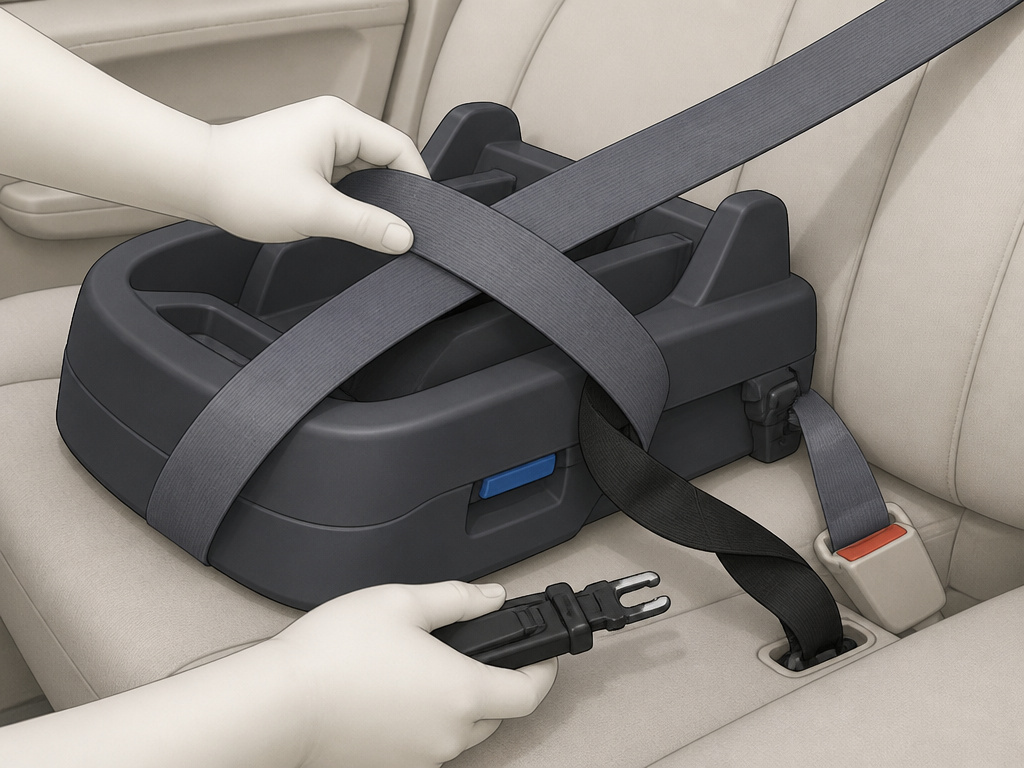
Theoretical safety and practical safety are different. The AAA Foundation LATCH system evaluation surveyed certified Child Passenger Safety (CPS) technicians—the experts who check installations for a living.
Their observations are blunt. While 81% agree LATCH is effective, 55% say it needs improvement. A staggering 84% often see parents using LATCH and a seatbelt together, which is dangerous. Nearly 80% frequently find LATCH-installed seats that simply aren’t tight enough.
From the survey: “Less than half (46.4%) of technicians believe parents are more likely to install a child seat correctly using LATCH than the seatbelt.”
Why? LATCH errors are not obvious. With a seatbelt, if it’s not locked, the seat is obviously loose. With LATCH, you can have the lower connectors clipped onto the wrong vehicle anchor bars (a “borrowed” LATCH scenario that may not be approved), or have the strap twisted, and the seat can still feel deceptively firm. The tether is routinely forgotten. The vehicle LATCH system rating protocol from IIHS exists because hardware depth, clearance, and force vary wildly between vehicles, making a correct install harder in some cars than others.
This is the core argument for the seatbelt. It’s universal, has no weight limit, and when it’s wrong, it’s visibly wrong. For installing multiple seats, like a challenging three-across setup, seatbelts almost always provide more flexibility than trying to juggle limited LATCH anchor positions. Your success with a forward-facing car seat or an ISOFIX car seat (the European rigid-LATCH standard) depends on this hardware reality.
LATCH vs. Seatbelt: The Decision Framework
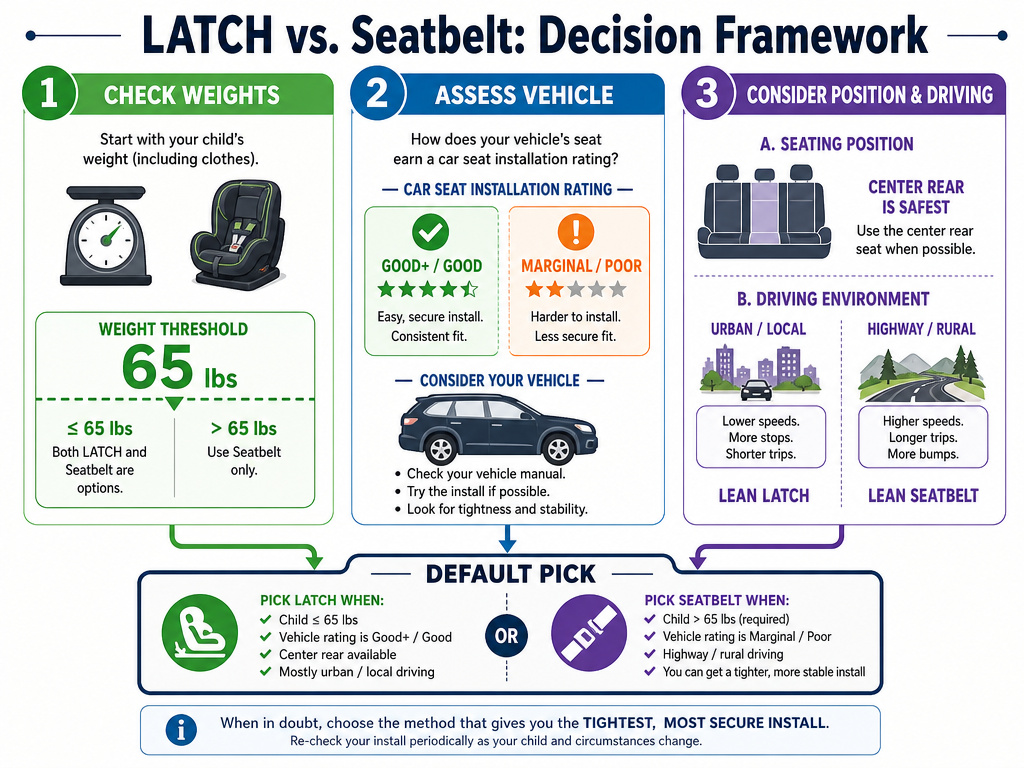
So, which do you choose? Stop looking for one answer. Follow this decision tree based on your specific situation.
First, check weights. Weigh your child. Add the weight of your car seat (find this in the manual or on a label). If the total is under 65 lbs and under your car seat’s LATCH limit, LATCH is a permitted option. If over, the decision is made: use the seatbelt.
Second, assess your vehicle. Does it have a “Good+” or “Good” LATCH rating from IIHS? Are the lower anchors easy to see and connect to with minimal force? If yes, LATCH’s ease-of-use advantage is real. If your vehicle has a “Marginal” or “Poor” rating, or you drive an older car where the anchors are buried deep in the seat crack, the seatbelt will be easier to get right.
Third, consider the seating position and crash mode. For a rear-facing infant seat in the center rear seat (often the safest position), you can only use LATCH if your vehicle explicitly allows borrowing inner anchors. Most don’t. The seatbelt is your only option. If you do mostly highway driving with longer following distances, the rear-impact risk from the 2015 study is lower. If you’re in dense urban traffic, it’s higher.
The default pick: For a newborn in an infant seat, in a vehicle with good LATCH hardware, use LATCH. It’s easier to get a tight install when you’re sleep-deprived. The moment your child’s weight (plus the seat) approaches the limit, or you switch to a convertible or forward-facing seat, plan to switch to the seatbelt. Practice the seat belt method before you need it.
Frequently Asked Questions
Does LATCH make the car seat safer than a seatbelt?
Not inherently. When both are installed correctly, both meet the same federal safety standard. The 2015 study identified a specific scenario (rear-facing infant seats in rear impacts) where LATCH showed higher head injury metrics. For forward-facing seats, using the tether with a seatbelt installation is critically important and provides equivalent protection.
Can I use LATCH in the middle seat?
Only if your vehicle owner’s manual explicitly states that the inner anchors from the two outboard positions can be “borrowed” to create a center LATCH position. Most vehicles do not allow this. In that case, you must use the seat belt for a center installation. Always check your manual—never assume.
My car seat feels rock solid with LATCH. Why switch to a seatbelt?
Because of the weight limit. The lower anchors are engineered and tested for a maximum load, usually 65 lbs combined weight. Beyond that, their performance in a severe crash is unproven. The solid feel is deceptive; you must switch based on the numbers, not the feel. The same goes for installing a car seat base with seat belt once you exceed the anchor limit.
What if my seatbelt doesn’t lock?
Most seatbelts switch from Emergency Locking Retractor (ELR) mode to Automatic Locking Retractor (ALR) mode when you pull the webbing all the way out. If yours doesn’t lock (you don’t hear/feel clicks as it retracts), you likely have a switchable retractor. Consult your vehicle manual. You may need to use a locking clip or the car seat’s built-in lock-off to secure the installation.
Is it ever okay to use both LATCH and a seatbelt together?
No. This is a serious misuse. Using both systems simultaneously, sometimes called “dual installation,” places conflicting forces on the car seat shell. In a crash, this can cause the plastic shell to crack or the anchors/straps to fail. Pick one system. The risks of using both LATCH and seatbelt together are well-documented by safety organizations.
The Bottom Line
The data is clear. LATCH is not a universal safety upgrade. It’s a convenience system with strict weight limits and, for infant seats in rear-end crashes, a demonstrated performance gap. The seatbelt is the more versatile, always-available tool, but it can have hidden defects.
Your job is to match the system to the moment. Use LATCH while it’s easy and within limits. Switch to the seatbelt the day the scale tells you to, or when your vehicle’s awkward anchors make a proper LATCH installation impossible. Never use both. And always, always use the tether for a forward-facing seat, no matter which lower attachment method you choose. That’s the rule that hasn’t changed.
