
Does a Fire Station Install Car Seats? How to Schedule Safely
This post contains affiliate links. As an Amazon Associate, we earn from qualifying purchases.
Many fire stations and police departments offer free car seat safety checks by certified Child Passenger Safety (CPS) technicians, but they do not install the seat for you. The service is an educational inspection: you bring your seat and vehicle, and the technician guides you through the correct installation process, ensuring you can do it yourself every time. Always call for an appointment first, walk-in availability is rare.
That “guide you” clause is the whole game. A certified technician’s job is education, not labor. They watch you install the seat, correct the angle, demonstrate the one-inch rule for movement, and lock the seat belt. You leave knowing how to do it, not just that it’s done. Skipping that hands-on lesson means the seat goes in wrong the next time you move it, and statistics show that happens to four out of five seats.
What follows: the non-negotiable rules for booking an appointment, the three documents you must bring, the physical limits of your car’s lower anchors that void a safe install, and the one question you must ask to verify a technician’s credentials.
Key Takeaways
- Fire station services are almost always by appointment only; walk-in availability is the exception, not the rule.
- You must bring your car seat, its instruction manual, and your vehicle’s owner’s manual to the inspection.
- The technician will guide you to install the seat yourself; they do not perform the installation as a service.
- Always verify the person assisting you is a currently certified Child Passenger Safety (CPS) technician.
- Lower anchors have a combined weight limit (typically 65 lbs for child + seat); exceeding it requires switching to a seat belt installation.
The Two-Step Reality of Fire Station Car Seat Services
Forget the idea of pulling into a firehouse bay for a quick install. The modern model is a scheduled safety check. The California Highway Patrol child safety program mandates that every Area office provide one day a week for appointments. The Phoenix Fire Department car seat program runs its four fitting stations by reservation. This isn’t bureaucracy. It ensures a certified technician is available and has time to do the job right.
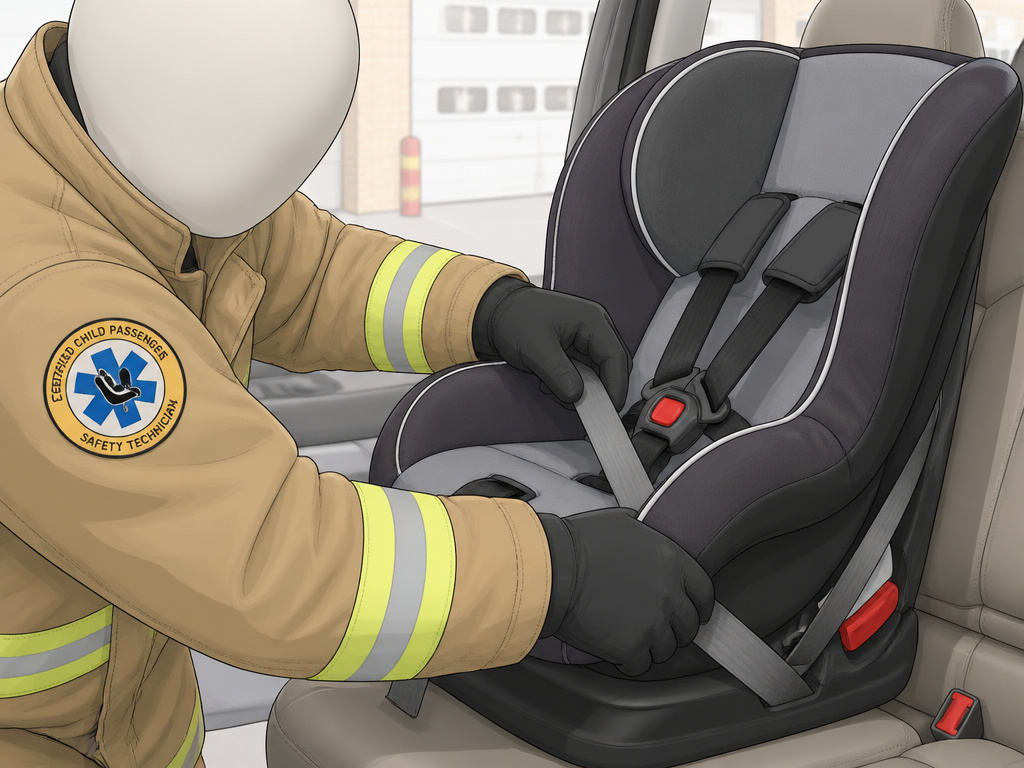
The service itself is a two-part hands-on lesson. First, the technician inspects your seat for recalls, expiration dates, and damage. Then, they coach you through the installation using your vehicle’s manual and the seat’s instructions. You handle the LATCH connectors or thread the seat belt. They check the recline angle, tighten the straps, and adjust the chest clip. The goal is your competence, not their convenience.
Where this goes sideways: Showing up without an appointment. Many departments simply cannot accommodate walk-ins, and you’ll be turned away. Call the non-emergency line or visit the department’s website to schedule.
What Exactly Happens at an Inspection?
A proper inspection follows a checklist. The technician will verify five things in this order.
- Seat Integrity: They check for an expiration date (usually molded into the plastic shell), look for cracks, and ensure the harness straps aren’t frayed. They will also run the seat’s model number through the NHTSA car seat safety guidelines recall list.
- Correct Fit for Child: They confirm the seat type, rear-facing, forward-facing, booster, matches your child’s age, weight, and height per the seat’s labels.
- Vehicle Compatibility: They pull your vehicle manual to identify the correct seating position and locate the lower anchor bars or tether anchors.
- Hands-On Installation: This is the core. You will be talked through either a LATCH system or a seat belt installation. The technician ensures the seat moves less than one inch side-to-side at the belt path.
- Harness and Buckle Fit: With your child in the seat, they adjust the harness straps to be snug (the pinch test) and position the chest clip at armpit level.
What You Must Bring to Your Appointment
Showing up empty-handed guarantees a failed visit. Departments are strict about this. The California Highway Patrol child safety program explicitly advises parents that the CHP may not have a seat to provide, and the seat you bring should not be defective, expired, or recalled.
| Item to Bring | Why It’s Non-Negotiable | If You Forget It |
|---|---|---|
| Your child’s car seat | The inspection is for your specific seat in your specific vehicle. | The technician cannot proceed. The appointment is wasted. |
| Car seat instruction manual | Contains critical weight limits, belt path diagrams, and recline angle indicators unique to your model. | Forces guesswork. An install based on general knowledge can be dangerously wrong. |
| Your vehicle’s owner’s manual | Shows the exact location of lower anchors and tether anchors, which vary by make, model, and seating position. | Risk attaching LATCH connectors to unauthorized hardware, compromising the installation. |
| Your child (if possible) | Allows for proper harness adjustment and fit confirmation with the actual passenger. | The final fit check is incomplete, leaving room for strap slack or mispositioned buckle. |
Some locations, like the Santa Clara County Fire Department, explicitly ask that you attempt an installation before your appointment. This isn’t a test. It helps you identify your specific points of confusion, so the technician can address them directly.
Who is Actually Qualified to Help You?
The person in uniform is not automatically certified. You need a Child Passenger Safety (CPS) technician who has completed the National Highway Traffic Safety Administration’s (NHTSA) standardized training. This certification is specific and current, it requires renewal.
A certified CPS technician must guide the parent or caregiver through a hands-on demonstration detailing the proper adjustment of a CPRS or seat belt, as well as the correct installation of a CPRS in a motor vehicle.
. CHP GO-100.7 Child Passenger Safety Program
How do you verify? Ask. A certified technician will have a wallet card with their name and certification number. If the person helping you is a “recorder” or “scribe” assisting the technician, they should not be giving installation advice. This distinction matters because the Federal Motor Vehicle Safety Standard 213 regulation sets the performance benchmark that all seats and installations must meet. An uncertified helper might miss a critical detail like lower anchor weight limits.
The Critical Detail Everyone Overlooks: Lower Anchor Weight Limits
Your vehicle’s lower anchors are not designed for unlimited weight. The official booster seat recommendations note that these anchors have weight limits set by both the vehicle and car seat manufacturers. The common limit is a combined 65 pounds for the weight of the child plus the weight of the car seat itself.
| Scenario | Installation Method Required | Reason |
|---|---|---|
| Child weighs 40 lbs + car seat weighs 18 lbs = 58 lbs total | Can use lower anchors (LATCH). | Combined weight is under the typical 65 lb limit. |
| Child weighs 50 lbs + car seat weighs 18 lbs = 68 lbs total | Must switch to vehicle seat belt. | Combined weight exceeds the lower anchor limit. The seat belt is now the safer, manufacturer-approved method. |
Exceeding this limit stresses the anchor bars and can cause them to fail in a crash. The switch from LATCH and seat belt systems is not optional. A good technician will weigh your child and your seat, do this math, and make the call. This is why bringing your manuals is non-negotiable, the limits are printed there.
Finding a Certified Inspection Station Near You
Start with your local fire department’s non-emergency line or community outreach webpage. If they don’t offer the service, they often partner with someone who does. Other reliable places to check include:
- Police Departments: Many traffic safety units offer inspections.
- Hospitals: Some pediatric wings or community health programs host monthly check-up events.
- AAA Offices: AAA provides free inspections at many locations for members and non-members.
When searching, use the term “child passenger safety technician” or “car seat check-up event” rather than “installation.” This will lead you to the certified services. For example, the San José Fire Department safety page clearly states they do not provide installations but directs residents to local inspection resources.
Common mistake: Assuming a correct install is permanent. Any time you adjust the harness, remove the seat for cleaning, or switch vehicles, you must re-check the installation. The technician’s lesson is the tool you use for life.
Frequently Asked Questions
Can I just walk into a fire station and get my car seat installed?
Almost never. The vast majority of fire departments and police agencies require a scheduled appointment. This ensures a certified technician is available. Walk-in policies are rare and usually advertised as specific “drop-in” events.
Is the service actually free?
Yes, in nearly all cases. These inspection services are funded as public safety outreach by municipal governments, highway patrol divisions, or non-profit grants. You should never be charged for a car seat safety check by a fire department or police agency.
What if my car seat fails the inspection?
The technician will explain the specific reason. If it’s expired, recalled, or was in a crash (even a minor fender-bender), they will tell you it is unsafe to use and must be replaced. They may provide resources for low-cost or free replacement seats but typically do not distribute seats on the spot.
Do they install seats in the middle seat?
Yes, a technician can help you with a middle seat installation. This is often the safest position in the vehicle. They will check your vehicle manual to see if the center seating position is approved for lower anchor use (some vehicles only have anchors for the outboard seats) or guide you through a seat belt install.
What’s the difference between a “check” and an “installation” service?
Semantics matter. No certified service will “install” the seat for you as a take-it-off-your-hands task. A “check” or “inspection” is the accurate term, they check your work and educate you. Any offer for a quick, do-it-for-you installation is a red flag that the provider may not be following NHTSA protocol.
The Bottom Line
A fire station car seat inspection is a vital, free resource, but it works on specific rules. You book an appointment, you bring your gear, and you do the work under expert guidance. The goal is to make you the expert. The certified technician is there to translate the dense language of your vehicle manual and seat instructions into hands-on skill.
Confirm the appointment. Bring the seat, the child, and both manuals. Watch for the lower anchor weight limit. Let the technician watch you struggle with the tightener, that’s the point. The one-inch rule at the belt path is your final exam. Pass it, and you drive away with more than a secured seat. You leave with the confidence to do it again next week, in your spouse’s car, or on a cross-country trip. That’s the real service.
