
Does an Infant Car Seat Go Behind Driver or Passenger Side?
This post contains affiliate links. As an Amazon Associate, we earn from qualifying purchases.
The safest place for an infant car seat is the rear middle seat, but only if your vehicle has a dedicated LATCH anchor set or a proper lap/shoulder belt there. If it doesn’t, the second-safest spot is behind the front passenger seat. The driver’s side is the least preferred rear position due to increased exposure to traffic-side impacts. A rear-facing seat must never go in the front seat with an active airbag.
That “if” is the catch most guides skip. The middle seat is statistically safest in a side-impact crash, but a 2024 NHTSA analysis found only about 40% of vehicles manufactured in the last decade have LATCH anchors for all three rear positions. The rest only have them for the two outboard seats. You can still use the seatbelt in the middle, but a lap-only belt is a deal-breaker. So the answer isn’t just “middle seat.” It’s middle seat if your car allows a secure, modern install. If not, you default to the passenger side.
What follows: the crash data behind the middle-seat claim, the exact steps to check your car’s LATCH setup, and the one scenario where putting the seat behind the driver is the smarter call.
Key Takeaways
- The rear middle seat is safest only if it has LATCH anchors or a full lap/shoulder belt. A lap-only belt fails.
- Behind the passenger seat is the default safe choice for easier loading and reduced curb-side risk.
- Put the seat behind the driver only if your daily routine involves frequent passenger-side street parking.
- Front seat placement is forbidden by every manual unless the airbag is physically deactivated, a feature few modern cars have.
- Your car’s manual and your seat’s manual are the final word. If they conflict, follow the stricter rule.
Where Should the Infant Car Seat Go?
According to the National Highway Traffic Safety Administration (NHTSA), the center of the back seat can be the safest during a possible side impact. This position places the child farthest from any point of intrusion in a crash.
The middle wins on physics. In a side-impact collision, the car’s door absorbs the hit. The middle seat sits farthest from either door, giving the car seat a few more inches of crumple zone. For a rear-facing infant, whose head and neck are the most vulnerable, those inches matter.
But the manual for your specific car seat adds a critical condition. The Graco Slimfit manual states, “Car seat must be rear-facing in the vehicle back seat.” It doesn’t specify a side. The Joie Saffron is clearer: “According to accident statistics, children are safer when properly restrained in the rear seating positions than in the front seating positions.” The rear is the rule. The side is your secondary decision.
The part nobody mentions: Your vehicle’s LATCH system dictates the choice. LATCH anchors are those small metal bars hidden in the seat crack. Most cars built after 2002 have them, but federal rules only require two sets, for the left and right rear seats. The middle seat often borrows anchors from the outboard positions, a practice called “borrowing” or “shared LATCH.” Some car seat manuals forbid this. Your first stop is your vehicle’s owner’s manual. Look for a diagram.
If the middle seat has its own dedicated LATCH anchors, use them. If it shares them, check your car seat manual. If both manuals allow borrowing, the middle seat is your spot. If one says no, you install on the passenger side.
| Seat Position | When It’s the Right Choice | When to Avoid It |
|---|---|---|
| Rear Middle | Vehicle has dedicated LATCH anchors or a lap/shoulder belt, and both manuals permit installation. | Lap-only belt present, or manuals forbid shared LATCH. |
| Rear Passenger Side | Default when middle isn’t viable. Easier curbside loading. | Your daily routine involves only driver-side street parking. |
| Rear Driver Side | Your regular parking is on the street with traffic on the passenger side. | All other scenarios; higher traffic-side exposure. |
| Front Passenger | Only if the vehicle has a physical airbag deactivation switch and it is confirmed OFF. | Any vehicle without a verified, manual airbag shut-off. |
The Middle Seat Myth (And Reality)
The advice “always put the car seat in the middle” is incomplete. It assumes your car is equipped for it. Many aren’t. The reality is a checklist.
First, check for LATCH. Push aside the rear seat cushion material where the back and bottom meet. Look for the rigid, U-shaped metal bars. Some vehicles mark them with a tag. If you see two sets for the outboard seats and nothing in the center, you likely have shared anchors.
Second, read both manuals. The Graco Slimfit manual is typical: it shows installation diagrams for left, right, and center using the seat belt. It doesn’t explicitly forbid borrowing LATCH for the center if the vehicle allows it. Other brands, like Chicco, explicitly prohibit it in their manuals. If your car seat manual says “do not use borrowed lower anchors,” you must use the seat belt in the middle, which leads to step three.
Third, assess the seat belt. Is it a lap/shoulder belt, or just a lap belt? A lap-only belt does not lock automatically. You need a locking clip, a relic that most parents haven’t seen and many installers get wrong. If your middle seat has a lap-only belt, abandon the middle. Move to the passenger side.
The middle seat is the goal, but a secure install on the side beats a compromised one in the center. A car seat that moves more than an inch side-to-side or front-to-back at the belt path is not safe, regardless of its position.
Driver Side vs. Passenger Side: The Real Difference
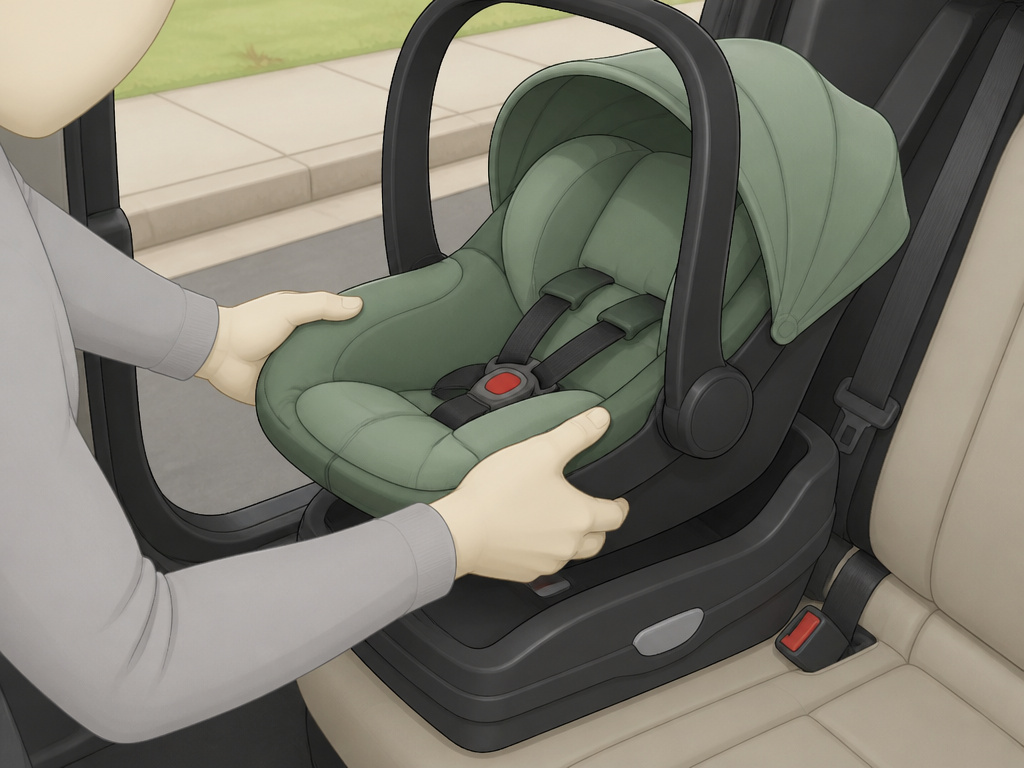
When the middle seat is out, you pick a side. The passenger side is the default recommendation for three concrete reasons.
Loading a baby from the curb is safer. You’re not standing in traffic. You can take an extra thirty seconds to get the harness snug without a truck rumbling past three feet away. For a newborn who needs a five-point check every trip, that curb-side space is a tangible safety margin.
Common mistake: Choosing the driver’s side for convenience. You get in the driver’s seat anyway, so it feels faster to load the baby right behind you. That logic works until you’re parked on a busy street and have to walk around the car with an infant carrier in one arm.
Passenger-side placement also positions the child farther from the most common side-impact scenario: a collision on the driver’s side of the vehicle. While no side is immune, statistics show the driver’s side is more frequently impacted.
So when does behind the driver make sense? If your daily life involves parallel parking on streets where the passenger side is against traffic. Think urban row houses or schools with no drop-off lane. In that case, the passenger side becomes the traffic side, and the driver’s side becomes the curb side. Flip the rule.
The driver vs passenger side debate isn’t about a universal winner. It’s about your driveway, your street, and your parking habits. Map your most common loading scenario. That tells you which side offers that curb-side buffer.
Why the Front Seat is a Hard No
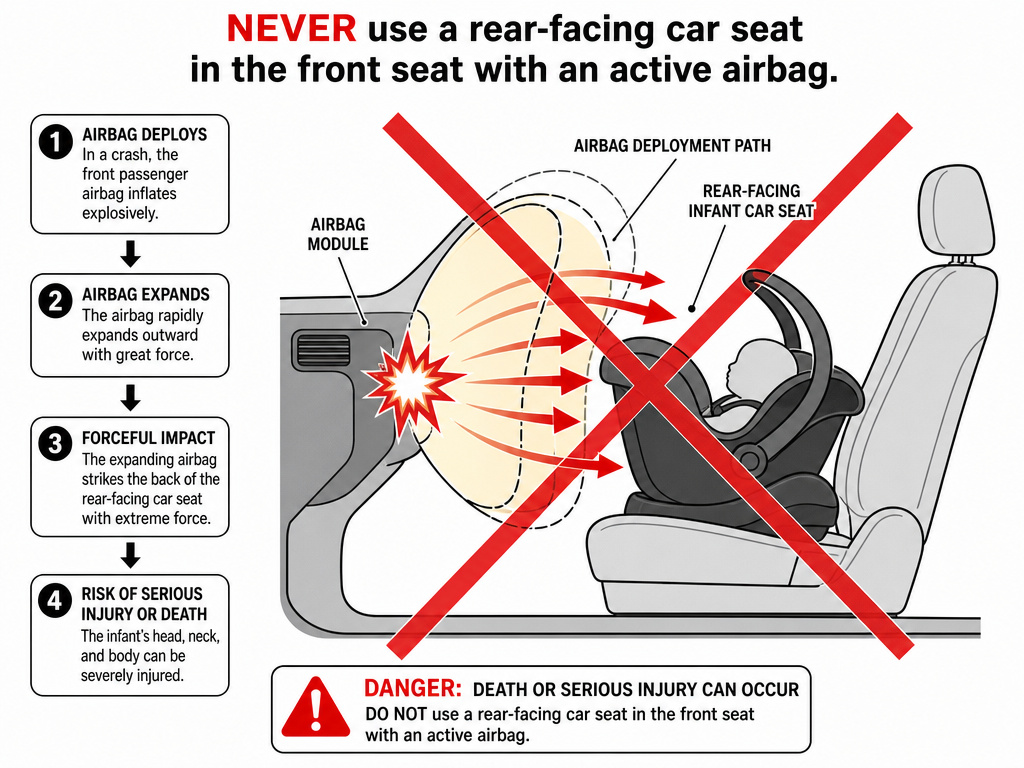
The Kia owner’s manual, referencing UN regulations, states it plainly: “Never place a rearward facing Child Restraint System on the front passenger seat, unless the airbag is deactivated.” The “unless” is a trap for most modern cars.
Front passenger airbags are designed to protect an adult’s body. They deploy with enough force to seriously injure or kill a child in a rear-facing seat. The force is directed toward the seatback, which in a crash would drive the car seat, and the child, into the deploying airbag. This is not a minor risk. It’s the reason every car seat manual, from the Cybex Cloud G to the Axkid Minikid, includes a version of this warning.
Deactivating the airbag is theoretically possible. Some older vehicles have a physical key switch in the glovebox or on the dashboard. Many newer ones have a weight sensor that automatically deactivates the airbag, but these sensors are notoriously finicky. Relying on an automatic sensor is a gamble with your child’s life. The Axkid Minikid manual is explicit: “If you wish to install your Minikid in a location where an airbag is fitted, then the airbag must be disconnected at an authorized service centre.”
Unless you drive a vintage car with a verified, manual shut-off switch that you have turned off and confirmed with the dashboard indicator, the front seat is not an option. Not sometimes. Not for quick trips. Never.
Installing for Safety, Not Just Convenience
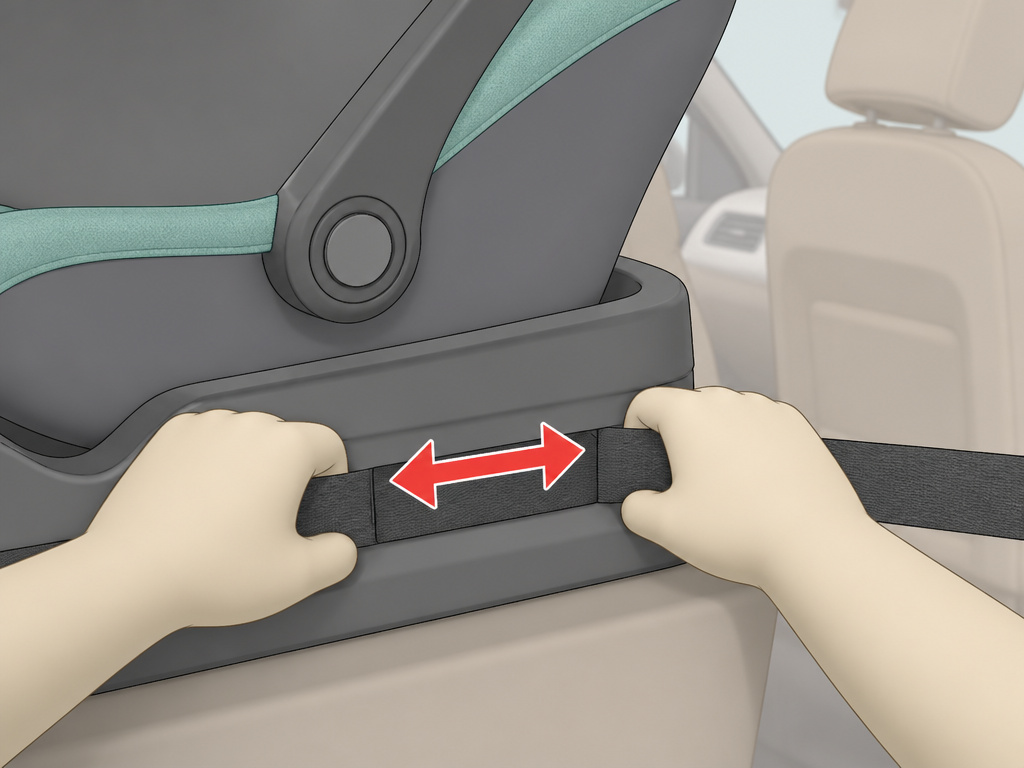
A safe car seat installation has one measure: movement at the belt path. After you’ve tightened the LATCH strap or seat belt, grab the car seat where the belts thread through it. Try to move it side-to-side and front-to-back. It should not shift more than one inch in any direction.
If it moves more, you’re not done. For LATCH installations, kneel in the seat and put your weight into it as you pull the strap tight. The connectors should sit at a correct angle, not twisted. For seat belt installations, ensure the belt is locked. Most modern cars have a switchable retractor; pull the belt all the way out until it clicks, then let it retract. That locks it.
The tether is for forward-facing seats. Rear-facing infant seats typically do not use the top tether in the United States. Check your manual. If it says to use it, attach it to the designated anchor, usually found behind the vehicle seat.
Your final check is the baby. The harness straps should be at or below the infant’s shoulders for rear-facing. The chest clip sits at armpit level. You should not be able to pinch any excess harness material at the child’s shoulder. A snug harness prevents the child from being ejected in a crash.
Frequently Asked Questions
Can I put the infant car seat in the middle with a seat belt?
Yes, if it’s a lap/shoulder belt and you can get a secure, less-than-one-inch install. If it’s a lap-only belt, you will need a locking clip, and most experts recommend choosing an outboard seat with a lap/shoulder belt instead for a simpler, more reliable installation.
What if my car only has two LATCH anchors?
This is common. Use the LATCH system for the rear passenger side seat, as it’s generally the second-safest position. You can still use the seat belt in the middle seat if both your vehicle and car seat manuals allow it and you achieve a secure install.
Is behind the driver ever safer than behind the passenger?
Only in the specific scenario where you almost always park with the passenger side next to moving traffic. If your passenger door regularly opens into a busy street, placing the seat behind the driver keeps you and the baby on the safer curb side during loading and unloading.
How do I know if my front passenger airbag is off?
Very few modern vehicles have a manual switch. If yours does, there will be a key slot, usually in the glove box or on the dash, and a corresponding warning light on the instrument panel that says “PASSENGER AIRBAG OFF.” Do not rely on automatic weight sensors. If you cannot verify the airbag is physically disabled, the seat must go in the back.
My infant seat base doesn’t fit snugly in the middle seat. What now?
Many vehicle back seats are slightly curved, making the middle position the narrowest and most contoured. If the base doesn’t sit flush, it can rock. Don’t force it. Use a rolled towel or pool noodle under the base only if your car seat manual explicitly permits it to level the seat. If it still doesn’t sit solidly, move to an outboard position where the base sits flat.
Before You Go
The rear middle seat is the target, but the passenger-side rear is the reliable default. Your car’s LATCH layout and your daily parking routine decide the final call. Read both manuals, the one for your car and the one for your seat. Their rules override any general advice.
A secure install in a suboptimal spot is safer than a loose install in the “best” spot. If the middle seat in your car has a lap-only belt or won’t accept a tight LATCH connection, let it go. Install it tightly behind the passenger seat and never look back.
When you’re ready to move on from the infant carrier, you’ll face the next set of choices between convertible and all-in-one seats. That’s a different set of measurements, but the same rule applies: the manual for the new seat and the manual for your car are the documents that matter.
