
How to Book Uber with Infant Car Seat | The Service Limits
This post contains affiliate links. As an Amazon Associate, we earn from qualifying purchases.
You book an Uber with an infant car seat in two ways: use the official Uber Car Seat service for a $10 surcharge, which provides a single Nuna RAVA convertible seat in an Uber XL, or bring and install your own infant seat in a standard UberX. The Uber Car Seat service is currently limited to New York City and uses the vehicle’s seat belt, not lower anchors, for installation.
That seat belt clause matters. Uber’s official guidance states the Nuna RAVA’s preferred installation method is the vehicle seat belt because it “eliminates confusion” and fits more vehicle models. For your own infant seat, this means the Uber you hail must have a seat belt with a locking mode. You’ll be checking for less than one inch of movement at the belt path.
What follows is the full breakdown: the exact specs of the seat Uber provides, the step-by-step tap-through in the app, and the concrete reasons the service vanished from three major cities in 2024. We’ll also cover the safer, more reliable path most traveling parents actually take: bringing their own seat.
Key Takeaways
- The Uber Car Seat service provides one Nuna RAVA convertible seat, installed with the vehicle’s seat belt, for a $10 surcharge on an Uber XL ride.
- As of January 2024, this service is only available in New York City; it was discontinued in Philadelphia, Orlando, and Washington D.C.
- You are always responsible for securing your child in the seat, whether it’s Uber’s or your own.
- For newborns and young infants, you must bring your own rear-facing seat; the Uber-provided seat is only for children 5+ pounds.
- Installing your own seat is often more reliable, but you must confirm the vehicle has a locking seat belt before the driver arrives.
How the Uber Car Seat Service Actually Works
Forget the idea of a generic “car seat option.” Uber partners with one brand: Nuna. The seat provided is a Nuna RAVA convertible car seat. This isn’t a random selection from a driver’s trunk; it’s a specific model with defined limits that every participating driver is trained to install.
The Nuna RAVA supports rear-facing use for children 5–50 lbs (up to at least two years old) and forward-facing for children 25–65 lbs (starting at two years old). Uber’s policy states installation is via the vehicle seat belt, not lower anchors, as it fits more vehicle models and seating positions.
The training is standardized, but the final responsibility lands on you. The driver ensures the seat is physically installed in the vehicle. You, the parent or caregiver, must secure your child correctly in the harness. No driver is certified to do that for you.
Each trip includes only one Nuna seat. If you have two children needing seats, you must provide the second one yourself. The vehicle will be an Uber XL—meaning a larger SUV or van—except in New York City, where standard sedans are used.
| Aspect | Uber Car Seat Service Detail | Why It Matters |
|---|---|---|
| Seat Model | Nuna RAVA convertible | One seat type only; not suitable for all ages. |
| Installation Method | Vehicle seat belt (per Nuna’s guidance) | You won’t find LATCH connectors; must understand seat-belt lock-offs. |
| Vehicle Type | Uber XL (except NYC) | Guarantees space for the seat, but may cost more than UberX. |
| Surcharge | $10 added to trip fare | The convenience fee for not bringing your own gear. |
| Availability | New York City only (as of Jan 2024) | If you’re not in NYC, the app button won’t appear. |
The geographic limitation is the biggest practical hurdle. The service was available in a handful of cities but retracted from Philadelphia, Orlando, and Washington D.C. In early 2024. Uber cites operational challenges, but the effect is simple: outside Manhattan, you’re on your own.
Booking with Your Own Infant Car Seat: The More Reliable Path
For infants under a year, and definitely for newborns, bringing your own seat isn’t an alternative—it’s the only safe way. The Nuna RAVA’s lower weight limit is 5 pounds, but most infant-specific carrier seats are designed for newborns down to 4 pounds. More importantly, they remain rear-facing, which is critical for spinal development.
Common mistake: Assuming any Uber vehicle will have a seat belt that locks. Most modern belts do, but some older models or specific seating positions may only have a switchable retractor. You need a locking mode to secure a seat without its base.
The process is straightforward, but it adds minutes to your pickup. You book a standard UberX (or Uber XL for more space). As soon as you book, text or call the driver through the app: “I have an infant car seat to install. Please allow an extra few minutes.” This sets the expectation and prevents a cancellation.
When the car arrives, your job is a quick three-point check: 1. Find a seating position with a seat belt that locks. Engage the locking mechanism according to your car seat manual. 2. Thread the belt through the rear-facing belt path. Pull tight until the seat moves less than one inch side-to-side or front-to-back at the belt path. 3. Ensure the carrier handle is in the correct, locked position for travel (often all the way back).
If the belt doesn’t lock, or the seat can’t be tightened sufficiently, you must cancel the ride. Your child’s safety isn’t negotiable. This is why many parents opt for a travel system with a quick-click base they can pre-install, or a lightweight, easy-install seat like the Cosco Scenera Next for rideshares.
The Step-by-Step Booking Process
The mechanics in the app are simple. The complexity is in the details you must verify before you tap “confirm.”
- Open the Uber app and enter your pickup and drop-off locations.
- Scroll through the ride options beneath the map. Look for “Car Seat” or a car seat icon. If you don’t see it, the service is not available in your city.
- Select ‘Car Seat’. The app will display the fare estimate inclusive of the $10 surcharge and note that the vehicle will be an Uber XL.
- Confirm your ride. Once matched, you can message the driver to confirm they have the seat installed.
- At pickup, perform your inspection. Verify the Nuna RAVA is installed snugly with the seat belt. Then, secure your child.
For your own seat, the steps are the same, but you select UberX or Uber XL. The critical step is the driver notification. Don’t skip it.
Why Uber Prefers the Seat Belt Over LATCH
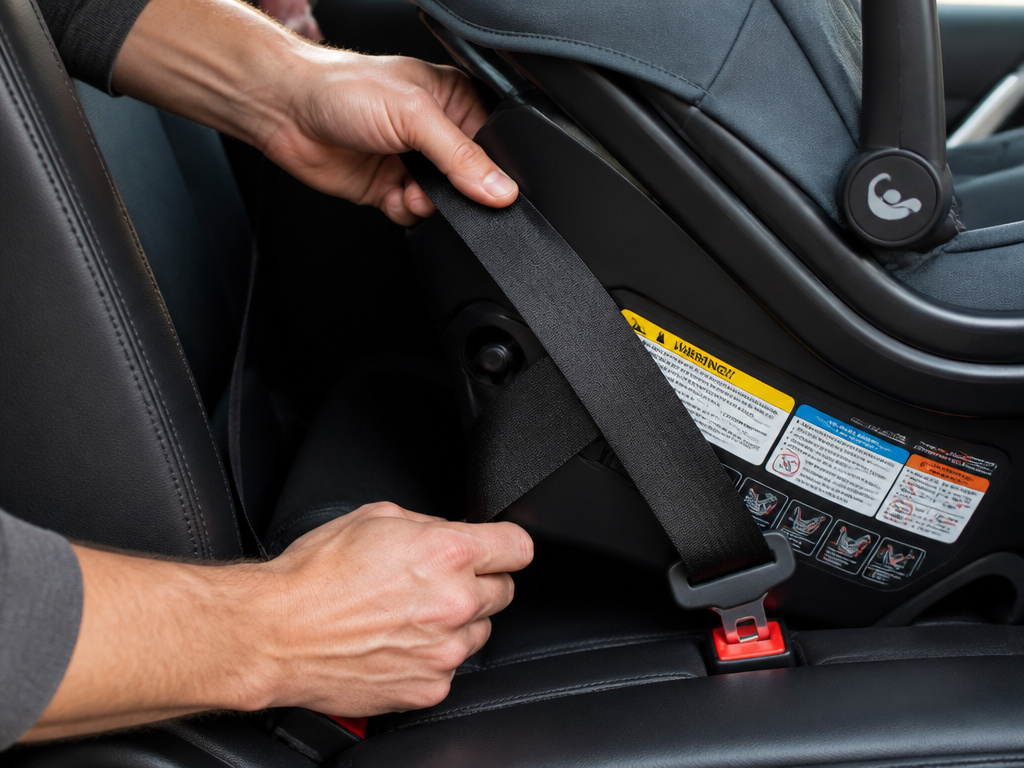
You might be wondering why a modern car seat isn’t installed using the dedicated LATCH (Lower Anchors and Tethers for Children) system. Uber’s help article is explicit: the seat belt is Nuna’s preferred method for the RAVA in this context.
The reasoning is practical, not necessarily safer. Seat belts are universal. Every rear seat in every car manufactured after 1996 has them. LATCH anchors, while standard, can be buried deep in seat crevices, differ in spacing, and have weight limits that parents often misunderstand. By standardizing on the seat belt, Uber ensures every trained driver can achieve a correct installation in any Uber XL vehicle, regardless of its make or model.
For your own infant seat, the same logic applies. If you’re using a base, it likely has both LATCH and seat-belt installation options. In an unfamiliar vehicle, the seat belt is often the faster, more foolproof choice. Just know how to lock it.
Legal Requirements and Safety Standards You Can’t Ignore
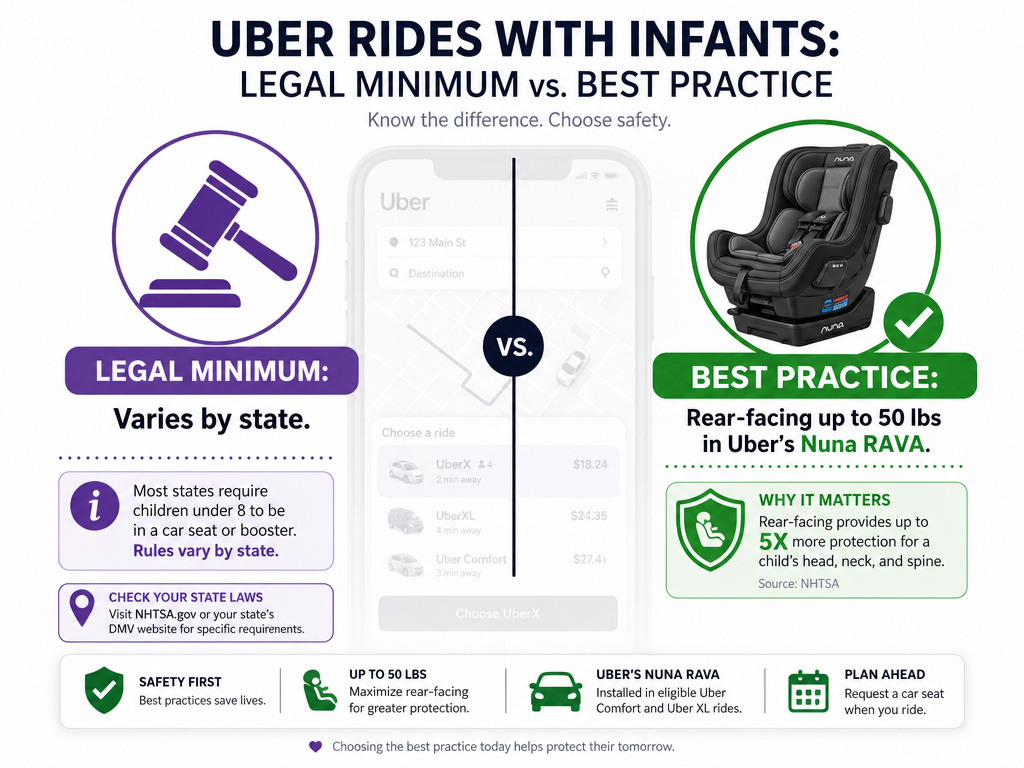
Uber’s policy is one layer. Your local law is another, and it’s the one that carries a fine. Every state and country has its own child passenger safety laws. They typically mandate a rear-facing seat until at least age two, and a car or booster seat until age 7-9.
In Victoria, Australia, for example, the law does not require taxi drivers to provide seats, but rideshare cars must follow standard road rules for private cars. Using an overseas model that doesn’t meet the local AS/NZS 1754 standard is also illegal there.
The legal minimum is just the starting point. Best practice, from organizations like the Royal Children’s Hospital Melbourne, is to keep a child rear-facing for as long as they fit the seat’s limits, ideally to three or four years old. The Uber-provided Nuna RAVA allows rear-facing up to 50 pounds—far beyond the legal minimum. If your child is two but still under 50 lbs, you can and should request it be installed rear-facing.
| Scenario | Legal Minimum | Best Practice / Uber Service Capability |
|---|---|---|
| Newborn in Uber | Rear-facing car seat required. | Bring your own infant seat; Uber Car Seat not suitable under 5 lbs. |
| 2-Year-Old in Uber Car Seat | Varies by state; often forward-facing allowed. | Can remain rear-facing in Nuna RAVA up to 50 lbs for superior safety. |
| Car Seat Age | Varies; some states have no law. | KidSafe Australia recommends replacing seats older than 10 years from manufacture date. |
| Post-Crash Use | Law often silent. | Seat must be replaced after any crash, even if damage isn’t visible. |
Frequently Asked Questions
Is the Uber car seat free?
No. Selecting the Uber Car Seat option adds a $10 surcharge to your trip fare. This is in addition to the standard Uber XL rate.
Can I use Uber Car Seat for a newborn?
No. The Nuna RAVA’s minimum weight is 5 pounds, and it’s a convertible seat, not an infant carrier. Newborns and young infants require a dedicated, rear-facing infant seat that you must provide and install yourself.
What if I need two car seats?
The Uber Car Seat service provides only one Nuna RAVA seat. If you have two children requiring seats, you must bring the second one yourself and install it. You would then book an Uber XL to ensure enough space.
Why don’t I see the Car Seat option in my Uber app?
As of January 2024, the Uber Car Seat service is only available in New York City. It was discontinued in Philadelphia, Orlando, and Washington D.C. If you’re outside NYC, the option will not appear.
How do I know if my Uber driver has a car seat?
When you book the Uber Car Seat option, the app matches you with a driver enrolled in the program. Their vehicle will have the Nuna RAVA pre-installed. You can also message the driver through the app after booking to confirm.
Before You Go
Booking an Uber with an infant car seat boils down to a single, sobering fact: the official service is a niche product available in one city. For everyone else, and for all infants, bringing your own seat is the only real-world solution.
That means your focus should shift from app navigation to installation confidence. Practice installing your seat with a seat belt in your own car until it’s a five-minute routine. Consider a lightweight, travel-friendly seat like the Cosco Scenera Next if your primary seat is a tank. Text your driver the second you’re matched.
The Uber Car Seat button is a convenience, but convenience and infant safety rarely travel in the same lane. Your own seat, correctly installed every time, is the ticket that actually gets you where you’re going.
