
How to Bring a Car Seat & Stroller on Plane Without Issues
This post contains affiliate links. As an Amazon Associate, we earn from qualifying purchases.
You can bring a car seat and stroller on a plane by verifying the FAA-approved label on your car seat, gate-checking your stroller at the departure gate, and using the car seat in your child’s purchased seat during flight. The car seat must have a visible, legible label stating it is “certified for use in motor vehicles and aircraft,” and the stroller must be used to transport a child on the same flight to qualify for gate-checking.
That label is the only thing standing between you and a denied boarding. Airline staff at the gate are trained to look for it, and if it’s missing or worn off, they can refuse the seat. Transport Canada and the FAA don’t require a separate certificate or document—the label on the seat itself is the legal proof. Everything else—gate-check procedures, overhead bin sizes, seat width limits—flows from that one red-printed line.
What follows: the three-step gate-check process airlines follow, how to handle a seat that doesn’t fit your assigned row, and the single biggest mistake parents make with infant seat bases. You’ll also learn your rights when the label is unreadable and what to do with a car seat bought outside the US.
Key Takeaways
- The FAA-approved label on your car seat is non-negotiable. If it’s missing or worn off, bring the owner’s manual or a manufacturer letter that ties the model number to aircraft approval.
- Gate-check your stroller, not check it at the ticket counter. Federal law mandates airlines accept strollers at the gate if they’re being used to transport a child on that flight.
- Most infant car seat bases are not approved for aircraft use. You’ll install the carrier directly onto the airplane seat using its built-in belt path.
- If your approved car seat doesn’t fit in your assigned seat, the airline must find another seat in the same class of service that will accommodate it.
- A booster seat used with just a lap belt is unsafe and prohibited. You can only use a combination seat on board if it’s in its 5-point harness mode and bears the FAA label.
The FAA Label That Lets You Board
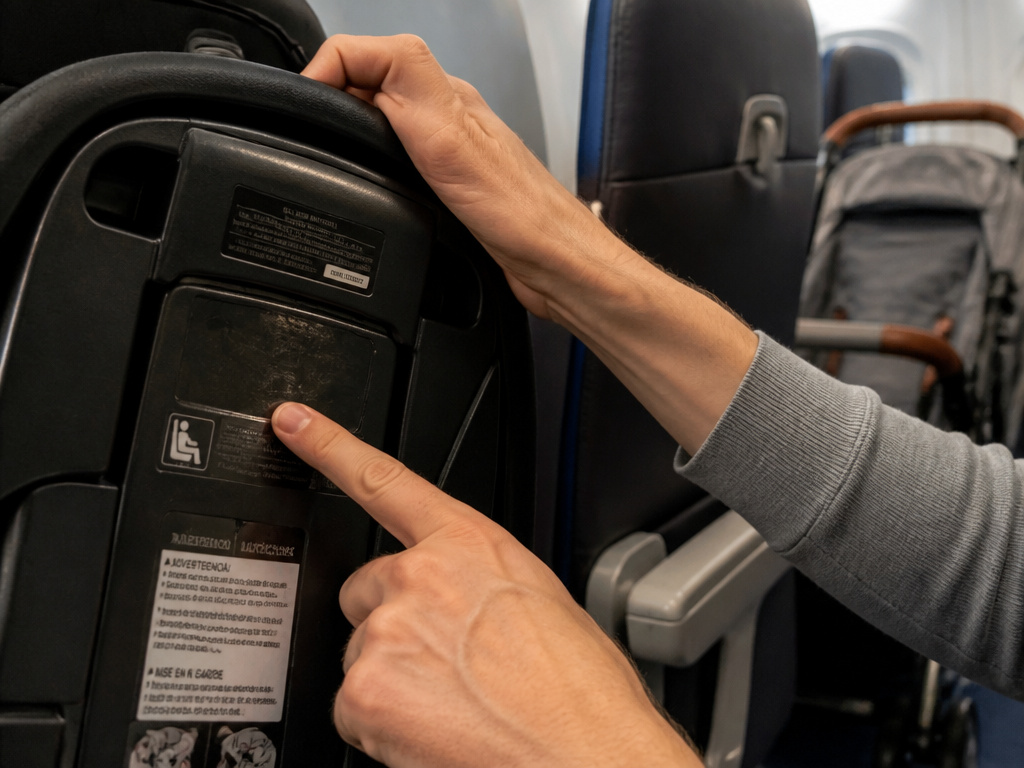
Look for the red text. Every car seat sold in the US that’s approved for aircraft use has a sticker, usually sewn into the fabric or molded into the plastic shell, with a statement in red lettering: “This restraint is certified for use in motor vehicles and aircraft.” That’s the entire regulatory framework. No separate card, no certificate, no FAA paperwork. If that label is legible, you’re cleared.
The label is a manufacturer’s declaration that the seat meets specific dynamic testing standards for both cars and planes. The testing simulates crash forces from different angles. A seat without this label hasn’t passed the aircraft portion of the test. Airlines know this, and gate agents are instructed to check for it.
A car seat is considered certified for use in motor vehicles and aircraft if that phrase appears on its label. If the label is unreadable, you may present the owner’s manual containing the same phrase, or a letter from the manufacturer specifically tying the car seat model to aircraft approval.
If the label is worn off or missing, you’re not out of luck, but you have extra homework. You need the owner’s manual for that exact model, which will contain the certification language. Download it from the manufacturer’s website if you’ve lost the paper copy. A printed letter from the manufacturer’s customer service department, explicitly stating that your specific model (include the serial number) is aircraft-approved, also works. Don’t show up with just a receipt or a product page screenshot—it must be the manual or a direct letter.
Foreign-made car seats follow a similar rule. Transport Canada and the FAA accept seats that bear a label showing approval by a foreign government or manufacture under United Nations standards. Look for a sticker referencing ECE R44/04 (Europe) or the Canadian CMVSS 213/213.1. The principle is the same: the label is the proof.
Where this goes sideways: Assuming your car seat is approved because it’s “brand new” or “expensive.” I’ve watched a family with a top-tier European seat get turned away at a US carrier’s gate because the agent couldn’t find the specific FAA phrase on the label. They had to buy a seat on the spot. Check the label before you pack.
Your Rights When the Seat Doesn’t Fit
A coach airplane seat is 16 inches wide. Your car seat must fit within that space, armrest to armrest. Some seats, especially convertible models designed to last years, have bases wider than 16 inches. This doesn’t automatically disqualify them.
If your FAA-approved car seat, for which you’ve purchased a ticket, does not fit in the assigned seat, the airline has a legal obligation to try to accommodate it elsewhere in the same class of service. They might move you to a seat with movable armrests—raising the armrest can gain you an extra inch or two. They could move you to a bulkhead row, which sometimes has more legroom (though not always more width). The key is that they have to try.
The rule isn’t a guarantee of a perfect fit, but it’s a powerful lever. It’s written into the FAA’s advisory circular that airlines use as their playbook. You don’t have to accept “it doesn’t fit” as a final answer if you’ve bought a seat for your child. Politely cite the FAA accommodation rule and ask what other seats in coach are available.
This is where a compact travel seat pays off. Models like the Cosco Scenera Next or the WayB Pico are designed with airplane dimensions in mind. They sacrifice some features for a narrower profile. For a child who has outgrown an infant carrier, these are the default picks.
| Seat Type | Typical Width | Fits 16″ Airplane Seat? | Best For |
|---|---|---|---|
| Infant Carrier (e.g., Chicco KeyFit) | 15–16 inches | Yes, usually | Infants under 1 year, used with or without base |
| Convertible Seat (e.g., Graco Extend2Fit) | 17–19 inches | Often no | Long-term use, often too wide for plane |
| Compact Travel Seat (e.g., Cosco Scenera Next) | 15–15.5 inches | Yes | Toddlers/Preschoolers, travel-only use |
| Combination Seat (Harness-to-Booster) | 16–18 inches | Maybe, check model | Older toddlers/young kids in harness mode |
Common mistake: Trying to use a booster seat on the plane. Airplanes only have lap belts, and boosters require a shoulder belt to function correctly. They are not approved for in-flight use. The only exception is a combination seat used in its 5-point harness mode with the FAA label.
What You Can’t Bring On Board
The list is short but critical. Getting it wrong means checking an item as baggage, which opens it up to damage and loss.
First, infant car seat bases. Most are not certified for aircraft use. You install the carrier directly onto the airplane seat using the seat belt threaded through the carrier’s built-in belt path. The base gets checked with your luggage. Some travel systems, like the Doona, integrate the base and carrier, but they are the exception, not the rule. Check your specific model’s manual.
Second, booster seats. As mentioned, they need a shoulder belt. Since airplane seats only have lap belts, a booster provides zero safety benefit and is explicitly prohibited by the FAA and Transport Canada. If your child uses a booster in the car, you have three options on the plane: use a harness-style combination seat (like a Graco Tranzitions), check the booster, or have them sit directly in the airplane seat using the lap belt alone.
Third, belly belts or loop belts. These aftermarket harnesses that attach to the adult seatbelt are not approved child restraint systems. They’ve been linked to internal injury risks in crash testing and are banned by name in Transport Canada’s guidance.
Finally, any car seat without the FAA label. This includes seats that are past their expiration date (usually stamped on the shell), seats that have been in a moderate or severe crash, and seats from unknown origins. Airlines can and will refuse them.
The 3-Step Gate-Check Process
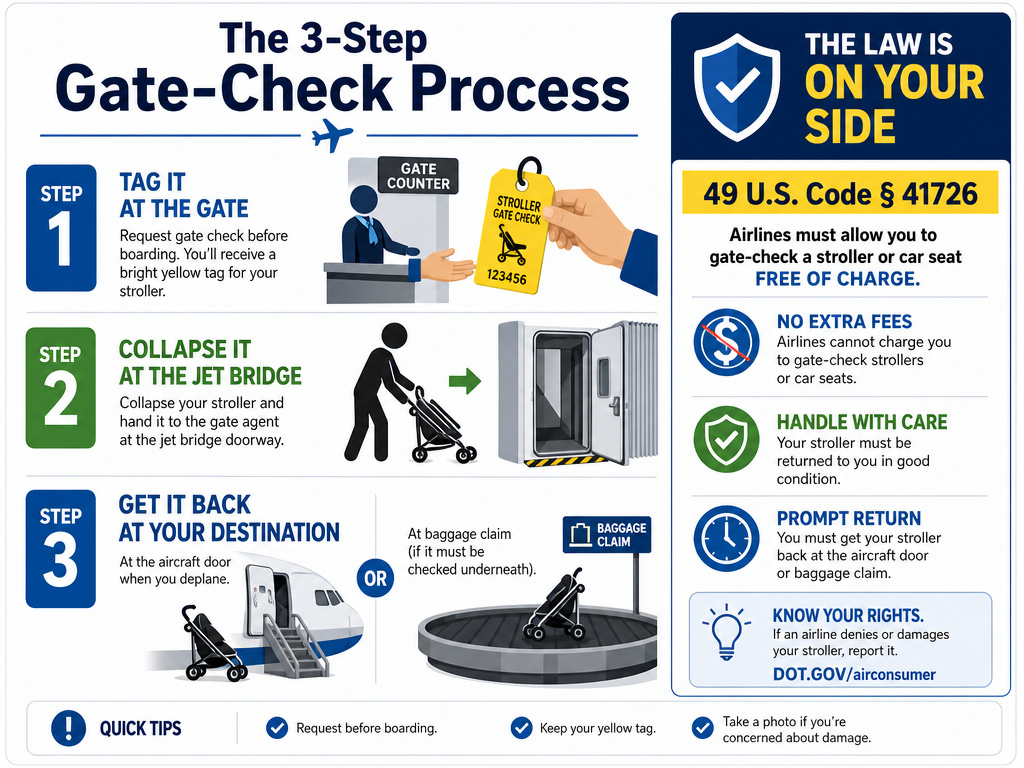
Gate-checking is the process of handing your stroller to an agent at the departure gate just before you board. It’s protected by federal law—specifically, 49 U.S. Code § 41726 on strollers. The law states an airline cannot deny you the ability to check a stroller at the gate if it’s being used to transport a child on the same flight. The only exception is if the stroller’s size or weight poses a safety or security risk.
Step 1: Get a gate-check tag. After you clear security, find your departure gate. Approach the counter and ask for a gate-check tag for your stroller. The agent will attach a durable plastic or paper tag with a claim number to your stroller’s frame. Do this early, not when your boarding group is called. Lines form.
Step 2: Collapse and leave it. When your boarding group is called, collapse the stroller and leave it in the designated area just outside the jet bridge door. For an umbrella stroller, this is straightforward. For a larger travel system, you might need to remove the seat or basket. Do a dry run at home. Gate agents are not there to help you fold it; they’re there to tag it and load it.
Step 3: Claim it planeside or at baggage claim. On most flights, your stroller will be returned to you at the arrival gate, right as you step off the plane. This is “planeside” or “gate return.” On some smaller regional jets or at tight-gate airports, it may come out on the regular baggage carousel. The tag you received will tell you which. Don’t walk away from the jet bridge without asking if you’re unsure.
The part nobody mentions: The gate-check tag is just a claim ticket. It does not guarantee careful handling. Strollers are considered “checked items” once they leave your hands, and the airline’s liability for damage is limited. A hard-shell travel case for your stroller is the only real protection.
What about the car seat? You can also gate-check a car seat, but it’s riskier. If you’re not using it on board, gate-checking is better than checking it at the ticket counter because it spends less time in the baggage system. However, it’s still thrown into a bin with other luggage. If you must check it, use a padded travel bag.
Stroller Size Limits and Overhead Bin Options
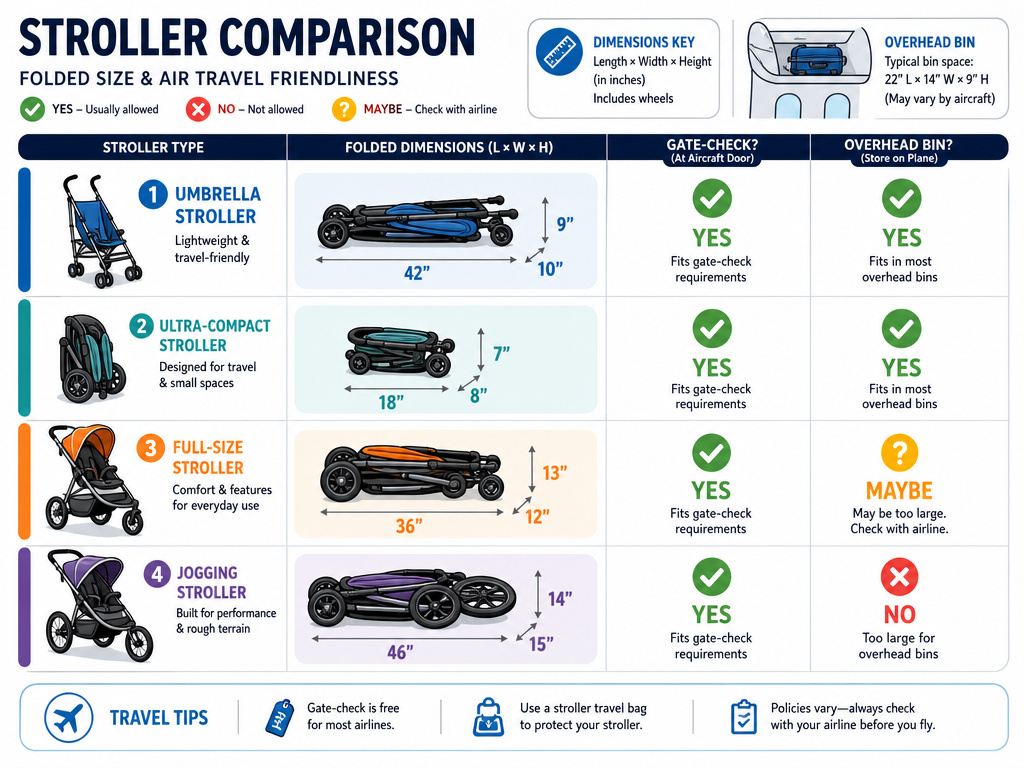
Not all strollers are gate-check candidates. The law has an out for safety and security risks, which airlines interpret as size and weight. A massive, non-collapsible jogging stroller might be denied at the gate and sent to oversized baggage.
Most airlines draw the line at collapsibility. If it folds with one hand and fits through the X-ray machine, it’s almost always accepted. The DOT assistive device stowage guide treats strollers as assistive devices, giving them priority over other baggage. This is why they get gate-checked instead of sent to the regular luggage belt.
For overhead bin storage, you need a truly compact stroller. The measurement that matters is the folded dimensions, not the seat width. Look for models advertised as “airplane-ready” or “cabin-approved.”
| Stroller Type | Folded Dimensions (LxWxH) | Gate-Check? | Overhead Bin? |
|---|---|---|---|
| Umbrella Stroller | ~12″ x 10″ x 36″ | Yes | Maybe on larger planes, usually gate-check |
| Lightweight Travel Stroller (e.g., GB Pockit) | 12″ x 7″ x 14″ | Yes | Yes, on most aircraft |
| Full-Size Travel System | ~30″ x 20″ x 40″ | Yes | No, must be gate-checked |
| Jogging Stroller (3-wheel) | Often does not fold compactly | Maybe | No, often sent to oversized baggage |
The Graco GoMax™ Frame is one of the few travel system frames designed to fit in an overhead bin. It’s a specific answer to the size problem. For everyone else, gate-checking is the standard.
Skip this if: You’re traveling with a newborn in an infant carrier. You can carry the carrier through the airport and install it directly on the plane. You don’t need a stroller frame at all for the airport leg, which simplifies everything.
How to Install Your Car Seat On the Plane
You bought the seat. You have the label. The plane door is closed. Now you have to get the seat installed correctly before taxi. Flight attendants are not certified to help you, but they will ensure you’re not blocking the aisle.
First, find the belt path. On rear-facing infant carriers, it’s often a clear channel at the base. On forward-facing convertible seats, it may be marked with red labels or arrows. Thread the airplane lap belt through this path and buckle it. Then, pull the belt tight. You should not be able to move the seat more than an inch side-to-side or front-to-back at the belt path. Use your body weight to press the seat down into the airplane seat cushion while you cinch the belt.
Second, check the angle. For a rear-facing seat, many require a specific recline angle to keep an infant’s airway open. Airplane seats don’t recline enough to achieve this on their own. Use a tightly rolled towel or a specialized travel pillow (like the Flyebaby Travel Pillow) under the foot of the car seat to get the correct angle. The seat’s built-in level indicator will tell you when it’s right.
Third, secure the child. Harness straps should be snug—you shouldn’t be able to pinch any slack at the shoulder. The chest clip should be at armpit level. For a forward-facing toddler, the top tether is not used because airplane seats don’t have tether anchors.
I watched a father install a forward-facing seat on a cross-country flight. He got the belt tight, but his son was swimming in the harness. The boy slipped his arms out before takeoff. The father didn’t notice until the seat next to him pointed it out mid-flight. Tighten the harness on the ground, before you board if possible. Once you’re in the air, you’re stuck.
If you’re using a travel system where the car seat clicks into a stroller frame, you’ll need to separate them at the gate. The frame gets the gate-check tag. The car seat comes with you onto the plane.
What to Do When Things Go Wrong
The label is illegible. The airline says your seat isn’t approved. The stroller is too big. You’re facing a gate agent who hasn’t heard of the accommodation rule. Have your documents ready.
- For a missing FAA label: Show the printed owner’s manual with the certification phrase. If you don’t have it, pull up the PDF on your phone from the manufacturer’s site. Have the model number and serial number handy.
- For a seat that doesn’t fit: Calmly state, “Under FAA guidelines, if an approved CRS doesn’t fit in the assigned seat, the airline is to try to accommodate it in another seat in the same class of service.” Ask if there is a seat with movable armrests or a bulkhead row available.
- For a denied gate-check: Cite the law. “Under 49 U.S. Code 41726, you cannot deny me the ability to check this stroller at the gate if it’s being used to transport my child on this flight.” If the agent claims a safety risk, ask them to specify what the risk is. A folded umbrella stroller is rarely a safety risk.
Your last resort is asking for a supervisor. Be polite but firm. The regulations are on your side, but not every frontline employee knows them in detail. Having the FAA Advisory Circular or the U.S. Code printed or bookmarked on your phone turns a subjective argument into a reference check.
Before you start: Pack a spare outfit for your child and a change of clothes for yourself in your carry-on. If your checked car seat or stroller is lost, you might be without it for days. Research rental options at your destination before you fly. Know the model of your seat in case you need to buy a temporary replacement.
Frequently Asked Questions
Can I use my car seat on the plane if my child is under 2 and flying on my lap?
No. A car seat requires a purchased seat. If your child is under 2 and flying as a lap infant, you cannot use a car seat on board. The seat would be unoccupied, and FAA regulations require the child restraint system to be occupied by the child it’s intended for during taxi, takeoff, landing, and turbulence.
Do I have to buy a ticket for my child to use a car seat?
Yes. You must purchase a seat for your child to use a car seat on the airplane. This is non-negotiable. The car seat is considered a piece of luggage if it’s not securing a child in a purchased seat, and it must then meet checked baggage requirements.
Can I check my car seat and stroller at the ticket counter instead of the gate?
You can, but it’s riskier. Checking them at the ticket counter means they go into the general baggage system, where they are handled by machinery and stacked under other luggage. Gate-checking is gentler and ensures they are among the last items loaded and first items unloaded. For a car seat you’re not using on board, gate-checking is the safer choice.
What if my stroller gets damaged during gate-checking?
Airlines are liable for damage to assistive devices, including strollers, while in their care. Report the damage immediately to the baggage service office at your arrival airport before leaving the airport. Take photos. They are required to repair or replace it, up to the original purchase price. The December 2024 DOT final rule establishes a presumption that the airline is liable unless they can prove the damage was pre-existing or caused by passenger negligence.
Are there any seats on the plane where I can’t put a car seat?
Yes. You cannot install a car seat in an exit row, in any seat that blocks emergency egress to the aisle, or in a seat with an airbag-equipped seatbelt (typically found in some business class configurations). A window seat is always the preferred and safest location, as it doesn’t block other passengers.
The Bottom Line
The process boils down to three documents: the FAA label on your car seat, your child’s boarding pass for a purchased seat, and the gate-check tag for your stroller. Check the label before you pack. Know your rights if the seat doesn’t fit. Gate-check, don’t ticket-counter-check.
For most families flying with an infant, the simplest setup is an FAA-approved infant carrier (like the Chicco KeyFit 30) carried through the airport and installed on the plane, paired with a compact, gate-check friendly stroller frame. For toddlers, a narrow, lightweight travel seat you can carry on your shoulder and a stroller that fits in the overhead bin cuts the variables in half. Everything else is managing the paperwork.
