
How to Fly With a Car Seat and Stroller | FAA Guide & Tips
This post contains affiliate links. As an Amazon Associate, we earn from qualifying purchases.
To fly with a car seat and stroller, you need three things: an FAA or EASA-approved car seat (marked by a sticker), a stroller under 20 lbs for gate check, and a confirmed airline seat for the car seat. Most airlines allow one of each per child for free, but the car seat must fit in a standard 18-inch wide aircraft seat and be installed in a window position.
That approval sticker is the only thing that gets your car seat past the gate agent. Without it, you’re checking the seat as baggage, which voids its safety certification if the airline damages it. The stroller weight limit is the line between walking your child to the jet bridge and checking a bulky frame at the ticket counter.
What follows is the sequence that works: verifying your gear’s approval, navigating airline policies, choosing between gate check and baggage check, and installing the seat correctly on the plane. By the end, you’ll know which of your two items gets gate-checked, which gets a seat, and how to secure both without last-minute surprises at the departure gate.
Key Takeaways
- Your car seat must have a visible FAA or EASA approval sticker to be used onboard; checking it as luggage often voids the manufacturer’s safety certification.
- Always book a window seat for the car seat installation; aisle installations are prohibited as they block emergency exit paths.
- Strollers under 20 lbs can typically be gate-checked; heavier travel systems must be checked at the ticket counter.
- Infant car seat bases and booster seats are not approved for aircraft use, only the carrier portion of an infant seat or a forward-facing convertible seat with the sticker can be used.
- Register your car seat with the manufacturer immediately after purchase; this is the only way you’ll be notified of a safety recall.
The FAA Approval Sticker: Your Non-Negotiable Pass
Look for a label on your car seat that states, “This restraint is certified for use in motor vehicles and aircraft.” It will cite compliance with Federal Motor Vehicle Safety Standard (FMVSS) 213. That’s your green light. No sticker, no cabin. Flight attendants are trained to check for this, and they will.
This restraint is certified for use in motor vehicles and aircraft. It meets all applicable Federal Motor Vehicle Safety Standards (FMVSS).. Standard language from an FAA-approved car seat label.
This isn’t a suggestion. The Federal Aviation Administration (FAA) explicitly recommends, and airlines require, the use of an approved child restraint system for children under 40 pounds. The sticker is the proof. If your seat is a European model, look for the EASA (European Union Aviation Safety Agency) mark. Canadian seats will reference Transport Canada Civil Aviation (TCCA).
Where this goes sideways: Assuming your “travel system” seat is approved. Many are not. The Evenflo Shyft DualRide manual states its certification, but the UPPAbaby Mesa Max manual must be checked for the specific aircraft-use clause. You must verify your exact model.
| Car Seat Type | Approved for Aircraft Use? | Critical Note |
|---|---|---|
| Infant Carrier (with FAA sticker) | Yes | The base is not approved; only the carrier gets buckled into the plane seat. |
| Convertible Car Seat (with FAA sticker) | Yes | Must be installed either rear- or forward-facing per the manual’s aircraft instructions. |
| All-in-One Seat in Booster Mode | No | Booster seats rely on the vehicle’s lap-shoulder belt; aircraft lap belts cannot secure them. |
| Backless Booster Seat | No | Not approved or safe for aircraft turbulence. |
The booster seat rule is absolute. A booster provides no crash protection on a plane. If your child uses a booster in the car, you need to bring their convertible seat or purchase a seat for them to use the aircraft belt alone if they are over 40 lbs.
Airline Policies Decoded: Your Pre-Flight Checklist
Airlines publish their policies, but they bury the details. The universal rule: one car seat and one stroller fly free per child. How you manage them splits into two paths at the airport curb.
First, call or check the website of your specific carrier 72 hours before your flight. Confirm your car seat’s dimensions. Most coach seats are 18 inches wide. The Evenflo Shyft DualRide manual explicitly states it requires a minimum seat width of 45.7 cm (18 inches). If your seat is wider, it won’t fit. You need this confirmation before you buy a seat for it.
Second, understand the stroller weight cutoff. As a general rule, strollers under 20 pounds can be gate-checked. Heavier travel system frames must be checked at the ticket counter with your luggage. This is why a lightweight umbrella stroller often beats the full-size travel system for air travel.
Common mistake: Not booking a seat for your car seat when your child is under two. You can hold an infant under two as a “lap child,” but their car seat must have its own purchased ticket to be used onboard. No ticket, no seat, the car seat gets checked.
Here is your pre-flight action list: 1. Verify Approval: Locate the FAA/EASA sticker on your car seat and take a photo of it. 2. Call the Airline: Confirm your specific car seat model is allowed and note any required documentation. 3. Book the Right Seat: Reserve a window seat for the car seat installation. Middle seats are sometimes permitted, but aisles are never allowed. 4. Weigh Your Stroller: Know if it’s under the 20-lb gate-check threshold. 5. Register Your Gear: Ensure your car seat is registered with the manufacturer for recall notices. The UPPAbaby MESA V2 manual warns that seats can be recalled and registration is mandatory.
Gate Check vs. Checked Baggage: The Airport Split
Your stroller and car seat will separate at the airport. One ideally stays with you until the airplane door; the other might go with your suitcase. The choice depends on weight, size, and your plan for the car seat.
The gate-check is the golden ticket for strollers. You use it through the airport, collapse it at the jet bridge, and pick it up as you disembark at your destination. It suffers less handling. For this, you want a stroller like the UPPAbaby MINU or a simple umbrella model, something you can fold one-handed while holding a child.
Checked baggage is for the heavy gear. If your stroller is part of a 30-pound travel system, it goes at the ticket counter. Use a padded travel bag. The same goes for your car seat if you are not using it on the plane (e.g., you have a lap infant). However, checking a car seat is a risk.
The part nobody mentions: Airlines’ liability for damaged baggage typically does not cover “articles damaged as a result of improper packing.” A car seat is a safety device. If it’s cracked or its structure is compromised in transit, its certification is void. The manufacturer’s warranty won’t cover airline damage, and you’ll have no proof it’s still safe. Using it onboard is the only way to guarantee its integrity.
| Item | Best Path | Why | Risk of Alternative |
|---|---|---|---|
| Car Seat (for use onboard) | Carry to your airplane seat | Guarantees it isn’t damaged in cargo. | Checking it risks unseen damage that invalidates its safety rating. |
| Car Seat (not used onboard) | Check at ticket counter in protective bag | Frees your hands in the airport. | Baggage handling may damage it; you may arrive with an unsafe seat. |
| Stroller (<20 lbs) | Gate-check at the jet bridge | Use it throughout the airport; less rough handling. | Checking it early means carrying your child and all gear. |
| Stroller (heavy travel system) | Check at ticket counter | Avoids struggling with a bulky frame in security and at the gate. | Gate agents may refuse it, causing a last-minute scramble. |
TL;DR: Gate-check the stroller, use the car seat on the plane if you bought a seat for your child. Any other combination adds risk and hassle.
Installing Your Car Seat Onboard: The Level Line Rule
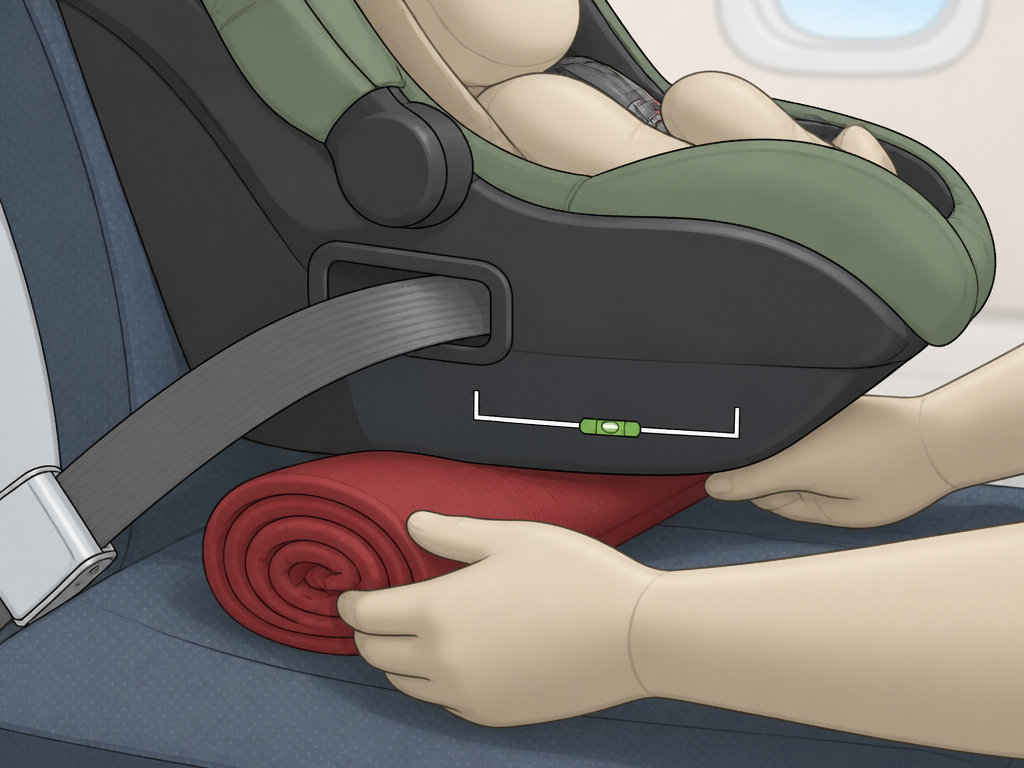
You’ve reached your window seat. Now, the installation is about the aircraft lap belt and a specific angle. Forget the LATCH system; it doesn’t exist on planes. You’ll use the standard lap belt, threading it through the car seat’s designated aircraft belt path as shown in your manual.
For rear-facing infant carriers, the level line is critical. The Evenflo Shyft DualRide manual instructs: “Adjust the seat angle until the level line on the infant carrier is level with the floor of the aircraft. An airline blanket may be placed under the infant carrier, near the seat back as shown to adjust the angle, if necessary.” This isn’t about comfort, it’s about keeping the child’s airway open at the correct recline.
The process is methodical: 1. Place the seat in the window seat, rear-facing for infants, forward-facing for larger toddlers as per the seat’s limits. 2. Thread the aircraft lap belt through the correct belt path. Pull it tight until the seat does not move more than an inch side-to-side or forward at the belt path. 3. Check the level indicator. Use a rolled blanket or towel under the seat near the back to adjust the angle until the line is level. 4. Secure your child in the harness, ensuring the straps are snug and the retainer clip is at armpit level. 5. Stow the carry handle in the approved position for takeoff and landing (often a specific “rebound” position).
Worth knowing before you start: Ask a flight attendant for a seatbelt extender the moment you board. Some car seats make the standard belt too short to latch. Requesting it early avoids a panic during final boarding.
If you’re using a forward-facing convertible seat, the same rules apply: window seat, tight lap belt, and follow the manual. The UPPAbaby MESA V2 manual includes a dedicated “Aircraft Installation” section, find yours and review it the night before you fly.
Navigating Security with a Stroller and Car Seat
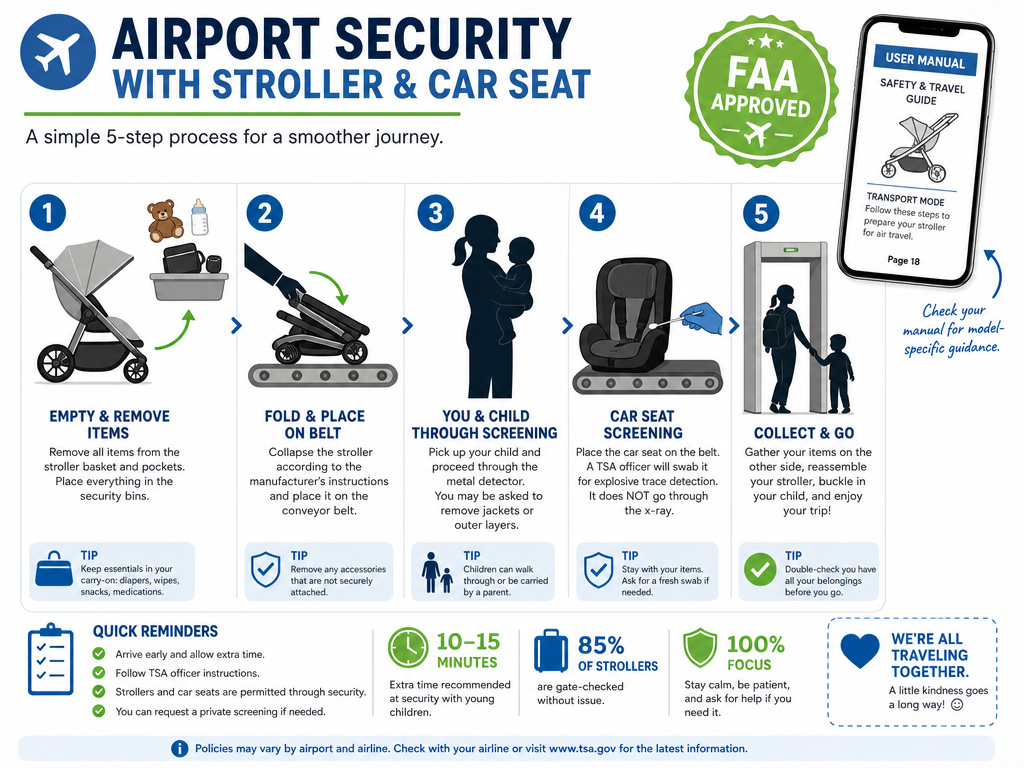
Security is a puzzle you solve by dividing your gear. The stroller goes through the X-ray belt. The car seat usually does too, but it might need a hand inspection. Your child will need to be out of both.
The sequence that works: * Empty the stroller basket. All items go into bins. * Collapse the stroller and place it on the conveyor belt. Practice this fold at home. * Remove the child from the car seat or stroller. Wear them in a soft carrier or hold them. * Place the car seat on the belt. If it doesn’t fit, a TSA officer will swab it for explosives residue. * You and your child walk through the metal detector.
Have your car seat manual accessible on your phone. If an agent questions its approval, you can show them the FAA sticker photo and the relevant manual page. They see hundreds of these; a prepared parent moves through faster.
Frequently Asked Questions
Can I use my infant car seat base on the plane?
No. Infant car seat bases are not certified for aircraft use. You install the carrier portion directly onto the airplane seat using the lap belt through the seat’s built-in belt path. The base gets packed in your checked luggage or left at home.
What if my car seat is too wide for the airplane seat?
If your car seat exceeds the typical 18-inch width, the flight attendant will not allow you to use it onboard. You will have to check it at the gate. This is why verifying dimensions with your airline before you buy a plane ticket for the seat is a critical step.
Do I need a special bag for gate-checking?
While not always required, a padded gate-check bag is a wise investment. It protects your stroller from grease, rain, and minor scratches. For a car seat, a protective bag is mandatory if you are checking it as baggage, but often optional for gate-check. Clear bags help baggage handlers identify the contents as fragile baby gear.
Can my toddler sit in the car seat during takeoff and landing?
Yes, and this is the safest place for them. The FAA strongly recommends children be secured in an approved child restraint system for all phases of flight. A properly installed car seat protects them during turbulence, which can be sudden and severe.
How do I know if my car seat has expired?
Check the manufacturer’s label on the seat. Most car seats expire 7 to 10 years after the date of manufacture. The UPPAbaby MESA V2 manual explicitly states to “discontinue use after 7 years from the date of manufacture.” Plastic degrades over time, and safety standards evolve. Using an expired seat is a safety risk.
Before You Go
Flying with a car seat and stroller boils down to preparation and knowing the two non-negotiable rules: the FAA sticker on the seat and the 20-pound limit on the stroller. Get those right, and the airport process becomes a predictable sequence instead of a stressful scramble.
Pack the car seat manual, know your airline’s specific policy, and always opt to use the seat on the plane if you’ve purchased a seat for your child. Checking a car seat should be your last resort. Your stroller is your logistics tool, keep it light enough to gate-check so it’s with you until the last possible moment. With this framework, you move from being at the mercy of airline policy to being in control of your family’s travel gear.
