
A Complete Guide on How to Gate Check a Stroller and Car Seat
This post contains affiliate links. As an Amazon Associate, we earn from qualifying purchases.
To gate check a stroller and car seat, you must navigate two separate but overlapping airline policies: one for the stroller and one for the car seat. Most U.S. Carriers allow both items to be checked for free at the gate, but American Airlines explicitly states you may only gate check one stroller or one car seat, a rule that breaks most travel systems. The critical step is verifying your stroller’s collapsed dimensions and weight against your specific airline’s limits before you reach security.
That single policy mismatch is where the system fails. A travel system is sold as a unit, but an airline may treat its components as separate items with a one-item limit. You can own the perfect gear and still be forced to check a piece at the ticket counter, which adds a baggage claim stop and handling risk.
What follows: the exact weight and size cutoffs for five major airlines, the ASTM safety standard that governs how a car seat attaches to a stroller, and the seven-step gate-check sequence that avoids the baggage claim surprise.
Key Takeaways
- American Airlines’ “one item” gate-check rule is the exception that forces most travel system owners to check the car seat at the ticket counter.
- Strollers over 20 lbs (American) or that don’t collapse below 10×36 inches (Air Canada) must be checked at the ticket counter, not the gate.
- The ASTM F833-13 safety standard requires a car seat/stroller combo to withstand a 50-pound static load; a mismatch can fail this test.
- Gate-checked items are typically returned at the jet bridge, but some airlines may send them to baggage claim, always ask the agent at boarding.
- Using a dedicated travel bag for each item is the single best protection against damage from baggage handling.
What Gate Checking Actually Means (And What It Doesn’t)
Gate checking is not a free pass for any baby gear. It’s a conditional service: you can use your stroller and car seat through the airport and hand them to an agent at the boarding door. In exchange, the airline transports them in the cargo hold and aims to return them at the jet bridge after landing.
The conditional part is where people get tripped up. Airlines publish size and weight limits for a reason, gate facilities have narrow closets and baggage handlers have weight limits. A Bob jogging stroller is a classic failure point. It’s heavy and doesn’t fold small.
Where this goes sideways: Assuming “gate check” means “any stroller.” Large, heavy strollers may only be checked at the ticket counter because airport gate facilities can’t handle them. You’ll find out at the gate, and your stroller will then go to baggage claim, not the jet bridge.
The retrieval location is the other hidden variable. While most flights return gate-checked items at the jet bridge, operational issues can reroute them to the main baggage carousel. If you have a tight connection or need the stroller immediately upon landing, that reroute adds a significant delay. The only way to know is to ask the gate agent where the item will be returned on this specific flight.
The One Airline Policy That Breaks Your Travel System
Most airlines are generous. Delta, Southwest, JetBlue, and United allow you to gate check both a car seat and stroller for free. They treat them as assistive devices, not counted baggage.
American Airlines is the outlier. Its policy clearly states only one stroller or one car seat can be gate-checked. This isn’t a suggestion, it’s a hard limit enforced at the gate. If you roll up with a Britax B-Agile stroller and a B-Safe car seat clicked into it, you have two items. The agent will ask you to choose one to gate-check and the other must be checked at the ticket counter.
Why does this matter? A car seat checked at the ticket counter is handled with regular luggage. It goes on the belt, through the sorting system, and onto the carousel. The risk of loss or damage is higher. It also means you can’t use the car seat in the airport, and you must retrieve it at baggage claim, not the gate.
I’ve seen parents with a Doona or other all-in-one travel system get caught by this. The product is a car seat and stroller in one, but American’s policy sees it as two functions, so it counts as two items. Their only option is to check the entire unit at the ticket counter as a single piece of luggage, which defeats the purpose of gate checking.
The fix is to know your airline’s policy before you book. If you’re flying American and want to use a travel system through the airport, you must purchase a seat for your infant and bring the FAA-approved car seat onboard. Then you can gate-check the stroller alone.
Stroller Size and Weight: The Hidden Gatekeepers
Airlines don’t publish stroller limits to be difficult. They publish them because the aircraft’s forward closet has physical constraints. The limits are your checklist before you leave home.
| Airline | Stroller Weight Limit for Gate Check | Key Dimension Limit | What Happens If You Exceed It |
|---|---|---|---|
| American Airlines | 20 lbs | Not specified | Must be checked at the ticket counter. |
| Air Canada | Not specified | 10 in x 36 in (collapsed) | Can only be checked at the baggage counter. |
| Delta Air Lines | Not specified | Not specified | Generally accepted; discretion applies to very large items. |
| Southwest Airlines | 35 lbs | 90 linear inches (collapsed) | Treated as regular checked baggage; standard fees may apply. |
| British Airways | Not specified | 46 in x 15 in x 15 in | Gate-to-door service at most airports. |
The Air Canada limit is the most precise: a collapsed diameter not exceeding 25.5 cm (10 in) and a length not exceeding 92 cm (36 in). Many standard strollers fail the 10-inch diameter test because of their wheel width. You’ll need a measuring tape.
Southwest’s policy is unique for its inclusion of stroller-wagons. If your collapsible wagon is designed for kids and under 90 linear inches and 35 pounds, it’s gate-checked for free. If it’s larger, not designed for kids, or carried in addition to a stroller, it gets standard baggage fees.
Common mistake: Weighing your stroller with the car seat attached and the diaper bag hanging from it. The airline’s weight limit is for the stroller alone, folded, as it will be stored. Add-ons push you over.
Your stroller’s manual rarely lists its folded dimensions and weight. You have to measure it yourself. Do this before packing for the trip. Finding out your UPPAbaby Vista exceeds limits at the airport is a $200 checked-bag fee and a guaranteed trip to baggage claim.
Car Seat Compatibility: More Than Just a Click
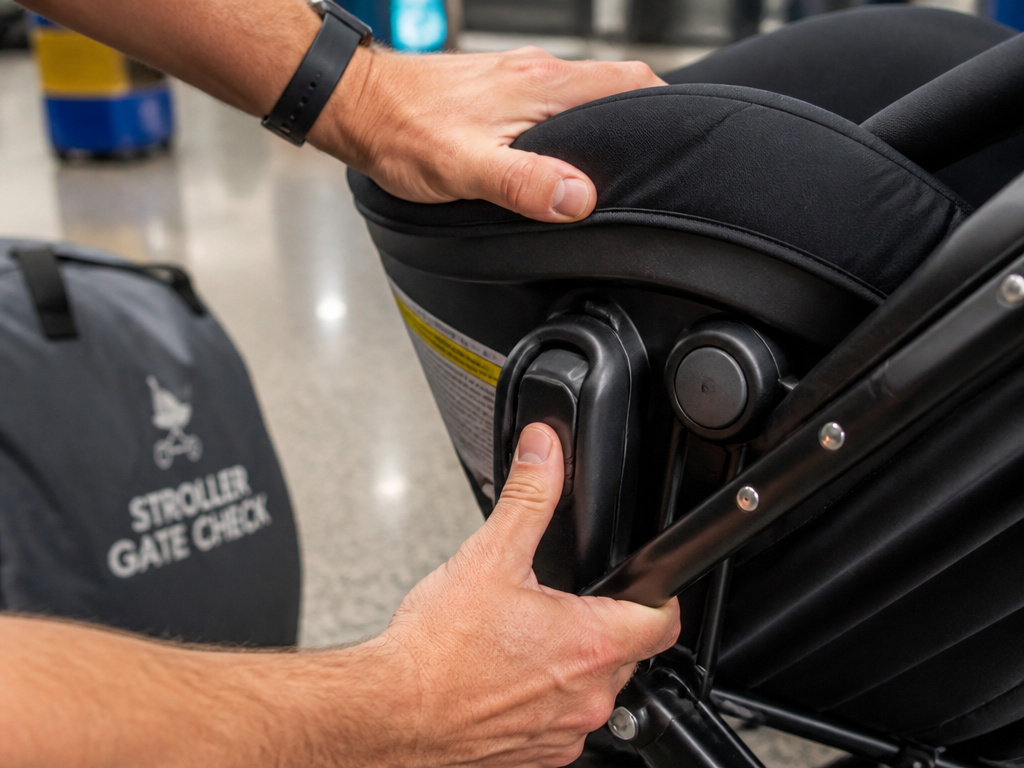
A car seat clicking into a stroller feels secure. The question is whether that connection is certified to handle the jolts of airport baggage handling. The ASTM stroller safety standard (F833-13) has a specific section for this.
The standard states a combination unit of a car seat on a stroller must support a static load of 50 lbf (222 N) placed in the center of the occupant area. It’s a test of the attachment mechanism’s strength. The Joie i-Snug 2 manual hints at this complexity, warning the carrier is designed for “certain Joie stroller models” and to check compatibility before purchase.
This isn’t just about durability. It’s about the gap between marketing and engineering. A universal travel system adapter might click, but has it been tested to the ASTM standard with your specific car seat model? Probably not. The risk is that a hard impact during baggage handling could snap the adapter or deform the stroller frame where the seat attaches.
The part nobody mentions: A car seat checked in a travel bag is thrown, stacked, and crushed. If it’s attached to a stroller with an untested adapter, that point takes the full force. A broken adapter is a cheap fix. A car seat with a compromised harness path from a bent stroller frame is not.
The safest path is to use only manufacturer-matched travel systems, like the Britax B-Safe with the B-Agile or the Chicco KeyFit with the KeyFit Caddy. These are tested as a unit. For other combinations, gate-check the car seat and stroller separately, each in its own protective bag. This isolates any impact.
The 7-Step Gate-Check Process (No Surprises)
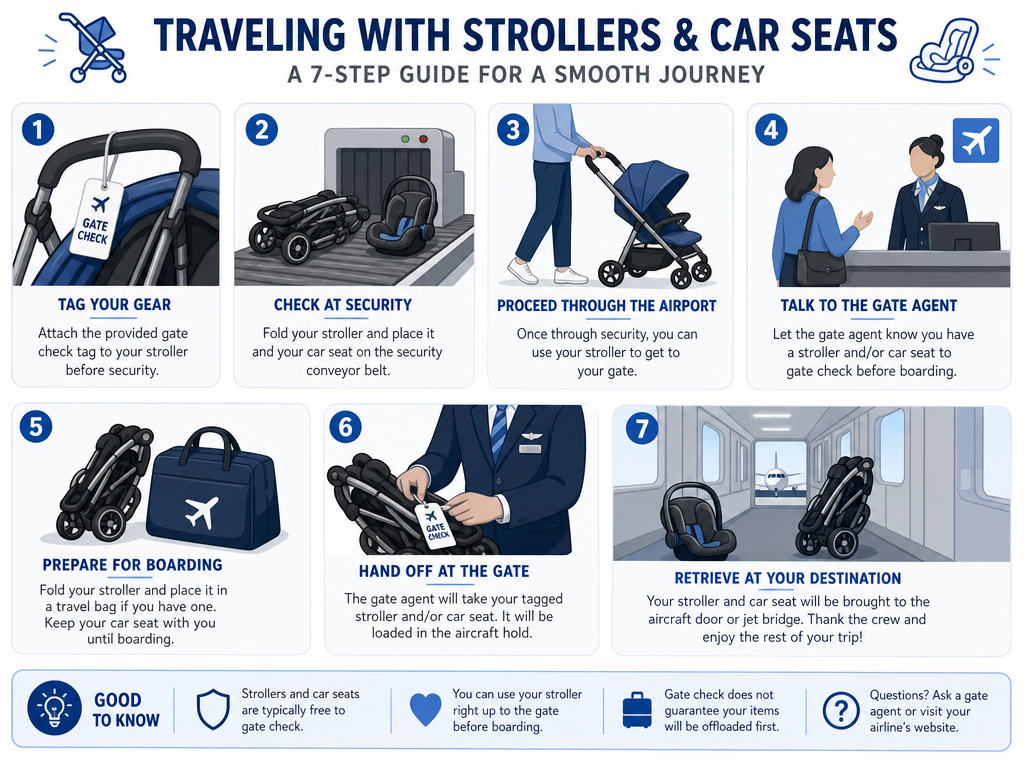
This sequence assumes you’ve already verified your airline’s policy and your gear meets the limits. It’s the mechanical how-to that avoids the last-minute scramble.
- Tagging at the Check-in Counter. Even if you’re using a kiosk, visit the airline desk. Tell the agent you wish to gate-check a stroller and car seat. They will provide special baggage tags. Attach these tags securely. This step documents your items with the airline and is your proof they were accepted for gate check.
- Security Preparation. Fold your stroller and remove the car seat before you reach the TSA belt. Have your child out of both items. Place the stroller and car seat separately on the conveyor. This speeds up the process and prevents TSA from needing a manual inspection.
- Use Through the Airport. Reassemble your travel system and use it normally to get to your gate. This is the whole benefit, saving your back and arms.
- The Gate Agent Check-in. Upon arriving at your departure gate, immediately approach the agent at the desk. Confirm you are gate-checking the items and ask the critical question: “Will these be returned at the jet bridge or at baggage claim?” Get a clear answer.
- Final Preparation at Boarding. When your boarding group is called, take your child out of the stroller. Fold the stroller. If you have a travel bag, place the stroller and car seat inside now. Leave the tagged items standing by the jet bridge door.
- Hand-off. An airline employee will take the items from you at the door to the jet bridge or directly at the aircraft door. You do not take them onto the jet bridge itself. Ensure the employee sees you leave them.
- Retrieval. Upon landing, proceed to the jet bridge. Your items should be waiting there, lined up. If they are not, ask the flight attendant or a gate agent immediately. Do not leave the gate area without them.
Skipping step 4, confirming the return location, is how you end up at baggage claim without a stroller for a tight connection. Airlines don’t volunteer this information; you must ask.
Gate Check vs. Checked Baggage: The Risk Trade-Off
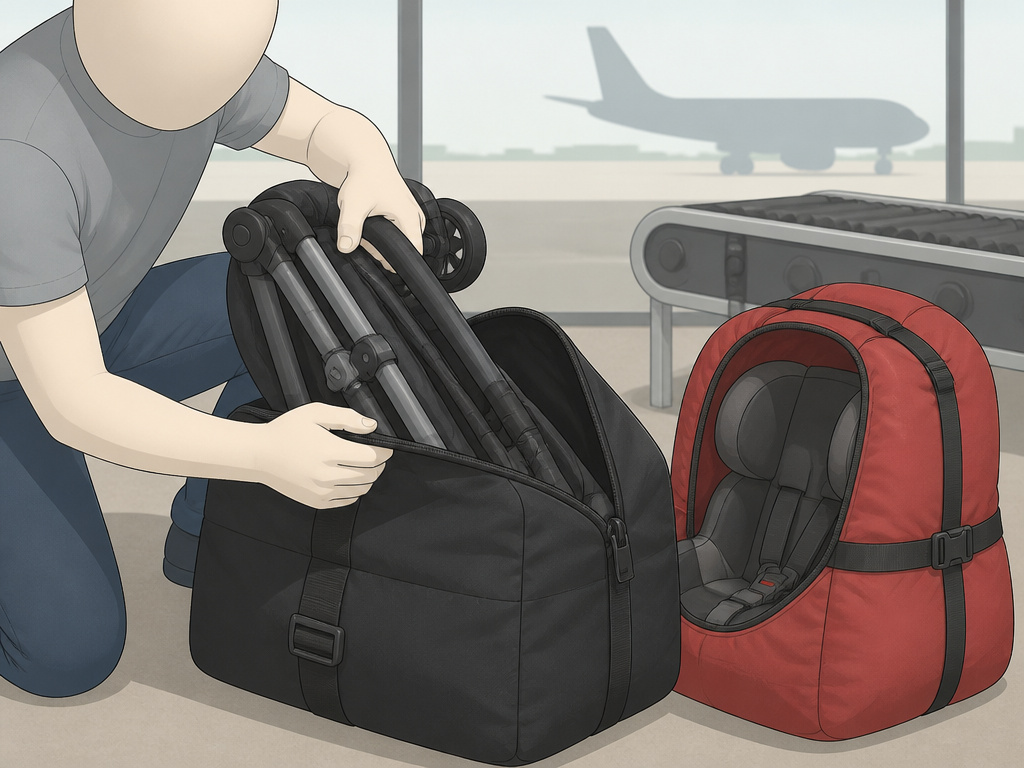
The primary advantage of gate checking is reduced handling. Items checked at the gate are typically hand-carried to a dedicated cargo hold and are the last items loaded, first items unloaded. They experience fewer conveyor belts, drops, and crushes than luggage checked at the ticket counter.
The trade-off is that gate-checked items are still in the cargo hold. They are not gentle with them. Wheels snap. Canopies tear. This is why a protective bag is non-negotiable. A $30 investment can prevent a $300 stroller repair.
A car seat is a special case. The safety of gate checking a car seat is debated because any hard impact could theoretically compromise its structure in a way that’s invisible. The conservative stance is that if you need the car seat at your destination, gate-check it in a protective bag. If you can rent or borrow one, consider checking yours at the ticket counter to keep the airport journey simple.
The table below breaks down the decision.
| Scenario | Best Choice | Why |
|---|---|---|
| Flying with a travel system on American Airlines. | Check entire unit at ticket counter as one bag, or buy seat for infant. | American’s one-item gate-check policy makes gate checking the system impossible. |
| Tight connection (<60 mins). | Gate check with confirmation of jet-bridge return. | You cannot afford to wait at baggage claim. |
| Car seat needed immediately at destination (e.g., rental car). | Gate check car seat in protective bag. | Ensures you have it upon landing without a baggage claim stop. |
| Large, heavy jogging stroller. | Check at ticket counter. | It likely exceeds gate size/weight limits and will be refused at the gate. |
The process for checking in a car seat and stroller at the ticket counter is straightforward: you treat them as regular checked bags. The agent will tag them, and they’ll go on the belt. The key is to use sturdy travel bags and consider adding an Apple AirTag or similar tracker inside each bag for peace of mind.
Essential Gear: What You Actually Need
You don’t need much. But the right few items prevent major headaches.
- Protective Travel Bags: One for the stroller, one for the car seat. Look for padded versions with backpack straps. The straps let you wear the car seat as a backpack through the airport if you’re not using it with the stroller.
- Gate-Check Tags: The paper tags from the airline are flimsy. Use a plastic tag holder or a durable luggage tag looped through the bag’s handle to keep the airline tag secure and readable.
- A Measuring Tape: Know your stroller’s folded dimensions and weight. Guessing fails at the worst moment.
- A Car Seat Cart: If you’re not using a travel system, a small cart that lets you wheel the car seat through the airport is a back saver. It converts the car seat into a temporary stroller.
Brands like J.L. Childress and Britax make well-regarded travel bags. The J.L. Childress Ultimate Car Seat Travel Bag has wheels and a handle, turning the car seat into a wheeled suitcase. For strollers, a simple, lightweight nylon bag with a drawstring often suffices, the goal is to keep wheels and fabric from snagging.
The one item to skip is an expensive, hard-sided travel case. It adds bulk and weight, often pushing you over the airline’s limits, and handlers treat it like any other hard suitcase.
Frequently Asked Questions
Can I gate check a car seat without a base?
Yes. Airlines only care that it’s a child restraint system. You can gate-check an infant carrier like the Chicco KeyFit or a convertible car seat like the Graco Extend2Fit, with or without its base. Pack the base in your checked luggage if you need it.
Do I need to buy a ticket for my baby to gate-check a car seat?
No. A lap infant is entitled to gate-check a car seat and a stroller on most airlines. You only need to purchase a seat if you want to use the car seat onboard the aircraft, which is the safest way for your child to fly.
What if my gate-checked stroller is damaged?
Report it immediately to the airline’s baggage service office before leaving the airport. Take photos of the damage. Airlines have liability limits for gate-checked items, but they will often cover repairs or replacement for damage caused during handling. Having a receipt for the stroller helps.
Can I use my stroller all the way to the airplane seat?
No. You must fold the stroller and leave it at the entrance to the jet bridge or at the aircraft door. You cannot take it down the jet bridge or onto the plane, even if folded.
Is a stroller bag required?
Most airlines do not require a bag, but many strongly recommend it. A few international carriers may have a bag requirement. Using one is the single best practice to prevent dirt, grease, and damage to your gear.
Can I gate check a car seat that’s attached to my stroller?
Yes, if your airline allows two items and the combined unit meets size/weight limits. However, for the reasons of compatibility and impact protection discussed earlier, it is safer to separate them and bag each individually before handing them over.
The Bottom Line
Gate checking a stroller and car seat is a logistics puzzle, not a right. The solution is in the specifics: your airline’s written policy, your stroller’s folded dimensions, and the compatibility of your travel system. American Airlines’ one-item rule is the biggest trap for the unprepared.
Pack a tape measure, invest in two protective bags, and always confirm the return location at the gate. The goal is to walk off the plane with your gear in hand, ready to go, not to start your vacation at a baggage carousel.
