Legitimate Ways on How to Get a Free Infant Car Seat & Safety
This post contains affiliate links. As an Amazon Associate, we earn from qualifying purchases.
You can get a free infant car seat through three legitimate channels: a manufacturer recall replacement, a verified non-profit or government assistance program, or a hospital discharge program for qualifying families. The fourth “path”, finding a free used seat, carries significant risk and requires a rigorous, seven-point safety inspection before use. Every free seat must pass the same safety standards as a new purchase.
That inspection is the whole game. A seat that costs you nothing can still cost your child everything if its history is unknown, its plastic is aged, or its manual is missing. The difference between a safe free seat and a dangerous one is verification, not price.
What follows: the four actual paths to a free seat, each with its own rules and red flags. We’ll walk through the specific recall notices that trigger free replacements, name the organizations that run legitimate programs, and detail the exact seven-point checklist from safety manuals that you must run on any seat before you buckle a child in.
Key Takeaways
- Recall replacements are the most common free seat. If your seat model is under recall, the manufacturer must provide a free repair kit, a new base, or a full seat replacement, check the NHTSA website using your seat’s model number.
- Never use a seat past its expiration date. Plastic degrades and safety standards change. Chicco seats expire at 6 years, Graco at 7 years; the date is stamped into the plastic shell.
- Inspect any used seat like a detective. You must verify no crash history, check for cracks/frays, possess the original manual, and confirm all parts are present. Missing one item means the seat fails.
- Avoid unregulated online marketplaces. Seats sold under generic names like “Joybuy Portable Infant Safe Seat” have been recalled for failing federal safety standards and offer zero crash protection.
- Assistance programs exist but have criteria. Organizations like Safe Kids Worldwide often partner with local agencies; eligibility usually requires proof of need and sometimes attendance at a safety class.
The 4 Proven Paths to a Free Infant Car Seat
Forget sketchy online giveaways. Legitimate free seats come from accountable sources with a paper trail. Here are the four avenues, ranked from most reliable to most risky.
| Path to a Free Seat | How It Works | What You Must Verify |
|---|---|---|
| Manufacturer Recall | The company issues a recall for a safety defect and provides a free remedy. | Your seat’s model number and manufacture date match the recall notice. |
| Assistance Program | A government or non-profit provides seats to qualifying low-income families. | The program’s legitimacy (check via .gov or known charities like Safe Kids). |
| Hospital Discharge | Some hospitals provide seats to ensure safe transport home for newborns. | The seat is new, in its original box, and not a recalled or expired model. |
| Used / Hand-Me-Down | Acquiring a seat from a friend, family member, or secondhand source. | Passes the full 7-point safety checklist. This is non-negotiable. |
The recall remedy is your legal right. If a manufacturer recalls your seat for a defect, like Dorel’s 2023 recall of Maxi-Cosi Coral XP bases where lower connectors could fail, they are obligated to fix it free of charge. You install the child restraint only with the vehicle safety belt until the new base arrives.
Path 1: The Recall Replacement. This is the most straightforward method. Car seats, like vehicles, are recalled when a defect is discovered that could injure your child. The NHTSA car seat safety guidelines database is the official source. You search by your seat’s brand, model number, and manufacture date. If it’s listed, you contact the manufacturer for your free remedy kit. This isn’t a giveaway; it’s a mandated correction.
Path 2: Non-Profit & Government Programs. Organizations like Safe Kids Worldwide coalition members often run periodic car seat distribution events. These are typically need-based. You might need to show proof of income, residency, or pregnancy. Some require you to attend a short car seat safety class. The key is verifying the program through your local health department or a reputable children’s hospital, not a random Facebook post.
Path 3: Hospital & Clinic Programs. Certain hospitals, particularly those serving high-need communities, have programs to provide a free infant car seat at discharge. This ensures every newborn leaves safely. The seat is usually a basic, new model. Always check it for a current expiration date and register it immediately to receive any future recall notices.
Path 4: The Used Seat Route. This is where extreme caution is required. A seat from a trusted friend or relative can be safe, but only if you can confirm its entire history. You are not just getting a seat. You are becoming its safety auditor.
The Mandatory Safety Checklist for Any Free Seat
A free seat is not a shortcut on safety. It must meet the same criteria as a seat you buy new. This seven-point checklist is compiled from manufacturer manuals and safety agency publications.
- Confirm No Crash History. The Chicco KeyFit Max manual states: “You MUST replace this Child Restraint if it has been involved in a crash, even if you cannot see visible damage.” This is non-negotiable. You must get this confirmation in writing or from a source you trust absolutely.
- Check the Expiration Date. Look for the date molded into the plastic shell, usually on the back or bottom. Chicco seats expire 6 years from manufacture; Graco seats like the SnugRide 30 expire at 7 years. Transport Canada states plastic weakens and labels fade, making expired seats unsafe.
- Possess the Original Instruction Manual. You need it to install correctly and identify all parts. If it’s missing, contact the manufacturer to order a replacement before using the seat.
- Inspect for Physical Damage. Run your hands along the plastic shell feeling for cracks, especially near harness slots. Check the harness straps for fraying, cuts, or severe fading. Test the buckle and adjuster for smooth operation.
- Verify All Parts Are Present. Compare the seat against the manual’s parts diagram. Ensure no screws, covers, padding, or the infant insert are missing.
- Check for Recalls. Even after passing the above, visit the NHTSA site and input the model number. A seat can be safe in every other way but still under an active recall for a hidden defect.
- Know Your Vehicle’s Rules. Your car’s owner’s manual dictates where and how to install a seat. Never place a rear-facing seat in front of an active airbag.
Where this goes sideways: Using a seat without the manual. The Graco SnugRide 30 manual has specific, non-intuitive instructions for using a locking clip with certain vehicle seat belts. Missing that step means the seat can shift more than an inch in a crash, which is a failure.
If the seat fails any point on this list, it is not safe. Destroy it, cut the straps, break the plastic shell, and write “UNSAFE” on it with permanent marker, so no one else can use it. The cost of a new seat is zero compared to the risk.
Recall Replacements: Your Step-by-Step Guide
When a recall is issued, the manufacturer’s remedy varies. Here’s how to navigate the process.
- Step 1: Locate your seat’s model number and manufacture date. This is on a label on the seat itself.
- Step 2: Search the NHTSSA recall database. Enter your information. If a recall is active, note the recall number and remedy.
- Step 3: Contact the manufacturer per the recall notice. Call or use their online form. They will ask for your seat’s details and your shipping address.
- Step 4: Follow the interim instructions. If the recall says “install with vehicle belt only until replacement arrives,” do exactly that. Do not use the defective part.
- Step 5: Install the remedy part when it arrives. Follow the new instructions precisely. Discard the old part.
Sometimes the remedy is a different product entirely. In one recall, Dorel offered a free Maxi-Cosi Rodi Sport Booster seat as a replacement for a outgrown convertible seat under recall. The process is bureaucratic but structured.
The Hidden Dangers of Counterfeit and Unregulated Seats
The rise of online marketplaces has flooded the zone with dangerous, non-compliant products. The December 2022 NHTSA recall of all “Joybuy Marainbow Portable Infant Safe Seat” and similar models is the textbook example.
These seats have generic, catchy names, sold at prices that seem too good to be true. They are. They have not been tested to meet Federal Motor Vehicle Safety Standard (FMVSS) 213, the U.S. Safety benchmark. In crash testing, they can shatter, detach, or fail to restrain the child.
How to spot a risky seat:
- It’s sold under a brand name that isn’t a known car seat manufacturer (e.g., “Joybuy,” “Farfí”).
- The listing lacks a specific model number or references to FMVSS 213 compliance.
- The price is drastically lower than major brands like Chicco, Graco, or Britax.
- Reviews mention flimsy plastic, missing parts, or vague instructions.
These are hazards with a fabric cover, not bargains. Stick to known brands you can research and register.Your child’s safest infant car seats will always come from companies subject to safety regulations.
Free Seat Programs: What to Expect and How to Qualify
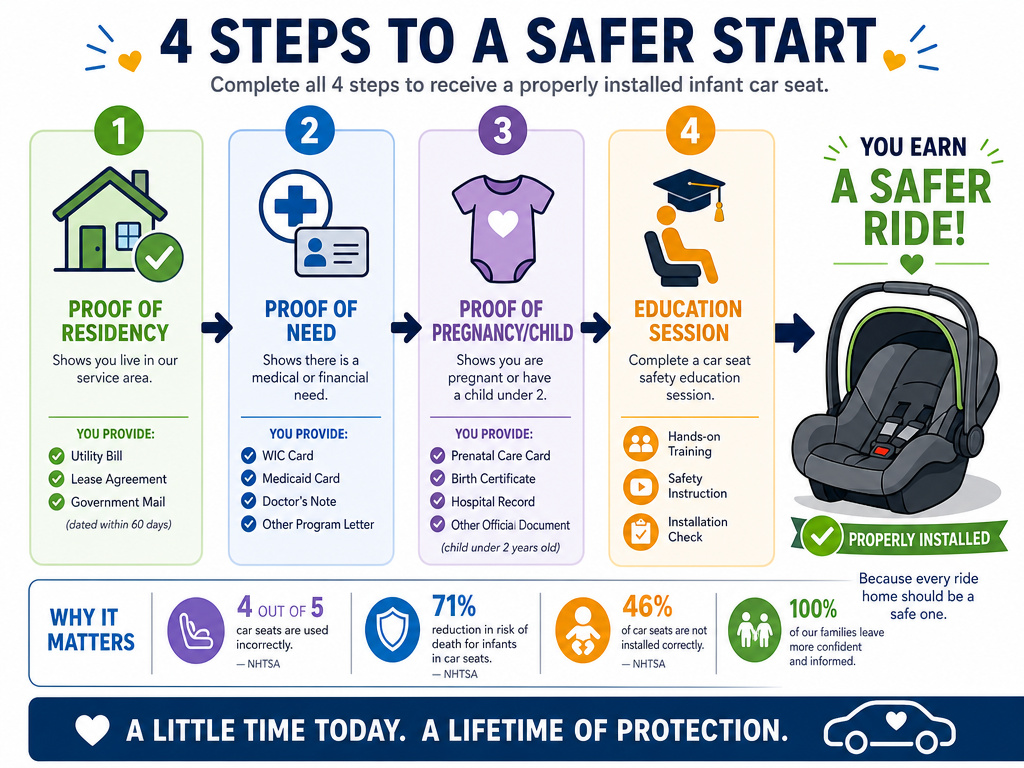
These programs are a lifeline, but they require action. They are designed to ensure seats go to families who need them and will use them correctly.
Most programs will ask for: * Proof of residency (utility bill, lease). * Proof of need (WIC card, Medicaid enrollment, referral from a social worker). * Proof of pregnancy or the child’s birth certificate. * Attendance at a 30-60 minute car seat education session.
The session is key. Providers want to ensure you know how to install the seat and buckle your child snugly. This education component is what turns a donated seat into an effective lifesaving device. You can often find these programs through your county’s public health department or by contacting a local chapter of Safe Kids Worldwide.
When a “Free” Seat Isn’t Worth It: The Used Seat Dilemma
This is the hardest call. A friend offers you their perfectly good infant car seat travel system. It looks clean. The temptation is huge.
Stop. Ask the seven checklist questions. If you cannot get definitive “yes” answers to all of them, the seat is a liability.
The most common failure points for used seats:
- The crash history question. “It was just a fender bender” doesn’t cut it. Manufacturers and safety agencies define a crash as any incident that required the vehicle to be towed, deployed airbags, or resulted in injury to a vehicle occupant. When in doubt, throw it out.
- The missing manual. You cannot guess at installation. The angle of recline for a newborn is specific and critical for breathing. Without the manual, you are flying blind.
- Discontinued models. Older seats may lack safety features now considered standard, like side-impact protection or simpler, more foolproof installation systems like LATCH.
If you decide to use a hand-me-down that passes inspection, register it immediately with the manufacturer. This is how you’ll be notified if a recall is issued later. Treat it with the same care as a new purchase.
Frequently Asked Questions
Are hospital free car seats safe?
Yes, if they are new, in an unopened box, from a reputable brand, and not expired. Hospitals typically partner with manufacturers or use seats donated through verified programs. Always check the expiration date and register the seat.
Can you get a free car seat from insurance?
Sometimes. A few private insurance plans or Medicaid in certain states may cover a car seat, often classified as “durable medical equipment” for premature infants or those with specific health conditions. You need a doctor’s prescription and must check your plan’s policy. It’s rare for standard births.
Is it illegal to use an expired car seat?
In the United States, there is no federal law prohibiting the use of an expired seat. However, using one violates the manufacturer’s instructions, which is required by law in every state. If you are in a crash and your child is injured while in an expired seat, you could be found negligent. In Canada, provincial laws require seats to be used according to manufacturer instructions, which includes respecting the expiry date.
What do I do with an unsafe car seat I can’t use?
Destroy it. Take it apart, cut the harness straps, break the plastic shell with a hammer, and mark it “UNSAFE” or “CRASHED.” Then dispose of it in a sealed trash bag so no one can retrieve and reuse it. Do not donate it or leave it on the curb.
How do I find local car seat help or inspection stations?
Use the NHTSA website’s inspection station locator. Certified Child Passenger Safety Technicians (CPSTs) will inspect your seat installation for free. They can also help you understand the features of a free car seat and stroller travel system you may acquire.
Before You Go
The goal is a safe child, not just a free seat. The most reliable path is through a manufacturer recall or a vetted assistance program. If you go the used route, your new job is forensic investigator. Check every date, every strap, every page of the manual.
When in doubt, the safe choice is to walk away. The resources exist to get a safe seat into your car. Use the NHTSA database, contact your local health department, and lean on the expertise of certified technicians. That’s how you get peace of mind that doesn’t come with a price tag.
