
Carry Car Seat to Leave Hospital: Is It Actually Required?
This post contains affiliate links. As an Amazon Associate, we earn from qualifying purchases.
You need a car seat to leave the hospital, but it does not have to be a carry-cot style infant seat. The hospital’s discharge policy requires a car seat that meets Federal Motor Vehicle Safety Standard (FMVSS) 213, fits your newborn, and passes a mandatory observation test called the Car Seat Tolerance Screen.
The real question isn’t about the seat’s style. It’s about three specific checks the hospital will run before they let you walk out the door. They will verify the seat’s safety certification, its physical fit for your baby, and your baby’s ability to tolerate the semi-upright position for 90 to 120 minutes. If any of those checks fail, discharge gets delayed.
What follows: the exact measurements hospitals use, the pass/fail criteria straight from clinical guidelines, and what happens when a baby doesn’t pass. We’ll also walk through the practical choice between an infant carrier and a convertible seat from day one.
Key Takeaways
- Hospitals are legally required to discharge newborns in a crash-tested car seat. The specific style, infant carrier or convertible, is your choice, but it must fit a baby as small as 4 pounds.
- Every baby born before 37 weeks, under 2.5 kg, or with certain medical conditions must pass a Car Seat Tolerance Screen, a 90–120 minute monitored test for breathing and heart rate.
- Failing the test means immediate removal from the seat and a mandated 12–24 hour wait before a retest. Two failures can lead to a car bed recommendation and extended hospitalization.
- Bring your car seat and its manual to the hospital several days before your due date or planned discharge. This allows time for the staff check and the tolerance test.
- The safest choice is the seat you can install and use correctly every time. For most families, that’s an infant carrier. For others, skipping the infant seat phase with a convertible works fine if the baby fits.
The Short Answer: Yes, But Not the One You Think
The phrase “carry car seat” is marketing, not medicine. What you actually need is any rear-facing child restraint system certified to FMVSS 213. This includes infant carriers (the click-into-a-base kind) and convertible seats rated for newborns.
Hospitals don’t mandate a style. They mandate a standard. Their policy, often based on the American Academy of Pediatrics report on safe newborn transport, is to ensure no baby leaves unprotected. The nurse isn’t checking for a carry handle. She’s checking for a label that says it meets the federal safety standard and for a harness that fits your baby’s shoulders.
This is where the first surprise hits new parents. You can absolutely use a convertible seat from the start. The catch is the fit. A 6-pound newborn swimming in a seat designed for a 12-pound infant won’t pass the hospital’s fit check. You need a model with low enough harness slots and often an infant insert approved by the manufacturer.
Where this goes sideways: Assuming any new car seat is fine. Seats have minimum weight limits, some start at 4 pounds, others at 5 or even 7. Bringing a seat rated for 7+ pounds for a 5.5-pound preemie means you’re not going home until you find a different seat.
The 3 Things Hospitals Actually Check
Before the paperwork is signed, hospital staff run through a specific protocol. It’s not a casual glance. It’s a verification against a checklist, often adapted from resources like the hospital discharge checklist.
1. Certification and Condition
The nurse or a certified child passenger safety technician (CPST) will look for two labels. The first shows the seat meets FMVSS 213. The second shows the date of manufacture. Many seats expire six years after that date. They will also check for any recalls and ensure all parts are present. No aftermarket accessories like head supports or strap covers are allowed unless they came with the seat.
2. Physical Fit for Your Newborn
This is a hands-on measurement. Using guidelines like those from Brigham and Women’s Hospital, they check three things: * Harness Height: The shoulder straps must be at or below the baby’s shoulders for rear-facing. * Crotch Strap Distance: The space from the child’s back to the crotch buckle should be less than 5 ½ inches to prevent “submarining.” * Recline Angle: The seat must be installed at the manufacturer’s specified angle, usually around 45 degrees, using the built-in angle indicator.
3. The Car Seat Tolerance Screen (ICSC)
This is the non-negotiable medical test for at-risk infants. If your baby is born before 37 weeks, weighs less than 2.5 kg (about 5.5 lbs), or has breathing or cardiac issues, they will undergo this monitored observation.
The baby is placed in your car seat, which is reclined to the correct angle. Pulse oximetry and heart rate monitors are attached. Then, they watch. For 90 to 120 minutes, or the length of your car ride home, whichever is longer, the staff looks for signs of respiratory distress.
| Pass/Fail Criteria | Measurement | Source |
|---|---|---|
| Oxygen Desaturation | SpO₂ < 90% for ≥ 10 seconds | Brigham and Women’s, MIEMSS |
| Bradycardia | Heart rate < 80 bpm for ≥ 10 seconds | Brigham and Women’s, MIEMSS |
| Apnea | Breathing pause ≥ 20 seconds | MIEMSS Guidelines |
The MIEMSS parent information handout explains this test to families. It’s not a judgment on your seat. It’s a test of your baby’s physiology in that semi-reclined position.
Infant Carrier vs. Convertible: The Real Trade-Off
You have two paths for that first car ride home. The infant carrier is the default. The convertible seat is the less common but perfectly legal alternative. The choice isn’t about hospital policy. It’s about your life for the next year.
The Infant Carrier (Group 0+)
This is the click-in seat with a handle. Its job is convenience for the first 9-15 months. * Pro: You can secure the baby in the house, click the seat into the base in the car, and never wake a sleeping newborn. It also clicks into many strollers. * Con: It’s a short-term use product. Most babies outgrow it by height or weight before their first birthday, so you’ll buy a convertible seat next. * Best for: Parents who will make multiple stops, use public transit, or want the stroller travel system compatibility. The Doona car seat is the extreme example of this convenience.
The Convertible Seat (Groups 0+/1/2)
This seat stays in the car. It rear-faces from birth (as low as 4-5 lbs) and later converts to forward-facing. * Pro: One purchase from infancy through toddlerhood. No need to install a car seat twice in the first year. * Con: You must unstrap the baby and carry them in and out of the car every single time. In rain, cold, or with a sleeping baby, this gets old fast. * Best for: Families on a tight budget, those with a primary vehicle the baby will always use, or parents who know they’ll babywear instead of using a stroller capsule.
The hospital’s only concern is fit. A convertible seat like the Graco Extend2Fit or the Britax One4Life can work from day one, but you must bring it in and prove it. Call your hospital’s maternity ward ahead of time. Ask: “Do you allow discharge with a convertible seat, and what are your fit requirements?”
What Happens If Your Car Seat Fails?
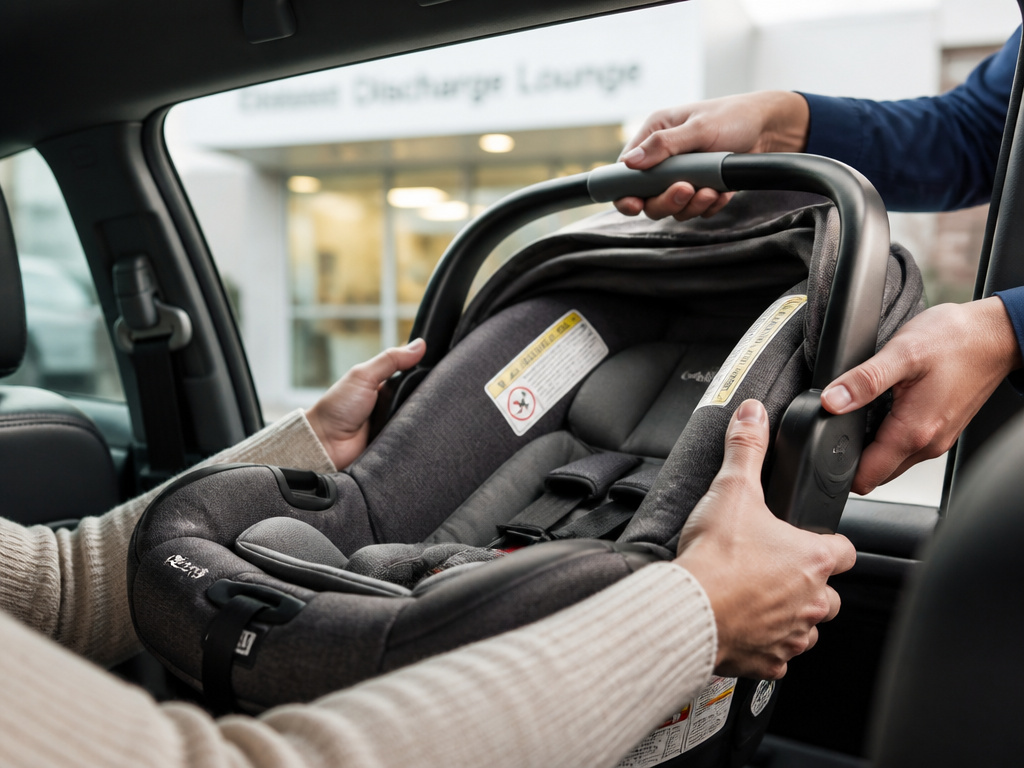
Failure happens in two ways: the seat fails the inspection, or the baby fails the tolerance test. The consequences are concrete and time-bound.
Seat Fails Inspection
If your seat is expired, recalled, missing parts, or simply too big for your baby, you cannot leave. You have two options: 1. Have a friend or family member bring a different, appropriate seat to the hospital. 2. Purchase a new seat. Some hospitals have loaner or retail programs, but you cannot count on this.
This is why the universal advice is to install the car seat and have it inspected by a CPST before your due date. The last place you want to troubleshoot installation is the hospital discharge lounge.
Baby Fails the Car Seat Tolerance Screen
This is a medical event. According to the Brigham and Women’s clinical guidelines, the staff will immediately remove your baby from the seat if failure criteria are met. The baby is placed flat in a bassinet or warmer for recovery.
The protocol then mandates a waiting period of 12 to 24 hours before a retest. If the baby fails the car seat test a second time, the discussion turns to a car bed. A car bed (like the Cosco Dream Ride) allows the infant to lie flat during transport. It’s a last-resort medical device, not a long-term solution.
The timeline expands quickly. A failure can add days to your hospital stay. This is the mechanical reason hospitals are so strict about the test for preemies, the risk of a failure on the highway is real.
A Step-by-Step Prep Guide for Parents
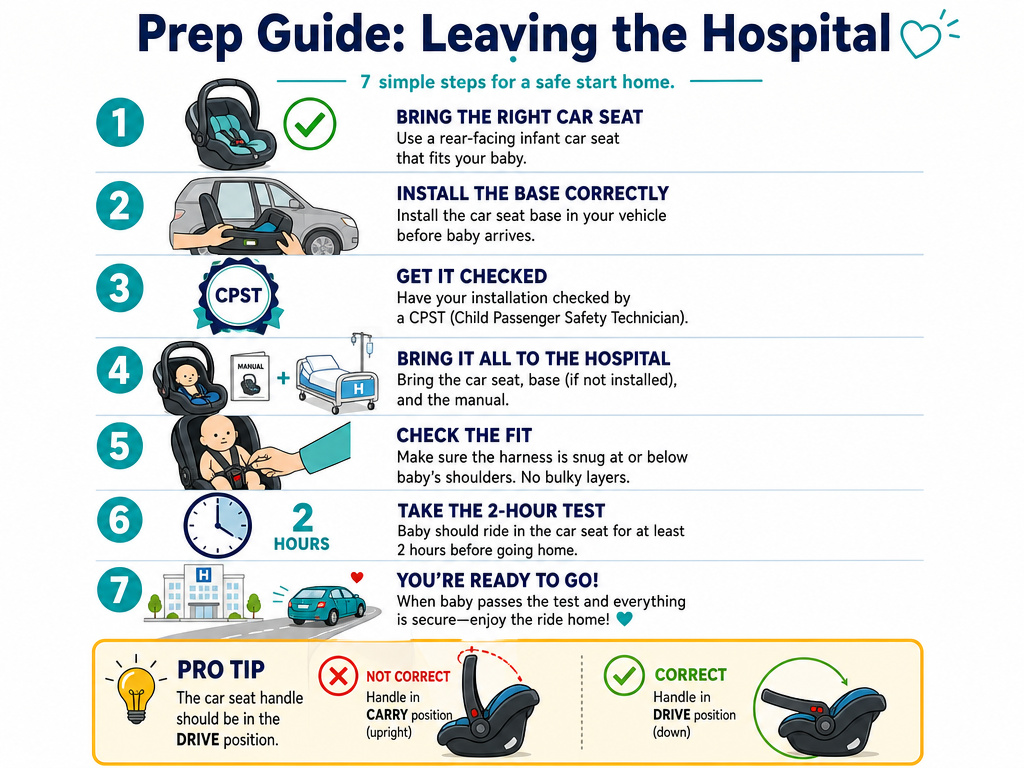
Don’t leave this to the last day. Follow this sequence to avoid discharge-day panic.
- Choose Your Seat. Decide between an infant car seat and a convertible based on your lifestyle, not hospital myths.
- Install It Early. Install the seat base or the convertible seat in your vehicle at least a month before your due date. Practice tightening the harness and using the latch system.
- Get a Professional Check. Find a CPST (via Safe Kids Worldwide) to verify your installation and fit. This is the single most effective step you can take.
- Bring the Seat & Manual. Take the car seat and its instruction manual to the hospital when you go in for delivery or several days before a scheduled discharge. Leave it in your room.
- Pass the Fit Check. A nurse or CPST will position a doll or your baby in the seat to verify harness height, buckle position, and recline.
- Complete the Tolerance Test. If required, the test will be scheduled. Plan for it to take up to two hours.
- Drive Home. Upon passing all checks, you’ll get final discharge instructions. Ensure the seat is installed tightly in the vehicle, over 90% of seats are installed with potentially deadly looseness.
The part nobody mentions: That car seat handle? It’s not a carrying handle in the traditional sense. It’s a transport handle that must be locked in the correct position for driving. Leaving it in the “carry” mode during a crash can cause the seat to rotate and increase injury risk. The manual shows the safe driving position.
Frequently Asked Questions
Can the hospital provide a car seat if I don’t have one?
Some hospitals have loaner or assistance programs, but this is not guaranteed. You should never plan on it. Their inventory is limited, and the seat may not be new or ideal for your vehicle. The responsibility to provide a safe, compliant seat is yours.
What if I’m being discharged and my partner has the car seat at home?
This creates a hard stop. The hospital will not discharge the baby until a compliant car seat is physically present, inspected, and the baby is secured in it. Always bring the seat with you when you come to the hospital for delivery or induction.
How do I know if my baby needs the Car Seat Tolerance Screen?
The hospital will tell you based on their criteria (gestational age <37 weeks, birth weight <2.5kg, or specific medical conditions). You can ask your pediatrician or the maternity nurse about your hospital’s specific policy for the car seat test.
Is it safer to use an infant carrier or a convertible seat from birth?
Both are equally safe when used correctly. The safety difference is negligible compared to the massive risk of incorrect use. The safest seat is the one you use properly, every single trip. For many, the convenience of the infant carrier promotes consistent, correct use.
Do I need to buy a separate base for my infant seat?
It depends. Many infant seats can be installed securely with just a seatbelt, so a base is a convenience item, not a safety requirement. However, some models, like certain Doona configurations, may have different rules. Always check your manual to see if you need a base.
What happens if I live walking distance from the hospital?
The law and hospital policy still apply. You must transport your newborn in a motor vehicle–appropriate child restraint, even for a two-block drive. There is no exemption for short distances.
Before You Go
You need a car seat to leave the hospital. Full stop. The myth of the mandatory “carry car seat” is just that, a myth. Your real job is to bring a federally approved seat that fits your newborn and to understand the hospital’s safety protocols.
Get the seat early. Install it correctly. Bring it with you. That’s the sequence that gets you home without a hitch. The choice between seat types is personal, but the requirement to have one is absolute. Your first act as a parent on the road is buckling them into a seat that could save their life. Make it count.
