
Solutions to Stop Toddler From Unbuckling Car Seat Harness
This post contains affiliate links. As an Amazon Associate, we earn from qualifying purchases.
A toddler unbuckling their car seat harness is a behavioral issue solved by a physical fix: check the harness fit first, then layer in consistent consequences and distractions. If the unbuckling persists and is a safety risk, a Certified Car Seat Safety Technician may approve the Merritt chest clip guard for three specific Evenflo models, the only manufacturer-approved exception to the “no aftermarket products” rule.
That gap between a snug fit and a tight one is where the problem starts. A harness that pinches or a chest clip that digs creates a physical irritant a toddler can feel but not articulate. They just know it hurts, so they undo it.
What follows: how to diagnose a bad fit, the behavioral tactics that actually stick, and the narrow, regulated path to the one product that can act as a last-resort physical barrier. This is about removing the reason to unbuckle in the first place, not about willpower.
Key Takeaways
- The chest clip must sit at armpit level on the sternum; even half an inch off can dig into soft tissue and cause pain that leads to unbuckling.
- Bulky winter coats compress in a crash, creating dangerous slack; use thin layers or a blanket over the secured harness instead.
- For extreme, persistent unbuckling that poses a driving hazard, Evenflo permits the Merritt chest clip guard on the Sonus 65, Maestro Sport, and SureRide/Titan 65 models only after consultation with a Certified Car Seat Safety Technician.
- Massachusetts law requires children to use a proper restraint until age 8 or 57 inches tall, framing unbuckling not just as a nuisance but as a legal non-compliance issue during travel.
- Turning a child’s jacket backwards prevents them from accessing the chest clip while keeping them warm, a simple physical barrier that requires no extra gear.
The First Step: Check the Fit and Feel
Before you label it a behavior problem, rule out a pain problem. An uncomfortable harness is the most common, fixable cause of unbuckling.
Look at the chest clip position first. The manual for the Evenflo EveryStage states the clip must be at armpit level. If it’s riding high near the collarbone, it presses on the throat. If it’s low on the belly, it pinches the soft tissue with every lean forward. That discomfort is a direct physical trigger.
The part nobody mentions: A chest clip just one notch too tight on the straps can tilt upward, turning the flat plastic plate into a corner that digs. You won’t see it from the driver’s seat, but your toddler feels it on every bump.
Next, assess harness height. For a forward-facing child, the straps should be at or just above the shoulders. If they’re below, the webbing cuts across the shoulder blade instead of lying flat. That creates a constant rubbing pressure. The Evenflo Titan manual is explicit: the harness must be snug against the child’s shoulders with no slack. Slack isn’t just unsafe; it lets the child wiggle enough to feel the strap chafing.
Finally, feel for bulk under the straps. A puffy coat is public enemy number one. In a crash, that material compresses instantly, leaving inches of dangerous slack. The child is less safe and also swimming in loose straps that twist and bind. Use a thin fleece layer and place a coat or blanket over the already-secured harness.
Behavioral Strategies That Aren’t Just Talk
Once the fit is corrected, you’re dealing with a habit. The goal is to make buckling the default and unbuckling a dead end.
Your most powerful tool is the car’s ignition. The rule is non-negotiable: everyone rides buckled, or the car doesn’t move. The first time your child unbuckles after you’ve started driving, find a safe place to pull over immediately. Stop the car, turn off the engine, and wait. Say nothing beyond “We wait until everyone is buckled.” The consequence is boring, immediate, and directly tied to the action. It works because it removes the fun of unbuckling, which is often your reaction, and replaces it with nothing.
Distraction is your second tool, but it has to be deployed before the urge to unbuckle strikes. Handing a toy after they’ve already unclicked rewards the behavior. Instead, have a special “car-only” bag with novel items. Think ahead: a new board book, a sticker album, or a few figurines they haven’t seen in a week. The moment they are buckled in, pass it back. You’re building a positive association with the harness click.
For some kids, the ritual itself is the draw. They unbuckle to see the red button pop up. If that’s the case, give them a dummy button to press. A travel-sized liquid soap pump with the spout locked, or an old remote control with satisfying buttons, can fulfill the sensory need without compromising safety.
When to Consider a Chest Clip Guard (And Which Ones Work)
You’ve fixed the fit. You’ve been consistent for weeks. The unbuckling is still happening every trip, and you’re white-knuckling the drive. This is where the conversation turns to a physical barrier, but the rules are strict.
The universal advice from manufacturers and technicians is clear: no aftermarket products. Adding anything not crash-tested with the seat can interfere with the harness’s performance. However, there is one documented, manufacturer-sanctioned exception.
If you’ve tried all other solutions and the unbuckling presents a real driving hazard, Evenflo allows the use of the Merritt chest clip guard on three specific car seats: the Evenflo Sonus 65, the Evenflo Maestro Sport, and the Evenflo SureRide/Titan 65. You cannot add this guard to any other seat.
This is a last-resort allowance for an extreme situation, not a recommendation. The guard is a hard plastic cover that clips over the existing chest buckle, requiring an adult thumb to depress a release on the side.A toddler’s fingers can’t generate the necessary leverage.
Before You Start: Using any aftermarket product on a car seat voids its certifications and transfers liability to you. You must consult with a Certified Car Seat Safety Technician (CPST) to assess your specific situation. They can confirm your seat model is one of the three approved and that the guard is installed correctly, it must not impede the harness tightness or the clip’s emergency release function.
| Solution Path | Best For | Risk If Skipped |
|---|---|---|
| Harness fit adjustment | Initial discomfort unbuckling | Treating a physical problem as behavioral, which never resolves |
| Consistent consequences (car stops) | Habitual unbuckling for attention | Reinforcing the behavior by giving it dramatic attention |
| Distraction before the urge | Boredom-induced unbuckling | Accidentally rewarding the unbuckle by giving toys after the fact |
| Merritt chest clip guard (CPST-approved) | Persistent, dangerous unbuckling on 3 specific Evenflo seats | Using an unapproved guard or on the wrong seat, which can crack in a crash and become a projectile |
The Legal and Safety Stakes: It’s Not Just Annoying
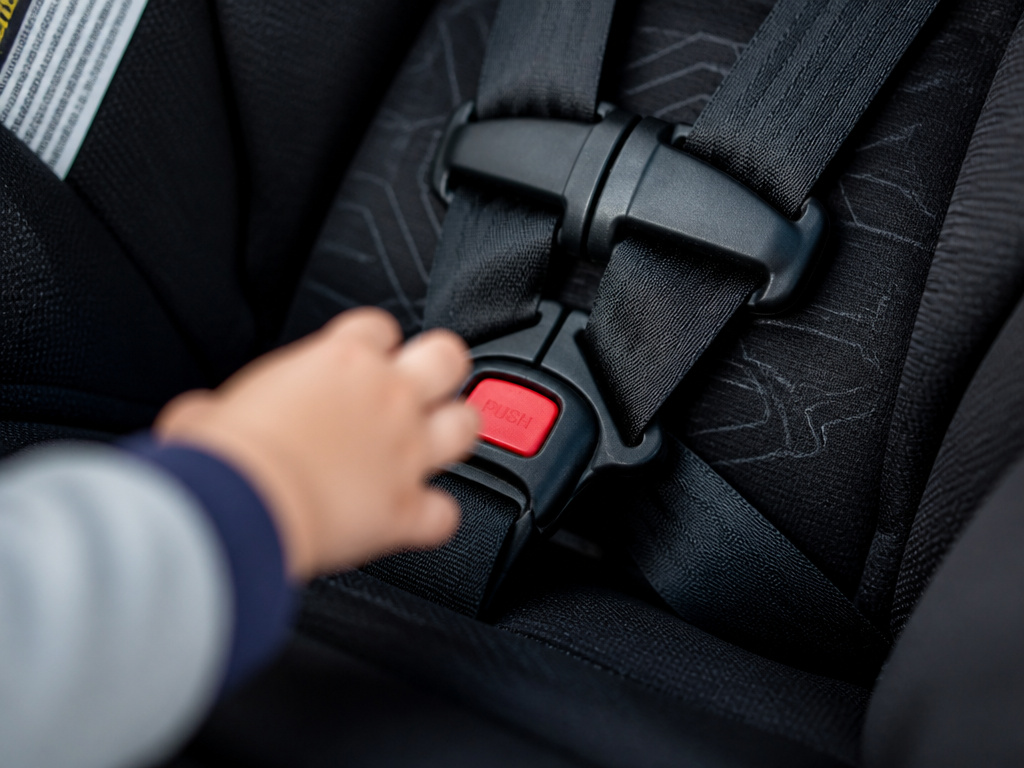 Framing this as a frustrating phase undersells it. A child who is unbuckled is completely unprotected. The legal framework underscores this seriousness.
In Massachusetts, children must be in a federally-approved child passenger restraint until they are 8 years old or over 57 inches tall. This isn’t a suggestion. If your toddler is unbuckled, you are in violation of the law. The official Massachusetts car seat FAQ states this plainly, and police can issue citations. More importantly, in a crash, an unrestrained child becomes a projectile, endangering themselves and everyone else in the vehicle.
The safety math is brutal. Proper use of a car seat reduces the risk of fatal injury for toddlers by over 70%. “Proper use” means buckled, snug, and correct. An unbuckled harness is a zero percent reduction.
This is why the advice escalates from adjustment to behavior to, in very narrow cases, a physical barrier like a clip guard. The alternative, an unbuckled child, is not an alternative at all. Your role is to enforce a rule they cannot yet understand for their own survival. That sometimes means using tools you’d rather not need.
Frequently Asked Questions
Is there a safe product to lock the chest clip?
For the vast majority of car seats, no. Most products marketed as “clip guards” or “lock covers” are not approved by seat manufacturers and can compromise the harness system. The sole exception is the Merritt chest clip guard for three specific Evenflo models, and only under the guidance of a CPST.
My toddler only unbuckles when wearing a coat. What should I do?
The coat is the problem, not the behavior. Bulky coats prevent a proper, snug harness fit. Dress your child in thin, warm layers like fleece, buckle the harness tightly so you cannot pinch any slack at the shoulder, and then place their winter coat or a blanket over the secured harness.
How tight should the harness straps actually be?
You should not be able to pinch any horizontal slack in the strap at the child’s shoulder. The “two-finger” rule is outdated and often allows too much slack. Use the “pinch test”: try to pinch the strap vertically. If you can get a grip on the webbing, it’s too loose.
When should I consider moving to a booster seat to stop unbuckling?
Never use this as a solution. Booster seats rely on the child’s maturity to sit properly with a seat belt. A child who unbuckles a five-point harness lacks that maturity. Moving them too early, before they meet the minimum age and weight requirements (often 4 years and 40 pounds), drastically increases their risk of injury.
Can I put the chest clip on backwards to make it harder?
No. Reversing the chest clip can damage its mechanism and prevent it from functioning correctly in a crash. It also often makes the buckle easier for little fingers to pry open. Focus on correct positioning at armpit level and a snug harness.
The Bottom Line
Start with the physical fit. A harness that is uncomfortable is a harness that will be undone. Make the strap height, clip position, and clothing layers your first checkpoint.
When the fit is perfect and the habit remains, your consistency is the next tool. The car doesn’t move until everyone is buckled. It’s a simple, boring consequence that breaks the attention cycle.
For the rare, persistent cases where safety is compromised every drive, know the narrow path. A Certified Car Seat Safety Technician can advise if your seat is one of the three Evenflo models that accepts the Merritt guard. That guard is a last-resort tool, not a first step.
Your toddler’s job is to test limits. Your job is to hold the line on the ones that keep them alive. Check the fit, enforce the rule, and seek expert guidance if you’re stuck. The phase will pass. Your diligence is what gets you both through it.
