
Reusing Car Seat for Second Baby: Safety Checklist & Guide
This post contains affiliate links. As an Amazon Associate, we earn from qualifying purchases.
You can reuse a car seat for a second baby if three things are true: it has not passed its expiration date (minimum 6 years, often 10), it has never been in a moderate or severe crash, and it has no active recalls or missing safety labels. This is the manufacturer and safety technician consensus. Missing any one of these conditions means the seat is unsafe and must be retired.
The “minor crash” clause is where most people get tripped up. A fender bender you drive away from might not count. A crash that deploys an airbag always does. The seat’s manual has the exact definition, and it’s stricter than you think.
What follows is the three-point checklist, the specific manufacturer rules that override general advice, and the one inspection step almost every parent skips. By the end, you’ll know exactly how to evaluate your seat and what to do if it fails.
Key Takeaways
- Expiration is not a suggestion. Plastic degrades with heat cycles and UV exposure; a seat past its stamped date can fail in a crash. Nuna seats expire at 10 years; Cybex infant seats at 6.
- Crash history is binary. If a crash doesn’t meet every criterion for “minor” in your manual (e.g., airbags didn’t deploy, door nearest seat undamaged), the seat is compromised and must be replaced.
- Labels are non-negotiable. Missing labels mean you cannot check the manufacture date for expiration or the model number for recalls. The seat is unusable.
- Aftermarket parts void safety. Using another brand’s cover, strap covers, or inserts changes how the seat performs in a crash and invalidates its certification.
- Disposal requires destruction. Before recycling or trashing a retired seat, cut all harness straps, remove the fabric cover, and write “DO NOT USE” on the shell with a permanent marker.
The 3-Step Safety Checklist
Forget vague advice. Reusing a seat comes down to three verifiable facts. If you answer “no” to any of these, stop. The seat is done.
The Technical Standard: According to the Nuna EXEC next manual, a child restraint must not be used if it is more than 10 years old, has been in a moderate-to-severe crash, or has damaged/missing parts. Federal law requires labels with the manufacture date and model number to be present and legible for safety verification.
1. Check the Expiration Date
Car seats expire. The plastic shell and internal foam weaken over time due to temperature extremes, sunlight, and general stress. The expiration date is stamped on a label on the seat’s shell, usually on the bottom or back.
- Minimum lifespan: Most seats are good for at least 6 years from manufacture. Cybex states this explicitly for their infant seats.
- Common maximum: Many convertible and all-in-one seats, like the Nuna EXEC next, have a 10-year life.
- No label, no go: If the label is faded, ripped off, or missing, you cannot confirm the date. The seat is unsafe. As noted in the Safe Kids second-hand car seat blog, without this label, you cannot check for recalls either.
Where this goes sideways: Storing a seat in a hot attic or freezing garage for years accelerates plastic degradation. A seat that’s been in storage for a long time might be within its date but still compromised.
2. Verify Zero Crash History
You must be 100% certain the seat has never been in a moderate or severe crash. “I think it’s okay” is not enough.
The Nuna manual defines a “minor crash” as one where ALL of the following are true: * The vehicle was driven from the crash site. * The door nearest the car seat was not damaged. * No vehicle occupants were injured. * The airbags did not deploy. * There is no visible damage to the car seat itself.
If any one of those is false, the crash is moderate-to-severe. The internal structure may have hidden stress fractures. You need a new seat. This is non-negotiable and echoes the Consumer Reports car seat reuse guide.
3. Inspect for Recalls, Damage, and Missing Parts
This is the hands-on inspection. You’re looking for three things:
| What to Check | What to Look For | If You Find It |
|---|---|---|
| Labels | White sticker with model number, manufacture date, and warnings. | Seat is unusable if missing or illegible. |
| Harness Straps | Fraying, cuts, severe fading, or stiffness. | Straps cannot be repaired; replace the seat. |
| Shell & Buckle | Cracks in plastic, a buckle that sticks or won’t latch, missing parts. | Seat is unsafe. Do not use. |
| Foam Padding | Remove the fabric cover. Look for cracking or crumbling foam. | Compromised energy absorption. Retire the seat. |
The part nobody mentions: You must remove the fabric cover to inspect the foam underneath. A parent on BabyCenter found their seat’s foam was “cracked in half” under a perfectly clean cover. They had no idea.
If your seat passes all three checks, you can move forward. If you’re shopping for a convertible car seats because your infant seat is outgrown, this same checklist applies.
When Reuse is NOT an Option
Some situations automatically disqualify a seat. These aren’t judgment calls.
After a Crash (The “Minor” Myth)
Most crashes are not minor. If an airbag deployed, the crash forces were severe. The seat absorbed energy it was not designed to absorb twice. Replace it.
Common mistake: Assuming a low-speed parking lot tap is fine. If it damaged the car door next to the seat, the transfer of force could have compromised the seat’s anchor points. The manual says replace.
When Using Hand-Me-Downs or Buying Used
Accepting a seat from a friend or buying a second-hand car seat adds huge risk. You cannot verify its history with certainty. The previous owner might forget a minor incident or not recognize damage.
The rule: Only reuse a seat if you are its original owner and have used it according to the manual every single time. Otherwise, the risk isn’t worth it.
If You’ve Used Unapproved Parts
This voids the seat’s safety certification. It includes: * Aftermarket strap covers not sold by the seat’s manufacturer. * A replacement cover from a different brand (e.g., using a Britax cover on a Graco seat). * Adding padding or inserts not crash-tested with that specific model.
The manuals are blunt: “DO NOT use another manufacturer’s cover, padding, fabric, or other soft materials.” They are part of the seat’s crash performance.
The One Step Everyone Skips: Deep Inspection
Passing the checklist is step one. A proper deep inspection is step two. It takes ten minutes.
- Strip it down. Remove every piece of fabric, the infant insert, and the harness pads. Follow the washing instructions, but inspect as you go.
- Run your hands over the shell. Feel for hairline cracks, especially around the harness slots and belt path. Look where the plastic bends.
- Test every function. Click the buckle 20 times. It must latch and release smoothly every time. Adjust the harness tightenener and loosener. Any stickiness is a fail.
- Check the recline mechanism. If it’s a convertible seat, move it between rear-facing and forward-facing positions. It should lock solidly with no slippage.
A clean seat is not a safe seat. A safe seat is one with a known history, intact parts, and a future date on its label.
What to Do With a Seat You Can’t Reuse
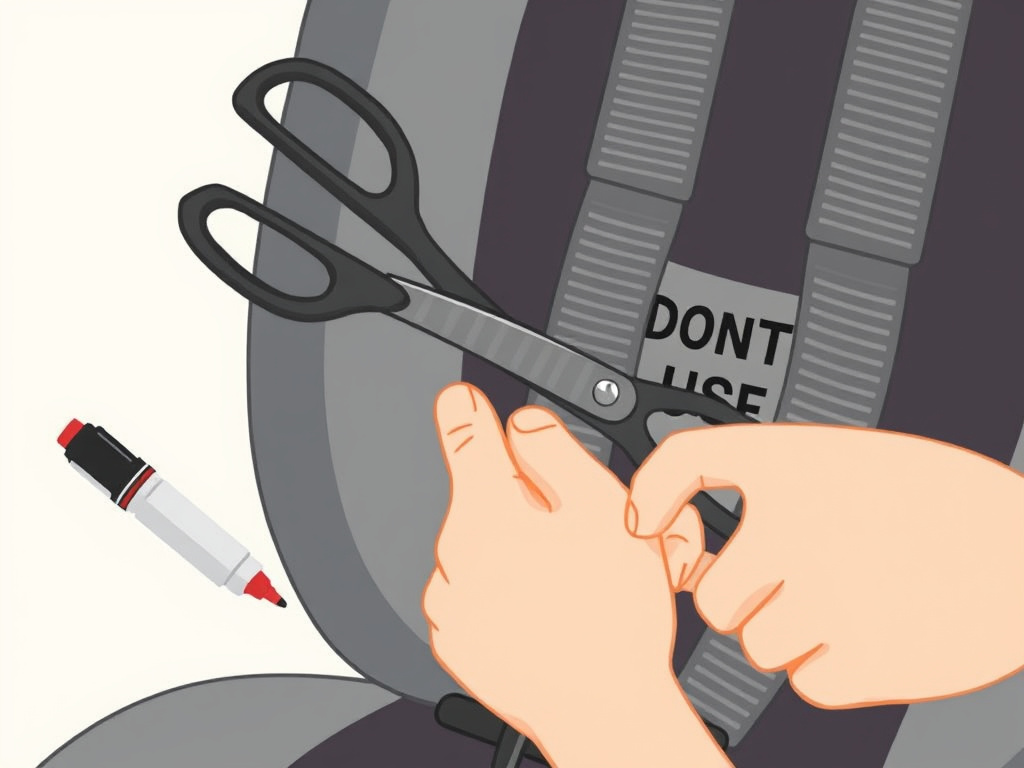 You don’t just throw it in the trash. A discarded seat can be picked up and used by someone else, thinking it’s safe.
- Destroy it. Cut the harness straps with scissors. Remove the fabric cover. Use a permanent marker to write “DO NOT USE – EXPIRED” or “CRASHED” on the shell.
- Recycle if possible. Some municipalities have recycling programs that take the polypropylene plastic. Check locally.
- Never donate a questionable seat. Thrift stores and donation centers often lack the expertise to check seats. You could pass on a lethal hazard.
For a seat that’s simply outgrown but still safe, consider selling it to a trusted friend with full disclosure, or use it as a backup for grandma’s car. When you’re ready to choose a best car seats for your growing family, start with a clean slate.
Frequently Asked Questions
Can I reuse a car seat after a minor crash?
Only if the crash meets the manufacturer’s specific “minor crash” criteria, which is stricter than common sense. For a Nuna seat, that means all five conditions were met: car drivable, no door damage, no injuries, no airbag deployment, no visible seat damage. If you have any doubt, replace it.
My car seat is 5 years old but looks new. Is it okay?
It depends on its expiration date, not its appearance. Find the label. If the manufacture date was January 2020 and the seat has a 10-year life, it’s fine. If it has a 6-year life, it’s expired. Appearance doesn’t matter; plastic fatigue is invisible.
Are there car seats with longer lifespans?
Yes. Many convertible and all-in-one models, like the Nuna EXEC next or the Evenflo Symphony, have 10-year lifespans. They are designed for longer use across multiple children. Always check the specific model’s manual.
Is it safe to use aftermarket accessories like strap covers?
No. Unless the accessory is made and approved by your car seat’s manufacturer (like Nuna, Graco, or Britax), do not use it. These items have not been crash-tested with your seat and can interfere with harness performance.
Before You Go
Reusing a car seat isn’t about frugality. It’s about forensic verification. The checklist is simple: date, crash history, physical integrity. Fail one, fail all.
If your seat passes, you’ve saved money without sacrificing safety. If it fails, you’ve just performed the most important safety check of all—the one that prevents a compromised piece of plastic from ever seeing the road again. When in doubt, a new car seat installation with a fresh seat is the only answer that guarantees peace of mind.
