
Properly Putting a Car Seat in Your Sit and Stand Stroller
This post contains affiliate links. As an Amazon Associate, we earn from qualifying purchases.
To put a car seat in a sit and stand stroller, you need three things: the exact brand-specific adapter for your stroller model, a compatible infant car seat, and a tight, click-confirmed lock. The adapter is not optional and is rarely universal, using the wrong one leaves a dangerous gap that can snap under motion.
That gap between the adapter’s latch and the stroller’s frame is where the whole safety equation lives. A sit and stand stroller’s design adds a second tier for an older child, which changes the frame’s balance point and the adapter’s mounting geometry. An adapter that’s “close enough” will rock, the car seat will tilt, and the standing platform becomes an unstable hazard for your toddler.
What follows: how to find your specific adapter, the physical three-point check for a secure fit, and the installation sequence that prevents the most common mistake, attaching the seat before the adapter is fully home.
Key Takeaways
- Sit and stand strollers almost never use universal adapters. You must buy the adapter made for your exact stroller model from the stroller’s manufacturer.
- Before you click the car seat in, perform the 3-step fit test: adapter-to-frame (no rock), seat-to-adapter (alignment), and lock confirmation (audible click).
- A loose adapter doesn’t just risk the infant seat; it compromises the stability of the standing platform for your older child.
- Always install the adapter to the stroller first, then click the car seat onto the adapter. Reversing this order strains the plastic latches.
- If your car seat brand and stroller brand differ, your only path is a verified cross-compatibility list from the stroller maker, never assume it works.
Why “Sit and Stand” Changes the Adapter Game
A traditional single-seat stroller frame is designed for one load in one position. A sit and stand stroller has a primary seat for an infant and a rear platform or small bench for a toddler. This second point of contact changes the frame’s flex and the center of gravity.
The adapter must be engineered for this specific load distribution. A universal adapter, or one made for a different stroller model, will mount to the same bars but won’t account for the extra stress. The result is a connection that seems tight when static but develops a wobble after ten minutes of walking over sidewalk cracks.
Where this goes sideways: Using an adapter from a standard single stroller on a sit and stand model. The latch mechanisms may click, but the attachment points are subtly different. The adapter can twist under the asymmetrical load, leading to a sudden lurch and a panicked grab for the car seat handle.
This is about physics, not marketing. The car seat adapter for your Joovy Caboose or Graco Roomfor2 needs to be the one listed in its manual.
The 3-Step Fit Test: Adapter, Seat, and Lock
You have the parts in front of you. Don’t just click and go. This ninety-second check catches the problems that cause mid-walk failures.
1. Adapter-to-Frame: The Rock Test.
Snap the adapter onto the stroller frame as directed. Grasp the adapter firmly and try to rock it forward, backward, and side-to-side. There should be zero movement. Any rock, even a tiny one, means it’s not fully seated or it’s the wrong part. Unlatch it and try again, checking for debris in the connector.
2. Seat-to-Adapter: The Visual Alignment.
Hold your infant car seat over the adapter. The guiding rails or connectors on the seat’s base should line up perfectly with the receiver on the adapter without forcing or angling. If you have to tilt the seat to make it fit, stop. This is a sign of car seat compatibility mismatch.
3. Lock Confirmation: The Click and Tug.
Press the car seat down until you hear a distinct, audible click. Then, grasp the car seat near its base and pull upward with reasonable force. The seat should not dislodge. Do not pull on the handle, it’s not a load-bearing part of the lock.
| Test | Pass Condition | If It Fails |
|---|---|---|
| Rock Test | No movement in any direction | Adapter is incorrect or not fully latched; clear connectors. |
| Alignment Test | Seat drops straight down, no tilt | Car seat is not compatible with this adapter. |
| Tug Test | Audible click; seat stays locked | Locking mechanism is faulty or obstructed. |
A failed test means your setup isn’t safe. Proceeding anyway risks the seat detaching on a bump.
Finding Your Exact Adapter: A Field Guide
You know you need the specific part. Here’s how to find it without the headache.
First, find the model name and number of your sit and stand stroller. It’s on a label, usually under the seat or on the frame’s rear. Write it down. Next, go directly to the stroller manufacturer’s website. Navigate to the “Accessories” or “Parts” section for your model. Search for “car seat adapter.” If the site lists one, that’s your part. Buy it.
I’ve watched parents try three different “universal” adapters from a big-box store before finding the right one. Each failed the rock test. The store’s generous return policy didn’t give back the two hours of parking-lot frustration.
What if your stroller brand and car seat brand are different? Your research starts with the stroller maker’s official compatibility chart. For example, UPPAbaby publishes a precise list of which Chicco, Graco, and Cybex seats work with their adapters. Seats not on that list are incompatible. This chart is your final authority, not a blog post or a store clerk’s guess.
For popular sit and stand models, here are the typical sources: * Graco (Roomfor2, Ready2Grow): Adapters are model-specific. The “Graco Click Connect” adapter only works with Graco Click Connect infant seats. * Joovy (Caboose): Sells separate adapters for Chicco, Graco (SnugRide), and Britax infant seats. * Evenflo (Pivot Xpand): Uses the “Evenflo SecureLock” adapter system for their own seats.
This step eliminates guesswork. A correct adapter makes the actual installation simple.
Step-by-Step: From Box to Walk
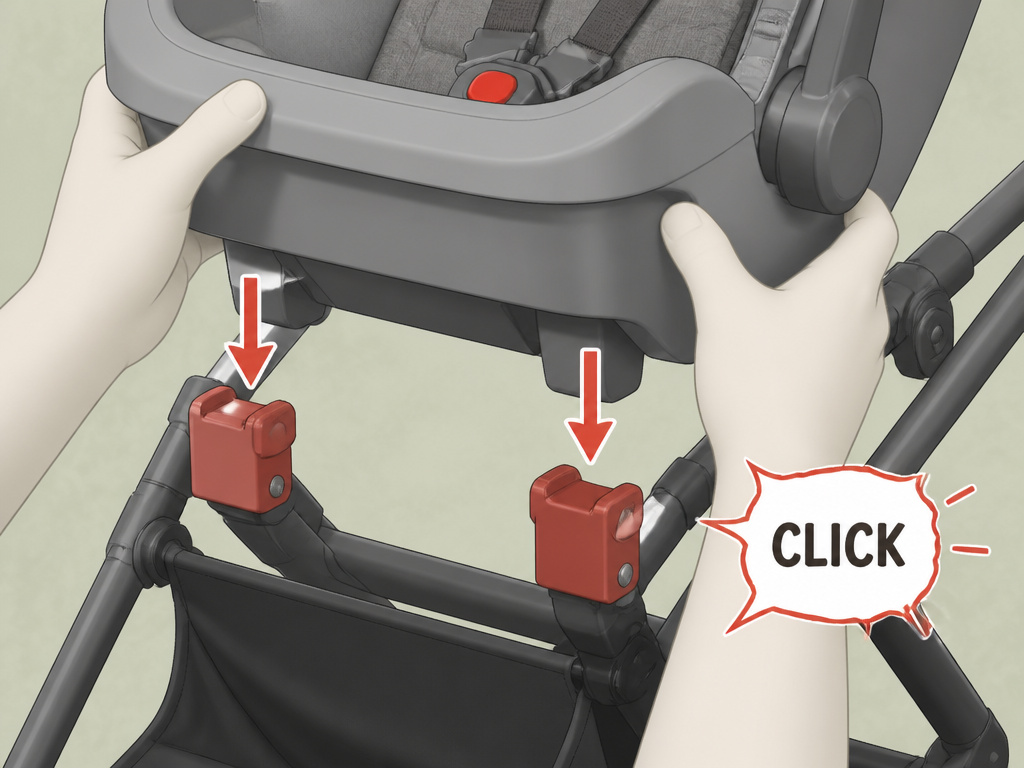 With the correct adapter in hand, the installation is a straightforward sequence. The wrong sequence can break a latch.
Before you start: Ensure the stroller is on a flat, stable surface with the brakes engaged. Have your infant car seat and adapter unpacked.
- Locate the adapter mounting points on your stroller frame. They are usually on the rear-facing side of the main seat frame. Consult your stroller’s quick-start guide if needed.
- Install the adapter to the stroller. Align the connectors and press or slide until they click into place. Perform the Rock Test from the previous section. This step is non-negotiable.
- Prepare the car seat. Remove any canopy or sunshade that might interfere. Ensure the carrier handle is in the correct position for travel (as per your car seat manual, often fully back or forward).
- Align and click. Position the infant car seat so its attachment foot or guides align with the adapter’s receivers. Lower the seat straight down. Listen for the click. Perform the Tug Test.
- Verify the standing platform. With the car seat installed, gently test the standing platform or rear bench with your hand. It should remain stable. If the whole stroller feels tippy, the adapter may be stressing the frame incorrectly, re-evaluate.
Common mistake: Clicking the car seat onto the adapter first, then trying to attach the whole assembly to the stroller. This torques the adapter’s plastic latches against the metal frame and can crack them on the third or fourth install. Stroller first, then seat. Every time.
What If You Don’t Have the Adapter Yet?
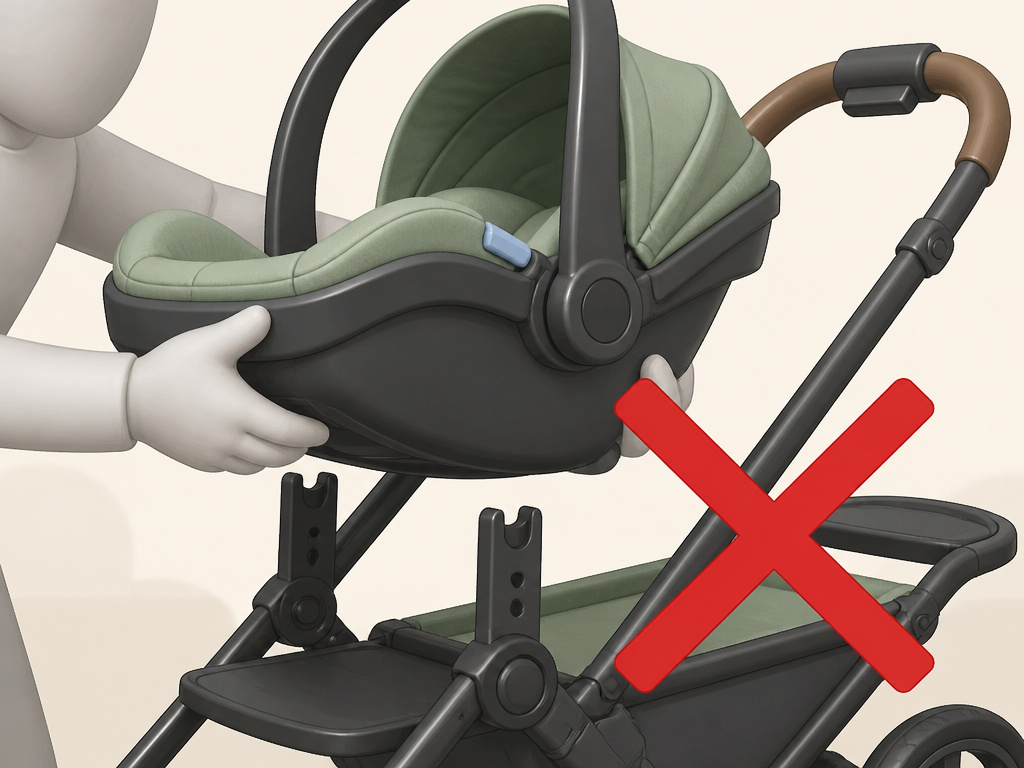 You’re shopping, or the adapter is out of stock. Can you still use the stroller? The short answer is no, not with an infant car seat.
An infant car seat is not designed to be secured by straps or bungees to a stroller. Without the rigid adapter connection, the seat can shift, tip, or detach. Your only safe alternatives are: * Use the stroller’s primary seat if it reclines fully for an infant (most sit and stand seats do not reflat enough for a newborn). * Use a car seat stroller travel system designed from the start for that seat. * Wait for the correct adapter.
This is a hard line. The convenience of a sit and stand stroller is fantastic, but only when the foundation is secure.
Troubleshooting a Wobbly or Unstable Connection
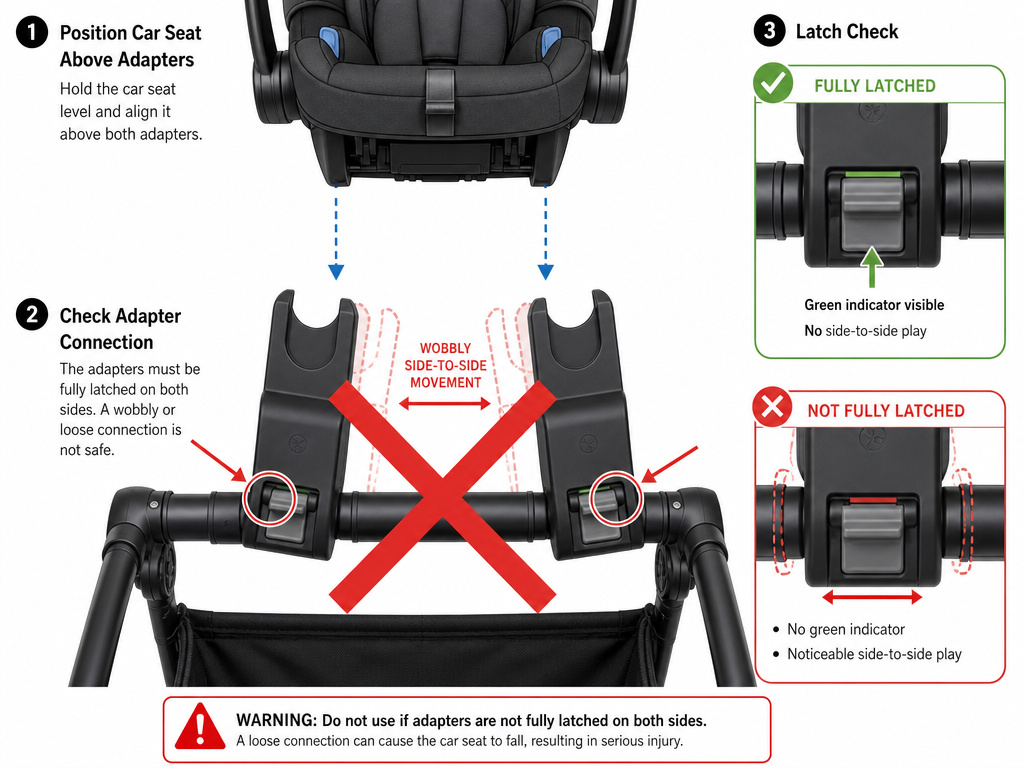 Even with the right parts, something can feel off. Here’s the diagnostic tree.
Problem: The car seat rocks side-to-side on the adapter.
- Likely Cause: The adapter is not fully latched on one side, or the car seat is not fully clicked into the adapter.
- Fix: Remove the car seat. Unlatch and re-latch the adapter to the stroller, ensuring twin clicks on both sides. Reinstall the seat.
Problem: The entire stroller feels tippy, especially when touching the handlebar.
- Likely Cause: The weight of the infant seat is too far forward or back, altering the balance. Or, the adapter is meant for a different stroller frame.
- Fix: Check the adapter placement. Some adjust forward/backward. If the feeling is severe, discontinue use, the adapter is likely incompatible.
Problem: The standing platform flexes or vibrates when the stroller moves.
- Likely Cause: This is a direct symptom of adapter stress transferring to the frame. The connection is not rigid.
- Fix: This is a critical stop sign. The adapter is compromising the stroller’s integrity. Remove it and contact the stroller manufacturer.
When in doubt, take a video of the wobble and email it to the stroller company’s customer support. They’ve seen it before.
Frequently Asked Questions
Can you use any infant car seat with a sit and stand stroller?
No. You can only use infant car seats that are specifically listed as compatible by your stroller’s manufacturer. Compatibility depends on the adapter, which is model-specific. Always check the official compatibility chart before buying.
Are sit and stand stroller adapters universal?
Almost never. While some brands use a single adapter across several of their own stroller models, an adapter from one brand (like Graco) will not work on another brand’s stroller (like Joovy). You must get the adapter designed for your exact stroller.
How do you know if the car seat is locked in correctly?
You will hear a definitive, audible click when the seat engages. After the click, perform the tug test: grasp the car seat at its base (not the handle) and lift upward. It should not release. A visual indicator, like a green window, may also show on the adapter.
Can a toddler use the standing platform with a car seat attached?
Yes, that’s the design. However, you must ensure the car seat is correctly installed and the adapter is rock-solid. A loose connection makes the whole stroller, including the platform, unstable. Always do a stability check with your hand on the platform after installing the seat.
What’s the difference between a travel system and using an adapter?
travel system is a stroller and infant car seat sold as a matched pair, designed to click together seamlessly, often without a separate adapter. Using an adapter on a sit and stand stroller is a way to add infant seat functionality to a stroller designed for older kids. The adapter is the crucial link.
Can you fold the stroller with the adapter attached?
It depends on the model. Many adapters must be removed before folding. Refer to your stroller’s manual. Forcing a fold with the adapter attached can damage the frame or the adapter’s locking mechanism.
The Bottom Line
Putting a car seat in a sit and stand stroller boils down to one non-negotiable part: the correct adapter. Skipping this step or guessing at compatibility isn’t worth the risk. Find your stroller model, buy its designated adapter, and lock it in with the three-step test. That click is the sound of the whole system telling you it’s ready to go. Then, and only then, you get the real benefit: one stable ride for two very different kids.
