
Tips for How to Travel with a Car Seat and Stroller Easily
This post contains affiliate links. As an Amazon Associate, we earn from qualifying purchases.
Travel with a car seat and stroller by using a certified travel system, knowing your airline’s gate-check policy, and installing the car seat on the plane if it’s FAA-approved. The UPPAbaby MESA V2 manual states the carrier alone is certified for aircraft use, but the base is not. For road trips, install using either the vehicle’s lower anchors OR the seat belt, never both, per NHTSA guidelines.
That distinction between the carrier and the base is where most airport confusion starts. You can roll a travel system right to the jet bridge, but what happens next depends on three things: the seat’s certification, the airline’s specific rulebook, and whether you bought a true system or just two separate pieces.
What follows is the mechanics of moving a small human and their safety capsule through terminals, onto planes, and into rental cars. We’ll cover the specs that actually matter for aircraft aisles, the math for lower anchor limits, and the one date on your car seat you cannot ignore.
Key Takeaways
- Use a travel system, not a guess. A true system like the Evenflo Shyft DualRide or UPPAbaby MESA with a compatible frame clicks together. An incompatible stroller and car seat “may result in serious injury to your child,” as the Evenflo manual explicitly warns.
- The aircraft seat is a different game. Your car seat’s base stays home. Only the carrier installs on the plane, using the aircraft lap belt through its guides. The Evenflo Shyft requires a minimum 45.7 cm (18 in) aircraft seat width.
- Gate-check the stroller, not the car seat. Airlines typically gate-check the stroller frame for free. If your car seat is FAA-approved, install it in your child’s plane seat. Checking the car seat as baggage risks damage you can’t see.
- Expiration isn’t a myth. The UPPAbaby MESA V2 product manual states to “discontinue use after 7 years from the date of manufacture.” Plastic degrades. That date is printed on the seat.
- Lower anchors have a weight limit. If your car seat label is missing, NHTSA provides a method: subtract the seat’s weight (found in the manual) from 65 pounds. That result is your maximum child weight for lower anchor use.
Choosing Your Travel System: Compatibility Is a Safety Feature, Not a Convenience
The wrong pairing is a hazard. A travel system is an infant car seat designed to click securely into a matching stroller frame. A random stroller with a car seat balanced on top is a tipping risk.
The Evenflo Shyft DualRide manual doesn’t mince words: using the stroller with an incompatible infant car seat “may result in serious injury to your child.” The connection isn’t just about smooth rolling; it’s a locked mechanical interface that prevents the seat from detaching if you hit a curb.
Where this goes sideways: Assuming any infant seat fits any stroller with universal adapters. Adapters must be model-specific. The UPPAbaby MESA V2, for example, is compatible with Vista and Cruz strollers, but needs separate, model-specific adapters for the Ridge or Minu.
Your two main paths are a dedicated travel system or a modular “car seat + stroller frame” combo. The dedicated system is simpler and often lighter. The modular route lets you upgrade the stroller later. Both work, but the manual for each piece is your final authority on what fits.
The 3-Step Airport Game Plan (Before Security, At Security, At the Gate)
Airport navigation with gear is a timed drill. Break it into three phases, and you avoid the frantic juggle at the gate.
Before Security: Use the stroller. Your child rides, and you hang a diaper bag from the handles. Check your car seat in a protective travel bag if you are not using it on the plane. A wheeled travel bag is the difference between a manageable walk and a back strain.
At Security: The stroller frame must go through the X-ray. You’ll need to collapse it. Practice the fold at home with one hand while holding your baby. Remove all loose items—toys, blankets, snacks—and put them in a bin. The car seat, if you’re carrying it on, also goes through the X-ray. TSA agents may swab it for explosives residue.
At the Gate: This is your decision point. Approach the agent and tag your stroller for gate-checking. It will be waiting for you in the jet bridge when you land. For the car seat, you have two choices: gate-check it with the stroller, or if it’s FAA-approved, bring it on board.
Most U.S. Airlines allow you to use an FAA-approved car seat in a purchased seat. It installs rear-facing only, using the aircraft lap belt. Notify the airline ahead of time that you’ll be using one.
TL;DR: Stroller as a wagon to the gate. Collapse at security. Gate-check the frame. Decide on the car seat before boarding.
Can You Use Your Car Seat on the Plane? The FAA Rule and the Width Test
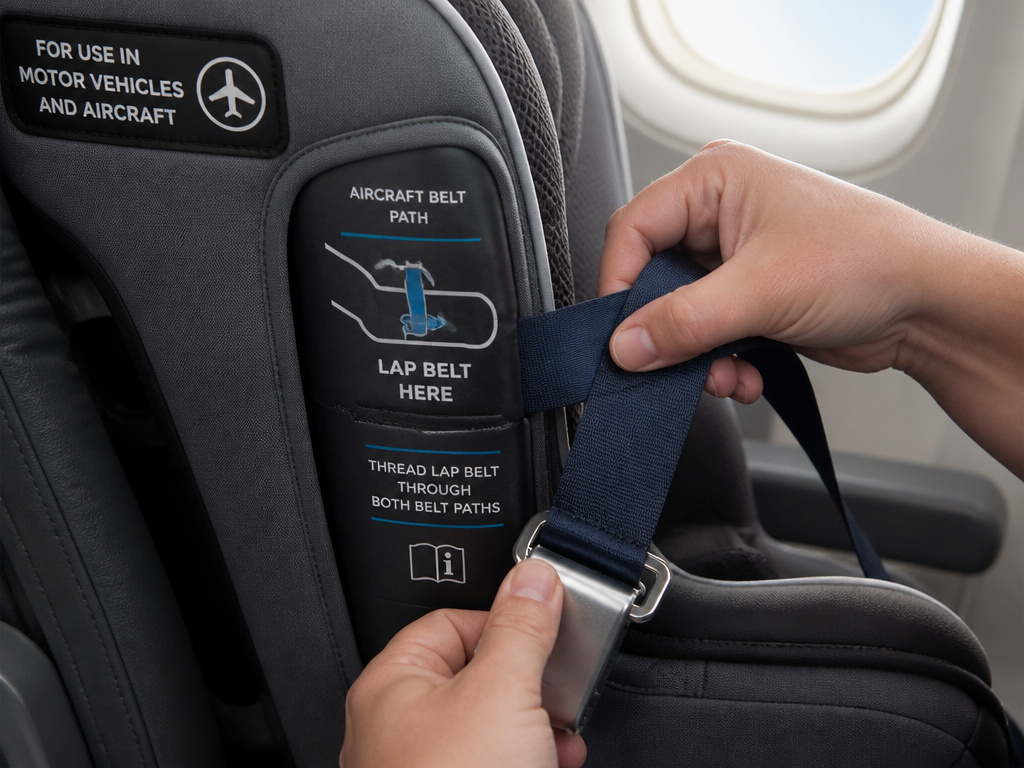 If you bought a seat for your child, using your car seat is the safest option. The Federal Aviation Administration (FAA) recommends it for children up to 40 pounds.
But “FAA-approved” is the first gate. Look for a label on the car seat that states, “This child restraint is certified for use in motor vehicles and aircraft.” The UPPAbaby MESA V2 manual has this label. The Evenflo Shyft DualRide manual confirms its certification for aircraft when used without the base.
The second gate is fit. Airline seats are narrow. Your car seat must fit within the width of the aircraft seat, which is typically about 17-18 inches. The Evenflo manual specifies a minimum 45.7 cm (18 in) seat width for installation. If the car seat hangs over into the aisle or the next seat, the flight crew can refuse its use.
Worth knowing before you start: You must install the car seat in a window seat. An aisle installation blocks the escape path in an emergency and is against FAA regulations. Always book a window seat for your child’s ticket.
Installation is straightforward. Thread the aircraft lap belt through the car seat’s belt path as you would in a car, and tighten it until the seat has less than an inch of movement side-to-side. The carry handle must be in a locked position.
How to Gate-Check a Stroller and Car Seat (Without Destroying Them)
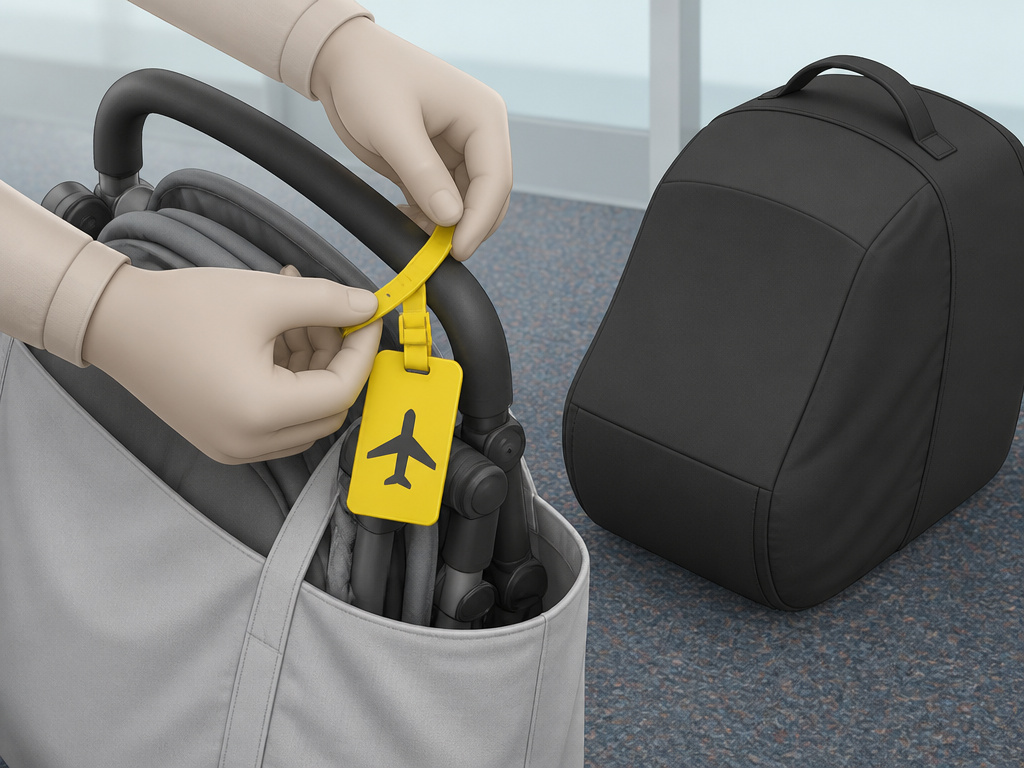 Gate-checking is the standard, free option for strollers and car seats you aren’t using onboard. “Gate-check” means you leave the item at the aircraft door just before you walk down the jet bridge. It’s handled separately from main luggage and is usually the last items on, first items off.
The risk is damage. Baggage handlers are not gentle. A protective bag is non-negotiable for a car seat. It keeps the harness straps from getting caught and torn on conveyor belts. For a stroller, a simple storage bag or even a large reusable shopping bag can keep it relatively clean.
Common mistake: Gate-checking a car seat in its retail box or with no bag. The box will be destroyed, and the seat will be covered in grime and potential chemical residues from the cargo hold.
When you gate-check, you’ll be given a tag. Attach it securely. Take a photo of the tag and your gear before you hand it over. If the item goes missing, this photo is your proof for the airline. When you land, wait at the jet bridge or the aircraft door. Your stroller and car seat should be brought back up to you there.
Checking Car Seats and Strollers as Baggage: A Last Resort
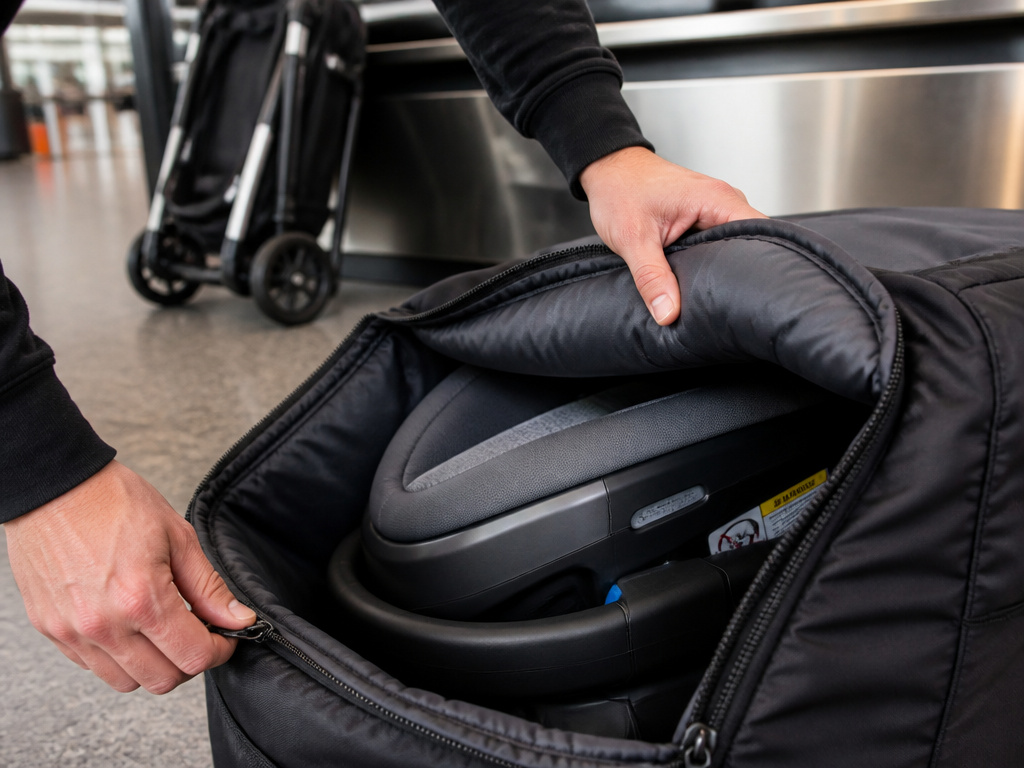 Checking car seats and strollers with your regular luggage should be your Plan C. The forces in the cargo hold can cause cracks in the plastic shell or compromise the internal foam. Damage isn’t always visible.
If you must check them, use a sturdy, padded car seat travel bag. Some airlines offer oversized baggage or special items counters for this. There is usually no fee for checking a car seat or stroller, even if you check them at the ticket counter, but always verify with your specific airline.
Before you check any car seat, know its history. Has it been in a crash? The UPPAbaby manual says to discontinue use after any crash. Have you exceeded its expiration date? If the answer to either is yes, checking it as baggage is the end of its life. Do not use it again at your destination.
Road Trip Setup: Installing in Rental Cars and Ride-Shares
The rules change when you land. You’re dealing with an unfamiliar vehicle, possibly no base, and tight time pressure.
First, determine your installation method. You will use either the vehicle’s lower anchor connectors (LATCH/ISOFIX) or the seat belt. NHTSA states never use both simultaneously, as it can put undue stress on the seat’s structure. The lower anchor system has a combined weight limit for the child and the car seat—usually 65 pounds.
| Installation Method | Best For | Critical Check |
|---|---|---|
| Lower Anchors (LATCH) | Quick, standardized install in most vehicles post-2002. | Find the combined weight limit on your car seat label. If missing, use the NHTSA math: 65 lbs – car seat weight. |
| Seat Belt | Older vehicles, or when the child + seat weight exceeds the lower anchor limit. | Ensure the belt is locked. Many have a switchable retractor; pull it all the way out until it clicks. |
For a rental, request a car with LATCH anchors when you book. When you get to the car, don’t just look for the anchors—feel for them deep in the seat crease. Buckle the car seat in, then get your weight into it. Push down hard into the vehicle seat while you tighten the belt or lower anchor strap. The car seat should not move more than one inch side-to-side or front-to-back at the belt path.
In a ride-share like Uber or Lyft, you have seconds. Practice installing your seat with just the seat belt in your own car until it’s muscle memory. The best choice for ride-shares is often a lightweight, belt-only convertible seat you’re deeply familiar with.
The Hidden Rules: Expiration Dates, Lower Anchor Math, and International Law
The fine print in the manuals contains the rules that aren’t about the journey, but about the integrity of the seat itself.
The 7-Year Rule: The UPPAbaby MESA V2 product manual explicitly says to “discontinue use after 7 years from the date of manufacture.” Plastic becomes brittle with heat and cold cycles. That expiration date is stamped on the seat, usually on the bottom or back. Ignoring it is a safety gamble.
Lower Anchor Weight Limit Calculation: Can’t find the label? NHTSA provides a method. Find the weight of the empty car seat in its instruction manual. Subtract that number from 65 pounds. The result is the maximum weight of your child for which you can use the lower anchors. After that, you must switch to the seat belt installation.
International Compliance: Laws vary. For example, the Ministry of Transport Malaysia mandates that Child Restraint Systems comply with UNR standards (R44 or R129) for children under 36 kg or 136 cm. If you’re traveling abroad, check the official child restraint requirements for your destination country. A seat that is legal in the U.S. May not be legal there.
A properly installed child restraint reduces the risk of death by over 70% for infants in crashes, according to NHTSA. That statistic hinges on the seat being current, undamaged, and installed to the manufacturer’s exact specifications.
Packing List and Pro Tips for Sanity
Beyond the gear, pack for the process. This list assumes you’re using the car seat on the plane. If you’re checking it, add a heavy-duty travel bag.
- Car seat & base (base stays home if flying).
- Compatible stroller frame.
- Gate-check bag for stroller (optional but recommended).
- Padded travel bag for car seat (if checking).
- 1ml syringe or medicine dropper (for measuring infant pain reliever without the bottle).
- Multi-tool or pocket knife (in checked luggage ONLY) for emergency strap adjustments.
- Roll of blue painter’s tape for securing loose straps to the car seat before bagging it.
- Printed copies of your car seat manual’s installation pages and the airline’s policy page.
Pro Tip: Use the stroller’s storage basket for your personal item, but mind the weight limit. The Evenflo Shyft’s carry-all bag has a 3.2 kg (7 lbs) maximum. Overloading it makes the stroller unstable.
Another Tip: If your child is close to outgrowing the infant seat by height, measure before you travel. The top of their head must be at least one inch below the top of the seat shell. A vacation is a terrible time to realize you need a bigger seat.
Frequently Asked Questions
Can I bring my car seat and stroller to the gate for free?
Yes. All major U.S. Airlines allow you to bring a stroller and a car seat to the gate at no extra charge, regardless of whether you use the car seat on the plane. The stroller is almost always gate-checked. The car seat can be gate-checked or used onboard if you purchased a seat and it is FAA-approved.
How do I know if my car seat is FAA-approved for the plane?
Look for a label on the car seat itself. It will state, “This child restraint is certified for use in motor vehicles and aircraft.” The wording is mandated by the FAA. You can also check your product manual. The UPPAbaby MESA V2 and Evenflo Shyft DualRide manuals both confirm aircraft certification for the carrier (without the base).
What is the best car seat and stroller combo for travel?
The best combo is the one you can install and collapse flawlessly while holding a baby. For simplicity, a dedicated travel system like the UPPAbaby MESA V2 with a Cruz V2 stroller is hard to beat. For maximum flexibility, a lightweight convertible seat like the Cosco Scenera Next paired with a compact umbrella stroller you can carry on works. The “best” is the system you’ve practiced with.
Do I need a special bag to gate-check my car seat?
You do not need one, but you absolutely should use one. A padded car seat bag for travel protects the harness and shell from dirt, moisture, and conveyor belt damage. A simple nylon sack is better than nothing; a padded bag with wheels is the gold standard.
Can I use the airplane seat belt to install my car seat?
Yes. You install the car seat on the aircraft using only the lap belt. Thread it through the seat’s airplane belt path (refer to your manual) and tighten it securely. Do not use the base. Do not use the shoulder portion of the belt. The seat must be in a window position and the carry handle locked.
The Bottom Line
Traveling with a car seat and stroller is a logistics puzzle, not a mystery. The answer lives in three documents: your car seat manual, your airline’s contract of carriage, and the NHTSA car seat safety guidelines.
Choose a truly compatible travel system. Use the stroller as your pack mule to the gate. Protect the car seat in a bag if it’s going in the hold. Install it on the plane if you can. And before you do any of it, check the manufacture date. That seven-year clock is ticking from the day it was made, not the day you start your trip. Your gear is just equipment. Your familiarity with it is what keeps the journey safe.
