
Traveling with a Car Seat and Stroller on a Plane Guide
This post contains affiliate links. As an Amazon Associate, we earn from qualifying purchases.
To travel with a car seat and stroller on a plane, you need a three-part plan: verify your car seat has the FAA aircraft certification label, confirm your airline’s specific stroller gate-check policy, and decide whether to use the seat on board or check it. The label is non-negotiable. Airlines will turn away a seat without the words “certified for use in motor vehicles and aircraft” in red letters.
The 20-pound mark is the decision point. The American Academy of Pediatrics says infants under 20 pounds must be in a rear-facing seat. Children between 20 and 40 pounds should be restrained in a car seat. If your child fits those weights, buying them a ticket and using the seat on the plane is the safest option. If not, you are gate-checking both pieces.
What follows is the breakdown of those three steps, the real risk of checking a car seat, and the one product that changes the math for toddlers.
Key Takeaways
- Your car seat must have the specific FAA label. No label means no in-cabin use.
- Gate-checking is for convenience, not safety. A travel bag protects from dirt, not from the forces in the cargo hold.
- For children 20-40 lbs, using the car seat on the plane is the AAP’s recommended safety standard.
- Always install a car seat in a window seat, never in an exit row or where it blocks aisle access.
- A lightweight, compact travel system like the Bugaboo Dragonfly or the Graco GoMax frame simplifies the entire airport process.
The 3-Step Pre-Flight Checklist
Do not show up at the airport and hope for the best. These three actions, done at home, prevent denied boarding and last-minute gate fees.
First, find the label on your car seat. It is usually on the back or side.
A child seat approved for aircraft use must bear two labels: ‘This child restraint system conforms to all applicable federal motor vehicle safety standards’ and ‘This restraint is certified for use in motor vehicles and aircraft’ in red letters. This is per the official EASA guidance for flying within the European Union, and U.S. FAA rules mirror this requirement.
If your seat says “for use in motor vehicles only,” it cannot be used on the plane. You must check it. All-in-one or combination seats often lack this certification.
Second, call your airline. Do not rely on generic website information. Policies on stroller size, gate-check tags, and where you collect gear vary. – Ask: “What is your specific procedure for gate-checking a stroller and a car seat?” – Ask: “Is there a weight or size limit for gate-checked strollers?” – Ask: “Do you provide baggage claim tags for gate-checked items, or do I collect them at the jet bridge?”
Third, measure your car seat. Most coach seats are 16 inches wide. Your car seat must fit within that space without hanging into the aisle. If it is slightly wider, you can usually raise the armrest for a snug fit. The flight attendant will not allow an installation that obstructs the aisle.
Common mistake: Assuming your convertible car seat will install the same way on the plane as in your car. If it has a tensioning plate, the manual will have separate instructions for aircraft installation. A rear-facing seat may need to be more upright than in a vehicle.
Gate-Check vs. Carry-On: The Damage Control Choice
This is not about convenience. It is a safety calculation with a clear winner for children in the correct weight range.
When to Use the Car Seat On Board
If your child is between 20 and 40 pounds, buy them a ticket and use the seat. The AAP recommends it because it provides the same crash protection for them as the seatbelt does for you. The harness holds them securely during turbulence.
You must install it in a window seat. This is a firm rule from the European Union Aviation Safety Agency. An aisle seat installation blocks emergency egress and risks injury from the service cart.
The part nobody mentions: A child seat approved to be attached only by ISOFIX or LATCH connectors cannot be used on a plane unless that specific aircraft seat has those anchors. Almost none do. You must be able to secure it using the standard airplane lap belt.
When to Gate-Check
Gate-checking means you use the stroller through the airport, then leave it at the door of the plane to be stowed in the cargo hold. You pick it up at your destination, sometimes at the jet bridge, sometimes at baggage claim.
The advantage is mobility. The disadvantage is risk.
Where this goes sideways: Putting faith in a travel bag to prevent structural damage. Consumer Reports’ auto safety manager cautions that no bag can protect a car seat from the forces experienced in the luggage compartment. The bag keeps it clean. It does not make it crash-worthy again.
If you gate-check, use a bag. A generic wheeled bag works as well as a branded one. It provides a layer against dirt, rain, and snags. Inspect the seat thoroughly for cracks or deep scratches before using it again in your car. Any visible damage means the seat is compromised.
| Method | Best For | The Real Risk |
|---|---|---|
| Use On Board | Children 20-40 lbs, any infant in their own seat | Seat may not fit width-wise; airline can refuse uncertified seats. |
| Gate-Check | Children over 40 lbs, or when you didn’t buy a seat | Structural damage in cargo hold that voids safety certification. |
| Check at Ticket Counter | Backup travel seats, unavoidable situations | Highest risk of mishandling and loss; never do this with your primary seat. |
Stroller Strategy: Getting Through the Airport
Your stroller choice dictates your stress level. The goal is to move quickly while carrying the least amount of gear.
A travel system is the most efficient setup. You snap the infant car seat directly onto the stroller frame. At the gate, you detach the seat to bring on the plane and gate-check the frame. The Bugaboo Dragonfly is a top pick for this because of its compact, stand-up fold.
For older toddlers, an ultra-compact stroller that fits in the overhead bin is the gold standard. The Graco GoMax frame is designed for this. You avoid gate-checking entirely.
Skip the bulky jogger. If it does not fold with one hand and stand on its own, it is a liability in a crowded security line. Airport staff will treat it roughly.
I watched a family struggle with a double jogger at a narrow gate in Atlanta. The flight attendants had to call for a special oversized baggage tag, and the stroller was the last item off the plane. They waited 35 minutes at baggage claim.
Before you fly, practice the fold. You will need to do it quickly at security while managing a child, shoes, and carry-ons. A travel bag for the stroller is wise. It keeps wheels from greasing up your other luggage.
The Car Seat Installation Drill
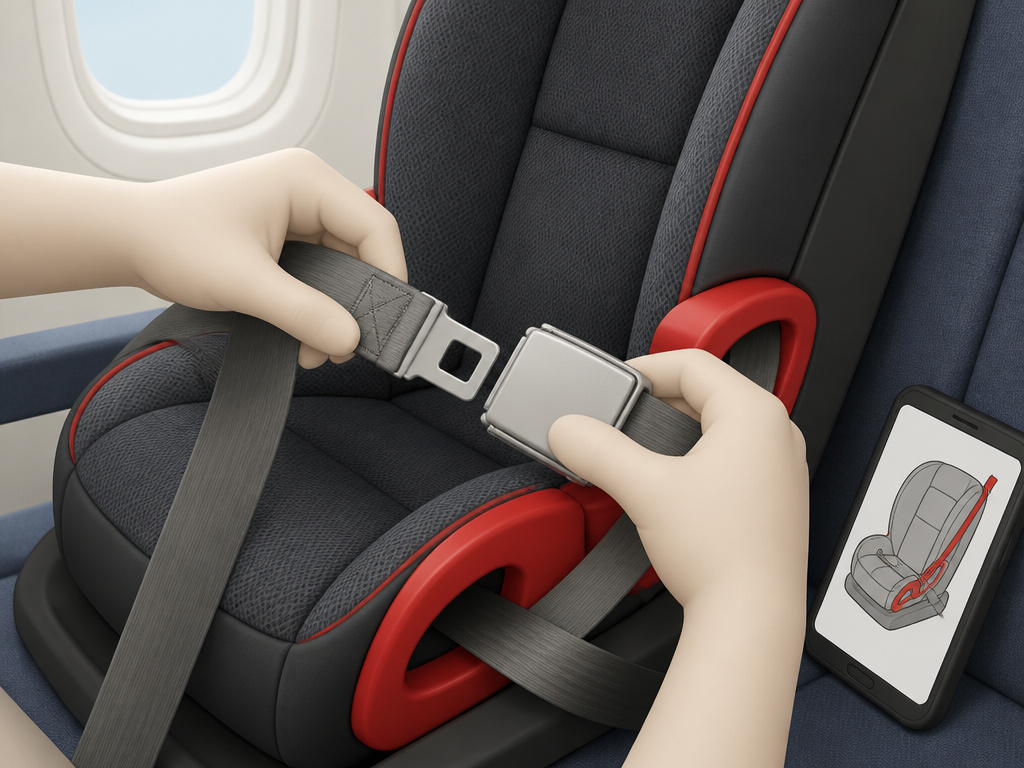 Installing a car seat on a plane is different. You have less space, a different belt path, and a nervous audience.
Print the installation page from your car seat manual or save it on your phone. Flight attendants can ask to see it. The manual will show you how to thread the aircraft lap belt through the correct path. It is usually simpler than a car installation.
Request a seat belt extender as soon as you board. The airplane buckle often gets trapped behind the deep car seat shell. The extender gives you the slack to fasten it.
Follow these steps: 1. Place the seat in the window seat, facing forward for toddlers, rear-facing for infants. 2. Thread the lap belt through the aircraft belt path marked in the manual. This is not always the same as the car’s path. 3. Buckle it, and then press your full weight into the car seat while you tighten the belt. You should get no more than one inch of side-to-side movement at the belt path. 4. Ensure the seat is upright if it reclines. It must be locked upright for taxi, takeoff, landing, and turbulence.
If the seat feels loose, unbuckle and start over. Do not assume it is fine.
Travel Bags and Gear: What Actually Helps
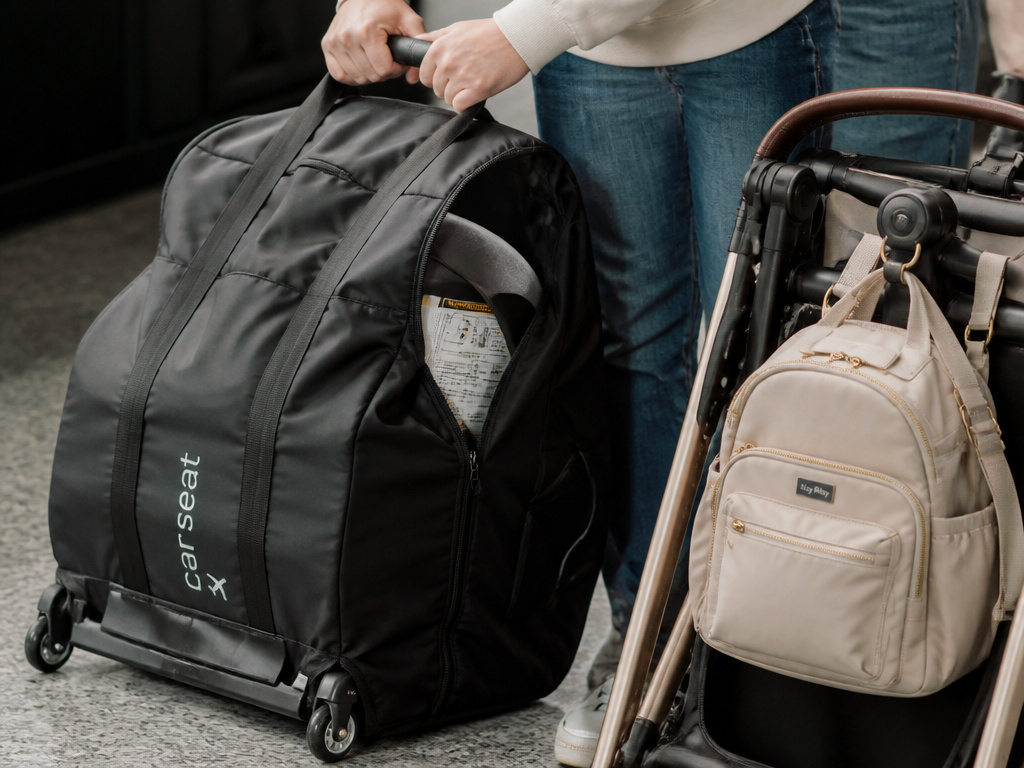 The market is full of accessories. Only two are essential.
A wheeled travel bag for your checked car seat is the first. It turns a bulky, awkward item into something you can roll. Look for padded handles and durable fabric. The protection is for cleanliness, not crashes.
A backpack-style diaper bag is the second. You need both hands free. A bag that slips onto your stroller handles is even better.
Consider the CARES harness for toddlers between 22 and 44 pounds who have outgrown their car seat. It is the only FAA-approved child safety device that is not a car seat. It works like an adult seatbelt but positions the shoulder strap correctly for a small body. It packs into a tiny pouch.
| Gear | Purpose | Priority |
|---|---|---|
| Wheeled Car Seat Travel Bag | Transport and cleanliness for checked seats | High |
| Stroller Travel Bag | Protect fabric and wheels from grease/dirt | Medium |
| CARES Aviation Safety Harness | For toddlers 22-44 lbs without a car seat | Situational (High if it applies) |
| Seat Belt Extender | Makes plane installation possible | Essential (get on plane) |
Do not buy a special “travel” car seat unless you fly constantly. Your daily seat, if it is certified, is perfectly safe. Lightweight seats like the Bugaboo Turtle Air by Nuna are easier to carry, but your primary concern should be certification, not weight.
Frequently Asked Questions
Can I use any car seat on a plane?
No. Only car seats with the specific label “This restraint is certified for use in motor vehicles and aircraft” are approved for in-cabin use. The airline will check for this label at the gate.
Do I have to pay to check a car seat or stroller?
All major U.S. Airlines allow you to check a car seat and stroller for free, in addition to your regular luggage. They are considered “assistive devices” for a child. Always verify with your specific airline, as policies on oversized items can vary.
What is the safest place for my child’s car seat on the plane?
The window seat is the only approved location. This prevents the seat from blocking the aisle in an emergency and protects your child from contact with the food and beverage cart.
Can I gate-check my travel system stroller?
Yes. You can use the stroller with the car seat attached through the airport. At the gate, you will detach the car seat to bring on the plane and collapse the stroller frame for gate-checking. Tag both pieces separately.
What if my car seat is damaged by the airline?
Report the damage immediately to an airline agent before you leave the baggage claim area. Take photos. Airlines have policies for damaged luggage, but they will not provide a loaner car seat. This is why using the seat on the plane is always the safer choice when possible.
The Bottom Line
Flying with a car seat and stroller is a logistics puzzle, not a mystery. Find the FAA label, call your airline, and measure your seat. If your child is between 20 and 40 pounds, buy the extra ticket and use the seat on the plane. That is the safest path.
Gate-check with a bag for cleanliness, not for crash protection. Choose a compact stroller you can fold quickly. Your gear will get banged up. Your child should not. The right plan turns a potential nightmare into a manageable, safe journey.
