
Is a Car Seat Safe for a Newborn Spine? The 45-Degree Rule
This post contains affiliate links. As an Amazon Associate, we earn from qualifying purchases.
A car seat is safe for a newborn spine when it is installed at the correct 45-degree recline, the harness is snug, and the child meets the seat’s size requirements. The seat must be rear-facing and properly secured to distribute crash forces across the infant’s back, shoulders, and pelvis, not the undeveloped neck. This is the core safety principle behind every modern infant restraint.
That 45-degree number is not a suggestion. It’s the outcome of crash physics and infant anatomy. Too upright, and the head can fall forward, compressing the airway and putting dangerous flexion stress on the cervical spine. Too reclined, and the infant risks being ejected from the harness in a collision. The entire system is engineered around that single angle.
What follows is a breakdown of the three things that make the difference: the exact recline mechanics, the special protocols for preterm infants that no federal standard covers, and the common installation errors that undo all the engineering.
Key Takeaways
- The 45-degree recline angle is the critical target for a newborn’s spinal safety. It ensures crash forces are spread across the back while keeping the airway open.
- Preterm and low birth weight infants require a 90-120 minute hospital observation before their first car trip, per American Academy of Pediatrics (AAP) guidelines. Federal standards do not address this medical need.
- A car seat is only securely installed if it moves less than 1 inch side-to-side or front-to-back at the belt path.
- Never use aftermarket inserts, head supports, or padding not sold with the seat. They change the harness geometry and create dangerous slack.
- The safest place for any child restraint is the rear center seat of the vehicle, away from active airbags.
The Critical 45-Degree Recline Angle
Look for the built-in angle indicator or level line on the side of the infant seat. The Peg Perego Primo Viaggio All-in-One manual states it directly: “Make sure that newborn infants are placed with backrest at 45°.” This is the first spec to verify before you ever put your child in the seat.
The 45-degree angle is a compromise between safety and physiology. It positions the infant so that in a frontal crash, the most common and severe type, the force is transferred along the rigid shell of the car seat into the child’s entire back, shoulders, and pelvis. The relatively large, heavy head is cradled and prevented from snapping forward.
If the seat is too upright, the infant’s head can slump chin-to-chest. This position can obstruct their airway, a risk highlighted for preterm babies but relevant for all newborns. It also focuses crash energy on the neck. If the seat is too reclined, the child can be ejected upward in a crash, as the harness straps are not aligned to hold them down into the seat. You get one chance to set this angle correctly at installation.
Common mistake: Using rolled towels or pool noodles under the seat base to achieve the angle. Many vehicle seats are sloped, and manufacturers often permit these aids. The mistake is not checking the final angle with the indicator after using them. The towel compresses under force, the angle changes, and you’re back to an unsafe recline. Use the level, not guesswork.
Why the Spine Needs This Specific Support
A newborn’s spine is c-shaped, lacking the cervical and lumbar curves of an adult. The vertebrae are not fully ossified, more like cartilage. The ligaments are lax, and the neck muscles are weak. This anatomy cannot resist bending or tensile forces. In a rear-facing seat at 45 degrees, the entire shell acts as a brace. The crash deceleration pushes the child deeper into the molded cocoon, with the load spread over a wide area of the back. The alternative, forward-facing, lets the body be thrown forward against the harness, with all the stopping force concentrated on the shoulders and neck. For a newborn, that is catastrophic.
| Recline Angle | Effect on Newborn | Risk If Incorrect |
|---|---|---|
| > 45° (Too reclined) | Body position too flat. | Increased risk of upward ejection; harness straps may not hold infant in seat during collision. |
| 45° (Correct) | Back fully supported, head cradled, airway open. | Crash forces distributed across back and pelvis. This is the safety target. |
| < 45° (Too upright) | Head slumps forward, chin to chest. | Airway obstruction; neck flexion places stress on cervical spine; focus of crash forces on neck. |
The Preterm and Low Birth Weight Infant Protocol
Federal Motor Vehicle Safety Standard (FMVSS) 213 sets crash-test performance rules. It has no minimum weight limit. The Evenflo Triumph manual explicitly notes the standard “does not address the special medical needs of preterm or low-birth weight infants.” This is the gap where hospital policy and pediatric guidelines take over.
The AAP protocol is specific: infants born earlier than 37 weeks or weighing less than 5 pounds must undergo a car seat tolerance observation before discharge. Hospital staff monitor the infant in the actual car seat, properly positioned at the correct angle, for 90 to 120 minutes, or the duration of the expected trip home. They are checking for apnea (pauses in breathing), bradycardia (drops in heart rate), or oxygen desaturation.
Where this goes sideways: Skipping this observation because the baby “looks fine.” Preterm infants have immature nervous and respiratory systems. The semi-reclined position can cause their relatively large head to slump, partially closing the airway. The stress of the position can trigger physiological events that aren’t visible without monitoring. This observation is a non-negotiable medical test, not a convenience.
If you are choosing a car seat for a newborn, and you have a preterm infant, your criteria shift. You need a seat that accommodates a very small size and allows for a precise, stable 45-degree angle in your specific vehicle. This is where consulting a Child Passenger Safety Technician (CPST) before purchase is worth the time.
How to Verify a Safe Installation
The rule from the Mayo Clinic is concrete: a properly installed car seat should not move more than 1 inch side-to-side or front-to-back when you grip it at the belt path and pull firmly. This test is for movement of the seat itself, not the child in it.
- Use the Right Belt Path. Convertible seats have separate paths for rear-facing and forward-facing installation. Threading the seatbelt or lower anchor strap through the wrong one creates a pivot point and dangerous slack.
- Kneel in the Seat. Use your full body weight in the seat while tightening the vehicle seatbelt or lower anchor strap. Car seat upholstery compresses; if you tighten it empty, adding a child creates looseness.
- Check the Tether for Forward-Facing (Later). While newborns are rear-facing, remember that when you eventually turn the seat forward, the top tether strap is mandatory. It reduces forward head excursion in a crash by up to 6 inches.
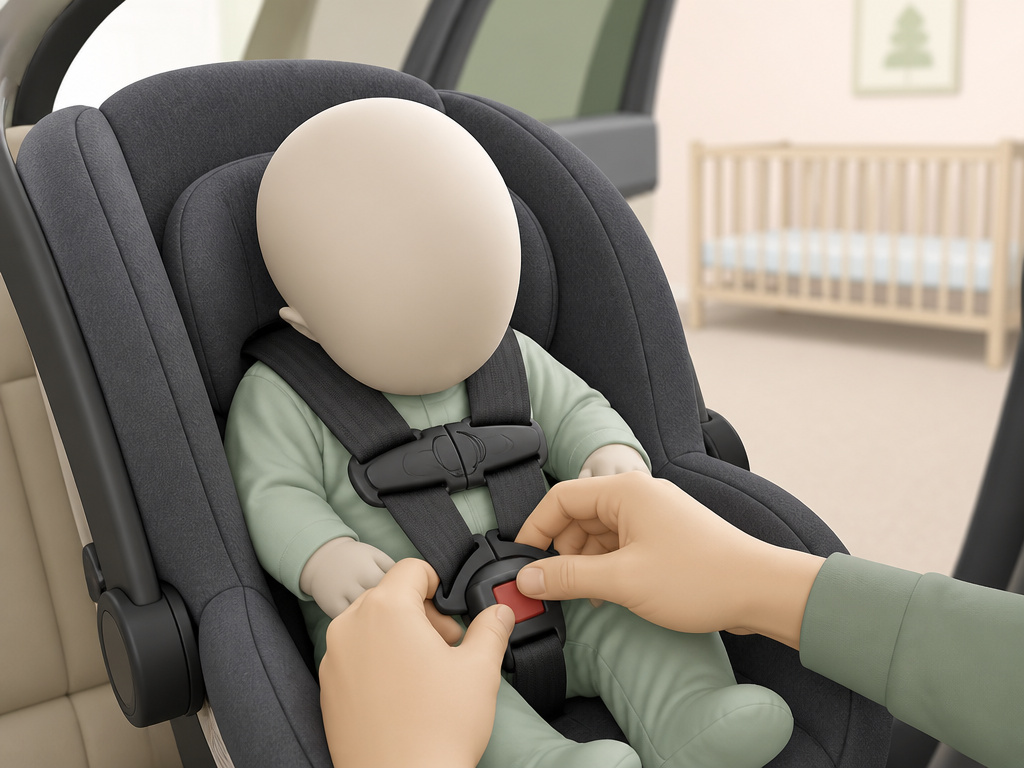
Forgetting to buckle a newborn correctly is the final failure point of a good installation. The harness straps should be at or below the infant’s shoulders for rear-facing. The chest clip must be at armpit level. The classic “pinch test” applies: if you can pinch a horizontal fold of harness strap at the child’s collarbone, it’s too loose.
The Danger of Aftermarket Add-Ons
The harness system is engineered as a unit. Adding any padding, head supports, or aftermarket inserts that did not come with the seat changes the geometry. It can create slack behind the child’s back or cause the harness to route incorrectly over the shoulders. In a crash, that slack allows the child to move violently before the restraint engages. This is why manufacturers universally warn against them and why using one typically voids the seat’s warranty. If your infant seems to need more support, the solution is a different seat model designed for smaller infants, not an accessory.
Rear-Facing vs. Forward-Facing: The Spinal Safety Difference
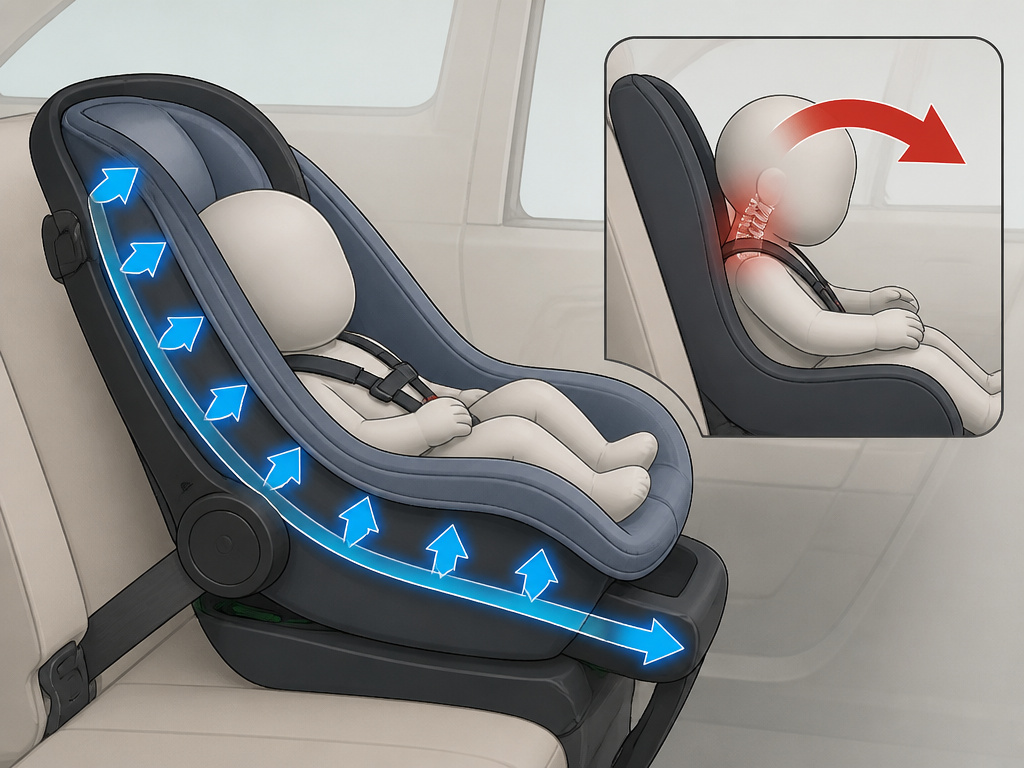
The data from the NHTSA car seat safety guidelines is unambiguous: rear-facing is safest. For the spine, the reason is physics. In a frontal crash, a rear-facing seat cradles and moves with the child, spreading forces. A forward-facing seat stops the child abruptly, with the harness acting as the primary restraint.
The neck is the weakest link. In a forward-facing scenario, the head, which is about 25% of a newborn’s body weight, is thrown forward. The immature cervical spine must resist that enormous tensile force. This can lead to internal decapitation, a severe spinal cord injury. Rear-facing eliminates this threat for much longer than many parents realize.
The new regulation, 49 CFR § 571.213b, reflects this. It raises the minimum weight for which a manufacturer can recommend forward-facing use from 20 lbs to 26.5 lbs. This aligns with keeping children rear-facing until at least age two, a best practice long advocated by the AAP. The change is a direct response to crash data and biomechanical research.
The Long-Ride and Sleep Risk
A car seat is for transportation, not prolonged sleep. The semi-upright position is not ideal for an infant’s airway over extended periods. Research cited by The Lullaby Trust indicates a risk of breathing difficulties, particularly for very young babies.
If your baby falls asleep in the seat during a drive, that’s normal. The risk comes from leaving them in that position after you arrive. Upon reaching your destination, move them to a firm, flat sleep surface. For long trips, plan breaks every 1.5-2 hours to take the infant out, feed, and change them. This also prevents pressure on the back of the skull and allows for movement.
A second adult in the back seat to monitor the infant’s position is ideal. If traveling alone, a mirror can help, but it’s no substitute for pulling over if you see the head slump forward. Knowing how to keep a newborn’s head up is about vigilance, not gadgets.
Frequently Asked Questions
What if my car seat doesn’t have a 45-degree angle indicator?
Most modern seats have a built-in level line or indicator. If yours truly doesn’t, you can use an aftermarket angle indicator that clips onto the seat shell. Do not use smartphone apps, as they calibrate to the vehicle’s floor, not the seat’s recline plane. The Peg Perego and Evenflo manuals both emphasize using the seat’s own guides.
My newborn seems cramped in the car seat. Is that bad for their spine?
Snug, cocoon-like fit is correct and safe. The infant should not be slouching or have room to curl sideways. The harness should be snug against the body. The “cramped” feeling often worries parents more than it bothers infants. A too-loose seat with room to move is far more dangerous for the spine in a crash.
Are infant carrier seats safer than convertible seats for a newborn spine?
Both are equally safe if they are installed at the correct 45-degree angle and the child fits within the manufacturer’s size limits. Infant carriers are often easier to achieve a proper recline in because they have a handled base. Convertible seats must be adjusted precisely within the vehicle. The safety outcome depends entirely on correct use, not the seat type.
How long should my child stay rear-facing for optimal spinal protection?
As long as possible, until they reach the maximum height or weight limit of their convertible seat in rear-facing mode. The American Academy of Pediatrics car seat guide recommends a minimum of age two, but many seats now accommodate children rear-facing to 40, 45, or even 50 pounds. This provides the best spinal and head protection through the toddler years.
Can I use a secondhand car seat for my newborn?
It is not recommended. You cannot be certain of its crash history, whether all parts are present, or if it has been recalled. Plastic degrades over time, and seats have expiration dates (often 10-12 years from manufacture). For something as critical as spinal protection, a seat with a known, full history is the only safe choice.
Before You Go
Spinal safety for a newborn in a car seat comes down to three verifiable actions: setting a 45-degree recline, getting a rock-solid installation with less than an inch of movement, and securing a snug harness. The federal standards set a baseline, but the medical protocols for preterm infants and the biomechanical reality of rear-facing provide the real guardrails.
Skip the non-essential gear. Trust the seat’s own indicators and instructions. If your situation is anything but standard, a preterm infant, an unusual vehicle, seek a professional inspection from a certified CPST. The spine you’re protecting doesn’t get a second chance to develop. The seat is just a tool; your diligence in using it correctly is what makes the ride safe.
