
Knowing When to Switch From Your Infant Car Seat | A Guide
This post contains affiliate links. As an Amazon Associate, we earn from qualifying purchases.
Switch from an infant car seat when your child reaches any one of three limits: the seat’s stated height limit, its weight limit, or their first birthday, whichever comes first. Consumer Reports’ crash tests show a 12-month-old is far more likely to hit their head in a rear-facing infant seat than in a rear-facing convertible, making the one-year mark a critical safety deadline even if the child still fits by size.
That “first birthday” clause isn’t a gentle suggestion. It’s the direct result of a dummy’s head smacking the back of a front seat during a simulated crash. The physics are simple: infant seats are shorter. When a toddler’s torso gets longer, their head rides higher relative to the seat shell, and in a rear-end collision, that head has less room to travel before contacting something hard.
What follows is a breakdown of the three hard limits, height, weight, and age, plus the mechanical and legal specifics most guides skip. You’ll learn how to calculate your lower anchor’s true weight limit, why a Graco Extend2Fit often beats a Chicco NextFit for long-term rear-facing, and the one state law that overrides all generic advice.
Key Takeaways
- The height limit, not the weight limit, usually forces the switch first. Most infant seats max out at 30-32 inches.
- Switch by the first birthday. Independent testing shows a 12-month-old’s head is significantly more likely to impact the front seat in an infant carrier than in a convertible seat.
- Lower anchors have a combined weight limit of 65 pounds. You must subtract the car seat’s weight to find your child’s maximum allowed weight for that installation method.
- Convertible seats are the next logical step. They offer higher rear-facing limits, eliminating the need for a second switch soon after.
- Always register your seat with the manufacturer. It’s the only way to get notified of a recall.
The 3 Non-Negotiable Limits That Force a Switch
You can’t negotiate with physics or federal law. Moving your child from an infant carrier to a convertible seat is triggered by one of three concrete barriers. Hitting any one of them means the seat is no longer certified to protect your child as designed.
Common mistake: Waiting for the weight limit. Children almost always outgrow an infant seat by height first. A child who is 30 inches tall but only 20 pounds has already outgrown a seat with a 32-inch, 30-pound limit.
1. The Height Limit: The 1-Inch Rule
This is the most frequent culprit. The limit is printed on a sticker on the side of the seat shell. It’s not a suggestion.
The rule states your child’s head must be at least 1 inch below the top of the hard seat shell. This isn’t about the soft, adjustable headrest, it’s about the rigid plastic structure underneath it. A child whose head is less than an inch from the top has outgrown the seat, period. Their head needs that clearance to be contained and protected during a crash.
Most infant carriers have a height limit between 30 and 32 inches. If your 4-month-old is 27 inches long, you’re on borrowed time. This is why many parents find themselves shopping for the next size car seat sooner than expected.
2. The Weight Limit: Check the Label
The weight limit is also on the seat’s label. Most infant seats top out between 30 and 35 pounds. While less common as the sole reason for switching, it’s a hard stop.
More importantly, you must check the lower anchor weight limit. This is a combined limit for your car’s LATCH system: child weight + car seat weight. The federal FMVSS 213 compliance requirements set a default maximum of 65 pounds for this combined weight.
If your car seat manual doesn’t state a specific limit, you calculate it: 65 lbs – weight of the car seat = maximum child weight for lower anchors. An infant carrier can weigh 10-12 pounds. If your child hits 53 pounds, you must reinstall the seat using the vehicle’s seat belt, not the lower anchors. For a convertible seat, this math becomes crucial as your child grows.
3. The Age Limit: 12 Months (Backed by Crash Data)
This is the limit most parents haven’t heard, and it comes from Consumer Reports’ independent crash-test results. Their testing showed a 12-month-old child dummy was “far more likely” to hit its head on the back of the front seat while in a rear-facing infant seat compared to a rear-facing convertible or all-in-one seat.
Convertible seats are simply taller. They provide more shell height above the child’s head, which translates to more protective space in a collision. Therefore, CR’s experts recommend switching from an infant carrier to a rear-facing convertible around the first birthday, even if your child hasn’t reached the seat’s height or weight limit.
| Limit Type | Where to Find It | Consequence of Ignoring It |
|---|---|---|
| Height | Sticker on seat shell | Head not contained; increased risk of head/neck injury. |
| Weight | Sticker on seat shell; lower anchor math. | Harness may fail; lower anchors can overload and detach. |
| Age (1 year) | Consumer Reports testing data. | Higher risk of head impact vs. A taller convertible seat. |
Why “As Long As Possible” Means Rear-Facing, Not Infant Seat
You’ll hear “keep your child rear-facing as long as possible.” That’s correct. But it refers to the rear-facing position, not the infant seat. The goal is to maximize the time in any rear-facing seat, which is safest for a young child’s developing neck and spine.
An infant seat is just the first chapter. A convertible seat with a high rear-facing limit, like 40 or 50 pounds, is the tool that lets you fulfill that “as long as possible” mandate. Switching to one at 12 months isn’t a graduation. It’s an upgrade to a safer, more appropriate container for a toddler’s body.
I prefer convertible seats with a 50-pound rear-facing limit over those that stop at 40. It’s not about having a giant child; it’s about buying time. The extra 10 pounds often translates to another full year of rear-facing, which is a year of drastically lower injury risk in a frontal crash.
State laws add another layer. For example, the California Highway Patrol child seat guide mandates children under 2 ride rear-facing. If you live in California, your “as long as possible” has a legal minimum of 24 months. A convertible seat is the only way to comply if your child outgrows the infant seat before age 2.
Infant Seat vs. Convertible: The Real-World Trade-Off
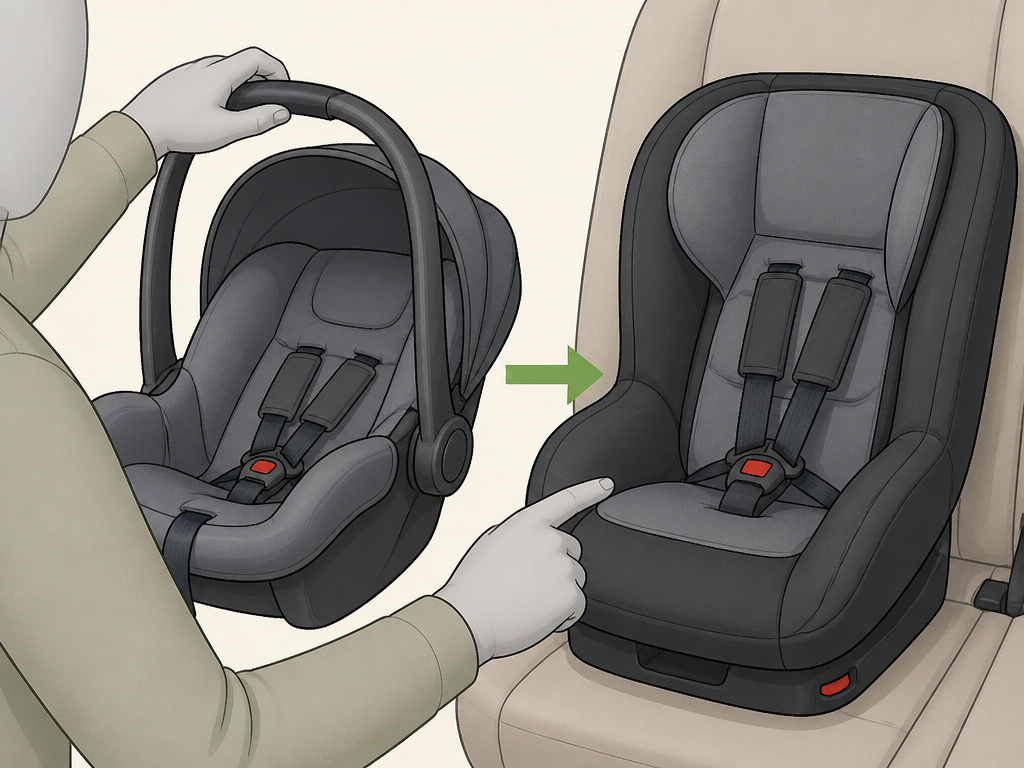
This isn’t an abstract choice. Each option has concrete pros and cons that play out in your daily routine. Knowing them lets you plan for the hassle you’re actually signing up for.
The Infant Carrier (Bucket Seat)
- Pro: Portability. You can click a sleeping baby in and out of the car without unbuckling them. It snaps into a travel system stroller.
- Con: Short lifespan. You’ll need a new seat within a year, sometimes as early as 6-9 months for tall babies.
- Con: Weight. Carrying a 20-pound baby plus a 10-pound seat is a 30-pound load. Your back will notice.
The Convertible Seat
- Pro: Longevity. A good one will last from infancy through the booster years. You buy it once.
- Pro: Better crash protection for toddlers. More shell height means better containment.
- Con: It stays in the car. You must unbuckle and remove the child every time.
- Con: Bulkier. It can be a tighter fit in smaller back seats.
Most families find the convertible’s cons are worth the trade for its safety and economic benefits. The portability of the infant seat is a short-term luxury. The protection of the convertible is a long-term necessity.
How to Choose Your Next Seat: The 2 Critical Specs
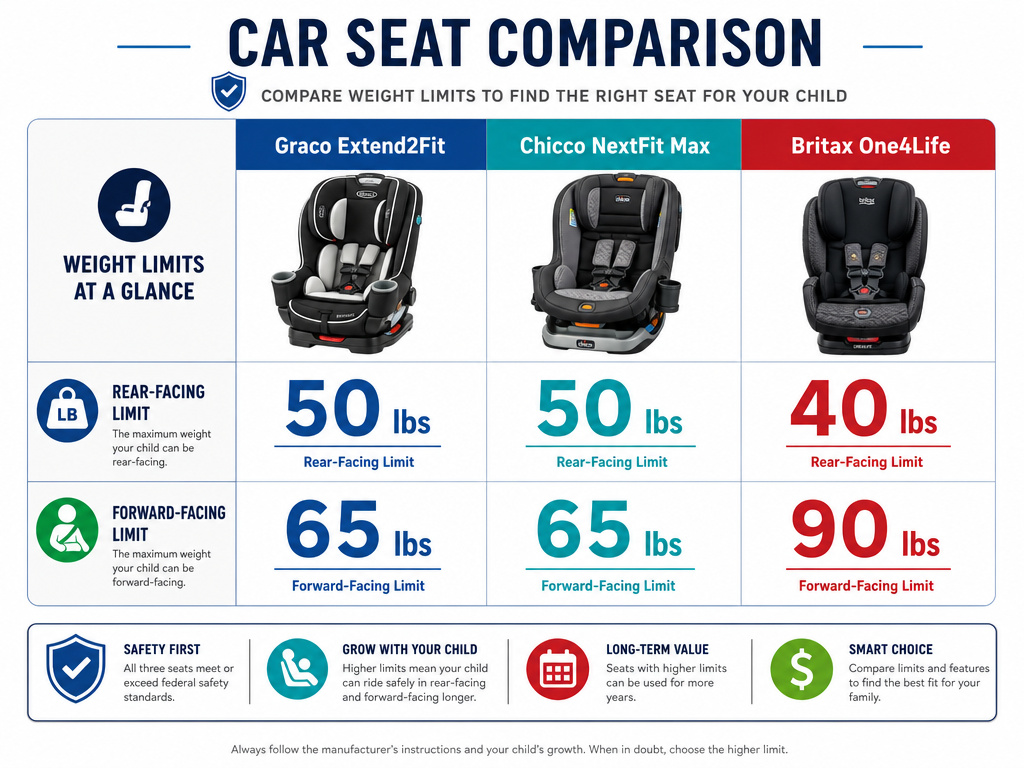
Once you’ve decided to transition to a convertible seat, ignore the cute patterns. Focus on two numbers printed in the manual.
1. Rear-Facing Weight Limit
This is the ceiling. Aim high. Seats like the Graco Extend2Fit rear-face to 50 pounds. The Chicco NextFit Max rear-faces to 50 pounds. The Britax One4Life goes to 40 pounds. The higher the limit, the longer you can delay the forward-facing move, which is unequivocally safer.
2. Forward-Facing Harness Weight Limit
After your child maxes out the rear-facing limit, they’ll use the same seat forward-facing with its 5-point harness. Limits here commonly range from 65 to 90 pounds. A higher limit means more years in a harness, which is safer than moving to a booster seat prematurely.
| Seat Model | Rear-Facing Limit | Forward-Facing Harness Limit | Best For |
|---|---|---|---|
| Graco Extend2Fit | 50 lbs | 65 lbs | Parents committed to extended rear-facing. |
| Chicco NextFit Max | 50 lbs | 65 lbs | Easy-adjust harness system; good for multiple vehicles. |
| Britax One4Life | 40 lbs | 90 lbs | Long-term use from infant to booster without another purchase. |
The Graco Extend2Fit is the default pick for most families. Its 50-pound rear-facing limit is best-in-class, and the extendable leg support gives taller toddlers more comfort. If you know you’ll have more than one child, a seat like the Britax One4Life that converts to a booster can be a smarter long-term investment.
The Installation Shift: Lower Anchors vs. Seat Belt
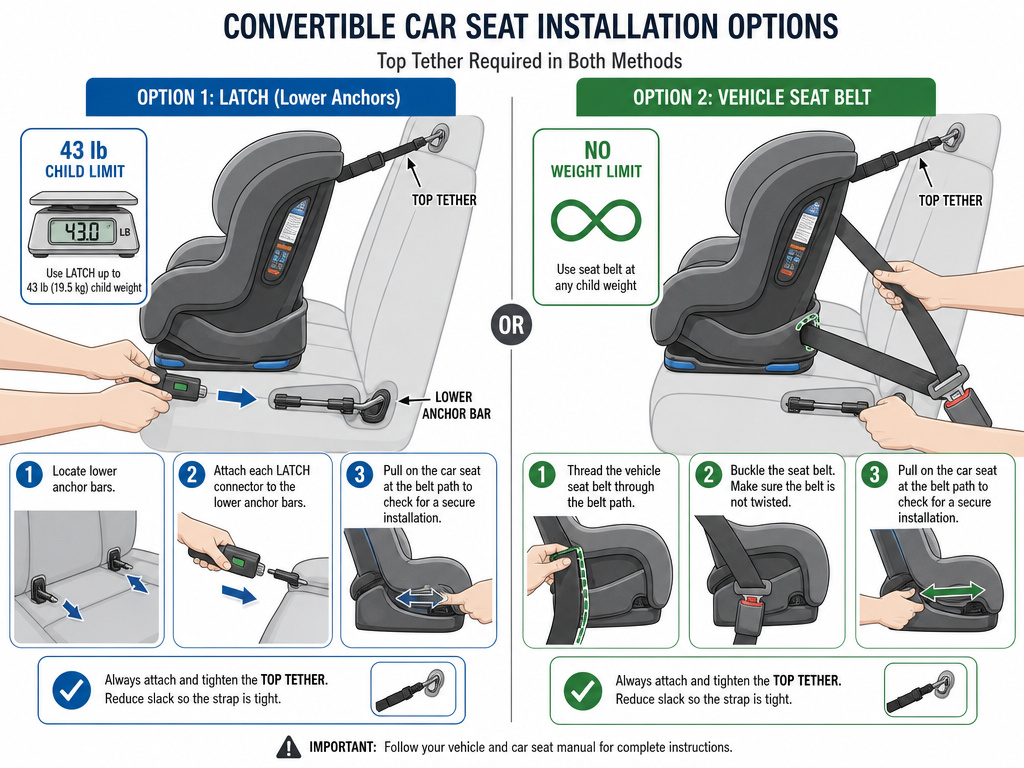
When you install your new convertible seat, you have a choice: use the vehicle’s LATCH lower anchors or the seat belt. Both are safe when done correctly, but the rules change as your child grows.
Remember the 65-pound lower anchor limit? That rule still applies. A typical convertible seat weighs 20-25 pounds. Do the math: 65 lbs – 22 lb seat = 43 lb child limit. If your child weighs 43 pounds, you must stop using the lower anchors and switch to a seat belt installation.
The seat belt has no such weight limit. It’s governed by the car seat’s own maximums. This is why the official child seat safety standard requires clear labels. You are responsible for knowing when to change installation methods.
Where this goes sideways: Forgetting the tether. When a convertible seat is forward-facing, you MUST use the top tether strap. It reduces the child’s head excursion in a crash by up to 6 inches. Not using it is like installing a shelf with only one bracket.
Always consult both your car seat manual and your vehicle owner’s manual. They are the final authority, not a generic blog post or YouTube video. For official guidance, the NHTSA car seat safety guidelines are the definitive source.
Frequently Asked Questions
My baby is 10 months and already at the height limit. Is that normal?
Yes, especially for longer-torsoed babies. Many parents are surprised to need a convertible car seat transition before the first birthday. Follow the height limit on the seat, not the age on the calendar. The 1-inch rule is absolute.
Can I use a convertible seat from birth?
Absolutely, if the seat’s manual states a minimum weight low enough for your newborn (often 4-5 pounds). Many convertible seats, like the Graco 4Ever, are approved for newborns. You skip the infant seat stage entirely. The trade-off is losing the carrier’s portability.
What if my child hates the new convertible seat?
This is common. The seat is unfamiliar and less cozy. Try a few short, positive trips first. Ensure the harness is snug and the recline angle is comfortable. Sometimes, a child objects simply because they’re more restrained, which is exactly what you want in a crash.
Do I need to buy a new seat if we’re in a minor crash?
Check the manual. Most manufacturers require replacement after any moderate or severe crash, even if the seat looks fine. Some allow continued use after a very minor collision. The NHTSA car seat safety guidelines define a “minor crash” with specific criteria. If in doubt, replace it. Your insurance may cover the cost.
How do I dispose of the old infant seat?
Cut the harness straps and write “EXPIRED” or “CRASHED” on the shell with a permanent marker. This prevents anyone from reselling or using it unsafely. Some retailers offer trade-in events where you can recycle the old seat and get a discount on a new one.
Before You Go
The switch from an infant seat isn’t a milestone to celebrate; it’s a safety protocol to execute. Let the three limits, height, weight, and the 12-month crash-test rule, be your guide, not a vague feeling.
Your next move is a convertible seat with a high rear-facing weight limit. Install it tightly with either lower anchors or the seat belt, register it immediately for recalls, and use that top tether the moment it goes forward-facing.
That’s the system. It’s not complicated, but it is specific. Follow the numbers on the labels, not the anecdotes from the playground. Your child’s seat is the most important piece of safety equipment you’ll ever own. Treat its limits with the seriousness they deserve.
