
Guide: What’s the Next Size Car Seat After Infant Carriers
This post contains affiliate links. As an Amazon Associate, we earn from qualifying purchases.
The next size car seat after an infant seat is a forward-facing convertible or all-in-one seat, but only when your child meets three specific limits: a minimum weight of 22 pounds (10 kg), a minimum age of one year, and they have outgrown their rear-facing seat’s height or weight maximum. The American Academy of Pediatrics and NHTSA recommend keeping children rear-facing until at least age two, so the true “next size” is often a rear-facing convertible seat used longer.
That two-year recommendation is based on how a child’s spine develops. A forward-facing seat holds a child back in a crash, while a rear-facing seat cradles them.The difference in neck strain is measurable, which is why every manual for a convertible seat prints the age-one minimum in bold.
The rest of this guide walks through the exact numbers from three major seat manuals, the new federal rule that changed booster seat minimums, and the one mistake that voids your seat’s certification faster than a crash.
Key Takeaways
- The literal next seat is a forward-facing convertible or all-in-one, but the safest progression is to a rear-facing convertible seat first, keeping your child rear-facing until age two or the seat’s limit.
- Federal rules now mandate a minimum 40-pound weight for booster seat use, a change from the old 30-pound standard published in the 2023 Federal Register.
- Every convertible seat has a minimum forward-facing weight of 22 pounds (10 kg) and a minimum age of one year; ignoring either voids the seat’s safety certification.
- Premature or low-birth-weight infants require a 90–120 minute hospital observation before their first car trip, a formal AAP guideline adopted by manufacturers like Evenflo.
- Transitioning too early to a forward-facing seat increases the risk of head and spinal injury; the seat’s harness and structure are not designed to protect a smaller, younger child’s frame.
The Forward-Facing Convertible Seat: Your Next Move
Look at the label on your infant carrier. The upper limit is usually 30-35 pounds or 30-32 inches. Once your child’s head is less than an inch from the top shell, or they hit the weight max, that seat is done. The next physical seat that fits them is a convertible.
A convertible car seat installs rear-facing for infants and toddlers, then forward-facing for older children. It doesn’t have a carry handle or a separate base. It stays in the vehicle. An all-in-one seat adds a booster mode later. For the purpose of moving up from an infant carrier, they function the same: they are the next larger shell.
Convertible and all-in-one car seats are certified for children from about 4-5 pounds up to 65 pounds or more in harnessed mode, with a forward-facing minimum requirement of 22 pounds (10 kg), one year of age, and the child meeting the seat’s specific height guidelines for shoulder strap position.
The Chicco Fit360 is a clear example. Its manual states it’s for children from 4 to 65 pounds and 49 inches or less. But the forward-facing fine print is specific: “ONLY for children… Who are at least one year old [and] who weigh between 26.5 and 65 lbs (12 –29.5 kg).” That 26.5-pound (12 kg) threshold is the new federal minimum, up from 22 pounds.
Why the one-year age minimum is non-negotiable. A child’s skeletal strength and head-to-body change dramatically in the first year. The harness and internal structure of a forward-facing seat are engineered to distribute crash forces across the strongest parts of an older child’s body—the pelvis and shoulders. For an infant under one, those forces concentrate on the abdomen and neck, where injury risk is highest. This is the biomechanical reason behind the rule printed in every manual.
The 22-Pound, One-Year-Old Rule in Real Seats
Manufacturer specs are the boundaries of the seat’s federal certification. Go outside them, and you are using an uncertified product.
| Seat Model | Minimum Forward-Facing Weight | Minimum Forward-Facing Age | Maximum Forward-Facing Weight (Harness) |
|---|---|---|---|
| Peg Perego Primo Viaggio | 22 lbs (10 kg) | 1 year (per AAP guidance) | 65 lbs (29.5 kg) |
| Evenflo EveryFit 3-in-1 | 22 lbs (10 kg) | 2 years (recommended) | 65 lbs (29.5 kg) |
| Evenflo Symphony | 22 lbs (10 kg) | 2 years | 65 lbs (29.4 kg) |
The Peg Perego manual is blunt: “NEVER use Primo Viaggio All In One in forward facing mode if baby weighs less than 10 kg (22 lbs).” The Evenflo Symphony adds the age layer: “At least 2 years old.” This creates the central decision for parents. Your child may hit 22 pounds at 9 months. The seat’s certification says you cannot turn it forward-facing yet. Your next car seat at that point is actually another rear-facing seat—a convertible, installed in the rear-facing direction.
Common mistake: Turning a convertible seat forward-facing the day your child hits 22 pounds. If they are under two, you have skipped the safest phase of the seat’s use. The harness is rated for a 22-pound child, but the crash dynamics are rated for a one-year-old’s development. Missing that age cutoff by months matters.
Why “Rear-Facing Until Two” Isn’t Just a Slogan
The NHTSA car seat transition guide states to keep a child rear-facing “as long as possible.” The 2023 Federal Register document provides the official reasoning: “NHTSA recommends that from 1 to 3 years they should be rear-facing as long as possible and then move to a harnessed and tethered forward-facing seat when they outgrow the rear-facing seat.”
This is the non-commodity core. The “next size” is about time. A child’s vertebrae are still cartilaginous.The rear-facing position supports the head, neck, and spine evenly during a crash, cradling the child into the seat back. Forward-facing suspends the child by the harness, placing immense strain on the neck as the head whips forward. The two-year mark is a developmental milestone where that risk begins to drop into an engineered range.
The legroom complaint is a red herring. Children sit cross-legged or with legs over the sides comfortably. The Peg Perego Primo Viaggio even includes an adjustable anti-rebound bar to create more rear-facing leg room. Discomfort is a parent’s projection, not a child’s complaint. The safety math doesn’t care about folded legs.
So your true car seat progression looks like this: 1. Outgrow infant carrier by height or weight. 2. Move to a convertible seat, installed REAR-FACING. 3. Use it rear-facing until child is at least two years old AND exceeds the seat’s rear-facing height or weight limit. 4. Then, and only then, turn the convertible seat FORWARD-FACING.
This is why buying a convertible seat as the best car seat after infant carrier is the standard advice. It handles the entire rear-facing toddler phase.
The 40-Pound Booster Minimum: Why It’s a Hard Line
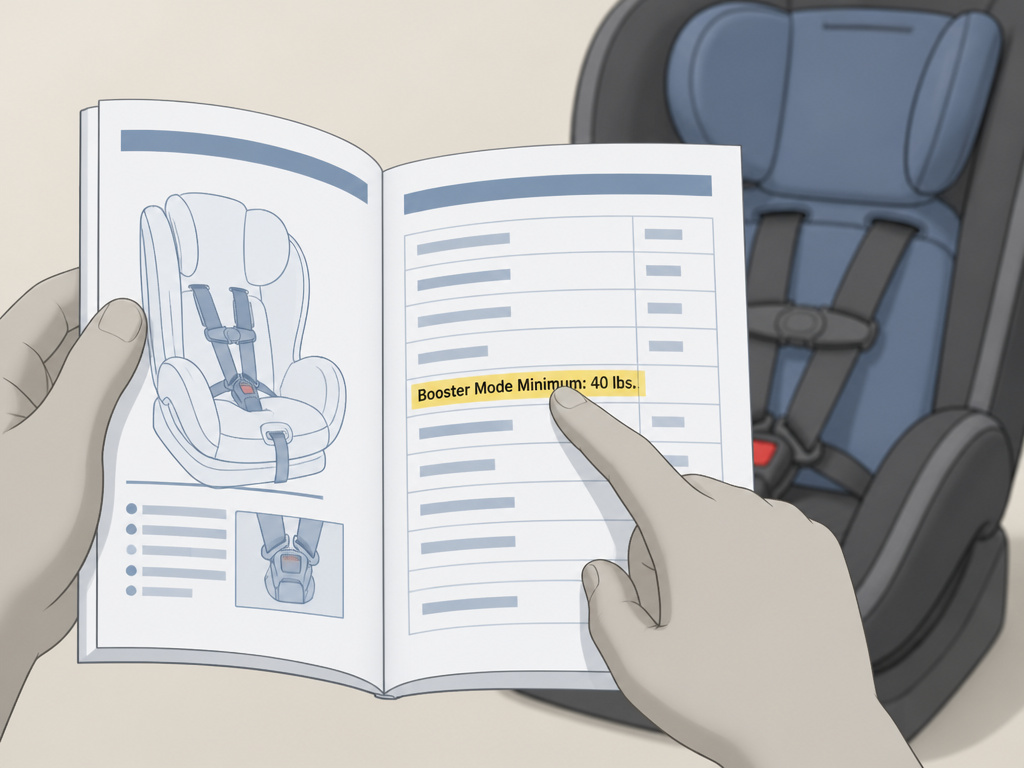
Many convertible seats morph into booster seats. The transition is tempting. It feels like a graduation. The Federal Register car seat rule PDF from December 2023 made that graduation much later.
The document states the agency estimates raising the manufacturer-recommended minimum weight for booster seats from 30 to 40 pounds (13.6 to 18.2 kg) will “potentially 1.2 to 4 lives will be saved and 1.6 to 5.2 moderate-to-critical injuries prevented” annually. This is now reflected in new seat manuals.
| Transition | Old Minimum Weight | New Minimum Weight (Post-2023 Rule) | Why the Change |
|---|---|---|---|
| Infant Carrier → Forward-Facing Harness | 20 lbs (9 kg) | 26.5 lbs (12 kg) | Reduces premature forward-facing transitions. |
| Forward-Facing Harness → Booster Seat | 30 lbs (13.6 kg) | 40 lbs (18.2 kg) | Ensures child’s skeletal maturity can properly position a vehicle seat belt. |
The Evenflo Symphony’s manual now lists booster mode for children “18 to 49.8 kg (40 to 110 lbs)” and “at least 4 years old.” The Peg Perego Primo Viaggio All-in-One specifies booster mode starts at 40 pounds (18 kg). This is a hard floor. A 35-pound three-year-old does not belong in a booster, even if the seat has the mode. The vehicle’s lap belt will ride up over the soft abdomen, not across the hard hip bones, leading to internal injuries in a crash.
How to know if your child is booster-ready:
- They exceed the forward-facing harness limit of their seat (usually 65 pounds).
- They are at least 4 years old.
- They weigh at least 40 pounds.
- They can sit still for the entire car ride, without slouching or playing with the seat belt.
Fail any of these, and the next stage seat is a higher-weight forward-facing harness seat, sometimes called a “combination seat.””
Special Case: The Premature or Small Newborn

The standard charts assume a full-term infant. The manual for the Evenflo Triumph car seat includes a mandatory section that most parents never see. It references an American Academy of Pediatrics guideline from 2009, reaffirmed in 2018.
For infants born earlier than 37 weeks or weighing less than 5 pounds at birth, the AAP “recommends that appropriate hospital staff observe your infant in the Child Restraint for a period of 90 to 120 minutes or the duration of travel, whichever is longer” before the first car trip. The staff checks for breathing difficulties or heart rate problems caused by the semi-reclined position.
This observation is a formal hospital discharge protocol for NICUs. If you have a preemie, your transition from infant seat timeline may be delayed until they pass this observation. The first seat must be rear-facing, and the angle must be precisely set to keep the airway open. The Chicco Fit360 includes a specific “Newborn Body Positioner” for infants 4-11 pounds for this reason.
When to Size Up: The Three Outgrowing Signs
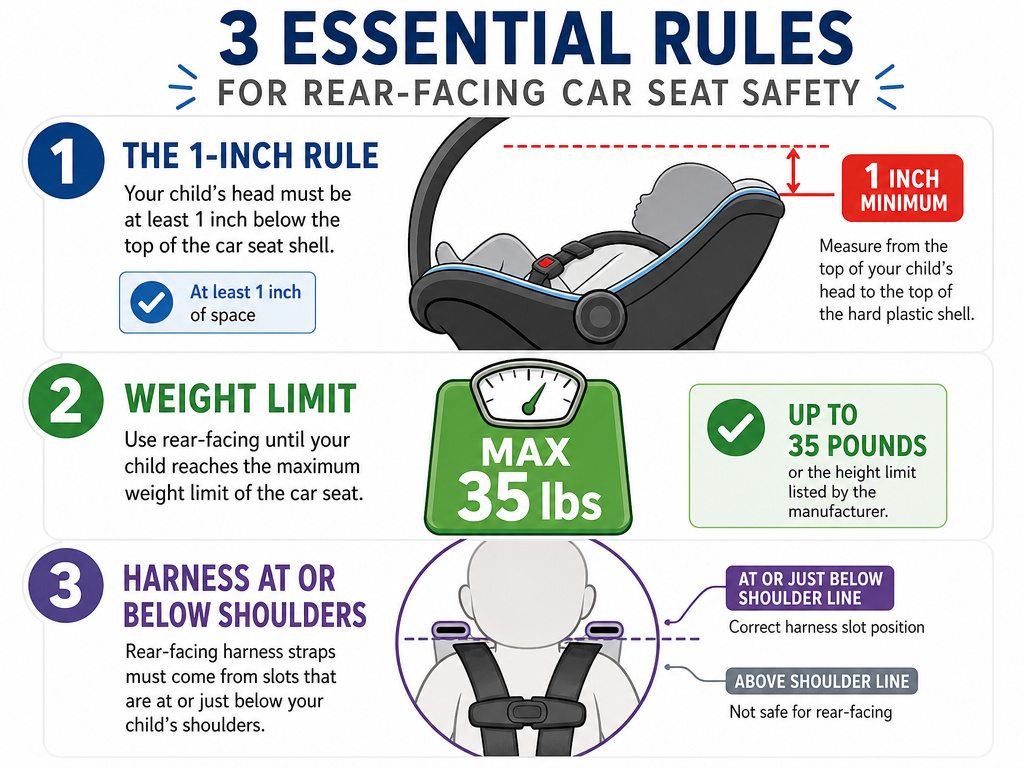
Knowing the when to size up from infant car seat is more precise than guessing. Check these every month once your child is about 6 months old.
- The One-Inch Headroom Rule. The child’s head must be at least one inch (2.5 cm) below the top of the infant carrier’s hard shell. Not the headrest padding—the actual plastic shell. This is the most common outgrowing sign.
- The Weight Scale. The child exceeds the seat’s maximum weight limit, printed on the label. Most infant carriers max out at 30, 32, or 35 pounds.
- The Shoulder Strap. The harness straps must be at or below the child’s shoulders in a rear-facing seat. If the straps are coming from below the child’s shoulder slots, and the seat has no lower slots, it’s outgrown.
If you see sign one or two, the infant carrier is finished. Do not use it for another day. You are now shopping for a convertible seat. Start by checking your vehicle’s back seat depth. A convertible like the Evenflo EveryFit 3-in-1 is large. It may not fit behind a tall front passenger. Measure first.
Frequently Asked Questions
Can I skip the convertible seat and go straight to a booster?
No. A booster seat requires a child to be at least 4 years old and 40 pounds. It positions the vehicle’s seat belt. A child who has just outgrown an infant carrier is nowhere near this size or maturity. The belt would cut across their neck and abdomen, causing severe injury. The post-infant car seat must have its own five-point harness.
My one-year-old is 30 pounds and tall. Can I turn them forward-facing?
By the strict letter of the manual, if the seat’s minimum forward-facing weight is 22 pounds and minimum age is one year, yes, you can. But you should not. The AAP and NHTSA recommendation is clear: rear-facing until at least two is safest. Your tall, heavy one-year-old still has the spinal development of a one-year-old. Use a convertible seat with a high rear-facing weight limit (like the Evenflo EveryFit, which goes to 40 pounds rear-facing) and keep them rear-facing.
What’s the difference between a convertible and an all-in-one seat?
Convertible seat switches from rear-facing to forward-facing with a harness. An all-in-one seat does that and also converts to a belt-positioning booster later. For your immediate next car seat stage after an infant carrier, they function identically. The all-in-one may last longer, but it is often larger and more expensive.
Are used convertible seats safe?
It is strongly discouraged. Transport Canada warns against seats without a known history. You cannot know if it was in a crash, is past its expiry date (usually 10-12 years from manufacture), or has missing parts. A car seat to get is a safety-critical purchase. New is the only guaranteed-safe option.
How do I install a convertible seat forward-facing?
You must use the vehicle’s seat belt OR lower anchors (UAS/LATCH) AND the top tether strap. The tether is mandatory for forward-facing installation and reduces head excursion by up to 6 inches. The seat’s manual will show the specific forward-facing belt path, which is different from the rear-facing path.
The Bottom Line
The search for the next size car seat ends with a number, not a product name. The number is two—as in years old, rear-facing. The safest path from an infant carrier is to a convertible seat installed rear-facing, used until your child is at least two and hits the seat’s rear-facing limits. Only then do you turn it forward-facing.
The new federal 40-pound booster minimum means the old “30-pound graduation” is gone. That changes the math for long-term seats. An all-in-one seat that boosts at 40 pounds might be outgrown by height before a child hits 40 pounds, making its booster mode useless. Read the manual for the seat in front of you, not the marketing box.
Your child’s size is a fact. The seat’s manual is a contract. Match them exactly. Anything else is a guess, and this isn’t a guessing game.
