
Check In a Stroller and Car Seat: What Your Manual Decides
This post contains affiliate links. As an Amazon Associate, we earn from qualifying purchases.
Yes, you can check a stroller and car seat with most airlines as luggage, but whether you should depends entirely on your specific model’s manual. Manufacturers write those warnings for a reason: a car seat checked without its travel-system frame is a 20-pound plastic shell tumbling down a conveyor belt. A stroller in carriage mode folded by a baggage handler can snap its frame at the hinge. The airline’s policy is the easy part. The manual’s fine print is what keeps your gear intact.
That gap between “allowed” and “advisable” is where gear gets destroyed. Airlines treat checked baby items as standard luggage, which means they are handled by the same systems that launch suitcases 10 feet onto a cart. Your stroller’s 50-pound weight limit and your car seat’s LATCH system aren’t designed for that kind of impact. The real question concerns whether your specific combination of stroller frame, car seat, and adapters is built to survive the journey, or if checking it voids the warranty on the spot.
What follows: the four specs you must match before you hand over your gear, the one calculation that determines if your car seat’s lower anchors are even legal for flight, and the exact line in the manual that makes gate-checking the only safe move for most travel systems.
Key Takeaways
- Check your stroller and car seat’s instruction manuals for explicit “DO NOT CHECK” warnings or compatibility notes before you fly; a manufacturer’s voided warranty beats any airline apology.
- Calculate the LATCH weight limit for your car seat (65 lbs minus seat weight) to see if it’s legal to install on the plane using the lower anchors; over the limit, you must use the aircraft seat belt.
- Gate-check your stroller whenever possible; it goes plane-side with less handling, but you must collapse it correctly and remove any detachable canopies or baskets first.
- A travel system’s car seat is only safe for flight if it’s certified for standalone aircraft use without its stroller base; many are not, and using an incompatible seat is a federal violation.
- Pack a car seat bag for checking, but know it only prevents scuffs, not crushing; the protection myth is why so many seats arrive with cracked shells.
The 4-Step Pre-Flight Check
You need four answers before you approach the ticket counter. Missing one turns a routine check-in into a last-minute scramble at the gate.
1. The Manual’s Verdict on “Checked Baggage”
Open the physical booklet or PDF for your stroller and car seat. Search for “aircraft,” “airline,” “check,” or “travel.” Most won’t mention it. Some, especially European brands following stricter EN or UN regulations, will have a clear prohibition.
Common mistake: Assuming “travel system” means “airline-ready.” The Evenflo Omni Ultra manual states its stroller frame is only compatible with three specific Evenflo infant car seats. Using another brand’s seat on that frame voids all safety certifications, and the warranty.
If the manual is silent, the default is not approval. It’s a gap the manufacturer leaves for your risk assessment. Your next check is the airline’s contract of carriage, which almost always disclaims liability for “collapsible strollers and child restraint systems” treated as checked baggage. They’re covered, but at a depreciated value that might not cover a $300 replacement.
2. The LATCH Math for Onboard Use
If you plan to use the car seat on the plane, you can’t just install it. The NHTSA car seat safety guidelines set a hard ceiling: a child restraint system installed with lower anchors (LATCH) must not exceed a combined weight of 65 pounds. That’s the child plus the seat.
| Car Seat Model | Seat Weight | Max Child Weight for LATCH | Must Use Seat Belt If Child Is… |
|---|---|---|---|
| Generic Infant Seat | ~10 lbs | 55 lbs | Over 55 lbs |
| Convertible Seat | ~20 lbs | 45 lbs | Over 45 lbs |
| Joie i-Snug 2 | ~9 lbs | 56 lbs | Over 56 lbs |
The formula is straightforward: 65 lbs – car seat weight = maximum child weight for LATCH. If your child exceeds that number, you must use the aircraft seat belt to secure the seat. No exceptions. This is a federal rule, not an airline one. Flight attendants aren’t trained to check this, but you are liable if the seat is misused.
3. The Stroller’s True “Checked” Configuration
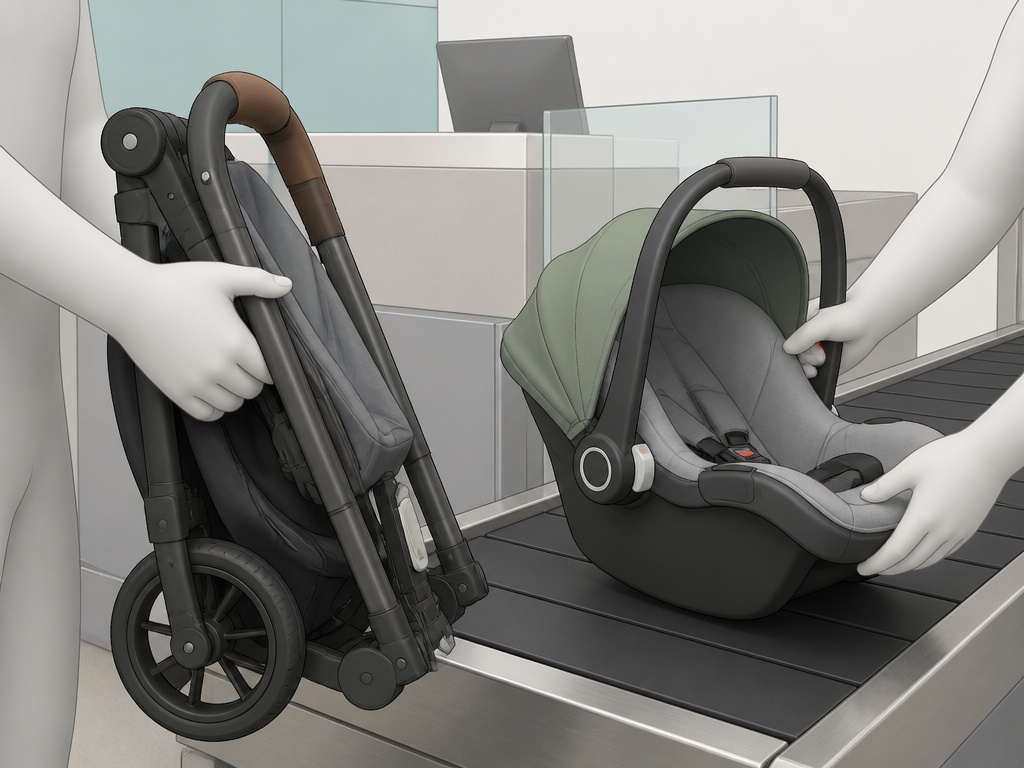 Are you checking the stroller fully assembled, or collapsed? If it’s a travel system, are you removing the car seat and checking the frame alone? The answer changes how you pack it.
A stroller checked in “carriage mode” – fully reclined for an infant – is at its most vulnerable. The Australian stroller mandatory standard mandates rigorous stability and impact tests, but those tests assume controlled lab conditions, not a baggage handler folding it with a knee. The Cybex Eos manual explicitly warns against using carriage mode for a child over 6 months or 20 pounds. Check it in that configuration with a toddler inside, and you’ve ignored the primary safety directive.
4. The Warranty Voidance Clause
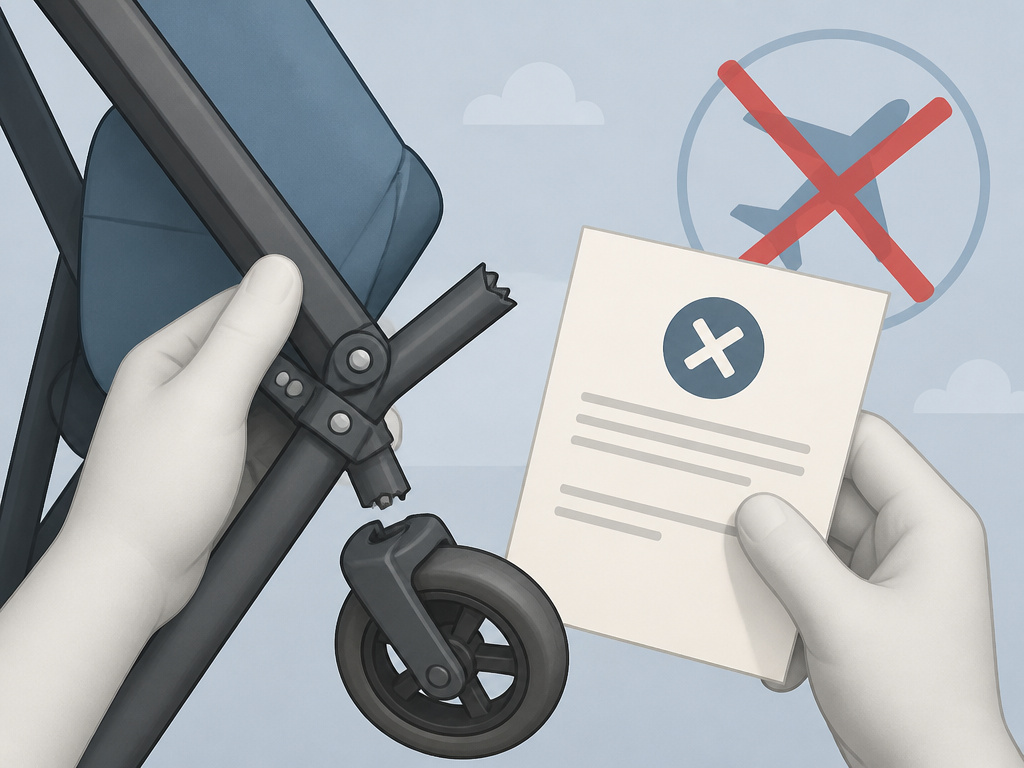 This is the line nobody reads until they’re filing a claim. Most stroller and car seat warranties cover defects in materials and workmanship for a limited period (Evenflo’s is 90 days from delivery). They do not cover “misuse, abuse, or damage caused by improper handling.” Checking the item as airline baggage consistently falls under “improper handling.”
If the manual doesn’t explicitly approve checking, and the frame snaps, your warranty claim will be denied. The airline’s baggage compensation might offer a fraction of the replacement cost. The financial risk sits with you.
When Gate-Checking Is the Smarter Move
 Gate-checking means you use the stroller through the airport, collapse it at the jet bridge, and pick it up plane-side after landing. It’s handled by ramp agents, not the main baggage system, which means fewer conveyor drops and crushing piles.
Why it’s safer: The stroller goes from your hands into a dedicated cart, then onto the plane’s cargo hold last. It comes out first. The total time in the harsh baggage ecosystem is minutes, not hours. For a car seat, the same logic applies, gate-checking usually means it’s placed in a protective bag and stored in a closeted compartment, not tossed with the suitcases.
But gate-checking has its own rules. You must collapse the stroller to its smallest footprint. Remove the child tray, cup holder, and any hanging bags. The gate-check guide calls this “stripping it down to the frame.” If your stroller has a reversible seat, like the Cybex Eos, make sure it’s locked in the forward-facing position before folding. A loose seat bouncing in a cargo hold can shatter the recline mechanism.
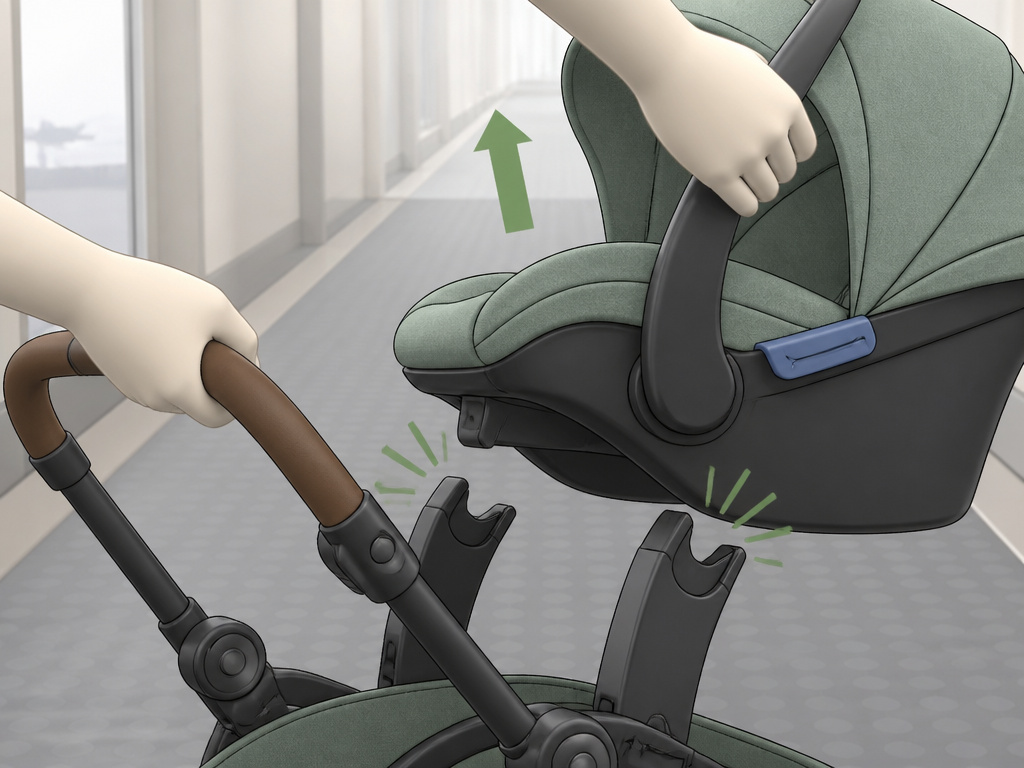
Where this goes sideways: Gate-checking a travel system’s car seat still attached to its stroller frame. Most adapters are plastic clips, not forged steel. A baggage handler grabbing the stroller handle to lift it can torque those clips and crack the car seat’s shell at the anchor points. Always separate them.
Airlines are generally generous with free stroller and car seat check at the gate, considering them “assistive devices” for small children. But policy isn’t protection. The step-by-step check-in guide is your checklist, not your guarantee.
Travel System vs. Separate Components: The Risk Split
A travel system, a stroller frame designed to click a specific infant car seat into place, is convenient on the ground. In the air, it’s a compatibility puzzle.
The car seat’s certification is standalone. The Joie i-Snug 2 is approved under UN Regulation No. 129 for use in vehicles with its base or with a seat belt. Its manual doesn’t address aircraft use. The stroller frame’s manual, like the Joie i-Juva, only certifies the stroller itself to European standard EN 1888-1:2018. The moment you click the seat into the stroller adapter, you’ve created a new assembly the manual never tested for airline handling.
If you check the frame and carry the seat onboard, you’re likely fine. If you check both, you’ve introduced two failure points: the frame’s folding joints and the seat’s shell integrity. The airline check-in policies won’t differentiate.
Separate components, a standalone stroller and a convertible car seat, often fare better. The stroller is engineered to fold. The car seat is a single, solid shell. Checking them separately spreads the risk. The stroller might get a wheel bent. The car seat might get scuffed. It’s unlikely both will be destroyed in the same incident, so you’re not stranded at your destination.
What Airlines Actually Do With Your Gear
They call it “special handling.” You watch it disappear down a conveyor belt or get tagged at the gate. Behind the scenes, it’s lumped in with other oversized items: golf bags, skis, musical instruments.
Baggage handling systems are designed for standard suitcases, not for the awkward shape and weight distribution of a stroller. The wheels catch on edges. The canopy snags. A car seat in a bag is a 20-pound cube that can be crushed under a 50-pound suitcase. The airline free check policies don’t mention that their liability limit is often $3,500 per passenger total, not per item. If your stroller and car seat are worth $800 together, and your luggage is also lost, you’re fighting for a slice of that cap.
The part nobody mentions: Airlines require car seats checked as baggage to be in a protective bag. This isn’t for the seat’s protection, it’s to keep the webbing and buckles from tangling in the conveyor machinery. A thin nylon bag offers zero impact protection. It’s a tangle-prevention device, not a shield.
Your best defense is a hard-sided travel case for the car seat. For the stroller, a heavy-duty nylon bag with padding at the hinge points. Even then, you’re trusting a system that breaks things daily.
The One Calculation That Changes Everything
Remember the LATCH limit: 65 pounds total. For a typical convertible car seat weighing 20 pounds, that means your child must be under 45 pounds to use the lower anchors on the plane. Most airlines allow use of an FAA-approved child restraint system in a purchased seat, but they don’t police the installation method.
If your child is 40 pounds, you’re clear. If they’re 48 pounds, you must use the aircraft seat belt. That’s a different installation method, one that often feels less secure because the belt path is longer and can introduce slack. Practice that installation at home before you fly. The bringing on plane logistics are one thing; a secure install in a cramped cabin is another.
Packing for Survival, Not Just Convenience
Assume your checked items will be dropped, thrown, and stacked. Pack accordingly.
- Remove everything detachable. Take off the cup holder, child tray, canopy, and storage basket. Pack these in your carry-on or checked suitcase. A snapped-off cup holder bracket renders the stroller annoying. A torn canopy leaves your child exposed.
- Fold it the right way. If your stroller has a multi-step fold, follow it. Forcing it closed can break the locking mechanism. The traveling with stroller and car seat prep starts with knowing the fold by muscle memory.
- Use a car seat travel bag. Not for cushioning, but for containing. The bag keeps the harness straps from flailing and getting caught. Some bags have backpack straps, which makes carrying in flight from check-in to gate less of a marathon.
- Tag it like it’s going to war. Put a copy of your itinerary and contact info inside the bag, not just on the outside tag. Outside tags tear off.
The goal is to arrive with gear that works, not gear that looks new.
Frequently Asked Questions
Can I check my stroller and car seat for free?
Yes, on virtually every major U.S. Airline, you can check a stroller and car seat for free. They are considered “assistive devices” for children and do not count toward your baggage allowance. This applies at both the ticket counter and the gate. Always confirm with your specific airline’s policy before flying.
Is it safer to gate-check or baggage-check my stroller?
Gate-checking is almost always safer. The stroller spends minimal time in the baggage handling system and is typically handled with more care as it goes directly into the aircraft’s hold. Baggage-checking subjects it to the full conveyor belt and sorting process, which poses a higher risk of damage.
Will the airline provide a bag for my car seat?
Some airlines offer large plastic bags at the check-in counter or gate, but availability is not guaranteed. These bags are thin and designed primarily to prevent straps from tangling in machinery, not to protect against impact. Bringing your own padded, durable car seat bag is strongly recommended.
Can I use my car seat on the airplane?
Yes, if it is certified for aircraft use (look for an FAA approval label on the seat). You must purchase a seat for your child to install it. Remember, you must follow the LATCH weight limit rule (65 lbs total weight for child plus seat) or use the aircraft seat belt if your child exceeds that weight.
What happens if the airline damages my stroller or car seat?
You must file a damage claim immediately at the airline’s baggage service office before leaving the airport. Airlines have limited liability for checked items, often around $3,800 per passenger total under international treaties. They may repair, replace, or offer a cash settlement. Note that manufacturer warranties typically do not cover airline damage.
Can I check a stroller that’s part of a travel system?
You can check the stroller frame, but you should almost always remove the car seat first. Check the car seat separately in a protective bag, or carry it onboard if you’ve purchased a seat. Checking them still clicked together puts stress on the adapter points and risks damage to both pieces.
Before You Go
Checking a stroller and car seat is a logistical step, not a safety endorsement. The airline says yes. The manufacturer’s manual often whispers no. Your job is to find where your specific model falls on that spectrum. Start with the manual’s warnings. Run the LATCH math. Then decide whether gate-checking or carrying on is worth the hassle. The system isn’t built to protect your gear, only you are. Pack for worst-case handling, tag everything twice, and never assume a travel system’s convenience translates to durability at 30,000 feet. The right choice is the one that gets both your child and their seat to the destination in one piece.
