
Can You Check a Stroller and Car Seat for Free? 3 Places That Do
This post contains affiliate links. As an Amazon Associate, we earn from qualifying purchases.
Yes, you can get a free safety check for your stroller and car seat in three official places: certified child passenger safety technician (CPST) inspection stations, manufacturer recall lookups, and government transport agency websites. These checks verify installation, search for recalls, and confirm expiry dates, but they do not assess crashworthiness or repair physical damage.
That distinction between a free safety verification and a paid mechanical inspection is where most parents get confused. The free services confirm you’re using a legal, un-recalled seat correctly. They won’t tell you if the plastic shell is fatigued or if the stroller frame is rusting from the inside.
What follows is a map of the three free paths, exactly what each one examines, and the critical questions they cannot answer. By the end you’ll know where to go, what to bring, and when to open your wallet for a deeper look.
Key Takeaways
- Free checks are for safety compliance: installation, recall status, and expiry. They are not structural integrity assessments.
- The NHTSA maintains a database of local child passenger safety inspection stations where certified technicians offer free appointments.
- Always register your gear with the manufacturer to get direct recall alerts; checking the NHTSA or Transport Canada site is your backup.
- Expiry dates are real and matter. A Graco 4Ever lasts 10 years; a standard Evenflo seat lasts 6. Using a seat past this date is an unverifiable risk.
- No free service will clear a seat that was in a collision or bought used with an unknown history. Those scenarios require replacement.
The Three Official Free Check Locations
You have three channels for a no-cost safety verification. Each serves a different purpose, and using all three is the complete picture.
1. Certified Child Passenger Safety Technician (CPST) Inspection Stations
This is the gold standard for a free, hands-on check. The National Highway Traffic Safety Administration (NHTSA) funds a network of certified technicians. You book an appointment at a local station, often a fire department, hospital, or police station, and a CPST spends about 30 minutes with you and your vehicle.
They do not install the seat for you. They teach you to do it correctly.
A CPST inspection follows a strict checklist: verifying the seat is not expired or recalled, confirming it’s appropriate for the child’s height and weight, checking that it’s installed in the correct vehicle seat using either the lower anchors or the seat belt (never both), and ensuring the harness is snug and the chest clip is at armpit level.
What it covers:
- Installation method (UAS/LATCH vs. Seat belt)
- Harness fit and positioning
- Recall status (they look it up)
- Expiry date check
- General condition for obvious damage
What it doesn’t cover:
- Stroller compatibility. They won’t certify that your infant seat clicks securely into your stroller frame. That’s in the stroller manual.
- Crash history. They take your word for it. If you lie about a crash, they have no way to know.
- Long-term material fatigue. They look for cracks and fraying, but can’t test plastic polymer strength.
To find a station, use the NHTSA child passenger safety inspection station locator. This is the primary source for free, in-person verification.
2. Manufacturer Recall Lookups & Registration
This is a free check you do yourself online. It’s not an inspection, but a vital verification of whether your model has a known safety defect.
Every car seat and stroller sold in the U.S. And Canada has a model number and date of manufacture. You can search these on the manufacturer’s website or on the NHTSA recall database. The critical step is registering your product with the manufacturer at purchase. This opts you into direct email alerts for future recalls.
| Action | Where to Go | What You Need |
|---|---|---|
| Register New Gear | Manufacturer’s website (link in manual) | Model number, date of manufacture, your contact info |
| Search for Active Recalls | NHTSA Recall Database or Manufacturer’s site | Model number and name |
| Get General Safety Guidelines | NHTSA car seat safety guidelines | N/A |
Common mistake: Assuming a store will contact you about a recall. The manufacturer only has your info if you register. No registration means you must self-check regularly.
Recall checks are free, perpetual, and non-negotiable. A recall might involve a replacement part, a repair kit, or a full seat replacement, all typically provided at no cost.
3. Government Transport Agency Websites
Transport Canada and the NHTSA provide free, authoritative reference materials that act as a check against your practices. This isn’t a personalized inspection, but a way to verify the rules you’re following.
Transport Canada’s page on “Children’s car seats and booster seats: How long are they safe?” is a prime example. It compiles manufacturer-submitted expiry dates, a free resource to check if your seat is within its useful life.
These sites answer the “what” and “how long” for free. They are your baseline for legal compliance and best practices.
What a Free Inspection Actually Covers (And What It Doesn’t)
Understanding the scope of a free check prevents the dangerous assumption that a passed inspection means your gear is invincible.
The Free Check List:
- Installation Security. The seat should not move more than 1 inch side-to-side or front-to-back at the belt path.
- Recall Status. The technician or you will confirm the model has no open recalls.
- Expiry Date. The date is stamped on the seat. For a Graco 4Ever, that’s 10 years from manufacture. For an older Graco model, it could be 6 years.
- Harness Fit. You should not be able to pinch a horizontal fold in the harness strap at the child’s shoulder.
- Obvious Damage. Visible cracks, severed straps, or missing parts are instant failures.
The Not-Covered List (These Require Judgment or Replacement):
- Previous Crash Involvement. Alberta’s government guidelines state it plainly: never use a seat that’s been in a collision. No inspection can certify a crashed seat.
- Unknown History of a Used Seat. Faded labels, missing manuals, and suspicious odors are red flags no free check can clear.
- Compatibility with Your Specific Stroller. Your Evenflo Omni-Ultra only accepts Evenflo LiteMax infant seats. A CPST won’t have the stroller manual memorized.
- Internal Wear and Tear. UV degradation of plastic, rust inside a stroller frame joint, or weakened foam from years of heat cycles are invisible during a quick check.
The free check is a snapshot of correct use at that moment. It is not a warranty on the product’s future condition.
When a Free Check Isn’t Enough: The Paid Inspection Gap
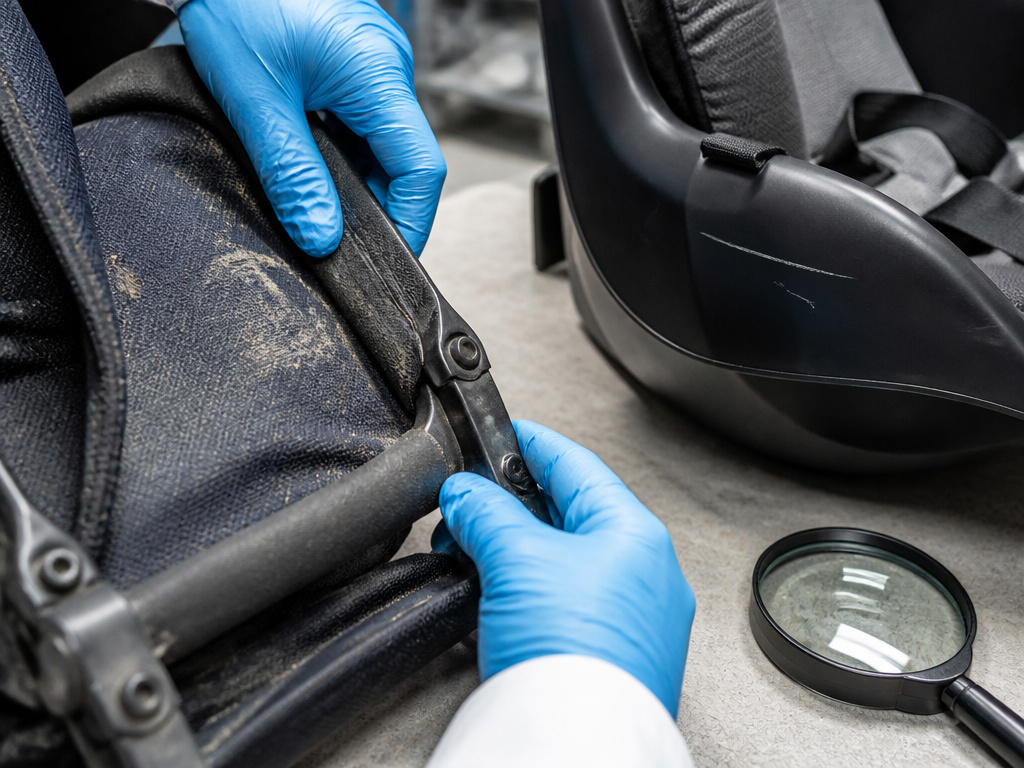
Some concerns fall outside the free service mandate. This is where you might seek a specialized, paid assessment, though these services are rare and should be approached with skepticism.
Scenario 1: The Questionable Used Find.
You bought a second-hand travel system. The seller swore it was never in a crash. The model isn’t expired or recalled. A free CPST check might pass its installation, but the technician will still advise against using it. Why? The history is unverifiable. No amount of money can buy certainty into a seat’s past. The only safe financial choice here is to spend the money on a new seat.
Scenario 2: Suspected Environmental Damage.
You left your stroller on a sunny patio for a whole summer. The fabric is faded, and the frame feels less rigid. The Joie i-Juva manual warns that excessive sun can warp parts. A free check might note the fading but can’t test the structural integrity of the plastic. Manufacturers don’t offer “degradation testing” services. If you suspect sun or heat damage, the paid option is replacement.
Scenario 3: Post-Minor Incident Doubt.
A shopping cart dinged your stroller frame, leaving a small scratch. The car seat was in a parking lot fender-bender so minor the airbags didn’t deploy. NHTSA has guidelines for post-crash use, but many manufacturers and provinces say “any crash” means replace. A paid mechanic could inspect for stress fractures, but their liability insurance likely prohibits certifying child-restraint equipment. You’re in a gray zone where paying for an opinion may not yield a legally defensible answer.
The pattern is clear. Free checks verify known rules. Paid inspections for child safety gear are an undeveloped market because liability is so high. When in doubt, the universally safe, though costly, path is replacement.
Stroller-Specific Checks: Weight Limits & Compatibility
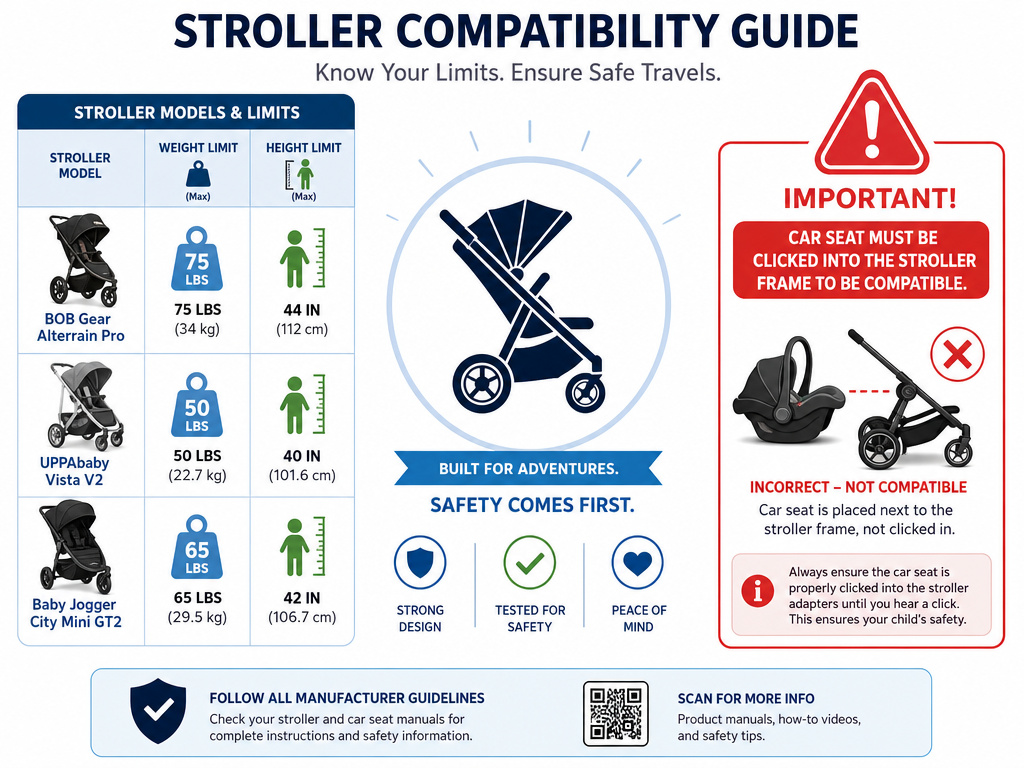
A free car seat inspection ignores the stroller half of your travel system. Stroller safety has its own checklist, grounded in the manufacturer’s manual.
The Two Non-Negotiable Numbers:
Every stroller has a maximum weight and height limit for its toddler seat. Exceeding them stresses the frame and compromises braking stability.
| Travel System Model | Max Weight for Toddler Seat | Max Height for Toddler Seat | Source |
|---|---|---|---|
| Evenflo Omni-Ultra | 50 lbs (22.6 kg) | 40 in (101.6 cm) | Evenflo Official Manual |
| Cybex Eos | 50 lbs (22.7 kg) | 38 in (96.5 cm) | Cybex Official Manual |
| Joie i-Juva | 33 lbs (15 kg) | Not specified by height | Joie Official Manual (EN 1888-1:2018) |
Exceeding these limits is a quiet risk. The stroller won’t break immediately. It will wobble more on turns, the recline mechanism will strain, and a sudden stop could overstress a joint.
The Compatibility Rule:
Your infant car seat only clicks into the stroller if the manual says it can. The Evenflo Omni-Ultra manual is explicit: “Only use Evenflo LiteMax™, LiteMax™ NXT, or Revolve LiteMax™ 180° NXT infant car seats with this stroller.” Using an unapproved adapter or a different brand seat creates a point of failure no free check will catch.
Where this goes sideways: Assuming all “universal” adapters are safe. If the stroller manufacturer hasn’t tested and approved that specific seat-adapter combination, you are conducting the crash test.
A free check won’t cover this. You must read your own stroller manual and obey its compatibility table.
How to Prepare for Your Free CPST Inspection
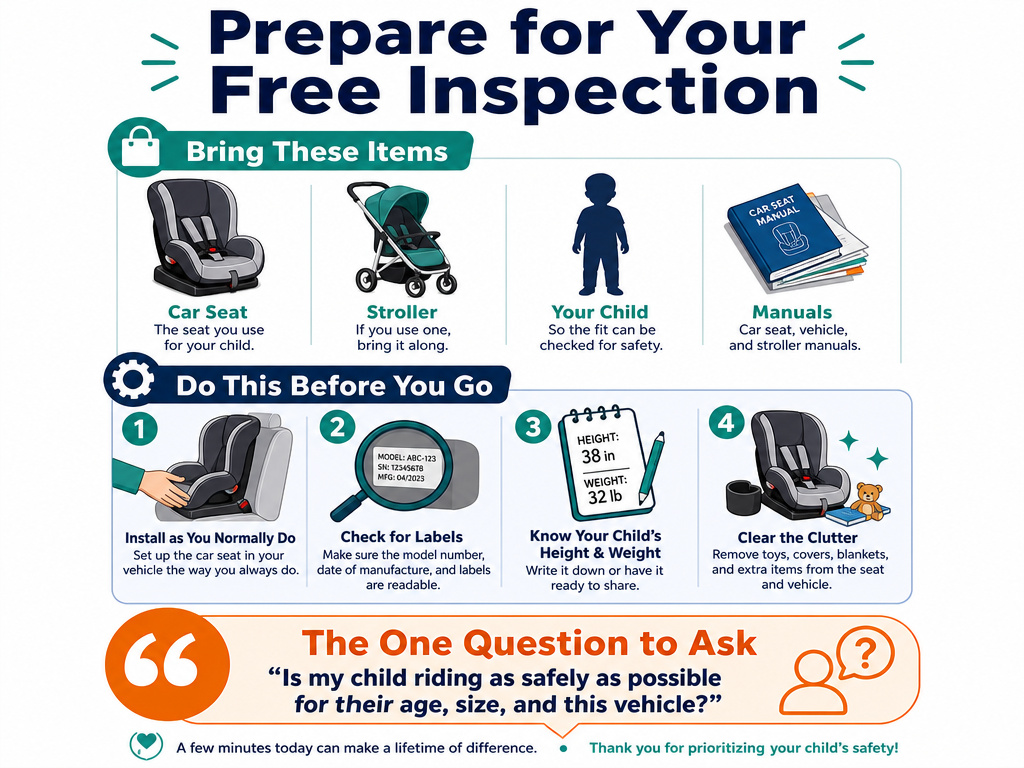
Getting the most from your 30-minute appointment requires a little homework. Arriving unprepared wastes time you could spend learning.
Bring These Items:
- The car seat and stroller.
- The child who uses the seat (or their exact height/weight).
- All vehicle owner’s manuals for the cars you use.
- The car seat and stroller instruction manuals.
- The specific vehicle the seat is installed in.
Do This Before You Go:
- Install the seat as best you can. The technician needs to see your technique to correct it.
- Find the model number and manufacture date on the seat and stroller.
- Write down your child’s current weight and height.
- Clear any clutter from your vehicle’s back seat.
The One Question to Ask:
At the end, ask the technician: “Can you watch me uninstall and reinstall this once, to make sure I’ve got it?” The transfer of skill is the entire point. If they just do it for you, you leave no more capable than you arrived.
This preparation turns a free compliance check into a true education. You’re not just getting a sticker; you’re building the competence to keep it safe for the next six years.
Frequently Asked Questions
Does Walmart or Target check car seats for free?
No. Major retailers do not offer certified car seat inspection services. Some may host periodic safety events with local CPSTs, but this is not a regular, in-store service. The permanent, reliable source is the NHTSA station locator.
Is checking a car seat at the airport considered a safety check?
Absolutely not. Checking at the airport is a baggage handling process, not a safety inspection. Airport staff verify that your car seat travel bags are properly tagged, not that the seat is correctly installed or unexpired. The safety of checking a car seat on a plane depends on your packing a car seat in a protective, wheeled travel bag.
Can I get a free check if I bought my seat used?
Yes, a CPST will still inspect it. However, they will strongly counsel you against using a seat with an unknown history. They will check for recalls and expiry, but cannot verify if it was in a crash. The inspection may be free, but the risk remains fully yours.
How often should I get a free check?
At minimum, with every major transition: when you move the seat to a new vehicle, when you switch from rear-facing to forward-facing, when you move from a harness to a booster, and when a new sibling uses the seat. An annual check is a good habit, as installation can loosen over time.
Do strollers have expiry dates like car seats?
Generally, no. Strollers do not have federally recognized expiry dates. Their lifespan is determined by wear, tear, and manufacturer weight limits. However, materials degrade. Plastic becomes brittle, metals fatigue, and fabrics fade. If a stroller is over 10 years old or shows signs of rust, cracking, or instability, retire it.
The Bottom Line
A free check for your stroller and car seat is a tool for verifying compliance, not a guarantee of indefinite safety. Use the three free resources. CPST stations, recall databases, and government guides, to establish a strong baseline. They will catch installation errors, flag recalled models, and warn you about expiry dates.
But these checks have hard boundaries. They cannot see into a product’s past or predict its material future. They won’t approve a questionable used seat or certify stroller compatibility. For those gaps, the only safe protocol is conservative replacement.
Register your gear. Book that appointment. Read the manuals. Then, pair that free verification with your own disciplined judgment about wear, history, and the limits of what any inspection can ever know.
