
Does the Base of a Car Seat Expire | The 7-Year Hard Stop
This post contains affiliate links. As an Amazon Associate, we earn from qualifying purchases.
Yes, a car seat base expires. Every base sold in Canada has a manufacturer-set expiry or useful life date, typically 6 to 10 years from its date of manufacture. Using a base past this date is unsafe and, in Canada, may violate provincial law as it no longer meets certified safety standards.
That date is a certified performance ceiling. The plastics, foams, and metal components in a base are engineered to absorb crash forces predictably within a defined window.Beyond that window, material fatigue, UV degradation, and evolving safety regulations mean the base cannot be guaranteed to perform as tested.
What follows is a breakdown of where to find that date, the specific timelines for major brands, the physical and legal reasons behind them, and what to actually do when your base reaches its limit.
Key Takeaways
- Car seat base expiry dates range from 6 to 10 years, set by the manufacturer and printed on a label on the base itself.
- In Canada, using an expired base may break provincial law, as the seat is no longer certified to current Canada Motor Vehicle Safety Standards.
- Never use a second-hand base if you cannot verify its full history, including crash involvement and manufacture date.
- After a moderate or severe crash, the base must be replaced immediately, regardless of its age.
- An expired base should be permanently destroyed, cut the harness straps and mark “EXPIRED” on the shell, to prevent someone else from using it.
Where to Find the Expiry Date on Your Base
You won’t find it in a manual you lost three years ago. The expiry or useful life date is physically printed on the base itself, usually on a white or silver sticker label.
Common mistake: Looking only on the seat carrier. The base and the seat are separate components, each with their own expiry timeline. A seat might have 8 years left while its base has already timed out.
The label is often on the underside of the base or along the back or side. You’ll need to uninstall it from your vehicle and flip it over. Look for a line that says “Do not use after,” “Expiry date,” or “Manufacture date” followed by a month and year. Some brands, like Nuna, note the expiration information is on the label on the underside of the base.
If you only find a manufacture date, you need to add the useful life period. A base made in June 2018 with an 8-year life expires in June 2026.
| Brand (Manufacturer) | Where to Look | What the Label Says |
|---|---|---|
| Baby Jogger | Top side of the base | Manufacture date; 7-year life from that date |
| Maxi-Cosi / Safety 1st (Dorel) | Label on the top of the base | “Do not use this base more than 8 years after the date of manufacture.” |
| Nuna Pipa | Underside of the base | Expiration date printed directly |
| Graco | Side or underside of base | Manufacture date; life varies by model (6-10 years) |
| Chicco | Side or underside of base | Manufacture date; 6-year life (from purchase with receipt) |
The 7-Year Hard Stop (And Other Timelines)
Manufacturers don’t pick these numbers at random. They are the result of durability testing and material science. Transport Canada compiles a voluntary list from manufacturers, and the variation tells you which brand’s engineering assumptions you’re buying into.
The Baby Jogger base manual states a firm 7-year life from manufacture. The Dorel Juvenile Group (Maxi-Cosi, Safety 1st) sets an 8-year limit. Others run longer.
DO NOT USE 7 YEARS AFTER THE MANUFACTURE DATE. The manufacture date can be found on the top side of your child restraint base. Baby Jogger, LLC User Manual
This concerns the entire energy-absorbing system, the lock-offs, the LATCH connector springs, the recline mechanism, wearing in ways that are impossible to inspect at home.
The Brand-by-Brand Expiry Guide
Use this table to decode your base’s lifespan. These figures are drawn from the manufacturer data published by Transport Canada.
| Brand | Typical Base Expiry | Critical Note |
|---|---|---|
| Graco | 6-10 years | Varies wildly by model. Early Nautilus boosters had a 9-year backless portion. The 4Ever is 10 years. |
| Chicco | 6 years | Life is 6 years from date of purchase if you have proof of purchase. Otherwise, it’s 6 years from manufacture. |
| Nuna Pipa | 7 years | Life is 7 years from date of purchase if you have proof of purchase. Otherwise, from manufacture. |
| Maxi-Cosi, Safety 1st | 8 years | Consistent across most Dorel infant seat bases. |
| Britax | 6 years | Applies to bases for infant seats like the B-Safe. |
| Evenflo | 6 years | Standard across their infant seat base lineup. |
| UPPAbaby | 7 years | Applies to the MESA infant seat base. |
The “proof of purchase” rule for Chicco and Nuna is a rare allowance. It acknowledges that a base sitting on a store shelf for a year shouldn’t rob your child of usable time. Keep your receipt.
Why a Car Seat Base Expires (The Physics and the Law)
The expiry date is a fuse for three converging risks: material decay, regulatory obsolescence, and unknown history. Ignoring any one of them gambles with the seat’s single job, to manage crash forces so your child doesn’t have to.
Material Fatigue is Invisible. The plastics in a base are subject to stress cycles (temperature swings, installation tension, vibration) and UV exposure. This slowly reduces their ductility, their ability to bend and absorb energy rather than shatter. You can’t see this change. A base that looks fine can be measurably weaker.
Standards Evolve. Health Canada’s regulations are updated periodically. A seat made before January 1, 2012, may not meet current requirements and cannot legally be sold or donated. While your older base might be “grandfathered” for use, it lacks newer safety insights.
History is Everything. This is the core reason manufacturers give for expiry. As Transport Canada notes, an expiry date mitigates the risk of a base with an unknown history. Was it in a crash? Was it stored in a damp garage where the metal LATCH anchors corroded? Did someone improperly modify it? An expiry date creates a hard, knowable limit where suspicion begins.
Where this goes sideways: Using a second-hand base from a friend or buy-nothing group. The Baby Jogger manual is explicit: “NEVER use a second-hand child restraint base that you do not know its history.” The expiry date is the only verifiable fact you have.
In Canada, the legal stake is clear. Provincial law requires seats to be certified to Canada Motor Vehicle Safety Standards and used per the manufacturer’s instructions. Using an expired base violates both clauses. In the event of a crash, insurance could deny a claim, and you could be found liable.
Expiry vs. Crash Replacement: Which Rule Wins?
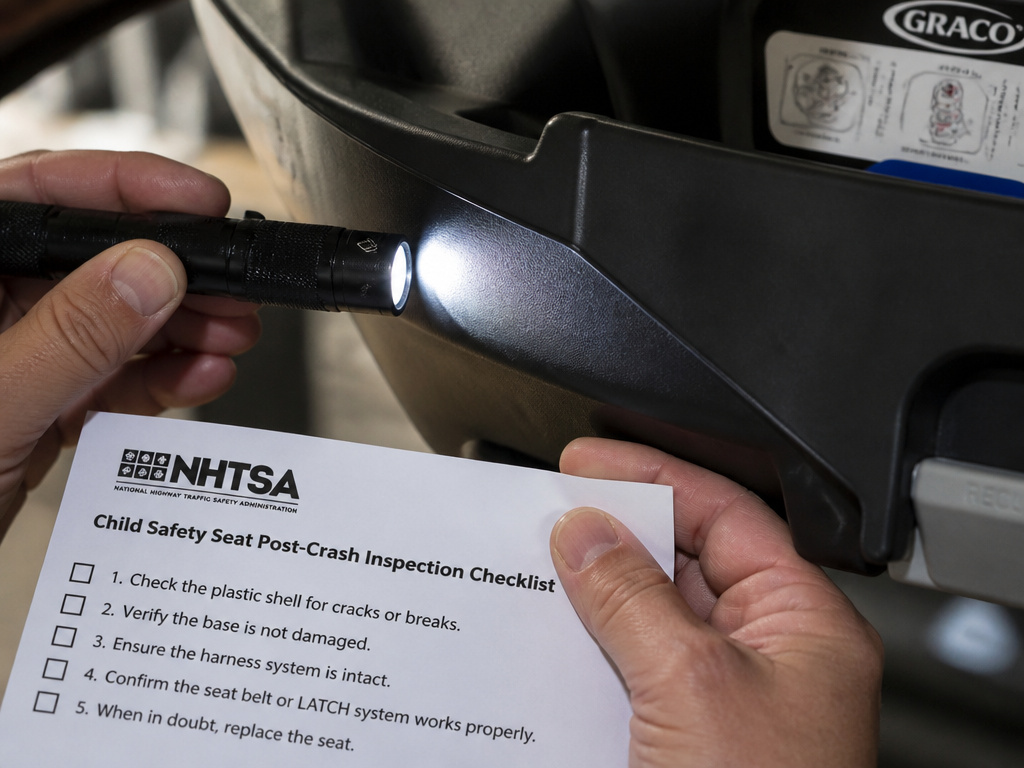
A crash replacement mandate overrides the calendar. If your base is in a moderate or severe crash, it’s done, throw it out today. The National Highway Traffic Safety Administration (NHTSA) provides a checklist for a minor crash where replacement may not be required.
All five of these must be true:
- The vehicle was driven from the crash.
- The door nearest the base was not damaged.
- No passengers were injured.
- Airbags did not deploy.
- There is no visible damage to the base.
If one condition fails, or if you’re unsure, you must replace a car seat base. The base is designed for one major energy event. Microscopic cracks in the plastic or stressed metal components won’t be visible. This is why knowing the history of a used car seat base is impossible and why expiry dates exist.
What To Do With an Expired Car Seat Base
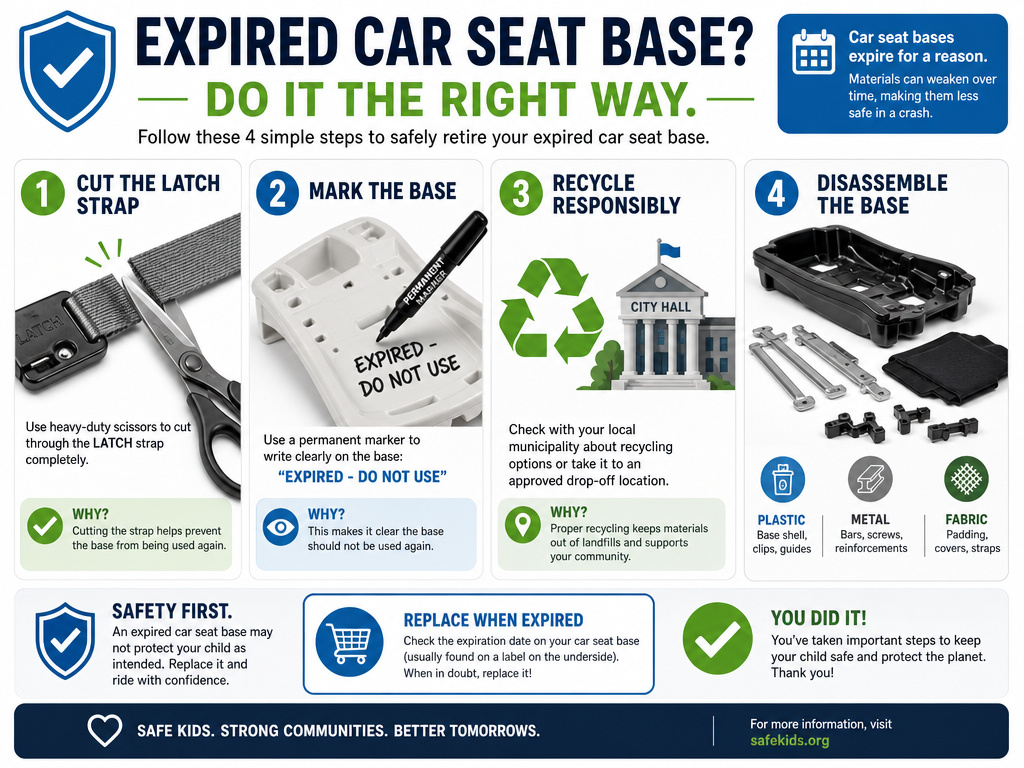
Do not donate it. Do not sell it. Do not pass it to a friend. An expired base is a liability.
The only responsible action is to render it permanently unusable. This prevents a well-meaning person from pulling it from a donation bin and trusting it.
- Cut all harness straps (if it has any) and the LATCH belt with heavy scissors.
- Use a permanent marker to write “EXPIRED – DO NOT USE” in large letters on the shell.
- Check with your local waste management for recycling programs for large plastics. Some municipalities have specific car seat recycling events.
- Disassemble it if possible, separating plastic, metal, and fabric to aid recycling.
This might feel wasteful, especially for a base that looks pristine. But its safety certification is a time-limited contract. The contract is up.
Frequently Asked Questions
Can I use an expired base in a stroller?
No. An expired base should not be used for any purpose that involves securing a child. If you want to use an infant seat as a stroller carrier, the seat itself must be within its expiry date and properly clicked into the stroller frame. The base is irrelevant for stroller use.
My base expired yesterday. Is it really unsafe today?
The change isn’t magical at midnight. The date represents the end of the tested safety margin. Think of it like a prescription medication, using it one day past expiry is probably fine, but the manufacturer cannot guarantee its efficacy or safety, and the further you go, the greater the risk. The principle you’re upholding is adherence to the certified limits. When a base expires, the safe choice is to stop using it.
Do I need a base at all?
For infant car seats, a base is not technically required for safe travel. You can securely install a car seat without a base using the vehicle’s seat belt. However, a base provides immense convenience and reduces installation errors. For daily use, most parents find a car seat base necessity is worth it. For a second vehicle, an additional car seat base is a common purchase.
How can I make my base last as long as possible?
Follow the care instructions. Keep it out of direct sunlight when not in use. Don’t clean it with harsh chemicals or submerge it. Store it indoors in a moderate climate. Never place heavy items on top of it. These steps help mitigate environmental aging, but they don’t stop the clock.
Are there any bases that don’t expire?
No. All car seat bases sold in Canada have an expiry or useful life date. It is a standard industry practice rooted in material science and liability.
Before You Go
The base of a car seat expires. The timeline is printed on it, typically 7 or 8 years from the day it was made. This rule exists because plastics fatigue, safety standards improve, and a base’s history fades. Using an expired base voids its safety certification and may break the law.
Find your label today. Do the math. If the date has passed, take it out of service and destroy it. If you’re shopping for a best infant car seat base, check the manufacture date on the box, a base that’s already been on a shelf for two years gives you less usable time. This is one area where the calendar is the boundary of a promise.
