
Can a Car Seat Be a Carry-On Item? Airline Rules Explained
This post contains affiliate links. As an Amazon Associate, we earn from qualifying purchases.
Yes, a car seat can be a carry-on item on most airlines if it is FAA-approved and fits within the aircraft seat dimensions. The critical factor is finding the phrase “certified for use in aircraft” or “approved for aircraft use” printed in the seat’s manual or on a label on the seat itself. Seats missing this explicit certification cannot be used onboard, regardless of their road safety rating.
That certification is your boarding pass. Without it, the gate agent has a solid, regulation-backed reason to send the seat to the cargo hold. The confusion starts because a seat can meet all federal standards for a car crash (FMVSS 213) and still fail the specific tests for an airplane’s different G-forces and seatbelt geometry.
You need to check three things before you even pack the seat: its aircraft certification status, its expiration date, and your airline’s specific policy on using it in an empty seat versus checking it for free. What follows is a breakdown of the exact language to look for in your manual, the hidden 7-year clock that voids most warranties and certifications, and how to navigate the gate check versus carry-on decision without getting caught at the jet bridge.
Key Takeaways
- The phrase “certified for use in aircraft” must be printed in your car seat’s manual or on a label on the seat itself for it to be allowed in the cabin.
- Most car seats expire 7 years after their manufacture date; using an expired seat voids its certification and any airline approval.
- Airlines typically allow you to use an FAA-approved car seat in an empty seat you’ve purchased, or gate-check it for free, it almost never counts against your standard carry-on baggage allowance.
- Infant seats used without their base are often the only configuration certified for flight; check your manual, as many bases are not approved for aircraft use.
- Contact your airline at least 48 hours before your flight to confirm their current car seat policy and any specific seat dimension requirements.
The Hard Floor: What the Manuals Actually Say
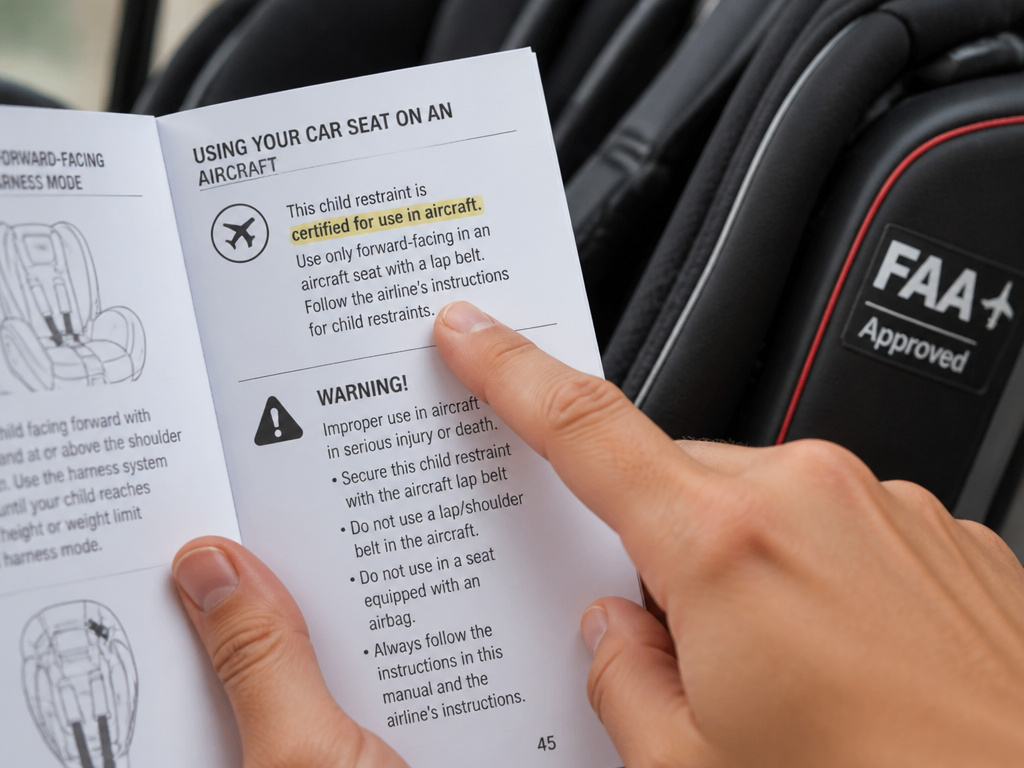
You can’t argue with a manual. While airline websites give general policies, the final authority rests with the 30-page booklet you probably tossed in a drawer. The language is precise, and missing it means a last-minute scramble at the gate.
“This child restraint is certified for use in aircraft. Use only on forward-facing aircraft seats. Follow the instructions for vehicle installation.”
That quote is from the Century Carry On manual. It’s the golden ticket. Its counterpart from the Graco Snuglock 35 LX manual is even more specific: “This child restraint is certified for use in aircraft when used without the base.” That last clause is the kind of detail that turns a planned carry-on into a gate-checked item.
The UPPAbaby Mesa Max manual states it “conforms to Canadian Motor Vehicle Restraint Systems and Booster Seat Safety Regulation (RSSR), CMVSS 213 for child restraint systems, and CMVSS 213.1 for infant restraint systems.” It then explicitly adds, “The child restraint is certified for aircraft use.” This dual-certification, road and air, is what you’re looking for.
The Federal child restraint system standard, 49 CFR § 571.213, sets the baseline for crashworthiness in motor vehicles. But it’s silent on airplanes. Aircraft certification is a separate test, and manufacturers must choose to pursue and label it. If that label isn’t there, the seat hasn’t passed.
Where to Find the Certification
Don’t rely on memory or a salesperson’s word. The proof is in one of two places:
1. A label on the seat shell. Look for a sticker near the child’s feet or on the backrest. It might say “FAA Approved” or “This restraint is certified for use in motor vehicles and aircraft.”
2. The printed manual. Search the PDF or paper booklet for “aircraft.” The statement is usually in the “Certification” or “Important Notices” section near the front.
If you can’t find it in under two minutes, assume it’s not certified. That assumption saves you from hauling a 20-pound seat through security only to be turned away.
The 7-Year Rule That Voids Everything
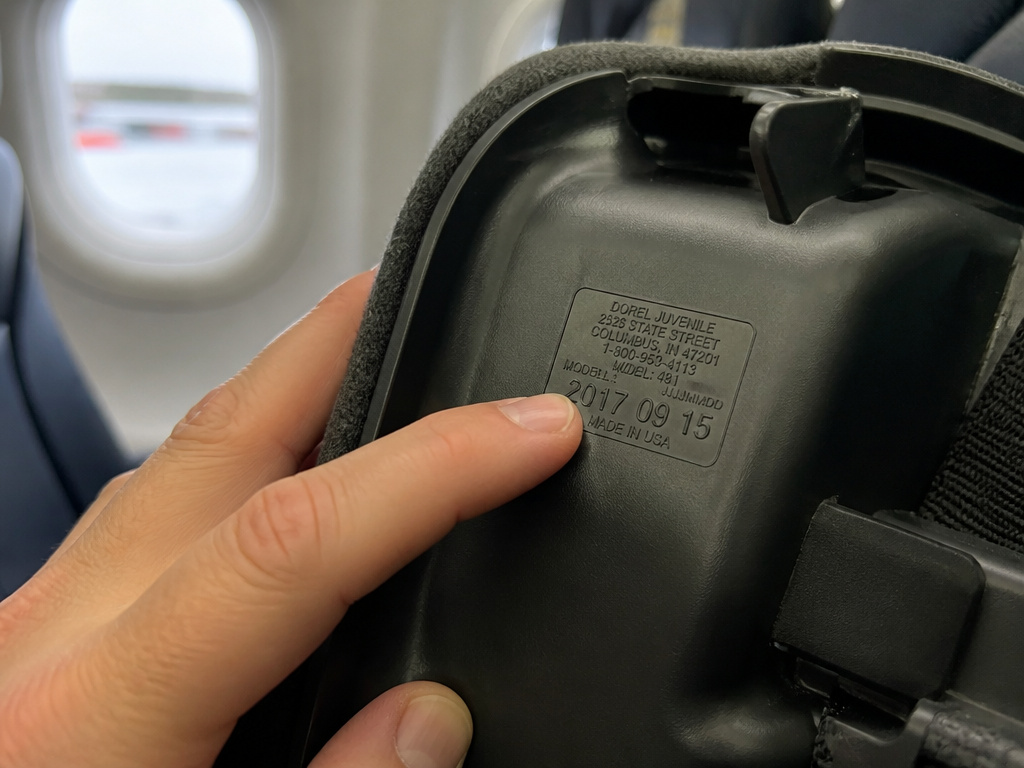
Aircraft certification isn’t eternal. Plastic degrades, harness webbing fatigues, and safety standards evolve. This is why every manual has an expiration date, and most set it at 7 years from the date of manufacture.
The Century Carry On manual is blunt: “STOP using this car seat and throw it away 7 years after the date of manufacture.” The BeSafe iZi Go Modular manual echoes it: “DO NOT use the seat for longer than 7 years. Due to ageing, the quality of the material may change.”
This isn’t a suggestion. An expired seat is considered structurally compromised. Its certification, including any aircraft approval, is void. An airline agent is within their rights, and following safety protocol, to refuse an expired seat at the gate, even if it has the “certified for aircraft use” label. The date of manufacture is stamped on a label on the seat shell; it’s the first thing a diligent agent will check.
| Car Seat Model | Aircraft Certification Language | Expiration Rule |
|---|---|---|
| Century Carry On | “Certified for use in aircraft.” | 7 years from manufacture date. |
| Graco Snuglock 35 LX | “Certified for use in aircraft when used without the base.” | 7 years from manufacture date. |
| UPPAbaby Mesa Max | “The child restraint is certified for aircraft use.” | Check manual for specific date. |
| Evenflo LiteMax NXT | Must state “certified for aircraft use” in manual. | Implied by general safety warnings. |
Common mistake: Assuming an “FAA-approved” sticker is forever. The 7-year clock starts ticking the day the seat is made, not the day you buy it. A seat that’s been sitting in a warehouse for two years gives you only five years of usable life.
The consequence of missing this is straightforward. You show up with a seat that passed the label check but fails the date check. You now have a bulky, 20-pound piece of luggage that must be checked, and you’ve lost your plan to use it onboard.
Airline Policy vs. FAA Regulation: Who Actually Decides?
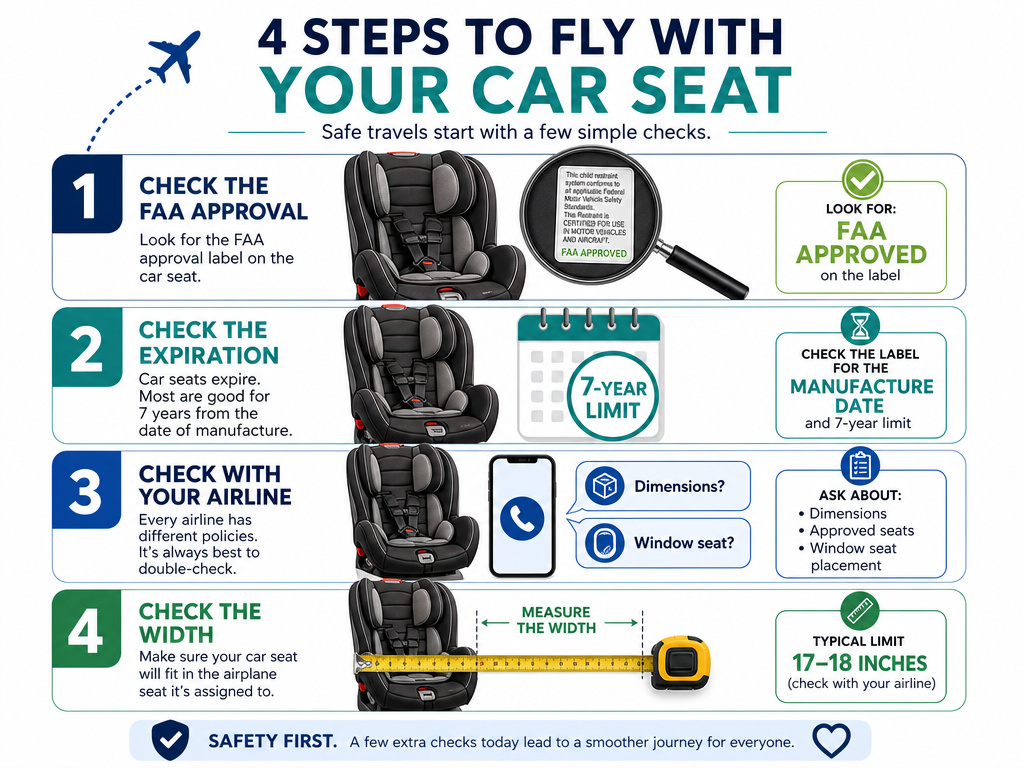
The FAA provides the baseline rule: if a car seat is FAA-approved, you may use it onboard. Individual airlines write the specific policy that determines if you will use it onboard. This distinction is where most travel plans hit a snag.
The FAA’s rule is permission. An airline’s policy is execution. Most carriers follow a standard template: the seat must be FAA-approved, it must fit in the purchased seat without obstructing the aisle or neighboring seat, and it must be installed in a window seat (never in an exit row). But the devil is in the details they don’t advertise on the homepage.
Southwest Airlines, for example, is famously generous with its family policies. Their Southwest Airlines car seat carry-on policy explicitly states that a child restraint system does not count as a carry-on or checked bag. It can be used in a purchased seat or checked for free. Other airlines mirror this, but some, like certain ultra-low-cost carriers, may have stricter width restrictions. A standard car seat is about 17 inches wide; some airline seats, especially on regional jets, are only 16.5 inches between the armrests. That half-inch is the difference between a secure install and a denied boarding.
Your verification drill is non-negotiable:
1. Find your seat’s FAA label. No label, no debate.
2. Check the manufacture date. If it’s past the 7-year mark, the label is irrelevant.
3. Call your airline. Ask two questions: “What are your exact dimensions for a car seat used in the cabin?” and “Do you require it to be in a window seat?” Get a reference number for the call.
4. Measure your seat. Width at its widest point, including any cupholders or side wings, is the critical number.
Skipping step 3 is how you end up in a standoff at the gate with a seat that’s technically approved but practically incompatible with that specific aircraft model.
Carry-On, Gate Check, or Checked Baggage?
Your car seat’s journey through the airport isn’t binary. You have three paths, and the best one depends on whether you bought a seat for your child and how much you trust baggage handlers.
Using it in the cabin is the safest option, as it’s the only way to ensure the seat isn’t thrown, crushed, or lost. This requires you to have purchased a seat for your child and for your seat to pass the airline’s fit test. You’ll install it rear-facing using the plane’s lap belt, following the same belt path you use in the car (without the base, as most bases aren’t aircraft-certified). This is where knowing how to carry a car seat through airport terminals efficiently pays off, a travel cart or a lightweight backpack-style carrier saves your back.
Gate-checking is the most common compromise. You use the seat to get to the gate, then hand it over at the jet bridge just before boarding. It’s tagged and placed in the cargo hold, but it’s the last item loaded and the first item off, reducing handling risk. It’s almost always free. This is a solid strategy if you didn’t buy a seat for an infant under 2, or if you’re unsure about the fit.
Checking it as baggage at the ticket counter is the riskiest. It goes through the main baggage system, with all the associated throws, drops, and potential loss. If you must do this, invest in a padded car seat travel bag. Some airlines will waive the checked bag fee for a car seat, but you must ask.
Where this goes sideways: Gate-checking a seat with a detachable base. You hand over both pieces, but only the seat comes back on the jet bridge. The base often goes to baggage claim, leaving you stranded at the arrival gate. The fix? Gate-check the seat, but carry the base on and stow it in the overhead bin if it fits, or check it in a dedicated, labeled bag at the ticket counter.
Your choice dictates your packing strategy. For a cabin install, you need nothing extra. For gate-checking, a sturdy travel bag is wise. For full baggage check, a padded bag is mandatory.
How to Verify and Prepare in 4 Steps
Don’t wing it. The process is mechanical, and following it removes the stress.
Step 1: Pull the manual. Download the PDF from the manufacturer’s website if you’ve lost the paper copy. Ctrl+F for “aircraft.” If the phrase “certified for use in aircraft” isn’t there, stop. Your seat cannot be a carry-on. You’re now in the gate-check or baggage-check plan.
Step 2: Find the date. Locate the manufacturing date sticker on the seat shell. Calculate the expiration date (manufacture date + 7 years). If your travel date falls after the expiration, the seat is out of compliance. Using it risks being denied at the gate and invalidates any warranty or liability protection.
Step 3: Call the airline. Do not rely on website FAQs. Speak to a representative. Confirm: 1) They accept FAA-approved seats, 2) The specific seat dimensions for your aircraft type (Boeing 737 vs. Airbus A320 can differ), and 3) That it will not count toward your carry-on baggage allowance. Get a name or case number.
Step 4: Do a dry run. Practice installing the seat in a chair at home using only a lap belt. Can you get it tight enough without the base? Does it fit within the chair’s width? This 10-minute test reveals problems you can solve in your living room, not at 30,000 feet.
Missing any step means you’re trusting luck. And airline travel has a way of converting luck into last-minute fees and frustrated sighs.
The One Thing Nobody Tells You About Warranty and Aircraft Use
The warranty fine print matters. The Besafe iZi Go Modular manual states its 24-month warranty is void if there’s “incorrect/improper use, abuse, misuse, or negligence.” It also says the guarantee expires if non-original parts are used. If you gate-check your seat and it comes back with a cracked shell from rough handling, that’s almost certainly considered “misuse” or “abuse” in the legal sense, not a manufacturing defect. The warranty likely won’t cover it.
Most manufacturers also advise against buying a seat second-hand because you can’t verify its history. This advice extends to air travel. A seat that’s been checked as baggage multiple times has endured stresses a manufacturer didn’t test for. The internal structure could be compromised without visible damage. This is a silent, unverifiable risk.
The practical takeaway is brutal but simple: if you need to rely on a car seat at your destination, never check it as baggage if you can possibly avoid it. Gate-check is better. Using it onboard is best. The packing a car seat for a flight guide becomes a damage-control manual, not a convenience tip.
Frequently Asked Questions
Does a car seat count as my carry-on bag?
Almost never. Major U.S. Airlines like Delta, American, United, and Southwest explicitly state that one FAA-approved child safety seat does not count toward your carry-on or checked baggage allowance. It’s considered a necessary child item, similar to a diaper bag. You can bring your seat plus your regular carry-on and personal item.
Can I use my car seat on the plane if I didn’t buy a seat for my baby?
No. FAA regulations and airline policies require that a child restraint system be secured in its own aircraft seat. If your child is flying as a lap infant (under 2 years old), you cannot use the car seat in the cabin. Your only options are to gate-check it or check it as baggage.
How do I know if my car seat is FAA approved?
Look for a sticker on the seat itself that says, “This restraint is certified for use in motor vehicles and aircraft.” It will also include the phrase “FAA approved” or “approved for aircraft use.” This label is required by law. If the sticker is missing or faded, check the seat’s instruction manual for a statement that says “certified for use in aircraft.” No sticker and no manual statement means it’s not approved.
Can I use the car seat base on the plane?
Most car seat bases are not certified for aircraft use. You must check the specific manual. For example, the Graco Snuglock 35 LX manual explicitly says, “This child restraint is certified for use in aircraft when used without the base. This child restraint’s base is NOT certified for use in aircraft.” Install the seat directly to the aircraft seat using the lap belt through the seat’s rear-facing belt path.
What if my car seat is too wide for the airplane seat?
Airlines have width limits, often around 16-17 inches, to ensure the seat doesn’t obstruct the aisle or the passenger next to you. If your seat is too wide, you will not be allowed to use it in the cabin. You will have to gate-check it. Always measure the width of your car seat at its widest point (usually across the base or with side impact wings) and compare it to your airline’s published dimensions before you fly.
Before You Go
The question isn’t just “can you,” but “should you.” A car seat can be a carry-on if it has the right label, is within its expiration date, and fits your airline’s seat. The label is the law, the date is the timer, and the fit is the airline’s rule. Ignore any one of those three and your carry-on plan becomes a gate-check compromise.
Verify the certification in your manual tonight. Check the manufacture date. Then call your airline with the exact seat model name. That five-minute call is cheaper than finding out at 30,000 feet that your assumptions were wrong. For the actual flight, your best bet is to use the car seat on the plane if you’ve bought a seat for your child. It’s the only way to guarantee it arrives intact and ready to use. If you can’t, gate-check it in a protective bag. Never send it into the baggage system unprotected.
