
Fire Department Car Seat Installation: Will They Help You?
This post contains affiliate links. As an Amazon Associate, we earn from qualifying purchases.
Yes, many fire departments offer free car seat installation help through certified Child Passenger Safety Technicians (CPSTs). The key is finding a station with a current CPST on duty, as not every firefighter holds the certification. You can locate one by calling 1-866-SEAT-CHECK or visiting safercar.gov.
That answer is the consensus, and it’s what you’ll find on every parenting blog. But the real question concerns what they are actually checking for when they say your seat is “safe.” The standard they use is a 2.5cm threshold, which translates to a 1-inch movement rule.That’s the line between a secure installation and one that could fail in a crash. It’s also the single most common point of failure for do-it-yourself installations.
Most people assume a firefighter will just muscle the seat tight. A certified technician follows a different script. They start with your vehicle’s manual, not your car seat’s. They look for buckle crunch, seat contour interference, and the exact angle of the LATCH strap. They know which vehicles have tether anchorages that are a nightmare to access and which car seat models have harness adjusters that bind under pressure. This article walks through exactly what to expect, how to prepare, and what to do if your local station can’t help.
Key Takeaways
- Not every firefighter is a certified Child Passenger Safety Technician (CPST); always call ahead to confirm a CPST is available.
- The universal standard for a correct installation is less than 1 inch of movement at the belt path when tested side-to-side and front-to-back.
- Always bring both your car seat manual and your vehicle owner’s manual to the appointment; technicians cross-reference both.
- Using both the seat belt and LATCH system together is almost always prohibited and can create dangerous pressure points.
- If your local fire department doesn’t have a CPST, hospitals, police stations, and health departments often host regular inspection events.
The 1-Inch Rule Every Technician Knows
You’ll hear it called the “inch test.” Pull the car seat side-to-side and front-to-back at the belt path, where the seat belt or LATCH strap routes through the car seat shell. If it shifts more than 1 inch (2.5cm) in any direction, it’s not tight enough. This isn’t a suggestion; it’s the performance standard referenced in technician manuals like the NZTA Child Restraint Technician’s Manual.
Where this goes sideways: Testing at the top of the seat back or the headrest. The car seat shell can flex, giving a false sense of movement. The force of a crash transfers through the belt path. If it’s loose there, the whole seat can pivot.
Why one inch? In a frontal crash, a loose installation allows the seat to rotate forward, increasing the forces on the child’s neck and spine. It also raises the risk of the seat striking the vehicle’s interior. A seat that moves less than an inch has effectively transferred its load into the vehicle’s structure.
How to Find a Certified Technician (It’s Not Just Fire Stations)
The National Highway Traffic Safety Administration (NHTSA) maintains a database of certified Child Passenger Safety Technicians. You find it at safercar.gov. Dialing 1-866-SEAT-CHECK (1-866-732-8243) connects you to the same resource. This is your starting point.
Fire departments are the most visible option, but they are not the only one. Hospitals, especially those with pediatric or trauma centers, frequently have CPSTs on staff. Many police departments host monthly car seat check events. Local health departments and even some AAA offices offer the service. The certification is the same; the venue is different.
Contact a certified Child Passenger Safety Technician in your area by visiting safercar.gov and select “Find Local Child Seat Help” or call 1-866-SEAT CHECK (1-866-732-8243).
The catch is availability. A station might have one certified technician who works Tuesday and Thursday days. Another might only offer checks on the first Saturday of the month. This is why you call ahead, confirm that the station offers checks, and confirm that a CPST will be present at your chosen time.
| Location Type | Pros | Cons | Best For |
|---|---|---|---|
| Fire Station | Often walk-in friendly, no appointment needed. | Technician may be on a call; not all firefighters are CPSTs. | Quick reassurance, basic installation check. |
| Hospital (Trauma Center) | Technicians often have deeper experience with special needs seats. | Usually by appointment only, may have long waitlists. | Complex cases, medically fragile children. |
| Police Department Event | Scheduled, dedicated time with multiple technicians. | Only available on specific advertised dates. | Thorough inspection with multiple opinions. |
| Health Department | Often free, focused on community outreach. | May only serve county residents, limited hours. | First-time parents, low-income assistance programs. |
What to Bring to Your Appointment (Don’t Show Up Empty-Handed)
Walk in with just the car seat, and you’ve wasted everyone’s time. A proper check requires two books and one living thing.
- Your vehicle’s owner’s manual. This is non-negotiable. The technician needs to know where your LATCH anchors are, the weight limit for those anchors, and if there are any weird rules about using the center seat. Your car’s manual dictates the rules of the game.
- Your car seat’s instruction manual. They will follow it step-by-step. They need to see the weight and height limits for your specific model, how to route the harness, and how to adjust the recline angle.
- Your child. If the child is present, the technician can check the harness fit on their body, the pinch test at the shoulder, the chest clip position, and whether the child actually fits the seat’s stated limits. If the child isn’t there, bring the child’s exact weight and height.
Forgetting the vehicle manual is the number one reason an installation takes twice as long. The technician ends up digging through their own reference materials or calling another station to look up your make and model.
The Technician’s Checklist: What They’re Actually Looking For
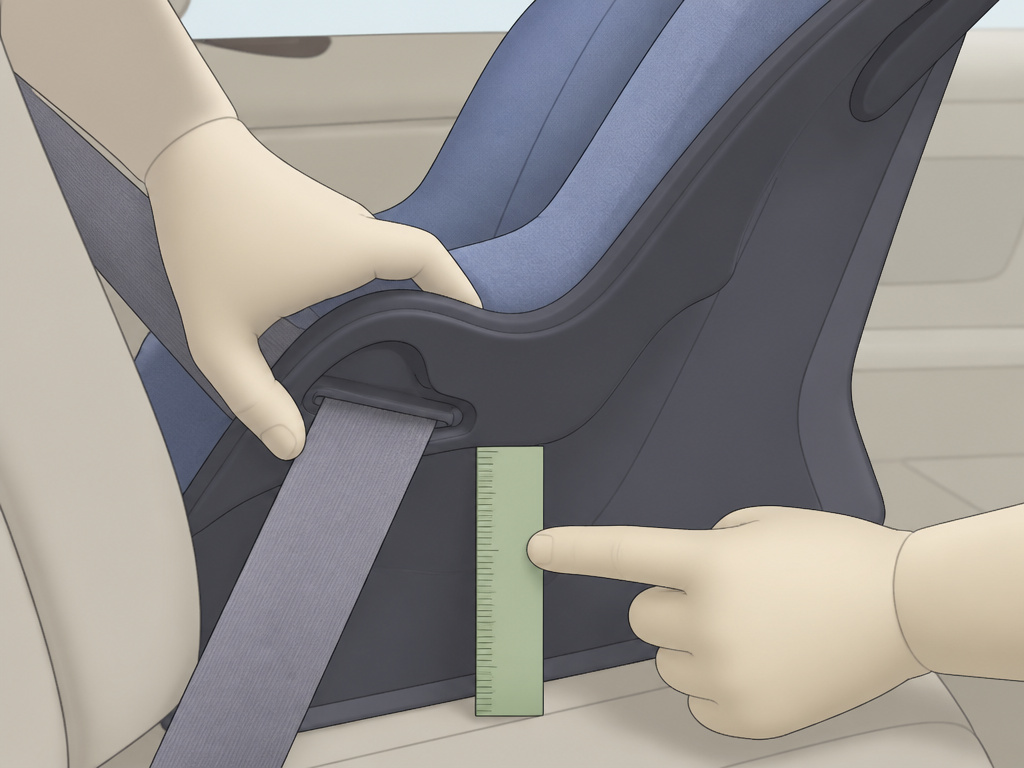
A certified check is a systematic process, not a quick tug and a thumbs-up. Here’s what happens, often in this order:
- Seat Selection & Expiry: They check the seat’s expiration date (usually stamped on the back or bottom). They confirm it’s the right seat for the child’s age, weight, and height.
- Vehicle Seat Compatibility: They inspect your vehicle seat for sharp edges, cracks, or contours that might prevent a flush fit. They’ll feel for the seat bight, the crease where the back and bottom cushions meet, to ensure the car seat base is fully seated against it.
- Installation Method: They’ll choose either the seat belt or the LATCH system based on which gives a tighter fit and follows both manuals. They almost never use both together unless both manuals explicitly allow it, a rare exception.
- The “1-Inch” Test: After tightening, they perform the movement test at the belt path. If it fails, they start over, often trying a different seating position or method.
- Harness Fit: If your child is there, they perform the “pinch test” on the harness straps at the shoulder. If they can pinch a horizontal fold in the webbing, it’s too loose. The chest clip should be at armpit level.
- Tether Use (Forward-Facing): For forward-facing seats, they will find and use the top tether anchor. This is non-negotiable. It reduces forward head movement in a crash by up to 6 inches.
Common mistake: Installing a forward-facing seat without using the top tether. The seat might pass the 1-inch test at the base, but in a crash, the child’s head can still slam into the front seat. The tether is what limits that whiplash motion.
When the Fire Department Says No (And Your Other Options)
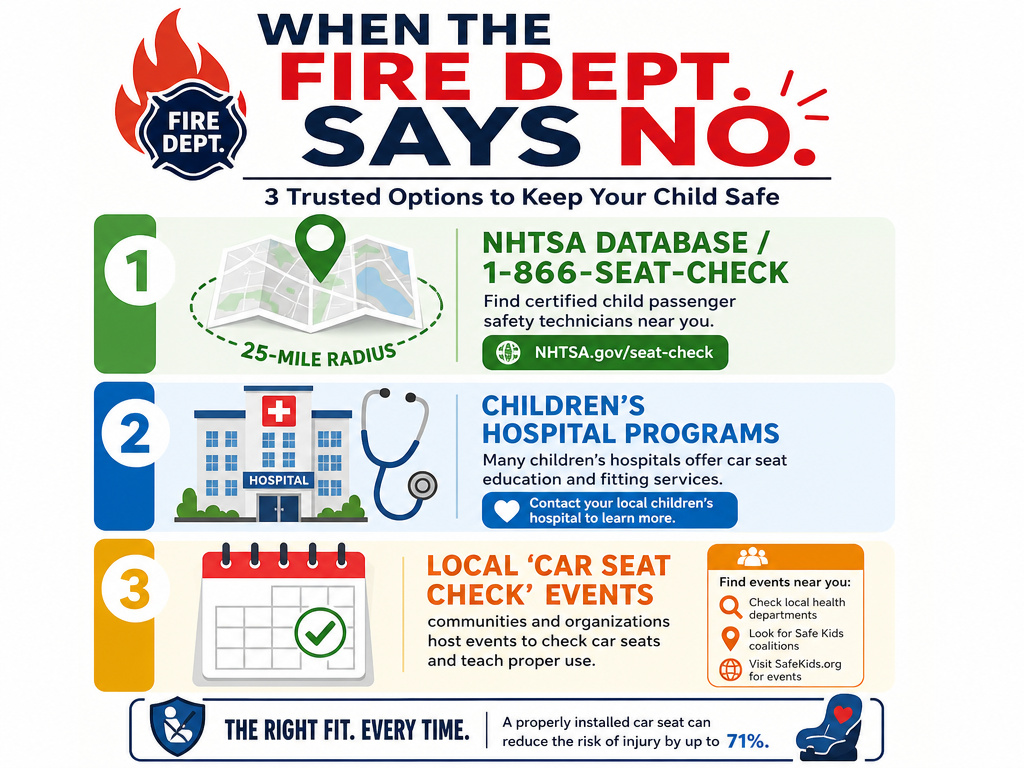
Your local station might not offer the service. Budget cuts, lack of certified personnel, or liability concerns can shut down a car seat program. If you hit a dead end, you have three clear paths.
First, go back to the NHTSA database or the 1-866-SEAT-CHECK hotline. Expand your search radius to 25 miles. A longer drive is better than an insecure seat.
Second, check with local children’s hospitals. The Cincinnati Children’s Hospital Medical Center, for example, runs a car seat assistance line at 803-RIDE (7433). These programs are often staffed by technicians who handle complex medical cases daily.
Third, look for “car seat check” events. These are often advertised by police departments, health departments, or even big-box retailers like Target or Babies”R”Us. They bring in multiple technicians for a half-day clinic. You wait in line, but you get a thorough check.
LATCH vs. Seat Belt: Which Will the Technician Choose?
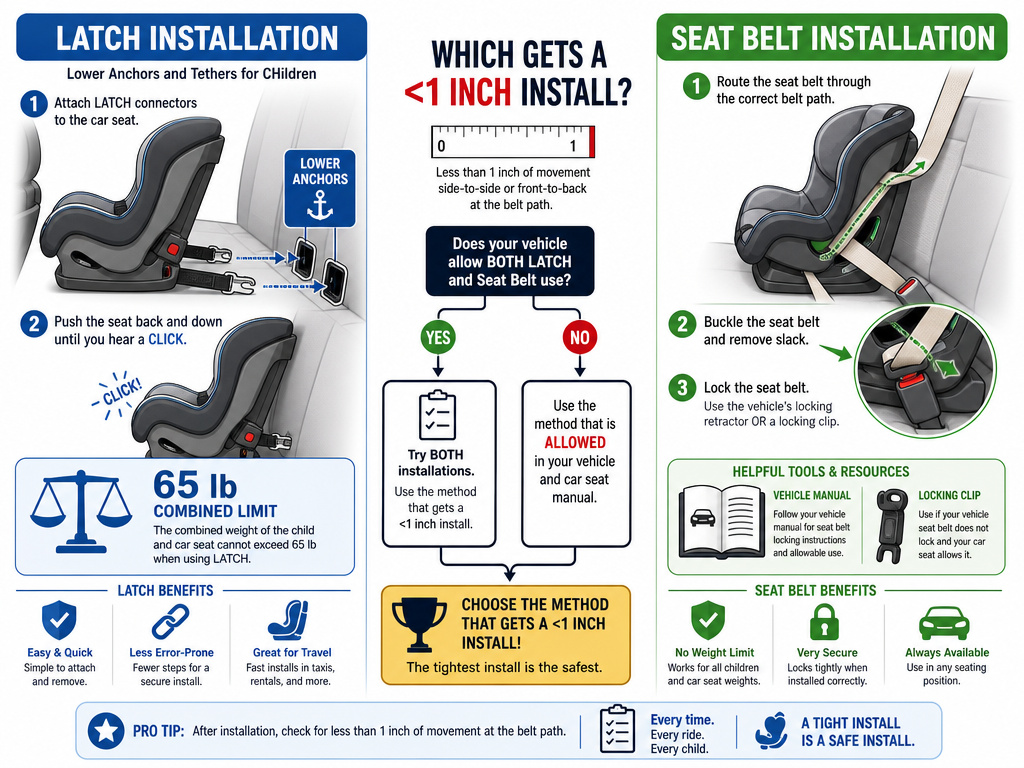
They don’t pick based on convenience. They pick based on which system gets a rock-solid, less-than-1-inch installation in your specific car with your specific seat. Here’s how they decide.
The LATCH system (Lower Anchors and Tethers for Children) is standardized in vehicles made after September 1, 1999, per FMVSS 225. It’s designed to be foolproof. But it has a weight limit, usually 65 lbs total, including the child and the seat. The technician will add your child’s weight to the seat’s weight to see if you’ve exceeded it.
The seat belt method is the universal fallback. It has no lower weight limit, but it relies on your vehicle belt’s locking mechanism. Some belts lock at the retractor, some need a locking clip. This is where your vehicle manual is critical.
| Factor | LATCH | Seat Belt |
|---|---|---|
| Weight Limit | Combined child + seat weight (often 65 lbs max). | No upper weight limit for the belt itself. |
| Ease of Use | Designed for easy, correct installation. | Can be confusing (switchable retractor vs. Locking clip). |
| Vehicle Rules | Check manual for anchor locations and weight limits. | Check manual for belt type and locking instructions. |
| Technician’s Pick | If weight limits allow and it gives a tight fit. | If LATCH weight is exceeded, or if it gives a tighter fit in that vehicle position. |
They will only use both together if both your car seat manual and your vehicle manual explicitly permit it. Using both can create conflicting force paths and overstress the seat shell. Most major brands like Chicco and Evenflo prohibit it in their manuals.
The Limits of a Fire Department Installation
A technician can ensure the seat is installed correctly today. They cannot guarantee it stays that way. Your job starts when you drive away.
- Rechecks are essential. Every time you remove and reinstall the seat, for cleaning, switching cars, adjusting the recline, you must recheck the 1-inch rule.
- After vehicle service, check the seat. If your car gets detailed, serviced, or if someone else drives it, verify the installation. It takes 30 seconds.
- Buckle crunch is a silent failure. This is when the seat belt buckle rests on the hard plastic of the car seat frame instead of fully on the vehicle seat cushion. In a crash, the buckle can snap. A good technician will spot this and move the seat to a different position.
- They won’t install an expired or recalled seat. They’ll tell you it’s unsafe and refuse to install it. They are not there to validate a dangerous decision.
The service is a snapshot. Your vigilance is the continuous film.
Frequently Asked Questions
Is car seat installation at the fire department really free?
Yes, almost always. Fire department car seat checks are a public safety service funded by grants or the department’s own budget. There is never a fee for the inspection or installation help. If someone asks for money, you are not at an official station event.
What if my car is old and doesn’t have LATCH?
LATCH was required in most vehicles starting with the 2003 model year. If your car is older, the technician will use the seat belt method. This is perfectly safe, seat belts are engineered to secure adult passengers, so they are more than strong enough for a car seat. The key is knowing whether your seat belt locks at the retractor or needs a locking clip, which your vehicle manual will state.
Can they help with an infant carrier base?
Absolutely. Installing an infant car seat base uses the same principles: less than 1 inch of movement at the belt path, correct recline angle (often indicated by a level bubble), and following both the base and vehicle manuals. Bases can be trickier because they are low-profile, making it harder to get leverage when tightening. Technicians have tricks for this, like putting their knee in the center of the base and using their body weight.
Will they tell me if my seat is expired or recalled?
Yes, that’s a core part of their job. They will check the manufacture date on the seat’s label (usually on the back or bottom) and inform you if the seat is past its expiration date, typically 6-10 years. They also have access to recall databases and will check your seat’s model number. If it’s recalled, they will tell you how to contact the manufacturer for a free repair or replacement.
What’s the difference between a firefighter and a CPST?
Any firefighter can be strong and pull a strap tight. A CPST (Child Passenger Safety Technician) has completed a 32-40 hour course, passed a written exam, and demonstrated hands-on skills with multiple seat types and vehicles. They are recertified every two years. A firefighter without this certification may not know about recent rule changes, specific seat quirks, or the nuances of your vehicle’s manual. Always ask for a CPST.
Before You Go
The promise of free help is real, but it comes with a responsibility on your part. Call ahead, bring your manuals, and understand that the technician is there to educate you, not to perform a one-time service. Their goal is to make you confident enough to reinstall the seat correctly yourself next time.
The 1-inch movement rule is the benchmark. If your seat moves more than that, it’s unsafe. Whether you use LATCH or a seat belt, the goal is the same: a solid connection between the car seat shell and the vehicle seat that leaves no room for doubt.If your local fire department can’t help, the 1-866-SEAT-CHECK line will point you to someone who can. Your child’s safety is worth the phone call.
