How to Rent a Baby Car Seat at the Airport Successfully
This post contains affiliate links. As an Amazon Associate, we earn from qualifying purchases.
Yes, you can rent a baby car seat at the airport from major car rental agencies, but a 2020 survey found 85% of parents encountered problems, from missing seats to damaged hardware. The process hinges on three specific things: confirming the seat’s availability and condition at pickup, understanding airline approval rules if you plan to use it on the plane, and knowing your legal right to a full refund if the rental company fails to deliver.
That 85% figure isn’t a vague warning. It’s a documented failure rate from a survey of 1,800 parents. It means the default assumption when you walk up to a rental counter should be that something will be wrong with the seat they provide. Your job is to know what to check for and what to do when you find it.
What follows is a breakdown of the rental landscape: the high-probability pitfalls at the rental counter, the exact airline rules that make a rental seat useless for your flight, and the emerging network of dedicated baby gear services that bypass the airport system entirely.
Key Takeaways
- 85% of parents report issues with rental car company car seats, including damaged seats, incorrect sizes, or no seat provided at all.
- Washington State law (RCW 47.04.310) guarantees a full rental refund if a paid-for child seat isn’t available within one hour of your arrival, a critical piece of leverage.
- Airlines have strict approval rules. A seat usable in a car isn’t automatically approved for the cabin; it must have specific labels (FAA or ECE R44-04/R129 with aircraft approval) and often a width under 43 cm.
- Dedicated baby gear rental services like Traveling Baby Company or Babonbo deliver inspected, age-appropriate seats to your hotel or Airbnb, often with cleaner records than rental agencies.
- Always perform a 60-second inspection before leaving the rental lot: check for recalls, damage, all parts, and that the harness adjusts snugly on your child.
The 85% Problem: Why Airport Car Seat Rentals Fail
You can reserve a seat. You can pay the daily fee. None of that guarantees the seat will be there, fit, or be safe when you arrive. The data from consumer groups paints a clear picture of systemic failure.
Common mistake: Assuming a reservation equals a guaranteed, suitable seat. In a survey of 1,800 parents who hired a car seat, 20% found no seat in the vehicle at pickup. 23% were given an incorrect size. 15% spotted missing parts, and 14% noticed damage.
The rental counter is a chokepoint. The employee handing you keys likely has zero training on child passenger safety. Their priority is turning over the car, not verifying that the Graco Convertible in the trunk is the right stage for your toddler or that its harness isn’t frayed. You become the quality control inspector.
Your inspection checklist at the counter is non-negotiable. Do not drive away until you’ve done this.
- Check for visible damage. Look for cracks in the plastic shell, fraying or cuts on the harness straps, and a functioning buckle. A bent metal buckle latch is a hard fail.
- Verify all parts are present. Is the infant insert there if you need it? Are the buckle tongues on the harness? Missing parts render a seat unsafe.
- Confirm it’s the correct type. Did you reserve a forward-facing convertible for your 3-year-old but get a backless booster? That’s an incorrect size. Refuse it.
- Do a quick fit on your child. Before installing, sit your child in the seat. The top of the harness straps should be at or just above their shoulders for rear-facing, at or just below for forward-facing.
If anything fails this check, go back inside. Your leverage is a little-known law.
Your Legal Leverage: The Washington State Refund Rule
While negotiating at a rental counter can feel hopeless, you have a powerful tool if your rental originates in Washington State. The Washington State RCW 47.04.310 statute is specific.
It states that if you pay a child restraint system rental fee and the seat is not available “in a timely manner” (defined as no more than one hour after your arrival), you may cancel the entire rental agreement without penalty and are entitled to a full refund. This law transforms the situation from a customer service complaint into a contractual breach. Mentioning this statute by name at a counter in Seattle-Tacoma or Spokane can change the outcome.
For rentals elsewhere, your power is the credit card chargeback. You paid for a seat as part of a service. If the service is not rendered, no seat, a broken seat, you have grounds to dispute the charge for that add-on.
| Rental Counter Problem | Immediate Action | Your Legal/Financial Leverage |
|---|---|---|
| No seat provided at pickup. | Go back inside immediately. Do not accept the car. | Washington State: Full refund right. Elsewhere: Dispute the seat fee. |
| Seat is visibly damaged or missing parts. | Refuse the seat. Request a replacement. | Rental agreement implies a safe, functional product. |
| Seat is incorrect type/size for child. | Refuse the seat. Show your reservation. | Failure to provide contracted service. |
| Seat is filthy or smells strongly. | Request cleaning or replacement. | Health/safety clause in rental terms. |
The table above is your decision matrix. Use it.
Airline Rules: The 43cm Width Limit
Renting a seat for your rental car is one challenge. Renting a seat you can also use on the airplane is a completely different puzzle. Most rental agency seats will not be approved for in-cabin use.
Airlines have two overarching rules: certification and dimensions. The seat must be approved for aircraft use by a recognized authority (FAA in the U.S., EASA in Europe with specific labels), and it must physically fit in the aircraft seat.
Technical Snapshot: For a child restraint to be accepted in a European Union airline cabin, it must bear two labels: the ECE R44-04 standard (with the last two digits 03 or 04 or higher) or the newer ECE R129 (i-Size) label, AND a separate qualification sign attesting to its approval for aircraft use. Seats labeled for ISOFIX/LATCH attachment are only allowed if the manufacturer’s instructions explicitly state they can also be installed using only an aircraft seat belt.
Air Premia, for example, states car seats used in the cabin must be FAA certified and have a width of less than 43 cm. That’s about 17 inches. Many standard convertible car seats are wider. The Joie i-Snug infant seat is a rare example of a compact, travel-friendly seat that meets such limits.
This is the critical gap: the bulky, all-in-one convertible seat a rental agency gives you for your SUV is almost certainly too wide for an airline seat. If your plan involves using the rented seat on the plane, you must confirm these specs with the airline and the rental agency before you book. Most agencies do not guarantee aircraft-approved seats.
The ISOFIX Aircraft Trap
You might rent a seat with ISOFIX connectors for easy car installation. That convenience vanishes on a plane.
Where this goes sideways: Relying on a seat that only installs with ISOFIX/LATCH for a flight. As ITA Airways explicitly notes, “Company aircraft are not equipped with such connecting points.” The seat is only allowed if its manual shows an alternate installation method using just the aircraft seat belt.
If your rental seat’s manual is missing, a common complaint, you cannot verify this. The flight crew will, and they will deny its use. Your backup plan collapses.
The Alternative: Dedicated Baby Gear Rental Networks
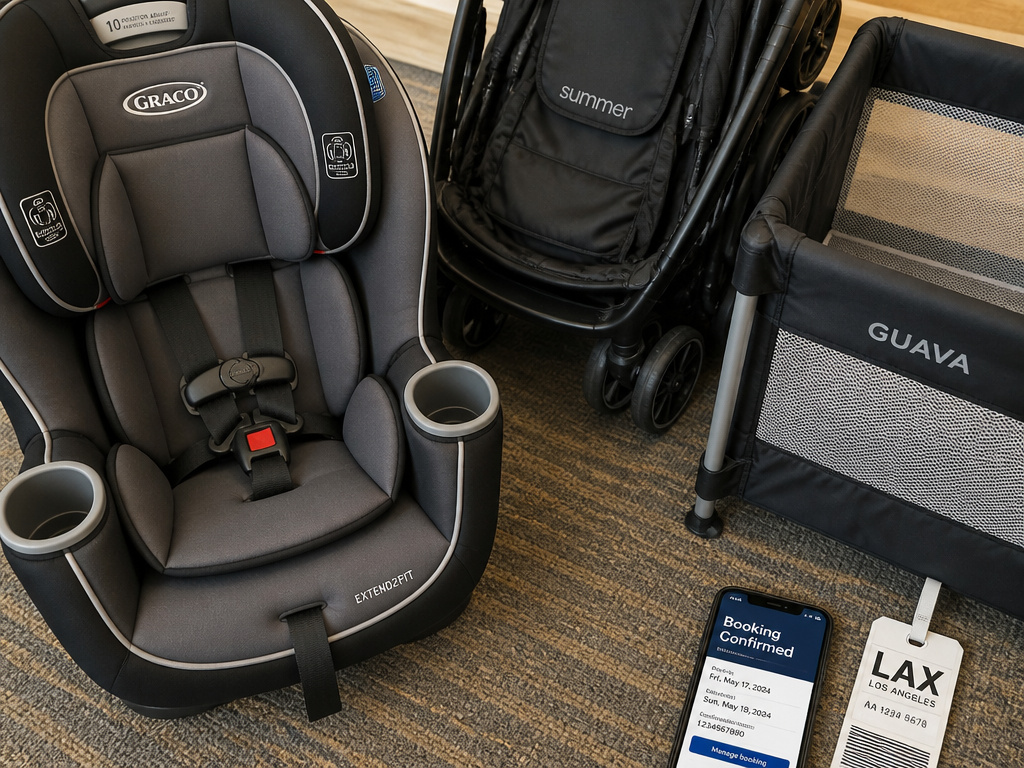
This is where the rental model gets flipped. Instead of hoping for the best at a chaotic airport counter, companies like Traveling Baby Company or Babonbo operate like specialized outfitters. You book a specific seat model online, and it’s delivered clean, inspected, and age-appropriate to your hotel, Airbnb, or even an airport meet-up spot.
The value isn’t just convenience. It’s risk reduction.
- Cleanliness and Inspection: These services sanitize and safety-check each item between rentals as a core part of their business. A rental agency treats car seats as low-priority accessories.
- Model Consistency: You can often see which model you’re renting (e.g., a Graco Extend2Fit) and read reviews from other parents. You’re choosing a product, not a mystery box.
- Bundling: Need a crib, stroller, and seat? These services offer packages. It simplifies logistics and can cost less than renting each piece separately from different vendors.
Babonbo’s model in Seoul is illustrative: local parents or shops list their gear, which is then cleaned and delivered. It turns the peer-to-peer market into a vetted service. This network is growing in major tourist destinations worldwide.
The bottom line: For a week-long vacation where you’ll need a seat every day, a dedicated service often costs the same as or less than a rental agency, with far fewer headaches. It turns a high-anxiety variable into a solved problem.
How to Choose: Airport Counter vs. Delivery Service
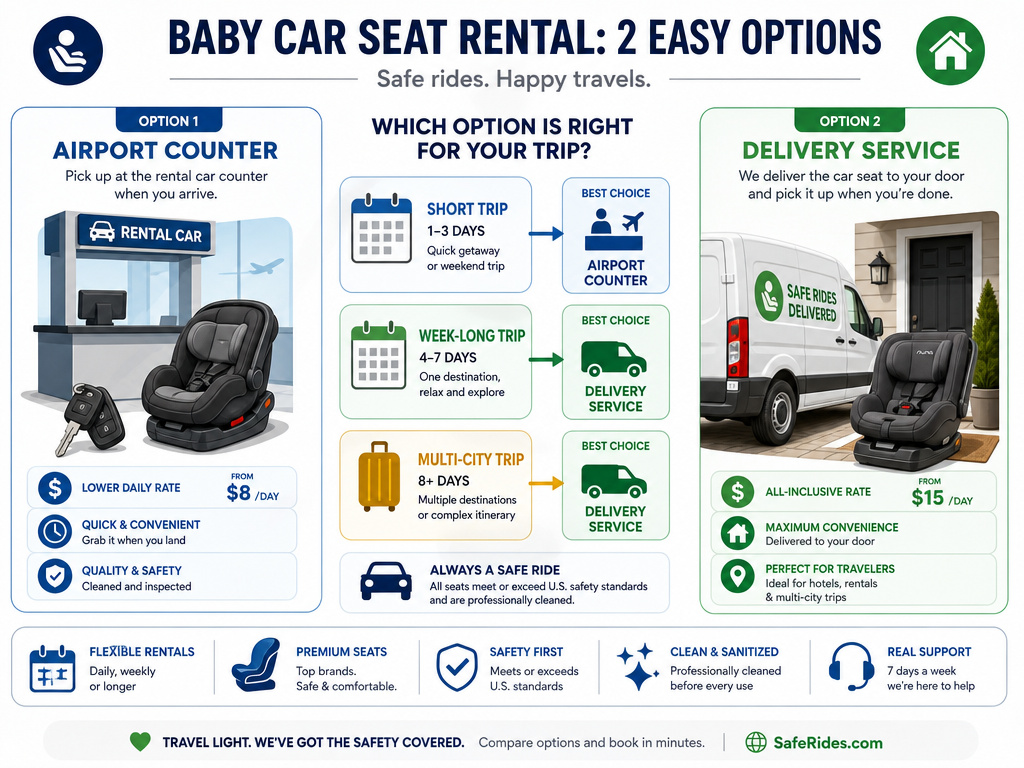
Your decision isn’t just about price. It’s about risk tolerance, trip length, and itinerary complexity. This isn’t a matter of “it depends.” For most families on a trip longer than a weekend, the delivery service wins.
| Scenario | Best Option | Why |
|---|---|---|
| Short trip (1-3 days), airport pickup/drop-off. | Rental Agency (with vigorous inspection). | The daily fee is bearable for a short period. The convenience of airport pickup can outweigh the risk. |
| Week-long vacation, hotel or Airbnb stay. | Dedicated Baby Gear Service. | Lower total cost, guaranteed condition and model, delivery to your door eliminates a travel leg. |
| Need seat for both flight and destination car. | Bring Your Own or Purchase Locally. | Finding a single seat that meets airline and rental car needs is extremely difficult via rental. |
| Traveling to multiple destinations/cities. | Dedicated Service (if available) or Bring Your Own. | Coordaging multiple pickups/drop-offs with a rental agency is a logistical nightmare. |
If you do go the rental agency route, your single most important task is mastering the art of the car seat transport through the airport to the rental facility. Having a plan to carry a car seat through terminals and onto shuttle buses is what makes the agency option physically possible. A lightweight travel cart can be a better investment than a week of rental fees.
Before You Go: The Inspection You Cannot Skip

No matter which path you choose, the final safety check is yours. Transport Canada provides a clear, physical metric: a properly installed car seat should move less than 2.5 cm (1 inch) in any direction at the belt path. If you can shove it side-to-side or forward, it’s not tight enough.
Your process for a rental car seats should mirror this rigor. Install it yourself. Use your knee to press down into the vehicle seat while you tighten the belt or lower anchors. Pull the harness snug, if you can pinch a vertical fold of the strap between your fingers, it’s too loose.
This isn’t bureaucratic box-ticking. It’s the difference between a restraint system that holds during a sudden stop and one that becomes a projectile. The rental company’s liability waiver doesn’t protect your child. Your diligence does.
Frequently Asked Questions
Can I rent a car seat at the airport without renting a car?
Sometimes, but it’s rare and unreliable. Major rental agencies are in the business of renting cars; the seat is an add-on. Dedicated baby gear rental services are built for this exact scenario, they will deliver a seat to the airport for use in a taxi, rideshare, or shuttle. Always book this service well in advance.
Are rental car seats clean?
You must assume they are not thoroughly sanitized between users. Rental agencies clean the interior of the car; the car seat is an afterthought. Reports of stains, crumbs, and smells are common. Carry sanitizing wipes and, if possible, a lightweight seat cover. Dedicated rental services prioritize cleanliness as a selling point.
What if my rented car seat is recalled?
This is a serious, often overlooked risk. Rental companies are not required to proactively check for recalls on their fleet of seats. Before using any rented seat, check the model name, number, and manufacture date on its labels. Visit the NHTSA website or the manufacturer’s site to verify it hasn’t been recalled. If it has, demand a different seat immediately.
Is it cheaper to rent a car seat or check my own?
For trips longer than 4-5 days, renting often costs more than a checked bag fee. Airlines typically check car seats for free. The calculation changes if you value not lugging your seat through airports, that convenience has a price. For very short trips, renting can be cheaper than risking damage to your own seat in baggage handling.
Can I use any car seat on an airplane?
No. The seat must be certified for aircraft use. In the U.S., look for a label that says, “This restraint is certified for use in motor vehicles and aircraft” in red lettering. Booster seats, backless or high-back, are never approved for aircraft use because they require a shoulder belt, which airplane seats lack. Always confirm with your specific airline at least 48 hours before your flight.
The Bottom Line
You can rent a baby car seat at the airport, but you should plan for it to go wrong. The 85% problem rate means your default setting is skepticism. Your power lies in three actions: knowing your inspection checklist, understanding the specific airline rules that make most rental seats unusable in the air, and exploring the alternative network of dedicated baby gear rentals that deliver what the airport counters often cannot, a clean, correct, and ready seat.
For a short trip where you’ll pick up and drop off at the same airport location, a rental agency seat can work if you inspect it ruthlessly. For any other scenario, a week at a beach house, a multi-city tour, or a flight where you need the seat, look past the airport counter. The safer, saner answer is usually waiting for you at your final destination.
