Does Enterprise Rent Infant Car Seats? How to Reserve Yours
This post contains affiliate links. As an Amazon Associate, we earn from qualifying purchases.
Yes, Enterprise Rent-A-Car does rent infant car seats, but it’s a location-by-location service you must reserve in advance. Their online booking system will show availability for your specific rental branch, and they stock models like the Safety 1st 22-323 and the Cosco Scenera 22-160. The critical detail is that you, the renter, are solely responsible for installing it correctly and ensuring it fits your child. Enterprise employees are prohibited from handling or installing the seat.
That self-installation clause is the line between a checked box and a safe child. You’re renting a piece of plastic and webbing, not a certified installation. The manual is in the box, the LATCH anchors are in the car, and the rest is on you.
What follows is a breakdown of the exact models Enterprise stocks, their weight and height limits, the step-by-step process to secure one, and the documented gap between what you book online and what you might actually find at the counter.
Key Takeaways
- Enterprise’s infant car seat inventory is branch-dependent. Booking online doesn’t guarantee the specific seat you need will be physically present at pickup.
- You are legally responsible for installing the rented seat correctly. Enterprise staff cannot touch it.
- The Safety 1st 22-323 rear-facing infant seat is for babies 5-22 lbs and 19-22 inches tall. The Cosco Scenera 22-160 convertible seat handles rear-facing from 5-35 lbs.
- Always call the rental branch directly after booking to confirm the seat is physically reserved and matches your child’s specs.
- Have a backup plan. If the seat is wrong or missing, you may need to buy one locally.
What Models Does Enterprise Rent?
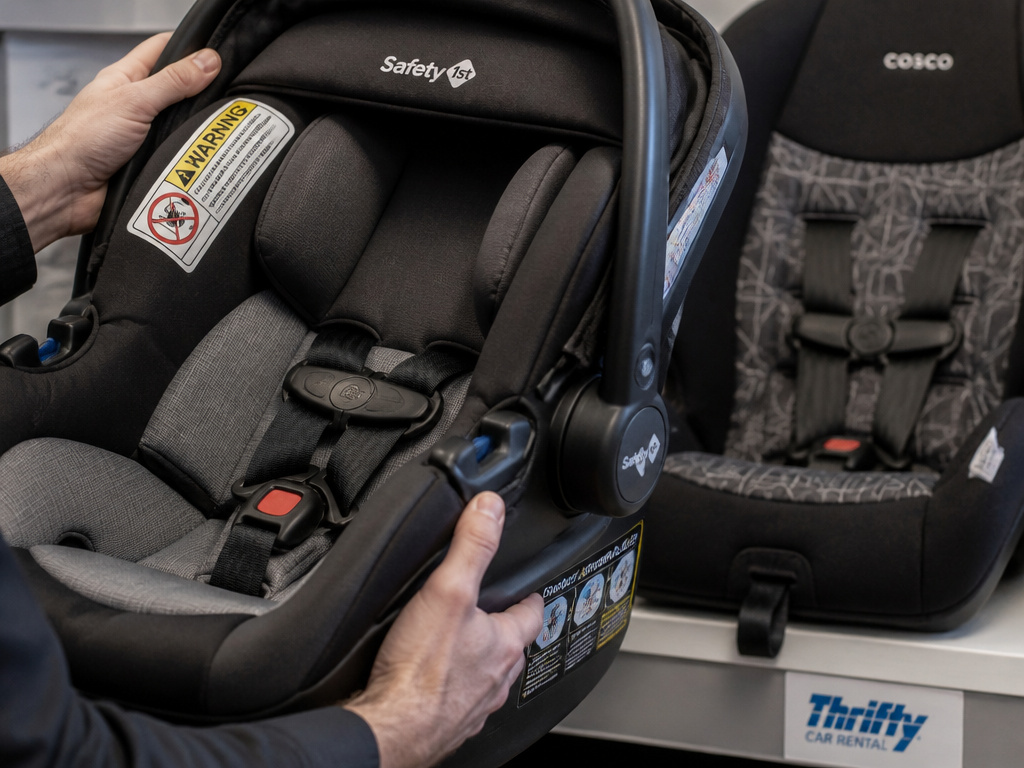
Enterprise doesn’t stock one universal infant seat. Their fleet is a mix of infant-only carriers and convertible seats, and which one you get depends entirely on what that specific branch has on the shelf that day. Two models appear consistently in their materials: the Safety 1st 22-323 for newborns and the Cosco Scenera 22-160 convertible.
The Safety 1st 22-323 is a rear-facing-only infant carrier. It’s designed for the smallest passengers: 5 to 22 pounds and 19 to 22 inches tall. This is a take-along seat with a handle, the kind you click into a base that stays in the car. It’s the default pick for a newborn.
The Cosco Scenera 22-160 is a convertible seat. It installs rear-facing for infants and toddlers (5 to 35 pounds) and can later flip forward-facing for older children (22 to 40 pounds). If your child is over 22 lbs but still needs rear-facing, this is what Enterprise should provide.
The part nobody mentions: The Scenera is a budget seat, and its rear-facing height limit is lower than many premium convertible seats. A tall 30-pound toddler might outgrow it rear-facing before they hit the weight limit.
Here’s the breakdown of what you’re likely to encounter:
| Model | Type | Rear-Facing Limits | Forward-Facing Limits | Best For |
|---|---|---|---|---|
| Safety 1st 22-323 | Infant Carrier | 5 – 22 lbs, 19 – 22 in | N/A | Newborns up to ~1 year |
| Cosco Scenera 22-160 | Convertible | 5 – 35 lbs | 22 – 40 lbs | Infants & toddlers 1-3 years |
| Cybex Cloud G Pro (Common at other agencies) | Infant Carrier | 4 – 30 lbs, < 32 in | N/A | Newborns up to ~18 months |
You won’t find a Cybex Cloud G Pro at Enterprise, that’s more common at agencies like Avis and Hertz. Enterprise’s inventory leans toward the simpler, more cost-effective models. The takeaway is simple: you must know your child’s current weight and height, not just their age, before you book.
How to Reserve an Infant Car Seat with Enterprise
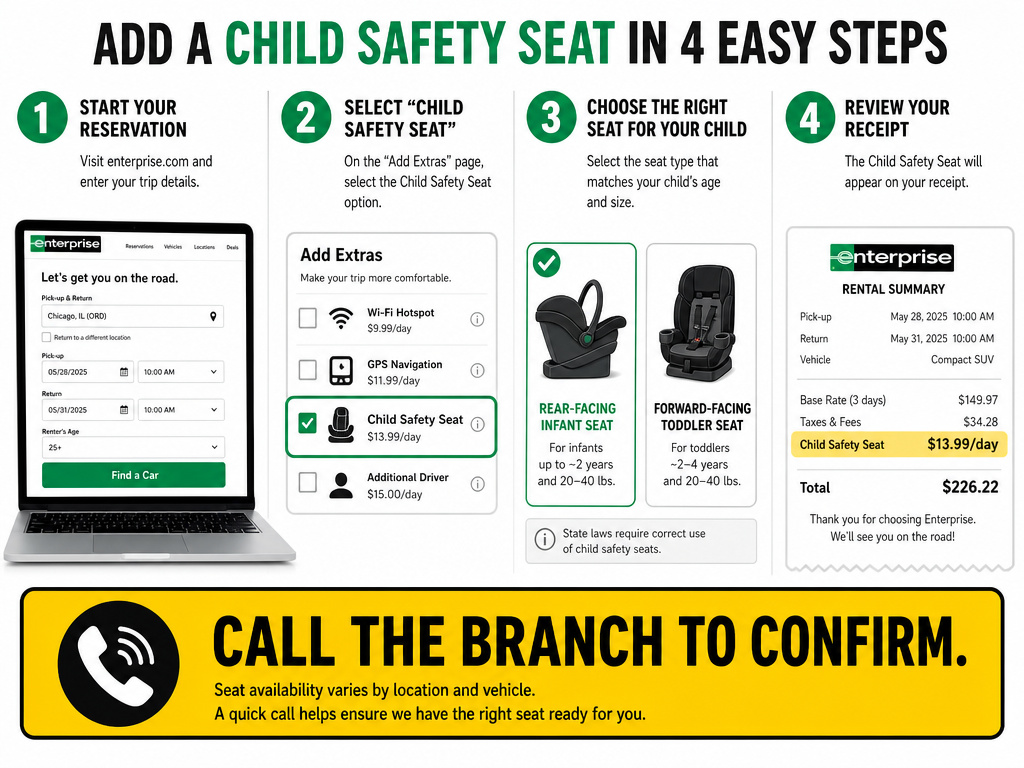
The reservation process is straightforward, but the confirmation is not a guarantee. You do this online when you book the car.
- Start your reservation on the Enterprise website. Enter your location, dates, and vehicle class.
- On the “Extras” or “Rental Options” page (usually after selecting the car), look for “Child Safety Seat” or “Infant Seat.”
- Select the seat type you need. The site should specify “infant” versus “toddler” or “booster.”
- The daily fee (often around $13.99) will be added to your total. There’s typically a weekly cap.
Stop here. The biggest mistake is thinking the online booking is the finish line. It’s not.
Common mistake: Assuming the online reservation guarantees the seat will be there. The website shows system availability, not physical inventory at the branch.
Your next step is non-negotiable. You must call the specific rental location you’re picking up from. Do this a day or two after booking. Ask them two questions: “Do you have the infant car seat I reserved physically set aside for me?” and “Can you confirm it’s the rear-facing model for a child under [your child’s weight]?” If they hesitate, you have your answer, the seat isn’t reserved. This is when you enact your backup plan.
The Self-Installation Rule and Why It Matters

Enterprise’s official policy, stated clearly in their FAQ, is that customers must install child seats themselves. Employees are prohibited from assisting due to liability. They will hand you the seat in its box, likely with the instruction manual still attached, and point you to your car.
This shifts all responsibility to you. You are now the installer, the inspector, and the liable party. The manual is your only guide, and the car’s seat belt or LATCH system is your only tool.
Before you start: An improperly installed car seat can fail in a crash. The seat should not move more than 1 inch (2.5 cm) side-to-side or front-to-back at the belt path. A loose installation is the most common and dangerous error.
The process isn’t complicated, but it is precise. For a rear-facing infant seat with a base, you’ll either use the vehicle’s LATCH anchors (the metal bars between the seat back and cushion) or the seat belt. The LATCH system is simpler and less prone to user error. Pull the connector straps tight until there’s no slack, then press down firmly on the seat base while tightening further. You should feel the car seat compress the vehicle seat cushion. That’s the tight fit you need.
If you’re using a seat belt, thread it through the designated belt path on the car seat (the manual has a diagram), buckle it, and then lock the seat belt. Most cars have a switchable retractor, pull the belt all the way out until it clicks, then let it retract to lock. Cinch it tight. Again, test for that 1 inch of movement.
For a detailed walkthrough, our guide on installing a Safety First car seat covers the exact steps and common pitfalls.
What If They Don’t Have the Right Seat?
This is the scenario most articles don’t cover, but it happens. You arrive after a long flight, the rental counter is busy, and they hand you a booster seat for your 30-pound toddler. Your child is 10 pounds under the booster’s minimum weight. The agent shrugs. They have nothing else.
A real traveler reported this exact situation at a small regional French airport with Enterprise. They had booked a toddler seat, were given a booster, and had to purchase a correct car seat locally for 138 euros. No other rental desks were open.
Your defense is the pre-trip phone call. If that fails, your options are brutal but clear:
1. Refuse the rental and find another agency at the airport (if any are open).
2. Purchase a seat from a nearby store. Walmart, Target, or a local baby store will have a Cosco Scenera for under $60.
3. Use a travel service that delivers a seat to your destination.
This is why knowing how to travel with a car seat is a more reliable skill than relying on rental inventory. Bringing your own, checked in a protective car seat travel bag, guarantees the right fit and familiar installation.
Enterprise vs. Avis: How Their Policies Compare
Enterprise isn’t the only game in town. Avis, for example, has a more structured program. They’ve standardized on Evenflo seats across their U.S. Fleet and explicitly support the LATCH installation system. Their website clearly states a cost, usually $13.99 per day, and allows you to add the seat during online booking.
The core difference is transparency. Avis publishes their daily rate and seat type; Enterprise’s information is sparser and buried in regional FAQ pages. Both, however, operate on the same fundamental rental-car logic: inventory is local, and what you book is a request, not a reservation.
| Aspect | Enterprise | Avis |
|---|---|---|
| Seat Models | Safety 1st 22-323, Cosco Scenera 22-160 | Evenflo models (e.g., Everyfit 3-in-1) |
| Daily Cost | ~$13.99 (varies) | ~$13.99 (stated) |
| Installation | Customer responsibility | Customer responsibility |
| Online Clarity | Low (info in FAQ) | High (clear product page) |
| LATCH Support | Implied (vehicle-dependent) | Explicitly stated |
The bottom line is the same: you are the installer. The rental fee buys you the hardware, not the expertise. Whether you’re looking at airport car seat rental options from Enterprise, Avis, or anyone else, the workflow is identical: book online, call to confirm, inspect on arrival, and install it yourself.
Special Considerations for Newborns and Preterm Infants
Renting a seat for a newborn introduces another layer of caution. The American Academy of Pediatrics (AAP) has specific guidelines for preterm and low-birth-weight infants (born earlier than 37 weeks or under 5 lbs). They recommend a 90- to 120-minute observation period in the car seat before discharge to monitor for breathing difficulties.
Both the Cybex Cloud G Pro and Evenflo Everyfit manuals cite this AAP guideline. The car seat must be at the correct recline angle, usually indicated by a level line, to prevent the infant’s head from flopping forward and restricting airways.
If you’re renting for a newborn, especially one with any medical considerations, a generic rental seat might not be the best choice. You have no history with that specific seat, its wear, or its condition. For a trip home from the hospital, using your own, professionally fitted seat is the gold standard. For a vacation, if your child falls into this category, reconsider the rental path altogether.
Your Backup Plans Are More Important Than the Reservation
Relying solely on a rental car seat is a gamble. Have a Plan B and a Plan C.
Plan B: Bring Your Own. Check it at the gate or as baggage. Use a sturdy bag for checking a car seat to protect it from dirt and damage. Airlines don’t charge for car seats or strollers. You know its history, its installation, and it fits your child.
Plan C: Use a Delivery Service. Companies like Baby’s Away, Rent-A-Car Seat, or even some local baby stores will deliver a cleaned, inspected car seat to your hotel or rental house. You pay more, but you get a specific model you can research in advance.
Plan D: Buy Upon Arrival. As a last resort, a big-box store like Walmart or Target sells basic, safe convertible seats like the Cosco Scenera for around $50. It’s an added cost, but it’s yours to keep or donate at the end of the trip.
The goal is to never be forced into Plan D at 10 p.m. In a strange city. A quick call to the rental branch after you book tells you which plan you’ll actually need.
Frequently Asked Questions
Does Enterprise charge for infant car seats?
Yes, Enterprise charges a daily fee for car seat rentals, typically around $13.99 per day. There is usually a maximum weekly charge. This fee is added to your total rental cost when you reserve the seat online.
Can I guarantee I’ll get an infant seat and not a convertible?
No. Enterprise’s online booking system typically only distinguishes between “infant” and “child” seats. An “infant” reservation should yield a rear-facing carrier like the Safety 1st 22-323, but final inventory is at the branch’s discretion. Calling the pickup location is the only way to try to confirm the exact model.
What if my child is between seat sizes?
This is the most common problem. If your child is 23 pounds, they’ve outgrown the Safety 1st infant carrier but might still need rear-facing. Enterprise should provide a convertible seat like the Cosco Scenera. You must know your child’s current weight and height and specify “rear-facing convertible seat” when you call to confirm.
Is it safer to bring my own car seat?
Generally, yes. You are familiar with its installation, you know its history (no unseen accidents or damage), and it’s guaranteed to fit your child. The main advantage of renting is not having to carry it through the airport. The trade-off is uncertainty and a seat you’ve never installed before.
What about car seat expiration?
All car seats have an expiration date, typically 6-10 years from manufacture. Rental companies are supposed to cycle out expired seats, but it’s a good practice to check the date on the seat you’re given. Look for a label with the manufacture date or the explicit expiration date. For more on this, see our guide to car seat expiration.
The Bottom Line
You can rent an infant car seat from Enterprise, but you’re renting a piece of hardware, not a service. The seat might be a Safety 1st 22-323 or a Cosco Scenera 22-160. You are responsible for installing it, and the branch you pick up from is responsible for having it.
The system is built on assumption, they assume the seat type you clicked online matches what’s in their storage room. You cannot make that assumption. Your single most important task is that follow-up phone call to the rental desk. If the agent sounds unsure, start working on your backup plan immediately. For most families traveling with an infant, the peace of mind that comes with using your own, familiar seat or a reserved delivery service is worth far more than the $13.99 daily rental fee.
