
How to Recycle a Used Infant Car Seat | Step-by-Step Guide
This post contains affiliate links. As an Amazon Associate, we earn from qualifying purchases.
To recycle a used infant car seat, you must first verify it is expired, recalled, or crash-damaged, then completely disassemble it. Follow the manufacturer’s specific instructions, like those in the Evenflo REVOLVE 180° LITEMAX NXT manual: remove all fabric and padding, take out screws, and separate plastic, metal, and foam. Recycle each material stream where accepted locally. If recycling isn’t available, destroy the shell to prevent unsafe reuse.
That disassembly clause is the whole game. A car seat isn’t a single item to a recycling facility; it’s a composite of plastics, metals, foam, and fabric that must be separated. The manual’s steps exist because garbage workers won’t do it for you, the time cost is too high, and mixed materials contaminate recycling streams.
What follows: the three conditions that mandate recycling, the exact five-step takedown, where to take the pieces, and what to do when your town has no program. By the end, you’ll know how to strip a seat to its components and ensure it never gets reused unsafely.
Key Takeaways
- Expiration is non-negotiable. Plastic becomes brittle and loses protective capacity, typically after 6–10 years. The date is stamped on the shell.
- Disassemble completely. Simply placing a whole seat in a bin guarantees it goes to landfill. You must separate plastic, metal, foam, and fabric.
- Crash damage is often invisible. A moderate or serious collision, even with an empty seat, can compromise the shell’s integrity. Replace it.
- Always check for recalls. Use the model number and manufacture date to verify against the CPS technician recall list PDF. Missing stickers mean assume all recalls apply.
- Destruction is a valid last resort. If no recycling program exists, physically break the plastic shell with a tool like a sledgehammer and mark it “NOT FOR USE.”
The 3 Conditions That Demand Recycling
A car seat reaches its end of life for one of three concrete reasons. Passing one is a hard stop, the seat cannot be donated, sold, or used again.
It has passed its expiration date. This isn’t a marketing ploy. The polymers in the plastic shell degrade from UV exposure, temperature swings, and general stress. They become brittle. In a crash, a degraded shell is more likely to crack or shatter rather than absorb and distribute force. Most seats expire 6 to 10 years from their manufacture date. Find the stamp molded directly into the plastic, usually on the back or bottom.
It was in a moderate or severe crash. The Consumer Reports seat retirement guide defines this as any accident that caused injuries, deployed airbags, or required the vehicle to be towed. The forces involved can create micro-fractures in the shell or compromise the harness anchor points. These defects are invisible. An unoccupied seat isn’t safe either, the crash energy still travels through the vehicle frame into the seat’s structure.
It is under an unrepaired recall. Recalls range from minor harness adjustments to critical shell defects. You must check. Use the seat’s model number and manufacture date against the current NHTSA recall and parts list. If the date sticker is missing or illegible, the safest assumption is that all possible recalls apply. Never guess with your child’s safety.
Common mistake: Assuming a seat is fine after a minor fender-bender. The official guidance is clear: if the crash met the moderate/severe criteria, the seat is compromised. The hidden damage won’t show up until the next impact.
The 5-Step Disassembly Method
Recycling starts in your garage with a set of screwdrivers and about 30 minutes. The goal is to turn one complex object into four simple material streams.
Step 1: Remove the fabric cover and padding. Unhook or unzip the seat cover according to your model’s manual. For the Evenflo REVOLVE 180° LITEMAX NXT, this involves detaching the buckle strap first. Pull out all foam inserts. This fabric and foam often cannot be recycled curbside, check local rules.
Step 2: Cut all harness straps. Use heavy-duty scissors or a utility knife. Slice the shoulder straps, lap straps, and chest clip strap into several pieces. This step is critical for preventing someone from retrieving and reusing a compromised harness. Do not just unbuckle it.
Step 3: Unscrew and separate the plastic shell. Flip the seat over and remove every screw connecting the base to the carrier, the handle, and any recline mechanisms. The plastic shell is usually #5 polypropylene. Keep it in the largest pieces possible, some facilities have minimum size requirements.
Step 4: Isolate metal components. This includes the steel reinforcement bar, the LATCH connectors, the harness adjuster mechanism, and any metal brackets. These are typically steel or aluminum and are widely recyclable.
Step 5: Sort and bag. You should now have four piles: plastic shell pieces, metal parts, fabric/cover, and foam padding. Bag them separately. This separation is what makes recycling your infant seat possible for municipal facilities.
| Component | Material | Recyclable? | Notes |
|---|---|---|---|
| Plastic Shell | #5 Polypropylene | Often, if clean | Check local facility for acceptance of large rigid plastics. |
| Metal Frame & Brackets | Steel / Aluminum | Yes | Remove from plastic; place in metal recycling. |
| Harness Straps | Nylon/Polyester | Rarely | Must be cut to deter reuse; usually landfill. |
| Foam Padding | Expanded Polystyrene (EPS) | Sometimes | Some specialty foam recycling exists; call ahead. |
| Fabric Cover | Polyester Blend | Rarely | Can sometimes be recycled as textiles if perfectly clean. |
Where to Recycle or Destroy the Seat
Your local options fall into a hierarchy. Start at the top and work down until you find a solution.
1. Municipal Curbside or Drop-Off Recycling. Call your city’s waste management department. Ask: “Do you accept disassembled car seat parts, specifically large rigid plastic (#5 PP) and separated metal?” Some do, some don’t. The Florida OPRC child seat recycling guide notes that plastic and metal can often go in standard bins, but pads and straps cannot.
2. Retailer Trade-In Events. Major retailers like Target and Walmart occasionally host car seat trade-in events, often around Earth Day. You bring the whole seat, and they handle the recycling through a partner. You might get a coupon toward a new purchase. These are not year-round.
3. Specialized Recycling Facilities. Search for “car seat recycling near me” or “plastic recycling center.” Some private facilities specialize in hard-to-recycle items. Be prepared to pay a small fee.
4. Physical Destruction and Landfill Disposal. This is the last resort when no recycling exists. The official safety recall publication is blunt: “Break it with a sledgehammer, crush it, or take it completely apart and mark it ‘not for use as a safety seat’ before throwing it away.”
Where this goes sideways: Putting a whole, intact seat in your trash. It looks usable. Someone may pull it from the dumpster and use it for their child, thinking they’ve found a score. That seat could be expired, recalled, or cracked. You are responsible for making it unusable.
How to destroy a seat safely:
- Take the disassembled plastic shell outside.
- Use a sledgehammer, axe, or powerful drill to break the shell into several pieces.
- Clearly write “DO NOT USE – UNSAFE” or “EXPIRED” in permanent marker on multiple pieces.
- Place all pieces and the cut straps into a sealed, opaque trash bag before disposal.
This final step ensures the car seat recycling chain ends with you, not with another child at risk.
What Not to Do With an Old Seat
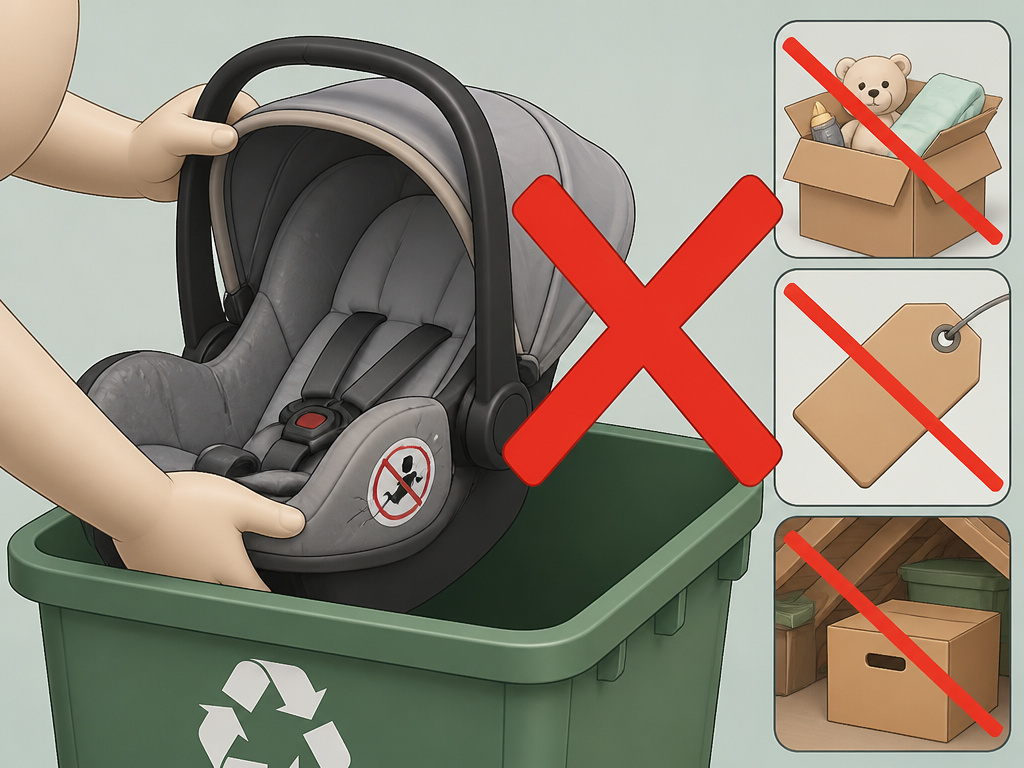 Knowing what to avoid is as important as knowing the correct process. These paths seem convenient but transfer risk.
Do not donate an expired or questionable seat. Reputable organizations that accept car seat donations have strict policies. They will check expiration dates and crash history. If you cannot 100% verify the seat’s safety, you are passing a liability, not a gift.
Do not sell it. The safety considerations for selling a car seat are immense. You cannot guarantee the buyer will install it correctly, check for recalls, or understand its history. The few dollars are not worth the potential consequence. A seat that needs recycling is not a seat for the secondhand market.
Do not store it for “maybe someday.” An expired seat in your attic is a temptation, for you to use with a future child, or for a friend in a pinch. It also takes up space. Once a seat is done, recycle it. This clears clutter and removes the ethical dilemma.
Do not partially disassemble. Removing just the cover isn’t enough. Leaving the harness intact or the shell whole defeats the purpose. Full disassembly is the only way to access methods for recycling a car seat properly and prevent harm.
Frequently Asked Questions
Can I put a car seat in the recycling bin?
No, not as a single unit. Recycling facilities sort materials by type. A car seat is plastic, metal, foam, and fabric fused together. It will be rejected and sent to landfill. You must disassemble it first and only place accepted components (like clean plastic and metal) in your bin.
How do I find the expiration date on my infant seat?
Look for a stamp molded directly into the plastic shell, not a sticker. It is often on the back or bottom of the seat carrier. The format is usually something like “MANUFACTURED ON: 01/2023” or “DO NOT USE AFTER DEC 2029.” If you cannot find it, assume the seat is expired.
My seat was in a minor crash. Is it okay?
Maybe, but the definition of “minor” is strict. If the vehicle could be driven from the scene, the airbags did not deploy, and no one was injured, some manufacturers permit reuse. However, many safety advocates and insurers, like Manitoba Public Insurance, recommend replacement after any moderate or serious collision. When in doubt, replace it. The cost of a new seat is far lower than the risk.
What if my local center won’t take the foam and fabric?
This is common. The Evenflo manual explicitly states that if local recycling won’t accept the padding, you may dispose of it in the landfill. Your primary targets are the plastic shell and metal. Bag the foam and fabric separately and place them in your regular trash after you have cut the straps.
Why can’t I just give it to a friend?
You can, but only if you are its original owner, you know its full history (no crashes), it is not expired, and it has no open recalls. You must also provide the manual. That’s a lot of conditions. Most of the time, donating your used seat responsibly means giving it to a certified organization that will vet it properly, not an informal hand-off.
The Bottom Line
Recycling a car seat is a physical, hands-on task. It requires a screwdriver, a pair of heavy scissors, and the resolve to break something that once kept your child safe. The process is straightforward: verify, disassemble, separate, and recycle or destroy.
The plastic shell and metal are the prize for recyclers. The straps and foam are often trash. Your local rules have the final say. When no program exists, destruction is the responsible choice. Take the sledgehammer, break the shell, and mark it. That final act ensures the seat’s story ends with you, protecting the next child who will never sit in it.
