
Is it Safe to Check a Car Seat | The Damage You Can’t See
This post contains affiliate links. As an Amazon Associate, we earn from qualifying purchases.
Checking a car seat is not safe if you plan to use it again on the road. Baggage systems are designed for luggage, not safety-critical gear. The drops, crushes, and extreme temperatures during transit can create hidden cracks in the plastic shell or bend the metal frame, compromising the seat’s ability to protect your child in a crash. Car seat technicians universally advise against it.
That one-inch tolerance for installation is the engineering margin built into Federal Motor Vehicle Safety Standard 213. A hairline fracture from a baggage cart impact can turn a secure fit into a catastrophic failure at 30 miles per hour.The seat might look fine, but its structural integrity is gone.
This guide walks through the physics of that hidden damage, the three alternatives that are actually safe, and the one piece of gear that changes the math if you must check.
Key Takeaways
- Baggage handling can cause internal damage to a car seat’s plastic shell and metal frame that is invisible on the surface, voiding its safety certification.
- Using the seat on the plane is the safest option, providing restraint during turbulence and guaranteeing the seat arrives undamaged.
- Gate-checking is less risky than standard check-in, as the seat has a shorter, gentler journey to the aircraft hold.
- A certified, padded travel bag is the minimum protection if you must check a seat; a simple nylon sack offers almost none.
- Buying a budget seat at your destination is often cheaper than replacing a damaged high-end seat and eliminates travel risk entirely.
The Hidden Damage: Why Baggage Handling is the Real Risk
Car seats are tested to withstand immense forces in very specific directions—forward and rearward in a crash. They are not tested to be thrown from a conveyor belt, crushed under a 50-pound suitcase, or frozen in a cargo hold. The difference is everything.
A car seat should not move more than one inch side-to-side or front-to-back when installed. This tolerance comes from FMVSS 213, the federal safety standard. Hidden damage from baggage handling can create flex points that turn a secure installation into a dangerous one during a crash.
The plastic shell is the heart of the seat’s protection. It’s designed to absorb and distribute crash energy in a controlled way. A sharp impact from a drop can create a micro-fracture. That fracture becomes a stress concentrator. In a collision, instead of the shell deforming as engineered, it can crack prematurely at that weak point.
Common mistake: Assuming a visual inspection is enough. You cannot see a compromised internal harness anchor point or a bent LATCH connector bar. The seat clicks into the base, the belt tightens, and everything looks normal until the moment it isn’t.
The risk parallels the recent warning from Tampa Police about counterfeit seats sold on TEMU. Those seats look real but lack the internal reinforcement to meet FMVSS 213. A damaged genuine seat is in the same category: it looks compliant but its performance is now unknown and unsafe.
| Baggage Handling Hazard | Type of Damage to Car Seat | Consequence in a Crash |
|---|---|---|
| Drop from conveyor (4-6 ft) | Hairline cracks in plastic shell, stressed metal frame welds | Shell may split, failing to contain the child |
| Crush under heavy luggage | Permanent deformation of side wings or headrest | Impact protection geometry is altered, increasing head excursion |
| Extreme cold in cargo hold | Brittleness in plastic components | Increased likelihood of shattering on impact |
| Moisture/Humidity | Corrosion of steel reinforcement bars & LATCH connectors | Weakened structural anchors could detach |
Your Three Real-World Alternatives (Ranked)

You have options that don’t involve trusting the baggage system. The ranking here is based on safety first, then convenience.
1. Use It On the Plane (The Gold Standard)
This is the only way to be certain your seat arrives safely. The FAA recommends using a car seat on board for children under 40 pounds.
Why it works: The seat is in your custody the entire time. It’s not thrown, crushed, or lost. More importantly, it restrains your child during turbulence, which is a real and common hazard. A lap-held child becomes a projectile during sudden drops; a secured child is safe.
Where this goes sideways: Assuming any car seat is airplane-ready. You need an FAA-approved car seat. Look for a label on the seat itself that states, “This restraint is certified for use in motor vehicles and aircraft.” Most U.S.-market seats have it, but double-check.
The process is straightforward. You carry the car seat through the airport, often using a travel cart. At your row, you install it in the window seat (so it doesn’t block emergency exits) using the airplane’s lap belt. Flight attendants know the drill.
2. Gate-Check as a Last Resort
If using the seat onboard isn’t possible, gate-checking is the next best thing. This means you use the seat all the way to the jet bridge, then hand it to an agent who places it in the cargo hold at the last minute.
Why it’s better than standard check-in: The seat avoids the main baggage sorting system—the most violent part of the journey. It goes from your hands to a dedicated cart, onto the plane, and is usually returned at the jet bridge upon arrival. Fewer handling points mean fewer opportunities for damage.
You still need protection. A padded bag is non-negotiable. The safety of gate-checking hinges entirely on that layer of padding against the inevitable bumps from the cart to the hold.
3. Buy a Seat at Your Destination
For longer trips, this can be the most stress-free solution. You purchase an inexpensive, compliant seat upon arrival.
The math: Weigh the cost of a budget seat against the replacement cost of your $300+ travel system if it’s destroyed. For a two-week vacation, the math often favors buying. You also avoid lugging the seat through airports entirely.
Ensure you buy from a reputable retailer, not a third-party marketplace. The Tampa PD counterfeit case shows the danger of cut-rate online sellers. Stick to major stores where you can verify the seat has the proper FMVSS 213 label.
If You Must Check: The Absolute Minimum Protection
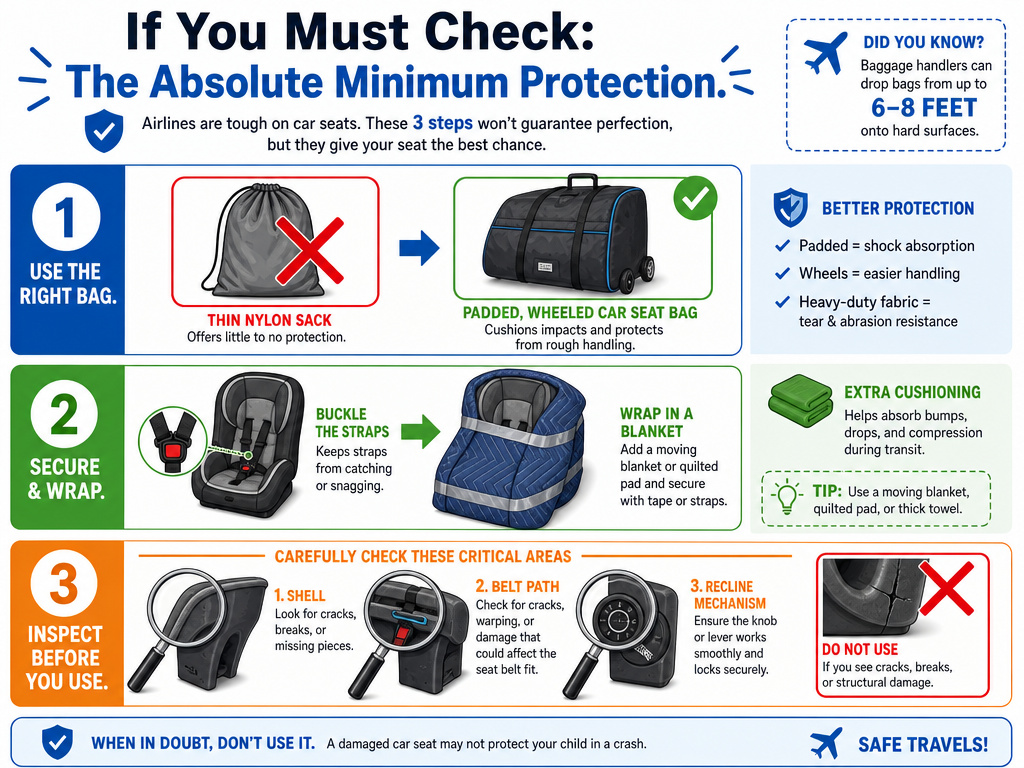
Sometimes, checking is the only option. If that’s your situation, your goal is damage mitigation. Here is the mandatory protocol.
Step 1: Get a Real Travel Bag, Not a Cover.
A thin nylon sack is for keeping the seat clean, not for protection. You need a padded bag with rigid panels. The best car seat travel bags have thick foam sides and a hard bottom. A wheeled car seat bag is even better—you avoid dragging and dropping it yourself.
Step 2: Pack It Like It’s Fragile.
Before placing it in the bag, buckle the harness straps and chest clip to prevent them from snagging. Wrap the seat in a blanket or bubble wrap for extra cushioning. Follow a dedicated guide on how to pack an infant car seat for a flight for model-specific tips.
Step 3: Inspect It Like a Technician Upon Arrival.
Before you use it, conduct a thorough inspection. This isn’t a glance. – Remove all padding and look at the bare plastic shell under bright light. Flex the shell gently with your hands, listening for cracks. – Check every belt path and LATCH connector for fraying, twisting, or bends. – Inspect the recline mechanism and adjustment knobs. Do they work smoothly? Any abnormality means the seat is compromised. Retire it immediately.
The Official Guidance and Why It Matters

Your instincts are backed by official sources. The Mass.gov car seat FAQ is a primary government resource that clearly advises caution with used or potentially damaged seats.
It states that a seat involved in a moderate to severe crash should not be reused. The forces in a crash are specific and known. The forces in baggage handling are random and uncontrolled. From a safety engineering perspective, a seat that has been through baggage handling is in the same category as a seat in a minor crash—its history is unknown and its integrity is suspect.
This is the application of a simple, conservative safety principle: if you don’t know the forces it has endured, you cannot guarantee its performance.
Bottom line: The system isn’t built for car seats. Your child’s safety is.
Frequently Asked Questions
Is gate-checking a car seat safer than checking it with luggage?
Yes, significantly. Gate-checking eliminates the automated baggage sorting system, which is where most crushing and high-impact drops occur. The seat takes a shorter, more controlled path directly into the aircraft’s hold. It’s still not without risk, but it’s the lesser of two evils if you can’t use the seat on the plane.
Can I use a garbage bag or a regular duffel bag to check my car seat?
No. A garbage bag or basic duffel offers zero protection against impacts. They tear easily, exposing the seat to dirt, moisture, and direct blows. This approach essentially guarantees damage. A purpose-built, padded travel bag is the bare minimum for checking a car seat.
How can I tell if my car seat was damaged after checking it?
Look beyond the surface. Remove all fabric covers and pads. Run your hands over every inch of the plastic shell, pressing firmly. Feel for flex points or hear for subtle crackling sounds. Inspect the metal frame for new bends or scratches. Check that all adjustment mechanisms work without sticking. If anything feels off, assume it’s damaged.
Are there car seats specifically designed to be checked?
No car seat manufacturer designs their product to withstand airline baggage handling. Some market “travel-friendly” seats that are lighter or more compact, but none certify them for checked baggage. Their safety certifications (FMVSS 213) are for vehicle crash performance, not cargo hold durability.
What should I do if the airline loses my checked car seat?
If the seat is lost, the airline is responsible for reimbursing you for a replacement of comparable value. File a claim immediately. More importantly, you are now at your destination without a safe seat. This scenario is why using the seat on the plane or buying at your destination are more reliable strategies.
Before You Go
The safest path is always the one where the car seat stays under your control. Use it on the aircraft. If that’s not possible, gate-check it inside serious protective armor. Checking it as standard baggage is a gamble with your child’s safety net.
Invest in a good car seat travel cart to make onboard use easy. Buy a robust infant car seat bag if gate-checking is your plan. The goal is to get the seat from A to B ready to do its one job perfectly.
