
Carry-On Rules: Does a Car Seat Count Onboard Your Flight?
This post contains affiliate links. As an Amazon Associate, we earn from qualifying purchases.
A car seat does not count as a carry-on item if you are using it for a ticketed child in their aircraft seat. The FAA and all major U.S. Airlines exempt it from carry-on limits, treating it as an assistive device. If you are not using it onboard, planning to check it, then it counts as a checked bag, subject to standard fees and limits unless your airline offers a free checked car seat allowance.
That exemption hinges on one condition: the child must have their own paid seat. A lap infant does not qualify. The seat also must bear a label certifying it is approved for aircraft use under federal standards. This isn’t a courtesy. It’s a federal safety regulation that overrides any individual airline’s carry-on rules.
What follows: the exact FAA rule, how to find the label, a breakdown of major airline policies, and a clear decision guide for when to gate-check, cabin-check, or skip bringing the seat altogether.
Key Takeaways
- A car seat is a free carry-on only if it’s FAA-approved and used for a child in their own ticketed seat. For a lap infant, it must be checked.
- Look for a red and white sticker on the seat that states, “This restraint is certified for use in motor vehicles and aircraft.” No label, no fly.
- Window seats are mandatory for car seat placement; they cannot be installed in exit rows or the rows directly before and after an exit.
- Non-collapsible strollers and stroller wagons cannot be gate-checked; they must be checked at the ticket counter, adding a significant logistical step.
- Always call your specific airline 72 hours before departure to confirm their current car seat as carry-on policy and seat assignment rules.
The FAA’s Rule vs. Airline Policy
The Federal Aviation Administration sets the baseline. Their rule is simple: if a child has a seat, you can use an approved child restraint system in it. The airline’s job is to enforce that rule, not to make it up. This creates a split where the federal right exists, but the airline’s procedures dictate how you exercise it.
The FAA’s position: An approved child restraint system (CRS) is an assistive device, not luggage. It does not count toward any carry-on or checked baggage limit when used as intended during the flight.
The critical proof is the label. The federal child restraint system standard (FMVSS No. 213) requires manufacturers to include it. You’ll find it on the shell, usually near the child’s feet or on the back. It’s a red and white circle with black text. If your seat is secondhand and that sticker is missing or defaced, the airline will not allow it onboard. They have no way to verify its certification.
Where this goes sideways: Assuming any car seat will do. Travel systems often include a “travel seat” that is not FAA-approved. Umbrella stroller attachments rarely are. You must check the label on the specific seat you plan to bring, not the model name.
| Scenario | Does it count as a carry-on? | Airline Action |
|---|---|---|
| Child has ticketed seat, FAA-approved seat used in-flight | No. Exempt. | Seat is secured in window seat; child must be harnessed during taxi, takeoff, landing, and turbulence. |
| Child has ticketed seat, but seat is not FAA-approved | Yes. Must be checked. | Gate agent will deny boarding with the seat; it will be checked to final destination. |
| Lap infant (no ticketed seat), FAA-approved seat | Yes. Counts as checked baggage. | Seat must be checked at ticket counter or gate; standard baggage fees may apply unless airline offers a free checked item for infant. |
| Bringing an extra seat “just in case” an empty seat is available | Yes. Counts as carry-on or checked bag. | You are subject to all standard baggage limits and fees for that item. |
The airline’s specific airline carry-on policy fills in the FAA’s blanks. They dictate the seat assignment (always a window seat), prohibit use in exit rows, and establish the gate-check procedure if the plane changes to a smaller aircraft at the last minute.
How to Decode Your Car Seat’s FAA Label
You are looking for one of two specific phrases. The first is the gold standard. The second is older but still valid.
- “This restraint is certified for use in motor vehicles and aircraft.” This is the modern, required text per FMVSS No. 213. It’s often inside a red and white circle.
- “This child restraint system conforms to all applicable Federal motor vehicle safety standards. This restraint is certified for use in motor vehicles and aircraft.” This is the older, two-sentence version.
The label is a physical, non-removable sticker. A manual entry or a separate certificate is not acceptable for airline personnel. They need to see the sticker on the spot.
Common mistake: Relying on the manufacturer’s website or customer service saying a model is “airplane safe.” If the sticker isn’t on your specific unit, it won’t fly. Check the seat itself, not the marketing.
What if the label is faded? Take a clear, well-lit photo of it on your phone before you leave for the airport. If the gate agent questions it, you have evidence. This has resolved more than one tense moment at the jet bridge.
The NHTSA car seat safety guidelines are your backup resource. They confirm the label requirement and offer a broader context for child passenger safety that applies on the road and in the air.
Airline-Specific Policies You Must Know
All major U.S. Carriers follow the FAA rule. Their differences lie in the details of checking seats, fees for lap infants, and how they handle oversold flights.
American, Delta, and United have nearly identical core policies. The car seat is free for a ticketed child. It must be in a window seat. It cannot be in an exit row. For a lap infant, you can check one car seat and one stroller for free, even if the infant doesn’t have a baggage allowance. This is a critical perk.
Southwest Airlines is famously family-friendly, and its Southwest policy reflects that. Not only is the car seat free for a ticketed child, but Southwest also allows two checked bags free for everyone, including a car seat checked for a lap infant. Their open-seating policy adds a twist: families with car seats board between the “A” and “B” groups, giving you a fair shot at a window seat.
JetBlue and Alaska Airlines also exempt the seat. Alaska explicitly states that a diaper bag and a breast pump cooler do not count as personal items, which is a lifesaver for packing.
The part nobody mentions: Non-collapsible strollers and stroller wagons must be checked at the ticket counter, not the gate. This is a universal rule buried in airline contract of carriage documents. If you have a heavy, fixed-frame wagon, you lose the convenience of gate-check.
Here is the breakdown of what happens when a flight is full and you were planning to use an empty seat:
| Your Situation | Best-Case Outcome | Likely Outcome | What to Do |
|---|---|---|---|
| Traveling with a lap infant, brought FAA seat hoping for empty seat | Empty seat next to you, agent allows you to use the seat for free. | Flight is full. Seat must be gate-checked. | At check-in, ask if the flight is full. If it is, check the seat immediately to avoid gate chaos. |
| Traveling with a ticketed child, plane is changed to a smaller aircraft with narrower seats | New seats still accommodate your car seat. | Your assigned seats are separated, or the new seat type won’t fit a car seat. | Gate agent must re-accommodate your family together. Your car seat may need to be gate-checked. |
| Checking a car seat for a lap infant | Seat arrives at baggage claim undamaged. | Seat is lost or arrives with broken parts. | Use a padded travel bag. Consider a backup plan like a rental car seat at your destination. |
Your best tool is a direct call to the airline. Ask three questions: “What is your specific carry-on item policy for FAA-approved car seats?” “Do you offer a free checked car seat for lap infants?” “Can you notate my reservation that we are traveling with an infant and a CRS?”
The Practical Decision: Use It or Check It?
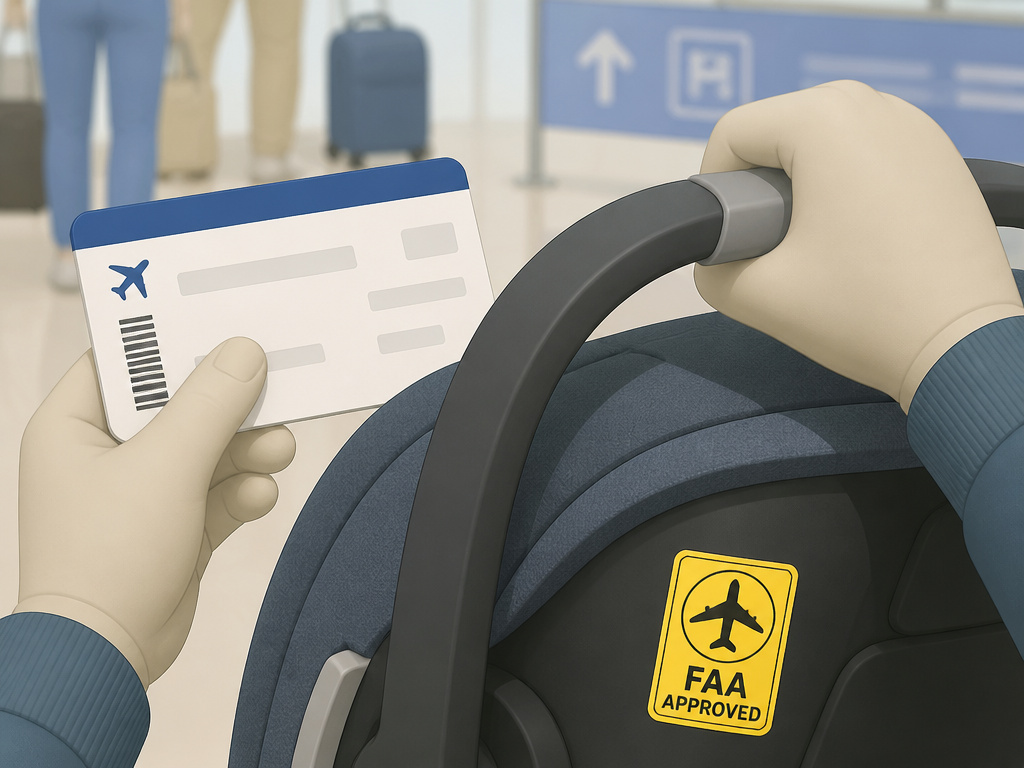
This isn’t just about rules. It’s about a real trip through a crowded terminal with a toddler, a diaper bag, and a 20-pound car seat. The decision to bring it onboard or check it changes the entire travel day.
Bring it onboard if:
- Your child is ticketed and you have the FAA label.
- The flight is longer than 2 hours and your child sleeps well in their own seat.
- You are traveling alone with your child and need a safe, familiar place to secure them while you use the restroom or organize belongings.
- You do not trust checked baggage handling with your $300+ safety device.
Check it if:
- Your child is a lap infant.
- You are connecting through a massive airport like Dallas/Fort Worth or Atlanta and the thought of carrying the seat that far is exhausting.
- The flight is under 90 minutes and you plan to wear your infant.
- You have a reliable, protective travel bag and are comfortable with the risk.
A padded travel bag is non-negotiable for checking. It doesn’t guarantee safety, but it protects from scuffs and keeps the harness straps from getting caught on conveyor belts. Some bags have backpack straps, which are essential for carrying a car seat through the airport.
Worth knowing before you start: The DOT Airline Passengers Bill of Rights covers assistive devices. If an airline damages your checked car seat, they are liable for repair or replacement up to its original value. You must file a report before leaving the airport.
Gate-checking is the messy middle ground. You use the seat in the terminal, leave it at the aircraft door, and pick it up on the jet bridge at arrival. It’s handled less, but it’s still out of your sight. For a lightweight infant seat, this is often the best compromise. For a bulky convertible seat, it’s a pain.
Your Step-by-Step Airport Game Plan
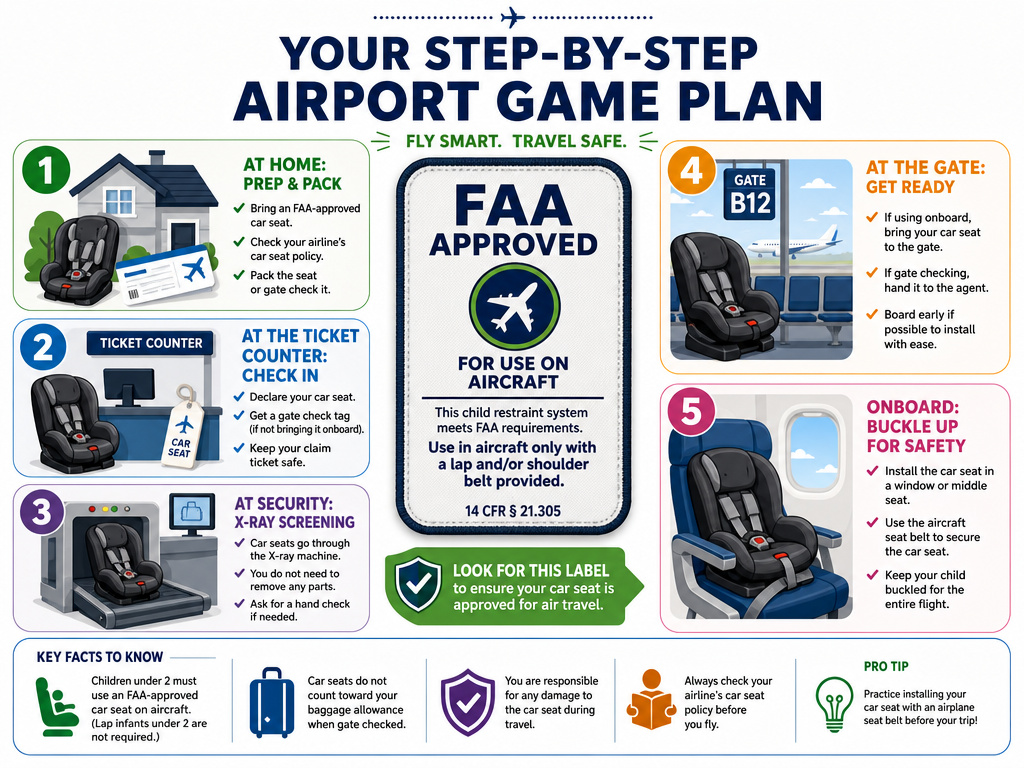
The sequence matters. Getting it wrong means backtracking through security or missing a flight.
1. At Home, Before You Leave:
Verify the FAA label. Take a photo of it. Confirm your child’s ticket and seat assignment. If you’re flying Southwest, check in exactly 24 hours before departure to get the best boarding position. Pack the car seat manual in an outside pocket of your carry-on, you might need it.
2. At the Ticket Counter:
Declare your car seat and stroller. If you are checking the car seat, this is where you do it. Get a gate-check tag for your stroller if it’s collapsible. Ask the agent to confirm your seats are still together and that the car seat is notated in your record.
3. At Security:
The car seat goes through the X-ray machine. You may be asked to swab it for explosives. Have the child walk through or be carried. Practice collapsing your stroller with one hand while holding a child with the other. It’s a skill.
4. At the Gate:
Approach the agent immediately. Confirm your plan: “We have an FAA-approved car seat for seat 12A.” If the flight is full and you have a lap infant, check the seat now. Get a gate-check tag.
5. On the Plane:
Install the seat rear-facing if your child is under the limits. Use the aircraft seat belt only, do not try to use the lower anchors. Thread the belt through the car seat’s designated path and pull tight. There should be less than an inch of movement at the belt path. The flight attendant will check this.
The harness straps must be snug on your child. The chest clip should be at armpit level. If your child is over two and forward-facing, the official child passenger safety ratings still apply: the harness must be tight, and the top tether is not used on aircraft.
Frequently Asked Questions
Can I use my car seat on the plane if my child is under 2 but I didn’t buy a seat?
No. The FAA and airline exemption applies only to a child occupying their own ticketed seat. A lap infant does not have a seat to secure the restraint to. You must check the car seat as baggage. Some airlines allow you to use it if there is an empty seat next to you, but you cannot count on this.
What if my car seat is too wide for the airplane seat?
This is a real problem with some convertible seats. Most airline seats are 17-18 inches wide at the armrests. Measure your car seat at its widest point. If it’s over 17 inches, you risk being told it doesn’t fit. Brands like the Cosco Scenera Next are popular for travel specifically because they are narrow (about 16 inches).
Does a booster seat count as a carry-on?
Yes, if it’s not being used in-flight. A backless booster seat is not approved for aircraft use because it requires the vehicle seat belt to function, and aircraft lap belts are not designed for it. It must be checked. A high-back booster with a harness that is FAA-approved follows the same rules as a car seat.
Can I bring a car seat and a stroller for free?
Generally, yes. Most airlines allow one car seat and one stroller per child to be checked for free, regardless of whether the child has a seat. This is in addition to your regular carry-on and checked baggage allowance. Always verify with your specific carrier, as budget airlines may have different rules.
What happens if the airline loses my checked car seat?
You must file a report with the airline’s baggage service office before leaving the airport. Under the DOT Airline Passengers Bill of Rights, they are responsible for compensating you, often with a loaner or reimbursement for a replacement. This is why many parents choose to gate-check or bring the seat onboard, it stays in their control.
Before You Go
A car seat is not luggage when it’s doing its job. The rule is clear: an FAA-approved seat for a ticketed child flies free. The work is in the details, finding the label, calling the airline, and measuring your patience for carrying it.
The window seat is non-negotiable. The exit row is forbidden. Your child stays harnessed when the seatbelt sign is on. These aren’t suggestions. They are the conditions of the exemption.
If you check it, bag it. If you bring it, practice installing it with a regular seat belt at home. The airport is not the place to learn.
For one answer: if your child has their own ticket and you have the sticker, bring the seat on the plane. The familiar, safe space is worth the hassle of carrying it through the terminal. For a lap infant on a short flight, check it in a good bag and travel lighter. Your back will thank you.
