
Do You Need a Car Seat for a Toddler on a Plane? FAA Advice
This post contains affiliate links. As an Amazon Associate, we earn from qualifying purchases.
A toddler does need a car seat on a plane for maximum safety, and the Federal Aviation Administration (FAA) strongly recommends it. While children under two can fly as a “lap child,” this practice is discouraged because arms cannot securely hold a child during unexpected turbulence. An approved Child Restraint System (CRS) in a purchased seat is the safest option.
That gap between what’s allowed and what’s recommended is where the confusion lives. Airlines follow the FAA’s minimum regulation, which permits lap children under two. But the agency’s own safety guidance, backed by the National Transportation Safety Board (NTSB), explicitly advises against it. The recommendation responds to documented injuries rather than being based on theory.
What follows: the specific FAA and NTSB warnings you should read, how to identify a plane-legal car seat in ten seconds, and the one-step verification that stops airport gate agents from turning your seat away.
Key Takeaways
- The FAA strongly recommends a car seat for any child, citing a 2019 NIH finding that unrestrained lap children are prone to in-flight injuries.
- Your car seat must have the specific phrase “This restraint is certified for use in motor vehicles and aircraft” on its label to be used on a plane.
- Booster seats and most baby carriers are prohibited during taxi, takeoff, and landing because they cannot be secured properly with a lap-only airplane belt.
- If you buy a seat and your approved car seat doesn’t fit, the airline must accommodate you in another seat in the same class of service.
- The CARES harness is an FAA-approved, lightweight alternative to a car seat for toddlers 22-44 lbs who can sit upright alone.
The Short Answer: FAA Rules & Recommendations
The law and the safety advice point in opposite directions. Legally, a child under two years old may be held on an adult’s lap. That’s the baseline rule in 14 CFR § 121.311. But every U.S. Safety agency warns you not to do it.
Common mistake: Treating the airline’s permission as a safety endorsement. The airline follows the legal minimum. The FAA’s safety guidance, which you can read on its FAA child travel safety guide, recommends the opposite.
The FAA states that the safest place for a young child is in an approved child restraint system in their own seat. This position is reinforced by the NTSB, which notes “preventable deaths and injuries have occurred in children under age 2 who were unrestrained” during turbulence and survivable accidents. Their NTSB child passenger safety alert is a single page that makes the risk unambiguous.
The core problem is physics. During severe turbulence, the forces acting on a child can exceed what an adult can physically restrain. A 2019 National Institutes of Health study, cited by the FAA, found injuries specifically cluster during meal service or turbulence, precisely when a lap child is most likely to be unrestrained or loosely held.
How to Spot an FAA-Approved Car Seat
Not all car seats are cleared for flight. A seat that is perfectly legal in your car might be rejected at the airplane door. The difference is on the label.
You are looking for one exact sentence: “This restraint is certified for use in motor vehicles and aircraft.” It must be printed on the seat itself, usually on a sticker on the side or back. Seats made after February 26, 1985, should have this in red lettering. If that sentence isn’t there, the gate agent is within their rights to deny its use, even if you bought a ticket for it.
| Label / Marking | What It Means | Is It Plane-Legal? |
|---|---|---|
| “This restraint is certified for use in motor vehicles and aircraft” (in red) | Seat meets FMVSS 213 and FAA aircraft seat standards. | Yes. The gold standard. |
| “This child restraint system conforms to all applicable Federal motor vehicle safety standards.” (alone) | Seat meets crash-test standards for cars only. | No. Missing the aircraft certification. |
| Foreign approval label (e.g., ECE R44/04) | Seat meets European Union safety standards. | Maybe. It must also have a marking showing approval by the relevant foreign government for aircraft use. Check with your airline. |
| No visible label or worn-off sticker | Certification status is unknown. | No. Assume it will be rejected. |
This rule is detailed in the official FAA CRS use policy. It’s non-negotiable. Before you fly, find that label and take a photo of it. That photo has settled more than one dispute with a weary airline employee.
The CARES Harness: A Travel-Specific Alternative
For toddlers who have outgrown a rear-facing seat but aren’t ready for the adult belt alone, there’s a dedicated device: the AmSafe Child Aviation Restraint System (CARES). This harness attaches to the airplane’s seat back and works with the existing lap belt.
The CARES harness is approved for children between 22 and 44 pounds and up to 40 inches tall, who can sit upright unassisted. It’s approved for all phases of flight. The major advantage is its size and weight, it fits in a small pouch, eliminating the need to lug a heavy car seat through the airport.
Where this goes sideways: Buying a counterfeit CARES harness online. The FAA warns that knock-offs use inferior webbing and lack the proper engineering. The real device will have “FAA Approved in Accordance with 14 CFR 21.8(d)” on its label. Buy directly from the manufacturer or a trusted retailer.
For a toddler on the cusp of the weight limit, a forward-facing FAA-approved toddler seat is often a more familiar and comfortable choice. But for the right child, CARES is a brilliant solution that simplifies travel with car seat and stroller immensely.
What You Cannot Use: Prohibited Restraints
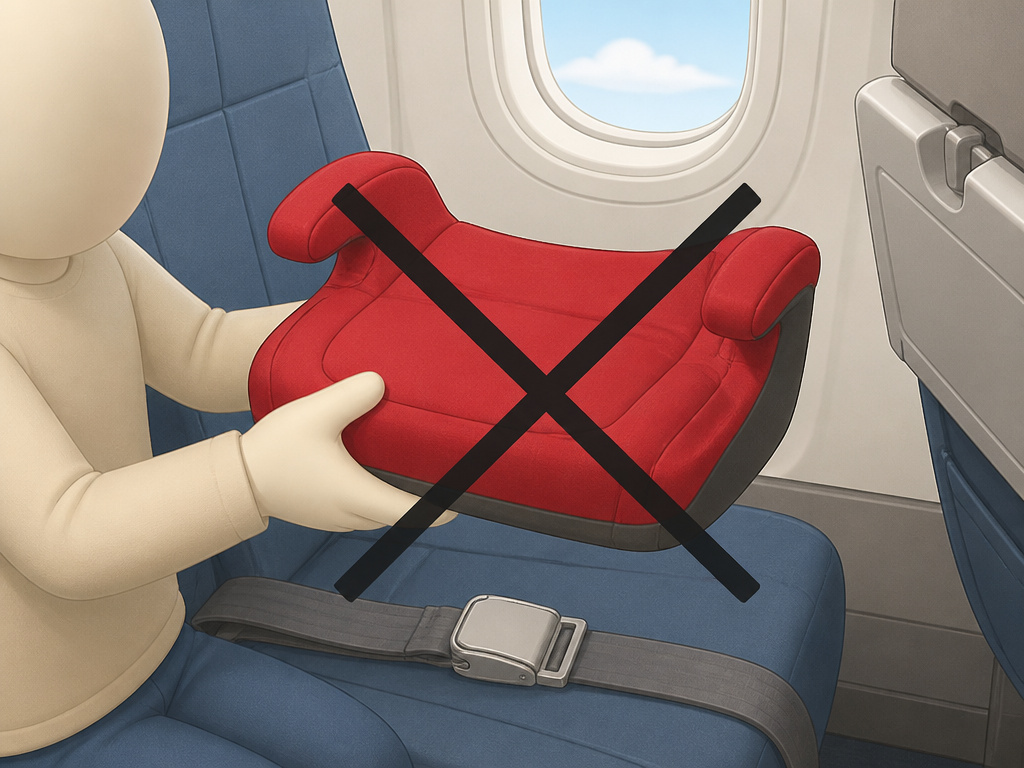
The airplane’s lap-only belt configuration disqualifies several common child restraints. Knowing what’s banned saves you from a last-minute scramble at the gate.
Booster seats are a hard no. They are designed to be used with a car’s three-point lap-and-shoulder belt to position the vehicle belt correctly. Since airplanes only have a lap belt, a booster provides no meaningful restraint and is prohibited during taxi, takeoff, and landing. The same goes for backless booster cushions.
Most infant carriers and baby-wearing wraps are also not approved. While an airline may allow them during cruise flight at their discretion, they are never permitted for takeoff, landing, or when the seatbelt sign is on. The FAA is clear: if it’s not an approved CRS or the CARES device, it doesn’t count for the critical phases of flight.
This is why checking your airline policies for car seats in advance is non-optional. Some airlines have additional restrictions beyond the FAA rules.
Buying the Airplane Seat & Installation Basics
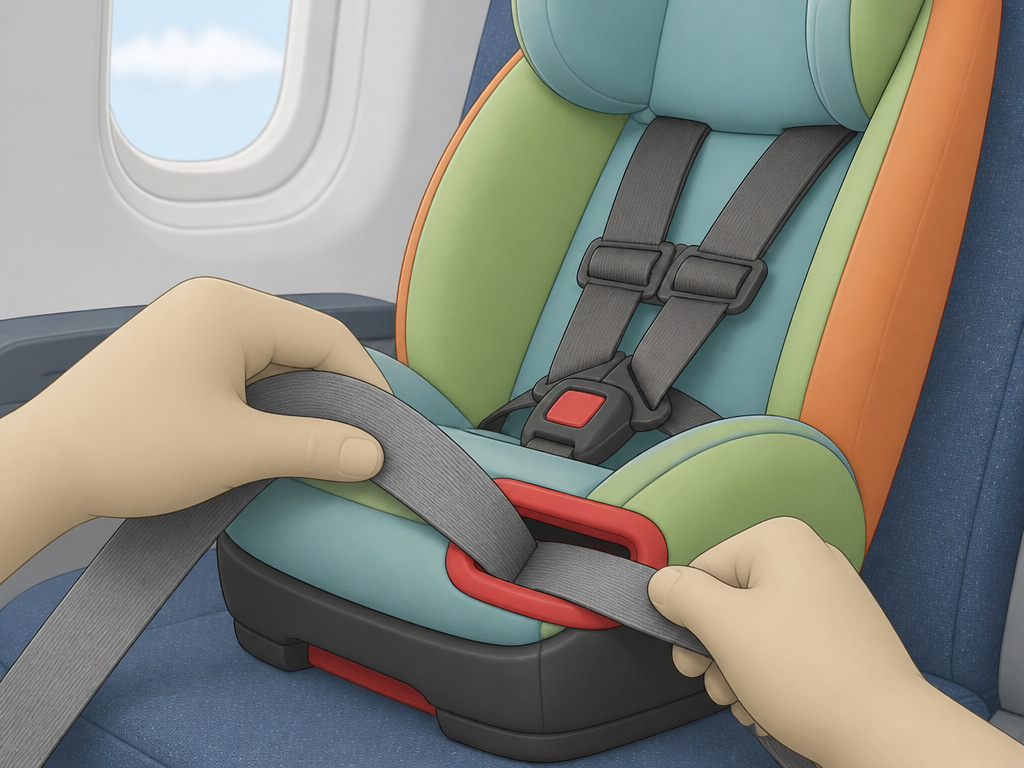
If you decide to use a car seat, and you should, you must purchase a seat for your toddler. You cannot place a car seat in an empty seat you didn’t pay for.
Before you start: The car seat must be installed in a window seat. This is an FAA rule to prevent it from blocking emergency egress for other passengers in the row. It cannot be installed in an exit row.
Installation is straightforward if you’re used to a seat belt install in your car. You’ll thread the airplane’s lap belt through the car seat’s forward-facing belt path (or rear-facing path, for an infant) and buckle it. Then, you press down into the seat and tighten the belt as much as you can. The goal is to eliminate any side-to-side or front-to-back movement at the belt path.
The seat back in front of your child must be upright for takeoff and landing. This can feel cramped, but it’s a safety requirement. For a detailed walkthrough, our guide to installing a car seat in flight breaks it down step-by-step.
What if you buy the seat, bring your approved car seat, and it physically doesn’t fit in the airline seat? The FAA has a rule for this, too. The airline is responsible for accommodating you in another seat in the same class of service. Don’t let them tell you to gate-check it without a fight, politely point out the FAA policy.
The Lap Child Reality Check
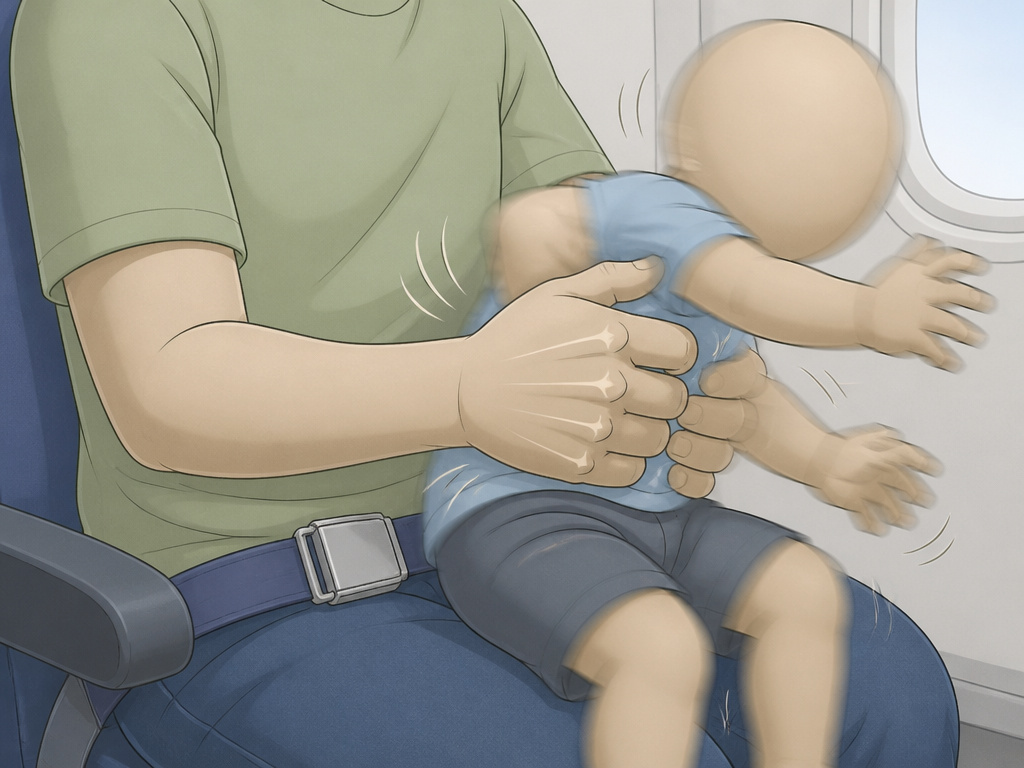
Choosing the lap-child option is a calculated risk to save money. It’s essential to understand what that risk actually is.
The danger is severe, unexpected turbulence that throws unsecured items and people into the ceiling.At that moment, no adult has the strength to hold onto a 25-pound toddler. The child becomes a projectile. The NTSB has reports of children suffering serious injuries this way.
Furthermore, during normal flight, a lap child offers a false sense of security. A sleeping toddler is heavy. An awake one is squirmy. For the entire flight, you are their only restraint system, and you are not designed for that job. Your arms fatigue. You get distracted. It’s exhausting.
If you must fly with a lap child, keep the adult’s seatbelt fastened low and tight across your own hips, with the child outside the belt. Never buckle yourself and the child together with one belt. And the moment the seatbelt sign illuminates, you must return the child to your lap, you can’t use a baby carrier or sling during those times.
Travel Logistics: Gate-Checking & Baggage Rules
A car seat is generally not counted as a carry-on or checked baggage allowance. Most airlines allow you to bring it for free, whether you use it on board or check it.
However, checking a car seat is risky. Baggage handlers are not gentle. A car seat that has been in a plane’s hold, tossed onto conveyor belts, and stacked under other bags may have suffered internal damage you can’t see. The plastic shell or internal foam could be compromised. The FAA and safety advocates strongly discourage checking your primary car seat.
If you need to check one, gate-check it. This means using it all the way to the jet bridge, where it’s handed to an agent and placed on the plane last. It comes back to you at the jet bridge upon arrival. It receives slightly less rough handling. For maximum protection, use a padded car seat travel bag.
Your other big gear item, the stroller, can almost always be gate-checked for free as well. Coordinating car seat and stroller policies is a key part of travel planning.
Frequently Asked Questions
Is it a law that my toddler needs a car seat on a plane?
No, it is not a U.S. Federal law for children under two. It is a strong safety recommendation from the FAA and NTSB. The law (14 CFR § 121.311) allows children under two to be held on an adult’s lap. However, the safety agencies state unequivocally that this is not the safest practice.
Will I have to pay for a seat for my toddler to use a car seat?
Yes. You must purchase a separate airline ticket for your toddler to have a seat in which to install the car seat. You cannot use an empty seat without paying for it.
What is the best type of car seat for airplane travel?
Lightweight, narrow, FAA-approved convertible or forward-facing seat is often ideal. Look for models known to fit well in airplane seats, like the Cosco Scenera Next. For specific models, see our list of recommended car seats for flying.
Can I use my infant carrier car seat on the plane?
Yes, if it is FAA-approved (check the label). Infant carriers are installed rear-facing in the airplane seat. You must purchase a seat for the baby to use it. The carrier’s base is typically checked with your baggage.
What happens if my car seat doesn’t fit in the airplane seat?
Per FAA policy, if you have purchased a seat for an approved CRS and it does not fit in your assigned seat, the airline must accommodate the CRS in another seat in the same class of service. Speak with a gate agent or flight attendant calmly and cite this rule.
Before You Go
The data from the FAA and NTSB is clear: a car seat on a plane is the baseline for safety. The “lap child” allowance is a regulatory relic, not an endorsement.
Your move is straightforward. Find the label on your seat. If it has the magic words, you’re set. If it doesn’t, you’re deciding between buying a car seat meeting FAA standards or accepting the documented risk of going without. For a toddler, the CARES harness splits the difference neatly.
Then, buy the seat, practice a seat-belt install, and book the window. You’re not just following rules. You’re anchoring your child to the structure of the aircraft itself, the only thing guaranteed to stay put.
