
How to Get Car Seat Out of Base | The Stuck-Release Fix
This post contains affiliate links. As an Amazon Associate, we earn from qualifying purchases.
To get a car seat out of its base, you must locate and fully depress the release handle or button, usually red or grey, while lifting the carrier straight up. The seat will not release if the handle isn’t pressed all the way in, if the base is improperly installed, or if debris is jamming the latch points. For a secure base install that still allows for easy seat removal, movement at the belt path must be less than 25 mm (1 in.) side-to-side or front-to-back.
That one-inch rule is the line between safe and dangerous. A base that shifts more is not secure. A base that doesn’t shift at all often means the seat belt or lower anchors are overtightened, which can deform the plastic and make the seat nearly impossible to detach later. The release mechanism is designed to work with a correctly tensioned base, not a cinched-down one.
What follows: how to find your model’s specific release, the step that fixes 90% of “stuck” seats, how to safely uninstall the base itself, and what to do when the standard steps fail. By the end, you’ll know the difference between a routine release and a sign of a bigger installation problem.
Key Takeaways
- The release handle must be pressed fully and held down while you lift, partial pressure is the most common reason a seat feels stuck.
- A properly installed base should not move more than 1 inch (25 mm) at the belt path; more movement is unsafe, zero movement can jam the latch.
- For seats that rotate (like the Evenflo REVOLVE), the locking tray must be in the green “locked” position facing the rear of the vehicle before you attempt to release the carrier.
- Never pull, yank, or use tools on the release mechanism. If it won’t budge, check for twisted vehicle belts pinching the base or food debris in the latch guides.
- Always consult your specific car seat manual, brands like Chicco, Graco, and Evenflo place their release handles in different spots and require different hand positions.
The Universal First Step: Find and Squeeze the Release
Look for a red or grey lever, button, or handle on the front or side of the base, near where the carrier sits. On a Chicco KeyFit base, it’s a large red button centered at the front. For an Evenflo REVOLVE 180° LITEMAX NXT, it’s a grey squeeze handle on the seat itself, near the carry handle. The Joie Rue uses a release lever on the base’s side.
Before you start: Ensure your vehicle is parked on level ground and the parking brake is engaged. An inclined surface can change the angle of the seat and base, putting extra stress on the latch mechanism and making release difficult or unsafe.
The action is always a press-and-lift motion, but the nuance is in the timing. You must press the release completely before you apply lifting force. Many parents press and lift simultaneously, which can bind the latch. Instead, squeeze the handle until you feel or hear a definitive click. Then lift the carrier straight up, not at an angle.
Where this goes sideways: Pressing the handle only halfway. The latch is spring-loaded and requires full compression to disengage. If you’re not hearing a click, you’re not pressing hard enough. This is especially true with bulkier winter gloves on, you lose tactile feedback.
| Brand & Common Model | Release Handle Location | Critical Action |
|---|---|---|
| Chicco KeyFit/KeyFit 30 | Large red button, front center of base | Press fully until click, lift carrier straight up. |
| Evenflo REVOLVE 180° | Grey squeeze handle on car seat, near carry handle | Squeeze, hold, then lift seat from rotating LockStrong tray. |
| Graco SnugRide SnugLock | Red lever at front of base, under carrier lip | Pull lever toward you while lifting carrier. |
| Britax B-Safe/B-Safe 35 | Button on carrier handle, must be in carry position | Press button while lifting handle to unlock from base. |
If the seat doesn’t release after a full press, stop. Do not force it. The problem is likely downstream, a pinched belt, a misaligned base, or an obstructed latch. Forcing it can break the plastic housing or the latch mechanism, which is a one-way ticket to buying a new seat.
When the Seat Won’t Budge: Diagnosing a Stuck Latch
A car seat that refuses to detach signals one of three problems: an over-tightened base, physical obstruction in the latch path, or a carrier that isn’t fully seated.
First, re-check the base’s installation. It should be secure, but not strangling the vehicle seat. Perform the one-inch test: grip the base at the seat belt or lower anchor path and try to move it side-to-side and front-to-back. According to the Evenflo SafeMax manual, proper installation means movement does not exceed 25 mm (1 in.). If it doesn’t move at all, the belt or LATCH strap is likely overtightened, compressing the base’s plastic and jamming the latch arms. You’ll need to loosen the installation slightly to remove the car seat.
Second, inspect for obstructions. Crumbs, loose change, and pet hair can fall into the channel where the carrier’s metal bars latch into the base. Unbuckle the harness and lift the infant insert to check the underside of the carrier. Look for the two metal bars or hooks, they should be clean. Use a vacuum attachment or compressed air to clear the base’s receiver slots.
Third, ensure the carrier is actually locked in. Sometimes, a seat placed hastily onto the base doesn’t click into place. It rests there securely until you try to remove it, and then nothing works. Lift the carry handle and press down firmly on the carrier. Listen for the double-click. If you hear it now, try the release handle again.
Common mistake: Yanking the carrier handle to lift the seat out. This puts all the stress on the plastic handle hinges, not the release mechanism. The handle can snap, leaving you with a seat stuck in the base and a costly repair. Always lift from the seat’s shell, near the child’s hips.
If these steps fail, your last resort is to fully uninstall the base with the seat still attached. This gives you a stable, well-lit workspace to inspect the mechanism. The process for how to remove the base of a car seat is your next move.
Removing the Base from Your Vehicle
You must detach the base from the car before you can thoroughly troubleshoot a stuck seat or switch the seat to another vehicle. The method depends on whether you used the vehicle seat belt or the LATCH system (Lower Anchors and Tethers for Children).
For LATCH installations:
- Locate the lower anchor connector release buttons on the base. They are usually red.
- Press each button to release the connector hook from the metal anchor bar in your vehicle seat.
- Some models, like the Chicco KeyFit, have a central UAS release lever. Lift it to loosen the strap before detaching the hooks.
- Once both sides are free, lift the base out. The LATCH strap will remain attached to the base.
For seat belt installations:
- Unbuckle the vehicle seat belt.
- For lap/shoulder belts, you must first unlock the retractor mechanism. This usually involves pulling the shoulder belt all the way out and letting it retract slowly to engage the locking mode.
- Feed the seat belt back out of the base’s belt path.
- Lift the base out.
A properly secured convenience base does NOT move more than 25 mm (1 in.) from side-to-side or from front-to-back at the lower anchor connector assembly/vehicle belt path. Evenflo SafeMax Car Seat Base Manual
This is the benchmark. If your base was tighter than this, you’ve found the likely cause of the jam. Once the base is out, place it on a table with the seat still attached. You can now see the latch mechanism clearly. Look for the moving parts that are triggered by the release handle. Press the handle and watch, do the latch hooks retract? If not, the mechanism may be broken. If they do retract but the seat still won’t lift, the guide rails may be misaligned.
This is also the time to verify your original base installation was correct. A flawed install creates problems downstream.
Model-Specific Nuances: Rotation, Handles, and Indicators
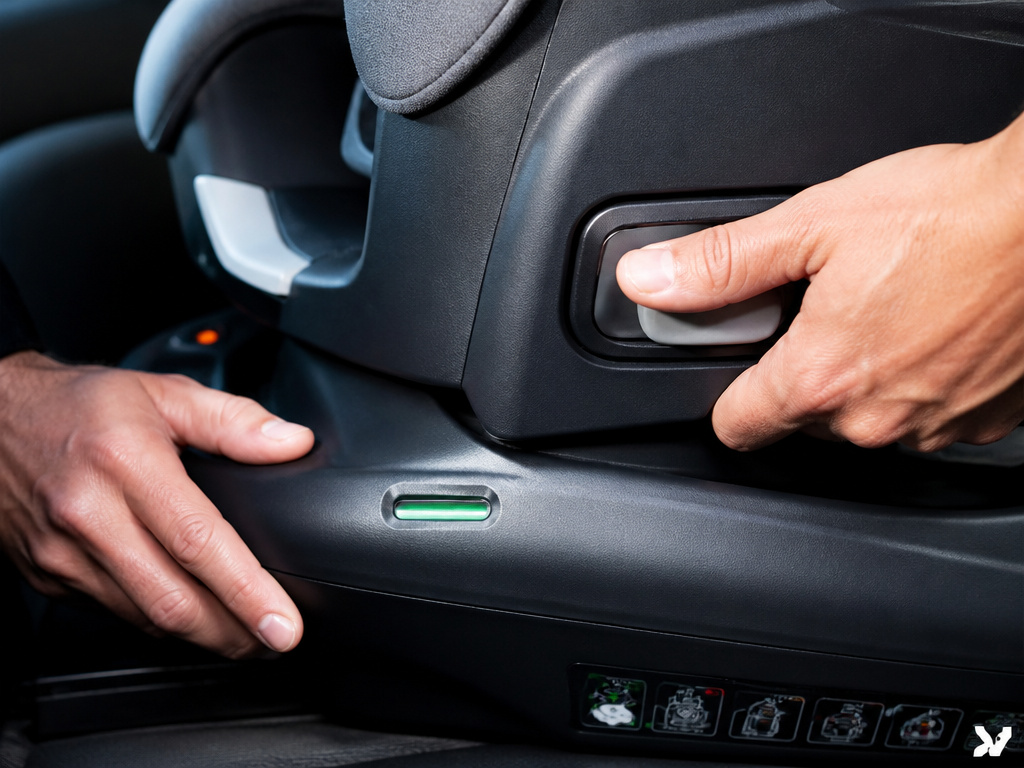 Not all infant seats detach the same way. Convertible seats and rotating models add steps.
For rotating seats (Evenflo REVOLVE 180°, Cybex Sirona S):
The carrier latches onto a rotating tray, not directly to the base. You must ensure this tray is in the locked, rear-facing position (usually indicated by a green window or marker) before you can release the seat. If the indicator is red, the tray is unlocked for rotation. Push the tray until it clicks and the green shows. Then squeeze the car seat’s release handle to lift it off the tray.
For seats with carry-handle releases (Britax, some UPPAbaby models):
The carry handle itself is part of the lock. It must be in the upright “carry” position to press the release button. If the handle is forward or back, the button won’t engage. This is a safety feature to prevent accidental release while driving.
What most people get wrong: Assuming all releases are on the base. Many newer models place the release on the carrier. Always check your manual. The five minutes you spend finding the right diagram prevent the twenty minutes of frustration trying to force the wrong part.
If you’re transitioning away from an infant seat system, understanding how to install a car seat without a base is the next essential skill. It’s simpler than you think.
Troubleshooting and Safety Checks Before Reinstallation
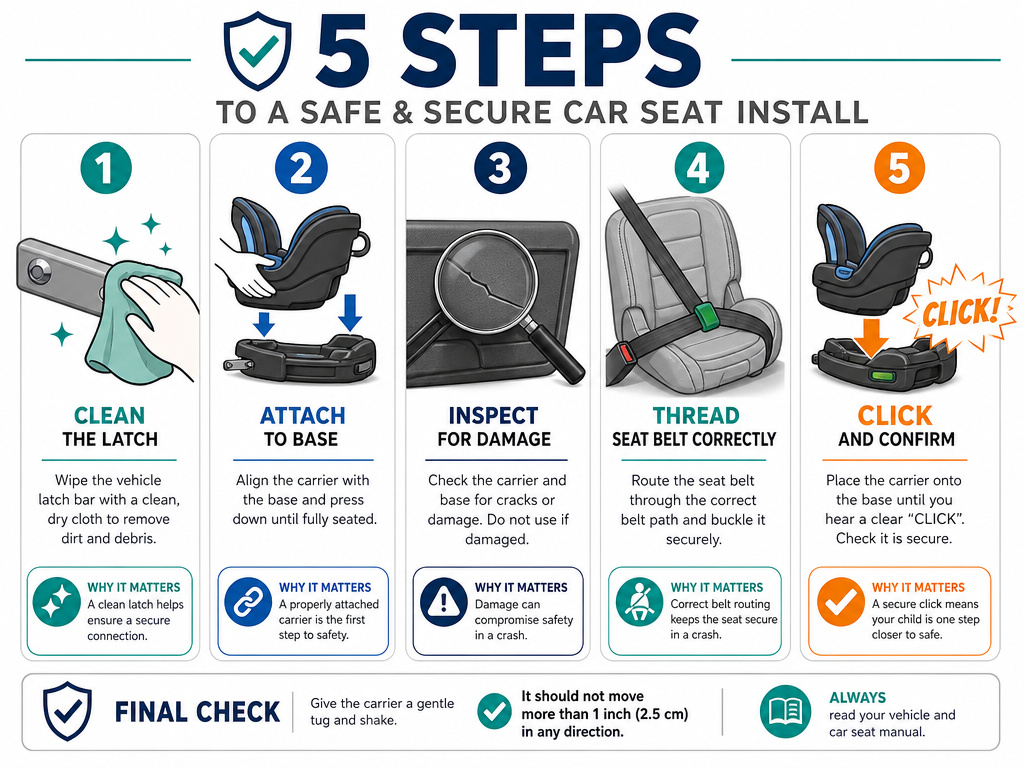 Once the seat is free, don’t just slap it back in. This is the moment to prevent the same problem.
- Clean the contact points. Wipe the metal latch bars on the carrier and the receiving slots on the base with a dry cloth.
- Test the release mechanism. With the base on the floor, click the carrier in and out several times. It should engage with a solid click and release smoothly.
- Inspect for damage. Look for cracks in the plastic around the release handle or the latch points on the carrier. Even a hairline crack can compromise safety.
- Reinstall the base correctly. Use either LATCH or the seat belt, never both. The base should be tight, but when you perform the one-inch test at the belt path, it should have a slight, purposeful flex. That flex is what allows the release mechanism to work.
- Reattach the carrier. Place it onto the base and press down firmly until you hear one or two distinct clicks. Tug upwards on the carrier, it should not come loose. If you’re unsure about your base setup, start over.
A final, critical step is registration. Child restraints are recalled for safety reasons. You must register your seat with the manufacturer to be notified. As noted in the Joie Rue manual, you can send your info to them or call 1-866-798-7866. For recall info, always check the National Highway Traffic Safety Administration (NHTSA) website.
Frequently Asked Questions
Why is my car seat so hard to get out of the base?
The most common cause is an overtightened base installation. If the vehicle seat belt or LATCH strap is cinched down too tightly, it compresses the plastic of the base, pinching the latch mechanism. Loosen the installation so the base moves just under one inch at the belt path, then try the release again.
Can you lift a car seat by the handle to get it out?
No. The carry handle is for carrying the seat once it’s detached, not for the extraction force. Lifting by the handle during release can break the handle’s pivot points. Always place one hand under the seat shell near the child’s hip area and lift from there while pressing the release with your other hand.
Is it safe to use a towel or pool noodle under the base to adjust the angle?
For rear-facing infant seat bases, some manuals allow a single rolled towel or a pool noodle placed at the vehicle seat bight (the crack) to achieve the proper recline angle. However, the Chicco OneFit LX manual explicitly warns against using anything to raise the child restraint off the vehicle seat, as it could slide in a crash. You must follow your specific seat’s manual. Never use aftermarket levelers not approved by your seat’s manufacturer.
What if the red release button is stuck and won’t press?
First, ensure no part of the vehicle seat belt is routed over or behind the button. If it’s clear, try pressing the carrier down into the base first, then press the release. This can relieve pressure on the latch. If it remains stuck, you must detach the seat by uninstalling the entire base as a unit and inspecting for a physical obstruction or broken part.
How do I know if my base is installed tightly enough?
After installation, grip the base at the seat belt or LATCH path and try to move it side-to-side and front-to-back. Proper installation, per the Evenflo SafeMax manual, means it does not move more than 1 inch (25 mm). If it moves more, you need to tighten the base. If it doesn’t move at all, it may be too tight.
Before You Go
Getting a car seat out of its base should be a smooth, one-motion process: press, click, lift. When it isn’t, that’s your car seat telling you something is off, usually the installation. The one-inch movement rule is your best guide. Secure the base to that standard, keep the latch path clean, and always press the release handle fully before lifting. If you hit a true mechanical snag, uninstall the base and seat together for a closer look. Your patience here is what keeps the mechanism working for the lifetime of the seat.
