
How to Choose a Baby Car Seat | The 3 Non-Negotiables
This post contains affiliate links. As an Amazon Associate, we earn from qualifying purchases.
To choose a baby car seat, match three non-negotiable specs: your child’s current height and weight, your vehicle’s seat and anchor system, and the car seat’s certified safety standard (FMVSS 213 or i-Size R129). The Graco Extend2Fit 3-in-1 is a default pick for most families because it converts from rear-facing to forward-facing to booster, covering 4 to 100 pounds.
The weight numbers on the seat’s label are a legal floor, not a suggestion. Federal regulation 49 CFR § 571.213b states manufacturers “shall not recommend” forward-facing harness use under 26.5 pounds or booster use under 40 pounds. Your child must meet both the seat’s minimum and the law’s minimum before you switch modes.
What follows is the framework that turns a wall of marketing into a ten-minute decision: three specs, two certifications, and the one field-test result that reframes both.
Key Takeaways
- Your child’s current height and weight, not age, decide the seat. Always use the seat’s lower anchor (LATCH) system weight limit, which is often 65 pounds minus the seat’s own weight.
- Federal law sets absolute minimums. A child must be at least 26.5 pounds to ride forward-facing in a harness and 40 pounds for a booster, regardless of what the seat’s manual says.
- Never buy a secondhand seat. You cannot verify its crash history, missing parts, or expired materials. The NHS explicitly advises against it.
- For most families, a convertible car seat like the Graco Extend2Fit is the most practical first purchase. It skips the infant carrier stage and lasts for years.
- Installation is everything. A perfectly chosen seat fails if it’s loose. Use either the seat belt or LATCH anchors, never both at the same time.
The 3-Step Car Seat Decision Framework
Forget the stroller compatibility and cup holders for a minute. The choice collapses to three sequential checks. Fail any one, and the seat is wrong.
First, weigh and measure your child today. Not their birth weight, not their “almost” weight. The number on your bathroom scale this morning. Car seats are certified for specific weight ranges, and the European i-Size standard uses height as the primary criterion. A height-based seat must be rear-facing until the child is at least 15 months old.
Second, check your vehicle’s manual. You need two facts: does your car have lower anchor bars (LATCH or ISOFIX) between the seat cushions, and what is the vehicle manufacturer’s upper weight limit for using them? If the limit isn’t stated, the NHTSA provides a calculation: subtract the weight of the car seat from 65 pounds.
A car seat needs one secure attachment point: the vehicle’s seat belt or its lower anchor system. Using both at once can create conflicting force paths in a crash and is prohibited by every manufacturer’s manual.
Third, read the car seat’s certification label. In the U.S., look for “FMVSS 213” or “49 CFR § 571.213” on a sticker. In Europe and the UK, look for a capital “E” in a circle followed by “R129” for i-Size. This label is your proof of compliance with impact testing. No label, no sale.
Your Child’s Size: The Only Numbers That Matter
Age is a terrible proxy for size. Two 18-month-olds can differ by 10 pounds and 6 inches. The seat’s label gives you a weight range and often a height range.
| Seat Mode | Minimum Weight (U.S. Law) | Typical Seat Range (e.g., Graco Extend2Fit) | When to Move On |
|---|---|---|---|
| Rear-Facing | Set by seat manufacturer | 4–50 lb | Child exceeds height OR weight limit |
| Forward-Facing (Harness) | 26.5 lb (12 kg) | 22–65 lb | Shoulders above top harness slot OR weight limit |
| Booster | 40 lb (18 kg) | 30–100 lb | Seat belt fits correctly without booster (usually at 4’9″ tall) |
The federal minimums are the hard floor. A seat might list a forward-facing start weight of 22 pounds, but the law says 26.5. You wait for the higher number.
Your Vehicle’s Reality Check
Not all seats fit all cars. A massive three-row SUV and a compact sedan have different back seat angles, cushion depths, and anchor placements. Before you buy, check the car seat manufacturer’s online fit guide or, better, try the floor model in your car.
The LATCH system (Lower Anchors and Tethers for Children) is standard in vehicles from 2003 onward. It uses two metal bars between the seat cushion and back. The top tether anchor is usually on the rear shelf, seat back, or floor.
The hidden limit: Your vehicle manual states a maximum weight for using the lower anchors. For many cars, it’s 65 pounds total, child plus seat. If your convertible seat weighs 20 pounds and your child is 40 pounds, you’ve hit the 60-pound mark and are close to the limit. At that point, you must unclip the lower anchors and reinstall the seat using the vehicle’s seat belt.
The Certification Label: Your Legal Proof
The certification is a contract. It says the seat was tested to a specific government standard under specific conditions. The old European standard, ECE R44/04, grouped seats by weight (Group 0+, 1, 2/3). The newer i-Size standard (ECE R129), introduced in 2013, mandates side-impact testing, ISOFIX installation, and rear-facing until 15 months.
If you see both labels, the seat meets both standards. Prefer i-Size if you have the choice, its testing protocol is more rigorous.
Convertible vs. Infant Seat: The Long-Term Math
This is the first real fork in the road. Do you start with a portable infant carrier or go straight to a convertible?
An infant car seat is a bucket-style carrier with a handle. It clicks into a base that stays installed in your car. The convenience is obvious: you can carry a sleeping baby from the car to the house without unbuckling them. Most models pair with a stroller frame to create a travel system.
They also have the shortest useful life. Most babies outgrow them by height, when their head is within an inch of the shell’s top, between 9 and 15 months. Then you must buy a convertible seat anyway.
A convertible car seat installs rear-facing from day one and later converts to forward-facing. It doesn’t have a carry handle or a separate base. You lift the baby in and out. The trade-off is longevity: a model like the Graco Extend2Fit works from 4 to 100 pounds.
Where this goes sideways: Buying an infant seat for a large newborn. Some 90th-percentile babies exceed the carrier’s weight limit within six months. That’s a $200 purchase with a half-year lifespan. Measure your baby before you commit.
For most families, especially those on a budget, a convertible seat is the smarter first purchase. It demands a little more effort upfront but saves you from buying a second seat in a year. If you want the carrier convenience, look for a convertible travel system that uses a convertible seat from the start.
Forward-Facing, Booster, and the Law’s Hard Stops
The move from rear-facing is the single most debated transition. The NHTSA car seat safety guidelines say keep your child rear-facing as long as possible, until they hit the seat’s height or weight limit. The American Academy of Pediatrics and Consumer Reports push further: rear-face until at least age 2.
The federal code is blunt. The FMVSS 213b federal safety standard says a manufacturer “shall not recommend” a forward-facing harness for a child under 26.5 pounds. That’s the law talking, not a suggestion. Your seat’s manual might say 22 pounds. You wait for 26.5.
The same regulation sets a 40-pound floor for booster seat use. This is why you see booster minimums of 40, 50, or 65 pounds on the box. The seat can’t legally be marketed for a lighter child.
| Transition | Legal Minimum | Safety Recommendation | Visual Cue |
|---|---|---|---|
| Rear → Forward Facing | 26.5 lb | At least age 2, or max rear-facing limit | Shoulders at or above lowest harness slots |
| Harness → Booster | 40 lb | 5–6 years old, until seat belt fits | Top of ears above seat back, or weight limit |
| Booster → Seat Belt | N/A | When lap belt lies across upper thighs, shoulder belt crosses chest | Child sits all the way back, knees bend at seat edge |
The shoulder belt test is the booster’s end point. The belt must lie across the collarbone, not the neck, and the lap portion must be low on the hips, not the stomach. If it doesn’t, stay in the booster. Many 10-year-olds still need one.
The One Mistake That Voids Your Warranty
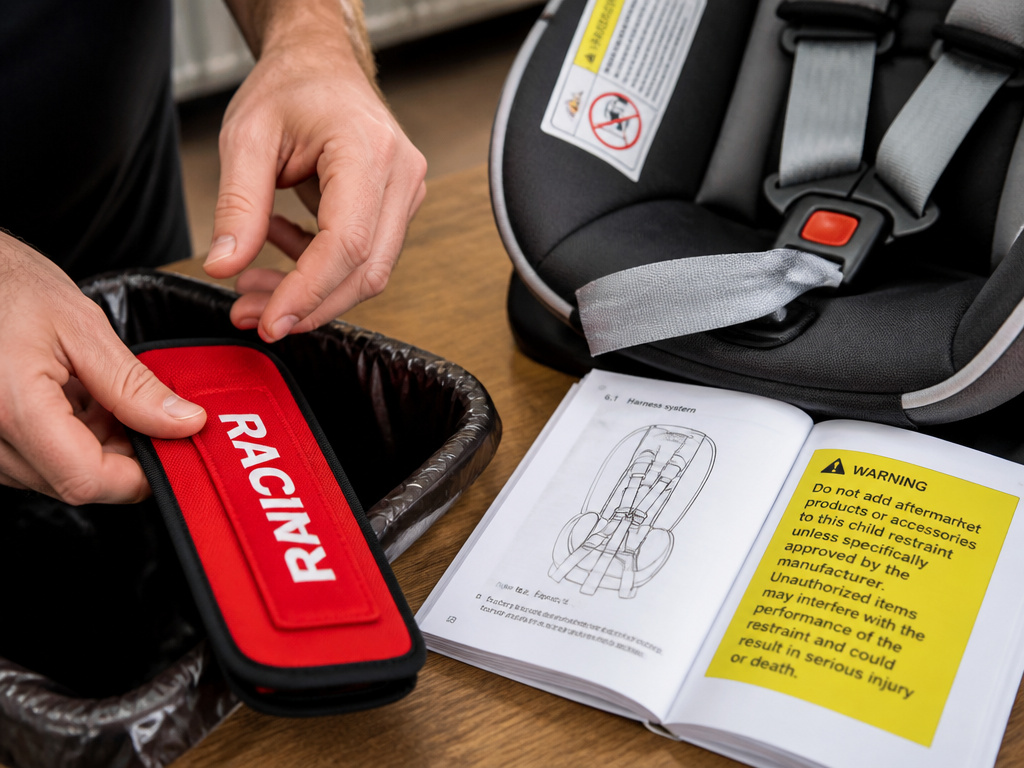
Manufacturers list a dozen “do nots” in their manuals. One overrides all others: do not use aftermarket accessories not provided by them. This includes strap covers, head supports, and seat protectors.
The reason is force distribution. An aftermarket car seat head support can change the angle of your child’s head in a crash, concentrating whiplash forces on a smaller area of the neck. A non-approved car seat protector can prevent the seat from gripping the vehicle cushion properly, allowing it to rotate.
Graco’s manual states it plainly: “DO NOT use accessories or parts other than those provided by Graco. Their use could alter the performance.” If you use one and are in a crash, the manufacturer can deny any liability claim. Stick with the parts in the box.
The Secondhand Seat Trap
It looks like a bargain. A barely-used, high-end model for a quarter of the retail price. The NHS advice is a single sentence: “Do not buy a secondhand car seat.”
You cannot know its history. It could have been in a crash that didn’t scratch the cover but microfractured the plastic shell. It’s almost certainly missing the manual. The straps may be sun-rotted or washed with harsh detergent, which weakens the fibers. Its materials degrade over time, most seats expire 6 to 10 years from the manufacture date.
The only acceptable hand-me-down is from a trusted family member where you know the full history, have the manual, and can verify it hasn’t expired. Otherwise, consider it a safety shell you cannot trust.
Installation: The Final, Non-Negotiable Step
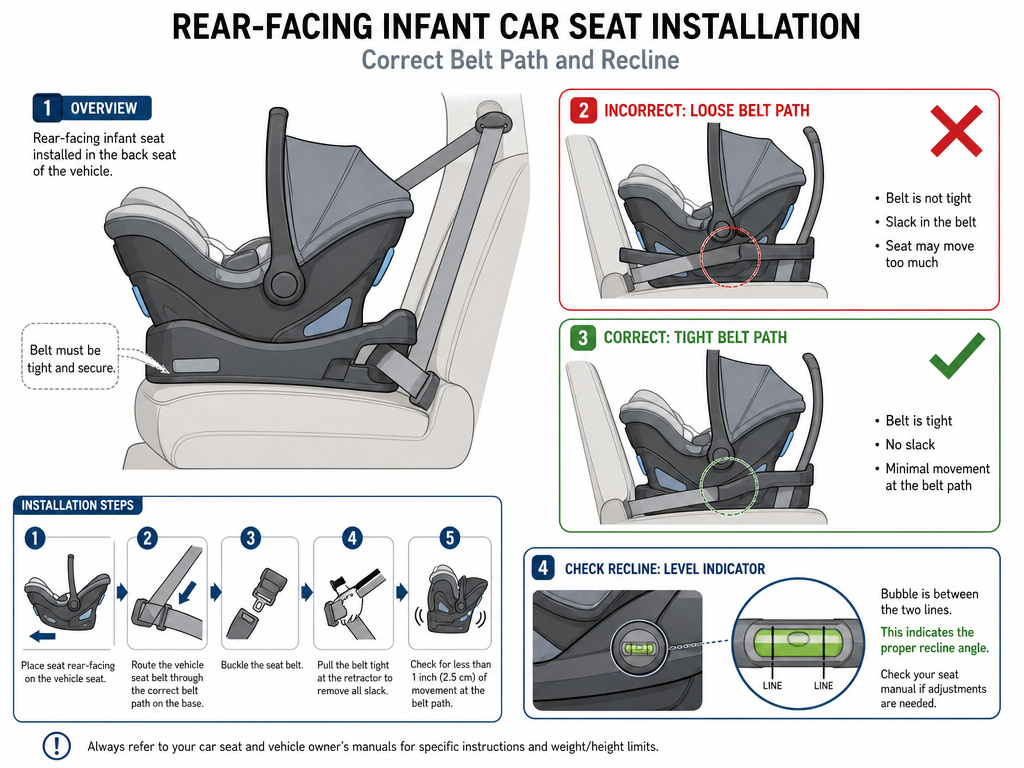
You can have the perfect seat. If it’s installed wrong, it’s a projectile. The Consumer Reports car seat buying guide notes that a majority of seats are installed with at least one error.
The rule is simple: use the vehicle’s seat belt OR the lower anchor system (LATCH/ISOFIX). Never both. The seat must not move more than an inch side-to-side or front-to-back at the belt path. For forward-facing seats, always attach the top tether. It reduces forward head movement in a crash by up to 8 inches.
Common mistake: Installing a rear-facing seat without checking the recline angle. An infant’s airway can close if the seat is too upright. Most seats have a built-in level indicator; the bubble must be between the lines. For a newborn under 3 months, the Graco manual requires an even steeper recline.
If you’re unsure, get a free inspection. Fire stations, police stations, and hospitals often have certified Child Passenger Safety Technicians. They’ll check your work and show you the right way. A 20-minute visit is cheaper than a lifetime of regret.
Frequently Asked Questions
What is the single most important factor when choosing a car seat?
The fit between your child’s current size and the seat’s certified limits. Weight and height are the primary data points. A seat that your child is on the cusp of outgrowing is a waste of money. A seat they are too small for is illegal and unsafe.
Can I use a car seat after its expiration date?
No. Plastics degrade, metals fatigue, and safety standards evolve. The expiration date (usually 6–10 years from manufacture) is stamped on the seat. Using an expired seat is like driving on expired tires, the failure might not be visible until the moment you need it most.
How do I know if my child is ready for a booster seat?
They must meet three criteria: at least 40 pounds (by law), mature enough to sit upright without slouching for the entire ride, and the vehicle seat belt must fit them correctly when they are sitting in the booster. The car seat transitions guide details the signs.
Are more expensive car seats safer?
Not necessarily. All seats sold in the U.S. Must pass the same federal crash test standard (FMVSS 213). A $300 seat isn’t inherently safer than a $150 seat. The extra cost often buys convenience features: easier installation, lighter weight, or nicer fabric. Safety is binary, it either passes the test or it doesn’t.
Why does my baby hate the car seat?
Discomfort is the usual suspect. It could be the harness is too tight, they are too hot, or the angle is wrong. For deeper issues like baby car seat crying, rule out physical problems first before assuming it’s behavioral.
Before You Go
Skip the infant carrier unless you truly need the portability. Buy a convertible car seat, the Graco Extend2Fit 3-in-1 or a similar all-in-one car seat, as your first and only seat for years. Install it rear-facing in the back seat, using the lower anchors until you hit your vehicle’s weight limit, then switch to the seat belt. Keep your child rear-facing until they max out the seat’s limits, which for most convertible seats is around age 4. That’s the safest path, and it’s simpler than the baby gear industry wants you to think.
