
How to Choose a Car Seat and Stroller: The Ultimate Guide
This post contains affiliate links. As an Amazon Associate, we earn from qualifying purchases.
To choose a car seat and stroller, match three things: your child’s size, your vehicle’s anchors, and the stroller’s compatibility. Start with a rear-facing infant car seat that clicks into a compatible stroller chassis, a travel system. Verify the car seat fits your car’s seat belt or lower anchors, and confirm the stroller meets the current ASTM F833-21 safety standard.
The “click” of a car seat locking into a stroller is the sound of convenience, but it hides a mechanical puzzle. That connection is a certified joint, not a universal fit. The wrong match leaves you carrying a twenty-pound infant seat in one arm and pushing an empty stroller with the other.
What follows is the breakdown of travel systems, adapter kits, and the safety certifications that actually matter. You will know how to read a car seat label, decode a stroller’s compliance, and spot the one spec that guarantees they work together.
Key Takeaways
- Never install a car seat using both the seat belt and the lower anchors. The NHTSA states it must be one or the other, as using both can overstress the vehicle’s structure.
- The lower anchor weight limit is not a guess. If the car seat label is missing, the maximum child weight for lower anchors is 65 pounds minus the weight of the car seat itself.
- Stroller safety has a date code. In the U.S., a compliant stroller manufactured after February 15, 2022, must meet the ASTM F833-21 standard, check the label for the manufacture date.
- “Universal” adapters are rarely universal. They typically only work within a stroller brand’s own ecosystem or a short list of approved car seat models.
- The safest seat is the one that fits your child, your car, and your use. A top-rated seat that installs poorly in your vehicle is less safe than a mid-tier seat that installs rock-solid.
The 3-Step Match System for Car Seat and Stroller
Forget browsing by brand or color first. The choice hinges on three sequential matches. Get the first one wrong, and the others won’t matter.
The NHTSA car seat safety guide is clear: select a seat based on your child’s current age and size, ensure it fits your vehicle, and use it correctly every single trip. The stroller is a secondary, though critical, mobility tool.
Step 1: Match the Seat to Your Child
This is non-negotiable. A seat too big or too small compromises the harness fit, which is the primary safety system.
- Birth to 2+ Years: Use a rear-facing-only infant seat (like the Graco SnugRide SnugFit 35 DLX) or a convertible seat set to rear-face. These cradle a baby’s fragile neck and spine. Keep your child rear-facing until they reach the seat’s maximum height or weight limit, often 40 or 50 pounds.
- 2 to 5+ Years: Switch a convertible seat to forward-facing. The five-point harness must sit at or above the child’s shoulders.
- 5 to 12+ Years: Use a belt-positioning booster seat until the vehicle’s seat belt fits properly, lap belt low on the hips, shoulder belt across the chest.
Where this goes sideways: Moving a child to the next stage too early. A one-year-old in a forward-facing seat is at severe risk of internal decapitation in a crash. The harness holds the body, but the underdeveloped spine cannot handle the whiplash forces.
Step 2: Match the Seat to Your Vehicle
A seat that doesn’t install tightly in your car is unsafe, regardless of its ratings. You need to check two things.
First, try before you buy. If possible, take the floor model to your car. Does it sit flush on the vehicle seat? Can you get a secure installation with either the seat belt or lower anchors? Some seats are simply too deep for compact car back seats.
Second, know your anchor limits. All cars after 2002 have Lower Anchors and Tethers for Children (LATCH) systems. These anchors have a combined weight limit, the weight of the child plus the weight of the car seat. This limit is usually 65 pounds.
| Your Car’s Factor | What to Check | Consequence If Ignored |
|---|---|---|
| Seat Belt Type | Read the vehicle manual to learn how to lock the seat belt (switchable retractor or locking clip). | An unlocked belt allows the car seat to shift several inches on impact. |
| Lower Anchor Weight Limit | Find the label on the car seat or vehicle manual. If missing, use the formula: 65 lbs – car seat weight. | Exceeding the limit can cause the anchors to deform or detach in a crash. |
| Tether Anchor Location | Locate the tether anchor (rear shelf, seatback, floor) for forward-facing installation. | Without the top tether, a forward-facing seat can rotate violently, causing head strike. |
If the car seat label is missing the lower anchor limit, that’s a red flag. It could indicate a counterfeit seat or prevent you from checking for recalls. The American Academy of Pediatrics guide stresses that a missing label should make you question the seat’s legitimacy.
Step 3: Match the Seat to the Stroller
This is where the “system” part comes in. You have two paths: the integrated travel system or the mix-and-match approach with adapters.
The travel system is the simplest path. Brands like UPPAbaby (Mesa car seat + Cruz stroller) or Chicco (KeyFit 35 + Bravo stroller) design the car seat and stroller to click together without extra parts. The compatibility is guaranteed and the mechanism is usually seamless.
The adapter path is for flexibility. You buy a stroller you love (like a Baby Jogger City Mini GT2) and purchase a brand-specific adapter to fit a car seat you choose. The adapter is a small metal frame that bolts to the stroller. The critical warning: an adapter labeled “universal” usually only works with a specific list of car seats, not all of them.
Before you buy any adapter, go to the stroller manufacturer’s website and find the official compatibility list. Do not trust a store clerk’s word. I’ve seen a Graco adapter that claimed to fit a Britax seat; it physically clicked in, but Britax had not certified that combination, voiding any safety assurance.
Travel System vs. Mix-and-Match: The Real Cost
The choice between a pre-matched set and building your own isn’t just about price. It’s about long-term use, hassle, and safety certainty.
| Aspect | Travel System (e.g., Graco Modes Pramette) | Mix-and-Match (Stroller + Adapter) |
|---|---|---|
| Initial Convenience | High. Seat and stroller are guaranteed to work. | Low. Requires research and purchasing separate adapter. |
| Long-Term Flexibility | Low. You’re locked into that brand’s seat for the infant stage. | High. Can change car seat brands later if needed. |
| Upfront Cost | Often lower as a bundled package. | Higher (stroller + seat + adapter). |
| Safety Certainty | High. The connection is OEM-designed and tested. | Variable. Only as safe as the adapter’s certified compatibility list. |
| Best For | Parents who want a guaranteed, no-fuss solution for the first year. | Parents who have a specific stroller in mind or plan for multiple children with different seats. |
The mix-and-match route demands diligence. That car seat stroller compatibility is not a suggestion. It’s a list of seats that have been physically tested with that stroller and adapter. Using an untested combination turns your stroller into an unapproved, untested vehicle for your child.
The Safety Specs You Can’t Ignore
Marketing talks about “safety features.” Regulations talk about standards and labels. You need to speak the language of regulations.
For the Car Seat: Look for the sticker on the side. It must show the date of manufacture and model number. This is your ticket to checking for recalls. More importantly, the seat must be certified to meet Federal Motor Vehicle Safety Standard (FMVSS) 213. All seats sold in the U.S. Have this, but a missing label is a major red flag.
For the Stroller: The label is even more critical. In the United States, the CPSC stroller business guidance mandates that strollers comply with ASTM F833-21. This standard covers everything from brake strength and stability to hinge entrapment hazards.
Easy to miss: The stroller’s manufacture date dictates which version of the standard it must meet. A stroller made after February 15, 2022, must comply with ASTM F833-21. One made between November 2019 and February 2022 should meet ASTM F833-19. This date is permanently printed on the product.
Canada has its own twist. Their regulations allow strollers to meet either ASTM F833 (with some sections excluded) or a hybrid of ASTM F833 and the international ISO 31110 standard. If you’re buying or traveling in Canada, this matters.
The federal car seat guidelines and stroller standards exist because of documented failures. CPSC data from a five-year period recorded over 1,200 stroller incidents, including injuries from wheel detachments, brake failures, and tip-overs. These rules are written from real-world accidents.
How to Future-Proof Your Choice
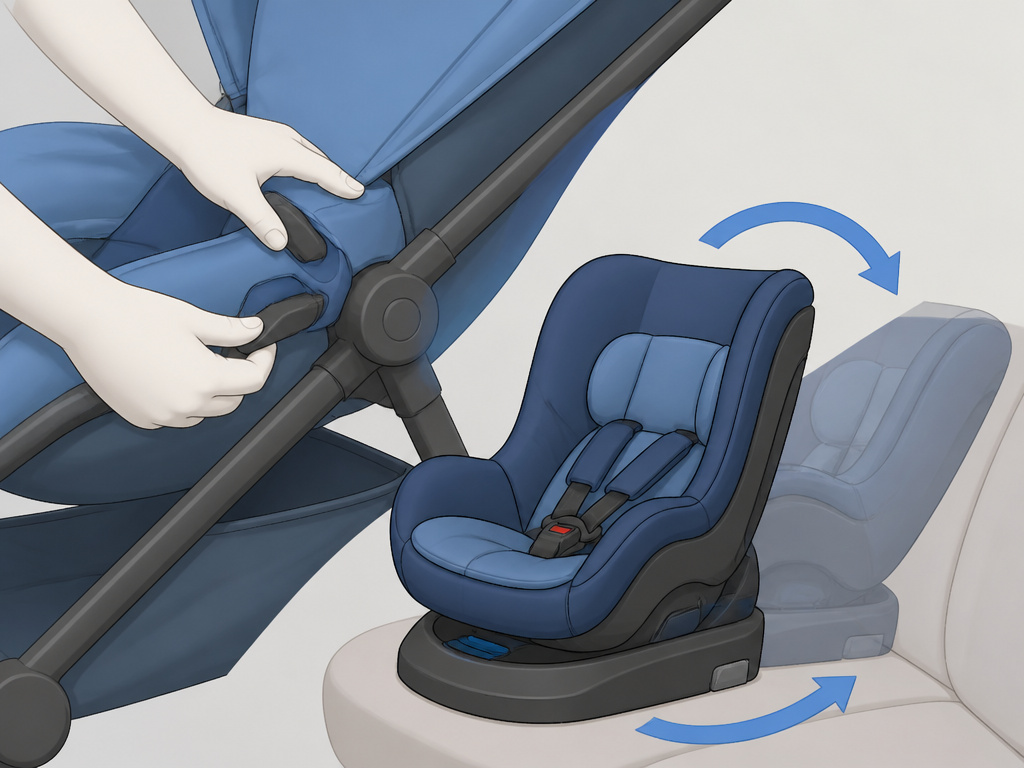 Your newborn won’t be in an infant seat for long. A forward-facing convertible seat and a lightweight umbrella stroller are in your future. Your initial choice can save you money and hassle down the line.
- Consider a Convertible Seat from the Start. A seat like the Britax One4Life or the Graco 4Ever can go from rear-facing infant to forward-facing child to booster. It never needs a “next seat.” The trade-off? It doesn’t click out of the car into a stroller. You’ll need a separate infant carrier or a stroller that fully reclines for a newborn.
- Choose a Stroller That Grows. Look for a stroller that isn’t just an infant car seat carrier. Does it have a fully flat recline for a newborn? Can the seat unit face both forward and parent-facing? Does it have a high weight limit for a toddler? The UPPAbaby Vista V2 is a prime example, converting from a single to a double stroller.
- Skip the “Cute” Extras. Do you need a cup holder that fits a Big Gulp? Probably not. Focus on the core: a one-handed fold, sturdy wheels for your terrain (air-filled for rough paths, plastic for malls), and a reliable brake. The extras add cost and weight.
Your goal isn’t to buy for a decade. It’s to buy a travel system or components that will serve you well for the next 3-4 years without needing a complete overhaul. This is where reading detailed car seat buying guide articles pays off, as they cover long-term testing and durability.
Frequently Asked Questions
What is the biggest mistake people make when choosing a car seat and stroller?
They prioritize the stroller’s look and assume any car seat will work with it. The car seat is the life-saving device. The stroller is a convenience. Choose the safest car seat that fits your child and car first, then find a stroller that is genuinely compatible with it. Forcing compatibility with an uncertified adapter is a common and dangerous error.
How long can I use an infant car seat?
Most infant seats are outgrown by height before weight. Your child has outgrown it when the top of their head is within one inch of the top of the seat shell, or when they exceed the seat’s weight limit (typically 30-35 pounds). This often happens between 12 and 18 months. Do not move to forward-facing at this point. Switch to a rear-facing convertible seat.
Are travel systems worth the money?
For many first-time parents, absolutely. The mental load of ensuring picking a car seat and stroller compatibility is eliminated. The convenience of clicking the sleeping infant from car to stroller without unbuckling them is a genuine quality-of-life upgrade during the fragile newborn phase. Just know you’ll likely need a different stroller or configuration once your child is sitting up independently.
Can I use a second-hand car seat or stroller?
It is not recommended unless you are certain of its complete history. For a car seat, you must know it has never been in a crash (even a minor fender-bender can compromise the structure), all parts are present and unexpired (seats typically expire 6-10 years after manufacture), and it has never been recalled. For a stroller, you must verify it meets current safety standards, all locks and brakes work perfectly, and there is no structural corrosion or fatigue. The risk often outweighs the savings.
What does “stroller compatibility” really mean?
It means the stroller manufacturer has physically tested and certified that a specific car seat, when attached via their specified adapter, passes safety tests for stability and secure attachment. It is not a theoretical fit. True compatibility is a short, specific list. Always check the stroller brand’s website, not the car seat box, for the official list.
The Bottom Line
Start with the car seat. Fit it to your child, then to your car. That is the non-negotiable safety foundation. Only then should you shop for a stroller, using the manufacturer’s official compatibility list as your bible, not a hopeful guess.
The easiest path is a reputable infant car seat travel system from a brand like Chicco or Graco. It guarantees the click. If you want more stroller flexibility, commit to the research, find the adapter and verify the match on the stroller company’s site. Your final check is always the label: a manufacture date for the stroller proving it meets ASTM F833-21, and a model number on the car seat so you can check for recalls. That’s how you build a system that’s both convenient and genuinely safe.
