
Do You Need a Car Seat Newborn Insert? Essential 5-11 lb Rule
This post contains affiliate links. As an Amazon Associate, we earn from qualifying purchases.
You need a newborn insert for a car seat if your infant weighs between 5 and 11 pounds (2.3–5 kg), as mandated by the manufacturer’s manual for models like the UPPAbaby MESA V2, Nuna EXEC, and Chicco Fit3x. The insert is not a comfort accessory; it’s a safety component that positions a small infant’s body so the harness fits correctly. Using the seat without the insert for a baby under 11 pounds leaves dangerous gaps between the harness and the child’s shoulders and torso.
That weight window is the only universal rule. Outside of it, the answer depends on your specific car seat. Some brands, like Cybex, recommend their insert for a wider weight range. Others, like Axkid, allow optional use up to 20 pounds if it improves fit. The decision is printed in your manual, and ignoring it compromises the seat’s crash-test certification.
What follows: the exact weight and height numbers from six major car seat manuals, the physical reason the insert matters, and the two-step test to know when your child has outgrown it.
Key Takeaways
- The newborn insert is mandatory for infants 5–11 lbs in seats like the Nuna EXEC, Chicco Fit3x, and UPPAbaby MESA V2. Skipping it creates a poor harness fit.
- For other models, check your manual. The Cybex ATON 2 insert is recommended up to 22 lbs, and the Axkid ONE 3 insert can be used optionally up to 20 lbs for a better fit.
- Remove the insert when your baby exceeds the manufacturer’s weight limit or fails the two-part fit test: the harness must be at or below the shoulders, and the child must not be sitting on the buckle.
- Never use an aftermarket or third-party insert. Only the one that came with your specific car seat model is crash-tested and approved for use.
- The insert’s primary job is safety, not comfort. It positions a small infant’s pelvis and spine so the five-point harness contacts the body at the correct points.
The Mandatory 5–11 Pound Rule
Open the manual for a Nuna EXEC, Chicco Fit3x, or Nuna REVV. The language is not a suggestion. The Nuna EXEC manual states the infant insert “is recommended for use with infants who weigh between 5–11 lb (2.3–5 kg). DO NOT use the insert for a child who weighs more than 11 lb.” The Chicco Fit3x manual is equally direct: “The newborn insert is only for infants who weigh between 5 and 11 lbs (2.3 and 5 kg).”
This is a compliance threshold, not a comfort guideline. Car seats are certified to meet federal safety standards under specific conditions. Those conditions include using all provided components for children within the stated size ranges.
The infant insert (p.24) is recommended for use with infants who weigh between 5–11 lb (2.3–5 kg). DO NOT use the insert for a child who weighs more than 11 lb. Nuna EXEC User Manual
Without the insert, a 7-pound infant swims in the seat cavity. Their pelvis sinks too far back, causing the shoulder straps to route too high above their shoulders. The chest clip sits too low, and the crotch buckle may be behind the infant’s bottom instead of between their legs. In a crash, this poor fit allows excessive movement, increasing the risk of injury.
This is where most parents get it wrong. They think the insert is just extra padding for a more comfortable ride. It is a structural spacer that brings the child’s body into the correct geometry for the harness to work as designed. Using a newborn insert is non-negotiable for a child under 11 pounds in those seats.
| Car Seat Model | Mandatory Insert Use | Optional Use Range | Source |
|---|---|---|---|
| Nuna EXEC | 5–11 lbs (2.3–5 kg) | Not permitted | Nuna EXEC Manual |
| Chicco Fit3x | 5–11 lbs (2.3–5 kg) | Not permitted | Chicco Fit3x Manual |
| Nuna REVV | 5–11 lbs (2.3–5 kg) | Not permitted | Nuna REVV Manual |
| UPPAbaby MESA V2 | 4–11 lbs (1.8–5 kg) | Can be used beyond 11 lbs until fit criteria met | UPPAbaby MESA V2 Manual |
| Axkid ONE 3 | 5–11 lbs (2.3–5 kg) | 11–20 lbs (5–9 kg) if better fit is achieved | Axkid ONE 3 Insert Manual |
When the Rules Are Different: Cybex and Axkid
Not all car seats follow the strict 5–11 pound cutoff. Two major brands have different protocols, which is why checking your specific manual is the only right answer.
The Cybex ATON 2 uses a two-component system. Its Newborn Inlay (an EPS foam piece under the seat cover) is recommended until the child is 11 pounds. Its Infant Insert, the padded piece you see, is recommended for a much longer period: “until 22 lb (10 kg) or until child needs more room.”
The Axkid ONE 3 manual is the most flexible. It states the insert must be used for infants 5–11 pounds. However, it may be optionally used for infants between 11–20 lbs if a better fit is achieved. This places the decision on a parent’s assessment of fit, not just a scale.
Common mistake: Assuming all inserts are the same. The Cybex insert is designed for extended use. Putting a Cybex-style insert in a Nuna seat is a violation of the safety certification.
This variance destroys the idea of a one-size-fits-all answer. It also means you cannot borrow an insert from a friend’s different-model seat. You must use the best infant insert for your model, the one it was sold with.
How to Know When to Remove It
You don’t remove the insert on the baby’s three-month birthday or when they smile a certain way. You remove it based on two concrete criteria: weight and fit. The weight limit is the hard stop. The fit test is the daily check.
First, know your seat’s limit. For the Nuna and Chicco models, that’s 11 pounds. For the Cybex ATON 2 insert, it’s 22 pounds. For the Axkid, it’s 20 pounds for optional use. When your child exceeds that number on a accurate scale, the insert comes out.
Second, perform the two-part fit test every time you buckle your child in: 1. Harness Height: The shoulder straps must be at or just below the child’s shoulders when rear-facing. If the insert is pushing the child up so the straps are above the shoulders, it’s time to remove it. 2. Buckle Position: The child must not be sitting on top of the harness buckle. If their bottom is on the buckle, you need to move the buckle to a farther-out position or remove the insert to create more depth.
The Axkid manual adds a height limit: discontinue use if the infant’s height exceeds 61 cm (24 inches). The UPPAbaby MESA V2 states you can use the insert beyond 11 pounds only until all fit criteria are met, like the child not slouching.
Where this goes sideways: Keeping the insert in too long. A 15-pound baby in a Nuna seat with the insert still in will be cramped. The harness will be tight over the shoulders but loose at the hips, and the child’s head may be pushed forward into an uncomfortable, chin-to-chest position.
If you pass the weight limit or fail the fit test, follow the guidelines for removing the insert. This usually means simply lifting it out of the seat cavity and storing it.
Why You Can’t Use Just Any Insert
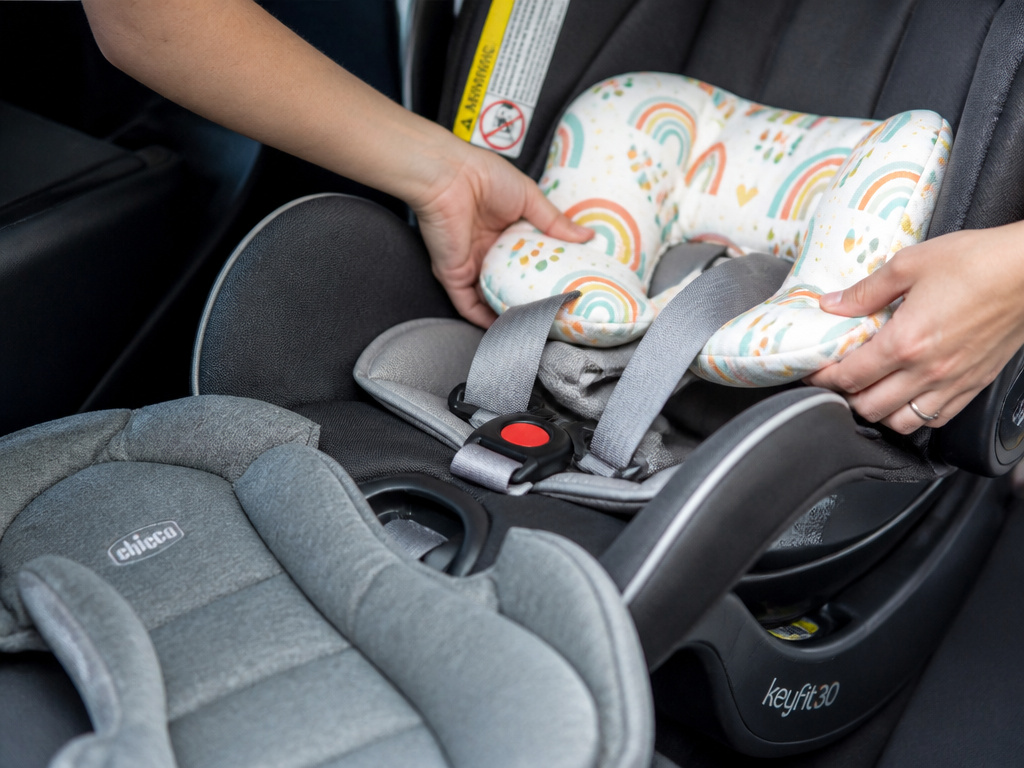
The market is full of aftermarket head supports, body pillows, and strap covers. They are not the same as your OEM infant insert. Using a non-approved insert voids the seat’s safety certification.
Those products are not tested with your specific seat model. They can interfere with the harness routing, create compressible material between the child and the harness straps, or change the recline angle. In a crash, compressible padding can compact, suddenly creating slack in the harness system.
The manuals are explicit. The Chicco Fit3x manual says, “Only the Fit3x newborn insert provided by Chicco should be used.” The Nuna manuals warn against using “another manufacturer’s cover, padding, fabric, or other soft materials.”
| Problem with Aftermarket Inserts | Safety Consequence |
|---|---|
| Alters harness routing path | Straps may not lie flat on child’s bones, concentrating force |
| Adds compressible padding | Creates false tightness; slack appears in a crash |
| Changes child’s seated position | Can affect head excursion or spinal alignment |
| Not fire-retardant tested with seat | Unknown material risk in a vehicle fire |
Your car seat’s crash test video, the one that earned it its certification, included that specific insert in the dummy’s setup. Deviating from that tested condition is an unmeasured risk. If you need additional support, look for a specialized newborn insert designed and sold by your car seat’s manufacturer as an accessory for your model.
The Physical Reason It Matters: Fit Over Comfort
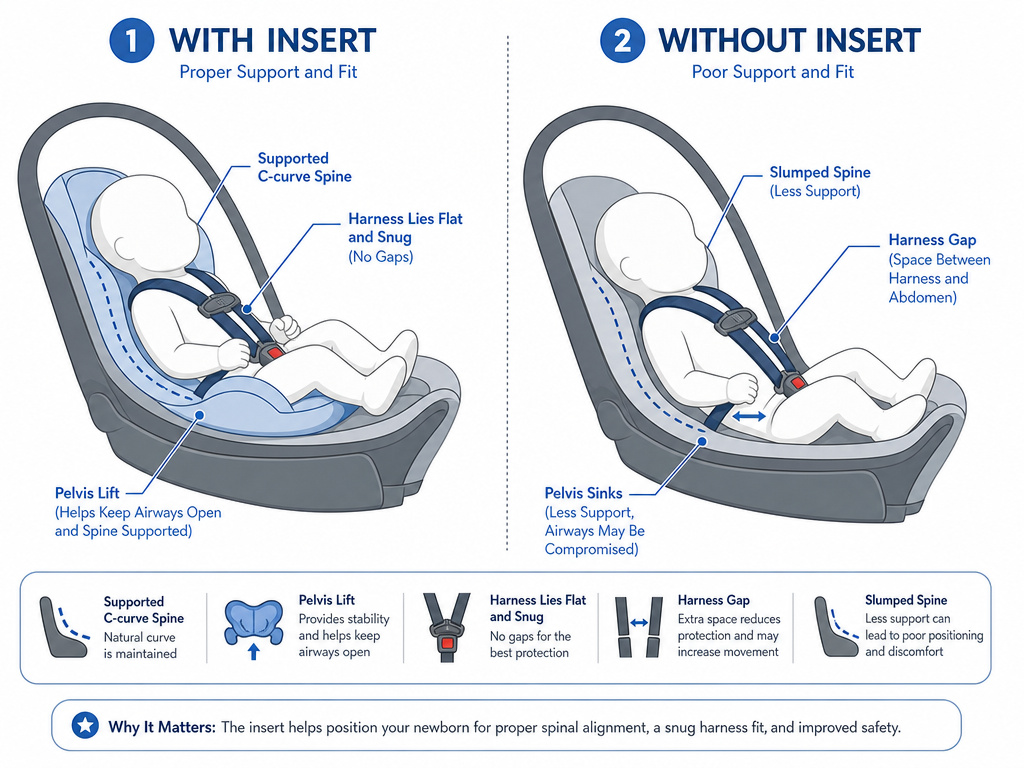
Think of the insert as a jig, not a pillow. Its job is to position the infant’s body in space so the harness’s five points make optimal contact.
A newborn’s body is not just a small version of a toddler’s. The proportions are different. The head is larger relative to the body, the pelvis is more rounded, and the spine has a natural C-curve. The insert accounts for this by: * Lifting the pelvis so the crotch strap falls between the legs, not behind. * Providing lateral support so the infant doesn’t slouch to one side, which misaligns the shoulder straps. * Creating a backstop so the infant’s back is fully supported, allowing the harness to be tightened snugly over the torso.
Without it, you’ll get a harness that seems tight at the shoulders but has a gap you can pinch over the child’s abdomen. That gap is where injury happens. This is also why proper positioning is crucial to keep a newborn’s head up and prevent airway-blocking head slump.
I see parents remove the insert early because their baby “looks big” or seems uncomfortable. That’s usually the insert doing its job, providing support. Taking it out because the baby fusses often makes the fit worse, and the fussing continues from a place of insecurity, not discomfort.
The insert is a safety tool. Comfort is a secondary benefit. If your baby seems genuinely uncomfortable, check the harness fit first. Is it snug? Are the straps at the right height? Is the chest clip at armpit level? Only after confirming correct fit should you consider the insert itself as the source of the issue, and even then, consult your manual before removing it.
Frequently Asked Questions
What if my baby is under 5 pounds?
Most infant car seats have a lower weight limit of 4 or 5 pounds. If your baby is below this minimum weight, the car seat is not approved for their use. You must consult your pediatrician and may need a car bed or other specialized restraint designed for preemies or very low birth weight infants. Do not use the seat without the insert thinking it will make more room; that violates the certification.
Can I wash the infant insert?
Yes, but follow the manual’s instructions precisely. Most inserts have a removable cover that can be machine-washed on a gentle, cold cycle with mild detergent. Do not bleach. Do not put the foam or structural parts in the washer or dryer. Air-dry the cover completely before reassembly. A wet insert can harbor mold and will not provide consistent support.
My car seat didn’t come with an insert. Do I need one?
If your car seat model did not include an infant insert in the box, it was not designed or tested with one. Do not add one. These seats are engineered for the full 4–35 lb range without additional padding. Adding an aftermarket insert to a seat not designed for it is unsafe. Check your manual to confirm.
How does the insert affect spinal development?
When used correctly for a properly fitted infant, the insert supports the natural C-curve of a newborn’s spine by providing full-back contact. The concern for newborn spine safety is prolonged time in the seat, not the insert itself. The insert helps maintain a neutral, supported posture during necessary travel.
The Bottom Line
Stop wondering. Open your car seat’s manual and find the section on the infant or newborn insert. It will give you a weight range, often 5–11 pounds, and clear instructions.
If your baby is within that range, the insert is a required part of the safety system. If your baby is beyond that range, use the fit test: harness at or below the shoulders, and not sitting on the buckle.If the fit is poor without the insert, your model might allow optional use, like the Axkid up to 20 pounds.
Never substitute the OEM part with something else. That single decision undoes every engineering hour that went into the seat’s safety rating. The insert is about making the harness fit. And fit is everything.
